
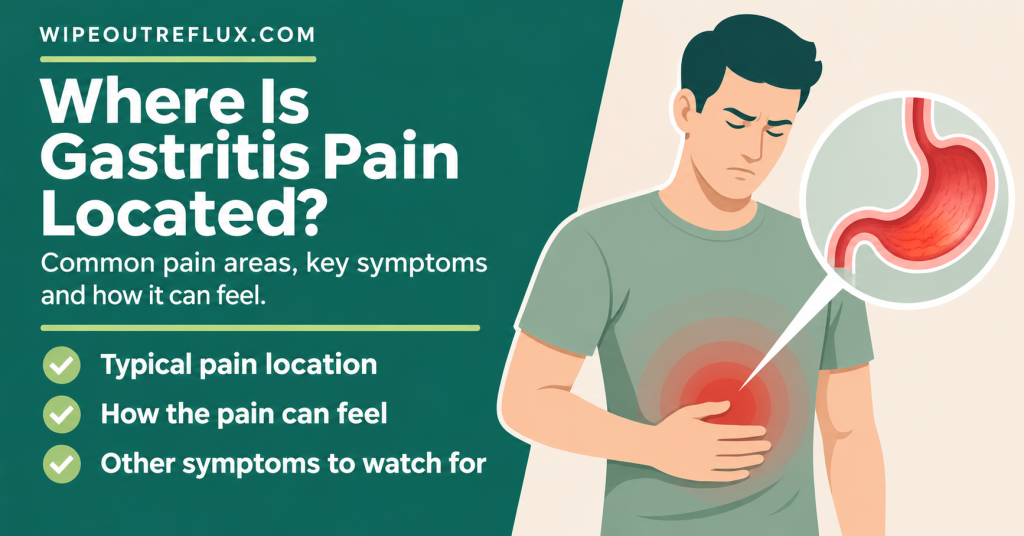
Gastritis pain is usually felt in the upper middle of the abdomen. This area is called the epigastrium: the soft spot just below your breastbone and above your belly button. It’s often described as a burning, gnawing or aching pain, sometimes slightly left of center, where most of the stomach sits. It can spread toward the back or up under the ribs, and it often changes with eating. Some people feel better after food, others worse. It shouldn’t feel like crushing chest pressure, pain running down the arm or jaw, or sharp pain on the right side, because those point elsewhere.
Location is a useful clue, but it isn’t a diagnosis. The epigastrium is shared by the stomach, esophagus, duodenum, pancreas, gallbladder and even the heart, and they all refer pain to roughly the same spot. Below I map where gastritis pain usually sits, how it differs from reflux, ulcer, gallbladder and heart pain, and which features mean you should get checked quickly.
Key Takeaways
- Gastritis pain is typically in the epigastrium: the upper middle abdomen between the bottom of the breastbone and the belly button.
- It’s often slightly left of center, because most of the stomach sits on the left side of the upper abdomen.
- It’s usually described as burning, gnawing or aching, often with nausea, fullness, bloating or early satiety.
- Reflux burning is usually higher, behind the breastbone, and can rise toward the throat. It’s often worse when lying down or bending.
- Gallbladder pain sits more under the right ribs, often after fatty meals. Pancreatitis pain bores through to the back.
- Heart attacks can cause epigastric pain that feels like indigestion, especially in women, older people and people with diabetes.
- Many people with gastritis on biopsy have no pain at all. Symptoms and the amount of inflammation often don’t match.
- Seek urgent care for chest pressure, pain with breathlessness or sweating, vomiting blood, black stools, or sudden severe abdominal pain.
Where Is Gastritis Pain Located?
Your stomach sits mostly in the upper left and upper middle of your abdomen, tucked under the left lower ribs. Its lower end, the antrum, curves toward the center and slightly right, where it joins the duodenum.
Because the stomach’s nerves don’t pinpoint pain precisely, inflammation anywhere in the stomach is usually felt as a broad, central discomfort in the epigastrium. This is the triangle between the bottom of your breastbone (the xiphoid) and your belly button, bounded by the lower ribs on either side.
Common patterns
- Center, just under the breastbone. This is the most common spot.
- Slightly left of center, under the left ribs. This is common too, reflecting the body of the stomach.
- Through to the back. Some people feel a dull ache spreading to the middle back. See acid reflux and back pain.
- Vague upper abdominal discomfort that’s hard to point to, often with fullness or bloating.
What gastritis pain feels like
- Burning or gnawing, like a hunger pang that doesn’t go away
- A dull ache or soreness
- Fullness or pressure after only a few bites (early satiety)
- Nausea, sometimes with vomiting
- Bloating and belching
These overlap almost completely with what doctors call dyspepsia. The Rome IV criteria describe epigastric pain and epigastric burning as core dyspeptic symptoms. When no structural cause is found, they classify them as “epigastric pain syndrome”, a type of functional dyspepsia [Stanghellini et al., Gastroenterology, 2016]. See functional dyspepsia.
The timing clue
Many people with gastritis notice the pain is worse on an empty stomach and eases a little after a small, bland snack. Others find that eating, especially a large or fatty meal, sets it off within minutes. Both patterns are common, so timing on its own won’t confirm gastritis.
Why Pain Location Can Mislead You
Two facts make it hard to diagnose gastritis by feel.
First, the amount of pain doesn’t match the amount of inflammation. Plenty of people with significant chronic gastritis on biopsy, including H. pylori gastritis, have no symptoms at all. Many people with severe epigastric pain have a normal-looking stomach. Even when H. pylori is found and treated in people with indigestion, only a minority are symptom-free afterward. A Cochrane review found a small but real benefit of eradication for dyspepsia symptoms, not a cure for everyone [Moayyedi et al., Cochrane Database of Systematic Reviews, 2006]. The Kyoto consensus formally separates “H. pylori-associated dyspepsia” from functional dyspepsia for this reason [Sugano et al., Gut, 2015].
Second, several organs share the same nerve supply. The esophagus, stomach, duodenum, pancreas, gallbladder and heart all send pain signals through overlapping nerve pathways. That’s why a heart attack can feel like indigestion, and why reflux can feel like a stomach problem.
Gastritis Pain vs Other Causes of Upper Abdominal Pain
| Condition | Typical location | Typical features |
|---|---|---|
| Gastritis | Upper middle, sometimes left of center | Burning or gnawing, nausea, fullness, early satiety. Can be better or worse with food. |
| Acid reflux (GERD) | Behind the breastbone, rising upward | Burning that climbs toward the throat, sour taste, regurgitation. Worse lying down, bending or after big meals. |
| Silent reflux (LPR) | Throat rather than abdomen | Hoarseness, throat clearing, lump sensation, cough. Often no heartburn at all. |
| Stomach or duodenal ulcer | Upper middle, often a pointable spot | Gnawing pain. Duodenal ulcers classically ease with food and wake you at night. Risk of bleeding. |
| Gallbladder (biliary colic) | Upper right, under the ribs, sometimes central | Steady, severe pain lasting 30 minutes to hours, often after fatty meals. Can spread to the right shoulder blade. |
| Pancreatitis | Upper middle, boring through to the back | Severe, constant pain, often eased by leaning forward, with vomiting. Often linked to alcohol or gallstones. This is an emergency. |
| Heart (angina or heart attack) | Chest or upper abdomen | Pressure, tightness or heaviness, often triggered by exertion. Can spread to the arm, jaw or back, with breathlessness, sweating or nausea. This is an emergency. |
For a closer comparison with reflux, see gastritis vs acid reflux, what does heartburn feel like? and indigestion vs acid reflux. For ulcers, see stomach ulcer or acid reflux?
Don’t dismiss “indigestion” that could be your heart
Heart attacks don’t always cause classic crushing chest pain. Some present as upper abdominal discomfort, nausea or a vague sense of indigestion. This is more likely in women, older adults and people with diabetes. If your “gastritis” pain comes on with exertion, comes with breathlessness, sweating, light-headedness or pain in the arm, jaw or neck, or simply feels different from your usual pattern, treat it as a possible heart problem and call emergency services. See heartburn or heart attack? and chest pain after eating.
How Gastritis Is Actually Confirmed
Because location and symptoms overlap so much, gastritis is confirmed with tests, not by where it hurts:
- H. pylori testing with a breath test, stool antigen test or biopsy. This is usually the first step.
- Upper endoscopy with biopsies, the only way to confirm gastritis and its type. It’s especially important if you’re over 55 or have warning signs. See how to prepare for an endoscopy.
- Blood tests for anemia, B12 and iron, particularly if autoimmune or atrophic gastritis is suspected.
- Ultrasound or blood tests for the liver and pancreas if gallbladder or pancreatic causes are possible.
Easing Gastritis Pain
- Remove irritants: stop NSAIDs (ibuprofen, naproxen, high-dose aspirin) unless your doctor says otherwise, and avoid alcohol.
- Eat small, bland, low-fat meals regularly rather than skipping meals or eating large ones. See the gastritis diet.
- Use an antacid for short-term relief if needed. See what is an antacid? For ongoing symptoms, ask about an acid-reducing medicine.
- Treat H. pylori if present. This is the step most likely to fix chronic gastritis for good. See how long does gastritis last?
When to Get Help
Call emergency services or go to the ER if you have:
- Chest pressure or tightness, or pain spreading to the arm, jaw, neck or back
- Upper abdominal pain with breathlessness, sweating, fainting or a racing heart
- Sudden, severe abdominal pain, especially if it’s constant or spreads through to the back
- Vomiting blood or material that looks like coffee grounds
- Black, tarry stools
See your doctor soon if you have unexplained weight loss, difficulty swallowing, persistent vomiting, new symptoms after age 55, or pain lasting more than a few weeks.
Conclusion
Gastritis pain usually sits in the upper middle of the abdomen, just below the breastbone and often slightly left of center. It feels burning, gnawing or achy, often with nausea, fullness and bloating. That’s a useful starting point, but the same spot is shared by reflux, ulcers, the gallbladder, the pancreas and even the heart, and the amount of pain often doesn’t match the amount of inflammation. Confirm gastritis with an H. pylori test and, where appropriate, an endoscopy, and never dismiss “indigestion” that comes with exertion, breathlessness or sweating.
If testing points to reflux sitting alongside gastritis, which is very common, then what you eat each day becomes the biggest lever you have. The Wipeout Diet Plan gives you gentle, low-acid meals that suit an irritated stomach and calm reflux at the same time. I built it around LPR, the hardest form of reflux to control, and it works just as well for GERD and everyday heartburn.
Frequently Asked Questions
Is gastritis pain on the left or right side?
It’s usually in the center of the upper abdomen, often slightly to the left, where most of the stomach sits. Pain mainly under the right ribs is more typical of the gallbladder or liver.
Can gastritis cause back pain?
Yes. Some people feel a dull ache spreading to the middle back. Severe pain boring straight through to the back is more typical of pancreatitis or a penetrating ulcer and needs prompt assessment.
Can gastritis cause chest pain?
Gastritis can cause discomfort high in the upper abdomen that feels like it’s in the lower chest. Burning behind the breastbone is more typical of reflux. Any chest pressure, especially with exertion or breathlessness, should be checked for a heart cause first.
What does gastritis pain feel like?
Most people describe it as a burning, gnawing or aching pain in the upper middle abdomen. It often comes with nausea, bloating, belching and feeling full after only a few bites.
Is gastritis pain constant or does it come and go?
It often comes and goes, typically flaring after certain foods or drinks, on an empty stomach, or after alcohol or painkillers. Constant, severe pain is less typical and should be assessed.
How can I tell gastritis from a stomach ulcer?
You often can’t tell from symptoms alone. Ulcer pain tends to be more localized and can wake you at night, but an endoscopy is the only reliable way to tell them apart. Both are commonly caused by H. pylori or NSAIDs.
Can gastritis cause pain in the throat?
Gastritis itself doesn’t usually cause throat pain. If you have throat burning, hoarseness or a lump sensation, reflux, especially silent reflux (LPR), is a more likely explanation. See LPR symptoms.
Research & References
- The Rome IV classification of gastroduodenal disorders, defining functional dyspepsia by postprandial fullness, early satiation, epigastric pain and epigastric burning, including the epigastric pain syndrome subtype [Stanghellini et al., Gastroenterology, 2016].
- A Cochrane systematic review of 21 randomized trials on H. pylori eradication for non-ulcer dyspepsia, finding a small benefit on symptoms [Moayyedi et al., Cochrane Database of Systematic Reviews, 2006].
- The Kyoto global consensus on H. pylori gastritis, which separates H. pylori-associated dyspepsia from functional dyspepsia and sets out how gastritis should be diagnosed [Sugano et al., Gut, 2015].

David Gray
12 years living with LPR · Consultant & researcher
I've lived with LPR for twelve years — the misdiagnoses, the PPI courses that did nothing, the slow work of figuring out what actually helps. Wipeout Reflux is where I translate the research into plain terms for people stuck in the same place. Every claim here is sourced to peer-reviewed work, and I consult one-to-one with LPR sufferers.