
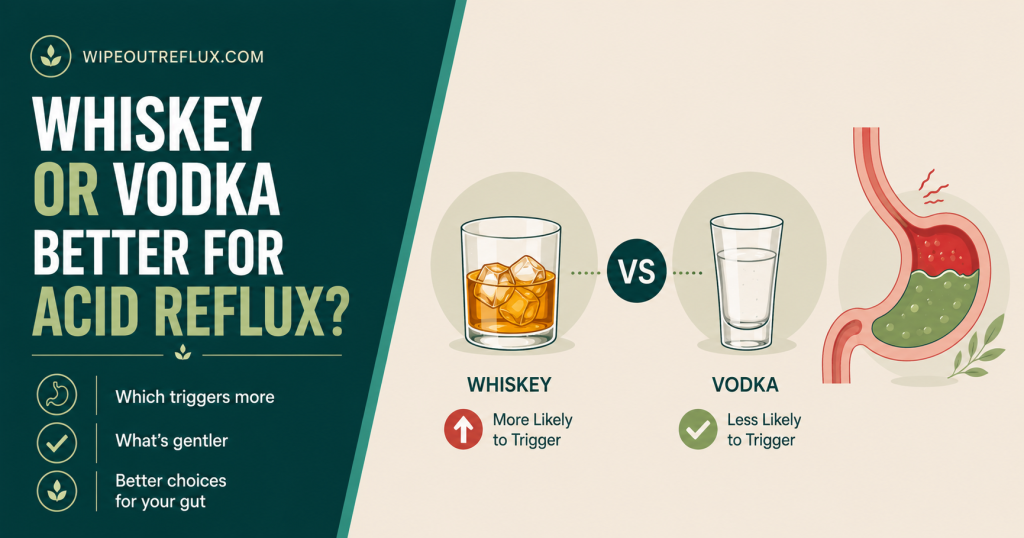
Vodka, marginally — and for reasons that have almost nothing to do with the alcohol.
Both are around 40% ABV, both are served in the same 25 or 35 ml measures, and both hit your lower oesophageal sphincter identically. Ethanol is ethanol. Where they genuinely differ is pH and congeners: plain vodka is close to neutral, usually pH 6 to 7, while barrel-aged whiskey typically sits around pH 4 to 4.5 because of what it picks up from the oak. Whiskey also carries dozens of flavour compounds that vodka has been distilled and filtered clean of.
Here’s the surprise, though, and it reframes the whole question: neither spirit stimulates your stomach to produce acid. Beer and wine do — dramatically. In a study measuring this directly, beer produced an acid response equal to 96% of maximal output and white wine 61%, while whisky and cognac produced no stimulation at all. So a measure of either spirit is already a better choice than a pint or a large glass of wine.
Which means the honest ranking is: vodka slightly ahead of whiskey, both well ahead of beer and wine — and the mixer you put in the glass mattering more than the choice between them.
Key Takeaways
- Vodka is the better choice, but the margin is small. Both are 40% ethanol, and ethanol is what relaxes your sphincter.
- Plain vodka measures around pH 6 to 7, close to neutral. Barrel-aged whiskey typically sits around pH 4 to 4.5 from compounds extracted during maturation.
- Neither spirit stimulates gastric acid secretion or gastrin release — unlike beer (96% of maximal acid output) and white wine (61%).
- Ethanol directly weakens the sphincter and the muscle contractions that clear acid back down, regardless of which bottle it came from.
- Bourbon carries far more congeners than vodka and produces worse next-day symptoms, though ethanol dose matters more than congener content.
- The pH difference matters most if you have LPR or silent reflux, because dietary acid below pH 5 can reactivate pepsin sitting in throat tissue.
- Mixers usually dominate the outcome. Vodka and Coke is worse than neat whiskey; whiskey with still water is better than either.
- Timing beats choice of spirit. A single evening drink measurably impaired night-time acid clearance in healthy volunteers, with prolonged reflux episodes averaging 47 minutes.
What the two spirits have in common
Before the differences, the part that doesn’t change — because it’s the biggest single factor and people skip past it.
Ethanol relaxes the sphincter, and both have the same amount
A standard measure of whiskey and a standard measure of vodka deliver the same dose of ethanol. Ethanol reduces resting pressure in the lower oesophageal sphincter, which is the valve keeping stomach contents where they belong.
It also does something less well known and arguably worse: it blunts the contractions that are supposed to sweep refluxate back down. In animal work with an oesophagus similar to ours, intravenous ethanol decreased sphincter pressure, decreased the amplitude of contractions in the smooth-muscle part of the oesophagus and prolonged their duration Keshavarzian et al., Alcoholism: Clinical and Experimental Research, 1991. Because the effect persisted after the nerves were blocked, it looks like a direct action on the muscle cells themselves.
That’s a double hit: more reflux gets through, and what does get through sits there longer. It’s the same motility problem that makes reflux stubborn in general, only chemically induced for a few hours.
Neither spirit escapes this. If you’re hoping one of them is “safe,” it isn’t.
Neither one tells your stomach to make more acid
This is where spirits genuinely earn their place ahead of beer and wine, and it’s the most useful thing in this article.
Researchers gave healthy volunteers intragastric ethanol at concentrations from 1.4% to 40%, plus beer, white wine, cognac and whisky, and measured both gastric acid output and gastrin release. Low-ethanol fermented drinks were powerful stimulants. Beer produced a one-hour incremental acid response equal to 96% of maximal acid output; white wine, 61%. Gastrin responses were 119% and 77% of the response to a protein meal.
Whisky and cognac produced nothing. No acid stimulation, no change in gastrin Singer et al., Gastroenterology, 1987.
Note what that implies: it isn’t the ethanol doing it. High-concentration ethanol didn’t stimulate acid at all. A separate line of work traced the effect to compounds created during fermentation — maleic acid and succinic acid, later isolated as the responsible constituents Teyssen et al., Gut, 1997.
So both whiskey and vodka skip a mechanism that beer and wine carry. That’s a real advantage, and it applies to both equally.
Where whiskey and vodka actually differ
1. pH: this is the main one
Vodka is essentially ethanol and water. Nothing is added, and the distillation and filtration strip out almost everything else. Commercially measured vodkas typically land between pH 6 and 7 — some slightly alkaline depending on the water used to bring them down to strength, some slightly acidic if citric acid has been added.
Whiskey is a different animal. Years in an oak cask extract organic acids, tannins and phenolic compounds, and the result is measurably acidic. Reported values for commercial samples cluster around pH 4 to 4.5, with some aged spirits going lower. Rum, similarly barrel-aged, tests in the same region. Clear unaged spirits like vodka and gin sit near neutral.
That’s a gap of two to three pH units — and because pH is logarithmic, that’s a hundredfold or more difference in hydrogen ion concentration.
How much this matters depends entirely on which kind of reflux you have. I’ll come back to that below, because it’s the part most articles get wrong in both directions.
2. Congeners
Congeners are the flavour and colour compounds produced during fermentation and maturation — acetaldehyde, fusel alcohols, tannins, furfural and dozens more. Dark spirits are full of them. Vodka has essentially none.
In the hangover literature, the highest-congener beverage tested (bourbon) produced more severe next-day symptoms than the effectively congener-free one (vodka) — though the reviewers were clear that the ethanol dose itself had a considerably stronger effect than congener content Rohsenow and Howland, Current Drug Abuse Reviews, 2010.
This is relevant to reflux more indirectly than people assume. Congeners aren’t specifically refluxogenic. But the nausea and general gastric upset associated with them isn’t nothing when your stomach is already irritable, and acetaldehyde in particular is a known mucosal irritant.
My honest read: real, but second-order. Don’t let it be the deciding factor.
3. Sugar and flavourings
Plain versions of both are sugar-free. Flavoured versions are where it goes wrong, and this is more often a vodka problem than a whiskey problem — the flavoured vodka category is enormous, and citrus and berry versions frequently include citric acid, which drops the pH sharply.
A flavoured vodka can easily be more acidic than a whiskey. If you’re choosing vodka on pH grounds, choose plain vodka, or you’ve undone the reason you chose it.
Liqueurs and cream whiskies are a separate category again — sugar, fat and dairy on top of the alcohol.
If you have GERD or classic heartburn
The difference between the two is small, and I’d be doing you a disservice to overstate it.
Your stomach sits at pH 1 to 3. A 35 ml measure of whiskey at pH 4 arriving in that environment is, in acid terms, a rounding error. It’s neutralised within seconds. The drink’s own acidity is essentially irrelevant to what refluxes back up.
What matters for heartburn is the sphincter effect, the impaired clearance, and the volume and timing of what you drink. Those are identical between whiskey and vodka at the same measure.
So if heartburn is your symptom: pick either, keep the measure small, don’t drink close to bed, and stop worrying about which bottle. The 25 ml of spirit isn’t your problem. What you mix it with, and when you drink it, is.
If you have LPR or silent reflux
Here the pH gap becomes the whole story, and vodka pulls meaningfully ahead.
The reason is pepsin. Pepsin is the digestive enzyme that travels up with refluxate and lodges in the tissue of your throat and larynx, where it can sit dormant for hours. It reactivates whenever acid arrives — and crucially, it doesn’t care whether that acid came up from your stomach or went down from your glass. That’s the basis for low-acid dietary approaches to stubborn LPR rather than GERD, which use a pH 5 cut-off for what’s permitted Koufman, Annals of Otology, Rhinology and Laryngology, 2011.
Whiskey at pH 4 to 4.5 sits below that threshold. Every sip passes acidic liquid directly across the exact tissue where pepsin is waiting. Plain vodka at pH 6 to 7 sits above it and doesn’t.
That’s a genuine mechanistic difference, and it explains something people with LPR symptoms often report but can’t account for — that whisky makes their throat feel raw in a way vodka doesn’t, even at the same strength.
It’s worth being precise about what this does and doesn’t mean. Choosing vodka removes one mechanism out of several. The ethanol still relaxes your sphincter, still impairs clearance, and still delivers reflux to your throat. Vodka is not throat-safe. It’s just less directly corrosive on the way down. If you’re actively trying to heal, it’s worth knowing how to neutralise pepsin in the throat as well.
The mixer decides more than the spirit
This is the part I’d most want anyone to take away, because it makes the whiskey-versus-vodka debate look like arguing about the deckchairs.
Plain vodka is roughly neutral. Now consider what people actually put in it:
- Cola — around pH 2.5, plus carbonation and caffeine. Vodka and Coke is far worse than neat whiskey, for anyone.
- Tonic water — acidic and carbonated. The default gin and vodka mixer, and a poor one.
- Orange juice and other citrus — strongly acidic. A vodka and orange is an acid delivery system.
- A wedge of lemon or lime — small volume, but pH around 2. Skip it.
- Soda water — the carbonation distends the stomach, which lowers sphincter pressure and triggers the relaxations that let reflux through.
- Ginger ale — fizzy and sugary, despite the reputation.
Against all of those, whiskey with a splash of still water is comfortably the better drink. The spirit is 25 to 35 ml. The mixer is often 150 to 200 ml. Both the volume and the acidity are coming overwhelmingly from the mixer.
If you want the least provocative version of either: a single measure, neat or with still water, no ice-cold carbonated anything, with or after food. That’s it. The rest is detail.
Timing beats everything
One study should change how you think about evening drinking more than any comparison of bottles.
Seventeen healthy volunteers — no reflux problem at all — were monitored with ambulatory pH probes on two nights. On one, they had 120 ml of scotch three hours after their evening meal. On the other, nothing. Normal supine acid clearance was impaired after that fairly modest amount, and seven of the seventeen had prolonged reflux episodes averaging 47 minutes, kicking in well over an hour after lying down. None of them had a single such episode on the control night Vitale et al., Journal of the American Medical Association, 1987.
That’s healthy people. If your sphincter already leaks, the same drink at the same hour does considerably more.
The lesson isn’t “vodka instead of whiskey.” It’s “not within four hours of lying down.” Protecting that window does more for your night-time reflux than any swap between spirits, and it pairs with the general rule about how long before bed to stop eating.
How much is too much?
The relationship between alcohol and reflux is dose-dependent and, usefully, linear. A meta-analysis of 29 studies found drinkers had 48% higher odds of GERD than non- or occasional drinkers, rising to 2.12 — more than double — in frequent drinkers, with the strongest association for erosive oesophagitis Pan et al., Alcohol and Alcoholism, 2019.
Linear matters. It means there’s no threshold you have to get under before you see any benefit — every reduction in frequency and volume buys you something proportional.
In practice, frequency is the lever worth pulling first. Three drinking evenings a week rather than seven does more than any change of spirit, and it costs you less than you’d think.
So which should you choose?
If you’re going to drink spirits and you have reflux:
- Plain vodka is the best of the two — near-neutral pH, no congeners, no sugar. The advantage is real but modest for GERD and more meaningful for LPR.
- Whiskey is acceptable for classic heartburn, where its acidity is swamped by your stomach anyway. Less good for throat symptoms.
- Both beat beer and wine, which stimulate acid secretion in a way spirits don’t, and come in far larger volumes.
- Flavoured vodka is often worse than whiskey. Check for added citric acid.
- The mixer and the timing outweigh the choice of spirit by a wide margin.
And if you’re eating out, the usual advice about managing reflux in restaurants applies double on an evening you’re drinking — the drink and the large late meal compound each other.
Conclusion
Vodka wins this comparison, but by less than the internet suggests, and for the specific reason that plain vodka is close to pH neutral while barrel-aged whiskey is not. If your symptoms are throat-based, that difference is worth acting on, because dietary acid below pH 5 can reactivate pepsin sitting in your larynx. If your symptoms are classic heartburn, the difference is largely academic — your stomach neutralises a small measure of whiskey instantly, and what’s really causing your symptoms is the ethanol’s effect on your sphincter and on the contractions that clear acid away. Both spirits do that identically.
What I’d rather you took from this than a brand preference: the glass is mostly mixer, and the mixer is usually the acidic, carbonated part. Getting that right, and not drinking within four hours of bed, will do more for you than any amount of agonising over bottles. Working out which drinks and foods actually sit above the pH 5 line is exactly what the Wipeout Food Reference Guide is for — it’s the essential reference for what’s allowed with acid reflux and LPR, with the pH value of each item, so you’re choosing on numbers rather than guesswork.
If you want the fuller approach rather than a lookup table, the Wipeout Diet Plan goes considerably deeper into the sequencing and the healing phase. It grew out of my own experience with LPR — the stubborn throat-based form that tends to shrug off standard treatment — but because it works on the same underlying mechanisms, it’s just as applicable if your symptoms are ordinary heartburn or GERD. Alcohol is one variable among several, and it’s rarely the one doing the most damage on its own.
Frequently Asked Questions
Is vodka really better than whiskey for acid reflux?
Slightly. Plain vodka measures around pH 6 to 7 while barrel-aged whiskey sits around pH 4 to 4.5, and vodka has essentially no congeners. But both contain the same ethanol at the same strength, and ethanol is what relaxes your sphincter. The advantage is real but modest.
Is whiskey acidic?
Yes. Commercial whiskey samples typically test around pH 4 to 4.5, with some aged spirits lower. The acidity comes from organic acids and tannins extracted from the oak cask during maturation, not from the alcohol itself. Unaged clear spirits like vodka are close to neutral.
Do spirits cause less reflux than beer and wine?
In one respect, clearly yes. Beer and white wine are powerful stimulants of gastric acid secretion and gastrin release, while whisky and cognac produced no stimulation at all in the same study. Spirits also come in much smaller volumes. They still relax the sphincter, though.
What is the best mixer for acid reflux?
Still water, at room temperature or lightly chilled. Avoid cola, tonic, soda water, citrus juices and ginger ale — all are either acidic, carbonated or both, and the mixer is usually five times the volume of the spirit.
Is vodka good for LPR or silent reflux?
It’s the better spirit choice, because at around pH 6 to 7 it sits above the pH 5 threshold at which dietary acid can reactivate pepsin in throat tissue. That doesn’t make it safe — the alcohol still promotes reflux — but it removes one direct mechanism that whiskey has.
Does flavoured vodka count?
Often not. Citrus and berry flavoured vodkas frequently contain added citric acid, which can drop the pH well below that of whiskey. If you’re choosing vodka for its neutrality, choose the plain version.
How long before bed should I stop drinking spirits?
At least three to four hours. A single 120 ml measure of scotch taken three hours after dinner impaired supine acid clearance in healthy volunteers and produced reflux episodes averaging 47 minutes that didn’t occur on control nights. Lying down removes gravity from the equation.
Does gin fit into this comparison?
Gin is an unaged clear spirit, so on pH and congeners it behaves much like vodka — commercial samples test near neutral. The usual problem with gin is the tonic, which is both acidic and carbonated.
Research & References
- Study in healthy humans of intragastric ethanol at 1.4–40% vol/vol plus beer, white wine, cognac and whisky, finding that beer and white wine produced one-hour incremental acid responses of 96% and 61% of incremental maximal acid output and gastrin responses of 119% and 77% of a peptone meal, while neither whisky nor cognac stimulated acid secretion or altered plasma gastrin Singer et al., Gastroenterology, 1987.
- Human study comparing alcoholic beverages, finding that drinks produced by fermentation such as beer and wine are powerful stimulants of gastric acid output and gastrin release, whereas beverages produced by distillation at equal or higher ethanol content are not Teyssen et al., Gut, 1997.
- Manometric study showing that acute ethanol decreased lower oesophageal sphincter pressure, decreased the amplitude of contractions in the smooth-muscle oesophagus and prolonged contraction duration, with the effects persisting after neural blockade, indicating a direct inhibitory action on the muscle Keshavarzian et al., Alcoholism: Clinical and Experimental Research, 1991.
- Ambulatory pH monitoring study in 17 healthy volunteers finding that 120 ml of scotch whisky taken after the evening meal impaired normal supine oesophageal acid clearance, with 7 of 17 subjects experiencing prolonged reflux episodes averaging 47 minutes that did not occur on control nights Vitale et al., Journal of the American Medical Association, 1987.
- Review of the role of beverage congeners in hangover, reporting that the highest-congener beverage (bourbon) produced more severe hangover ratings than the essentially congener-free beverage (vodka), while noting that ethanol dose had a considerably stronger effect than congener content Rohsenow and Howland, Current Drug Abuse Reviews, 2010.
- Systematic review and meta-analysis of 29 studies reporting a pooled odds ratio for GERD of 1.48 (95% CI 1.31–1.67) in drinkers versus non- or occasional drinkers, rising to 2.12 in more frequent drinkers, with a linear dose-response relationship Pan et al., Alcohol and Alcoholism, 2019.
- Randomised trial in 25 reflux patients showing that 300 ml of white wine or 500 ml of beer taken with a meal increased postprandial oesophageal acid exposure compared with water (wine 23% of time below pH 4 versus water 12%; beer 25% versus water 11%) Pehl et al., Alimentary Pharmacology and Therapeutics, 2006.
- Study of a low-acid diet in recalcitrant laryngopharyngeal reflux, using a pH 5 threshold on the basis that pepsin deposited in laryngeal tissue can be reactivated by hydrogen ions from ingested acid Koufman, Annals of Otology, Rhinology and Laryngology, 2011.

David Gray
12 years living with LPR · Consultant & researcher
I've lived with LPR for twelve years — the misdiagnoses, the PPI courses that did nothing, the slow work of figuring out what actually helps. Wipeout Reflux is where I translate the research into plain terms for people stuck in the same place. Every claim here is sourced to peer-reviewed work, and I consult one-to-one with LPR sufferers.