
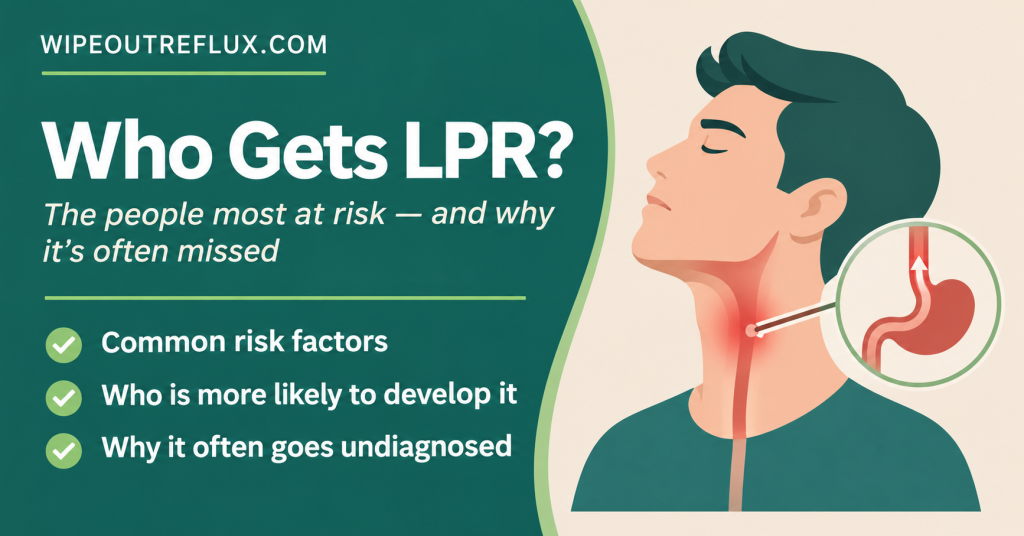
A new 2026 study of 1,650 people attending a throat clinic found that 44.7% had laryngopharyngeal reflux (LPR, or silent reflux). It identified seven independent risk factors: being 65 or older, a BMI of 25 or more, smoking, a preference for strong tea, a weak or poorly functioning lower esophageal sphincter (LES), previous throat (laryngeal) surgery and high blood pressure [Zhang et al., Frontiers in Medicine, 2026].
Four of those seven are things you can change or influence: weight, smoking, strong tea and, to some extent, how well your LES works. In this article I break down what the study found, why each factor might raise your risk, where the study is weaker than the headlines suggest, and what you can actually do with this information.
Key Takeaways
- The study included 1,650 consecutive outpatients with throat (laryngeal) conditions at a large hospital in China, seen between August 2024 and August 2025.
- 738 of them (44.7%) were diagnosed with LPR. That’s people already at a throat clinic, not the general population.
- The seven risk factors, from strongest to weakest: abnormal LES function, BMI 25 or more, age 65 or older, high blood pressure, preference for strong tea, smoking, and previous laryngeal surgery.
- Each factor raised the odds of LPR by roughly 1.5 to 2.4 times.
- Spicy food, diabetes, COPD, heart disease and anemia were more common in people with LPR, but didn’t hold up as independent risk factors.
- The study has real limitations: one hospital, no reflux symptom scores and a diagnosis that partly relied on the LES test it then called a risk factor.
- The modifiable factors (weight, smoking, strong tea) line up with what we already know about reflux, which makes them worth acting on.
The Study at a Glance
The research was published in Frontiers in Medicine in May 2026 by a team at the First Affiliated Hospital of Soochow University in Suzhou, China [Zhang et al., Frontiers in Medicine, 2026]. Here’s what they did:
- Who: 1,650 consecutive adult outpatients with throat and voice-box conditions
- When: August 2024 to August 2025
- How LPR was diagnosed: typical symptoms (a lump feeling, hoarseness, chronic cough, throat itch or pain) plus either abnormal LES function on esophageal manometry, or reflux-type changes on laryngoscopy confirmed by improvement with anti-reflux treatment
- What they measured: age, weight, lifestyle habits, other health conditions and test results
- How they analyzed it: multivariate logistic regression, which tests each factor while accounting for the others, so each one counts as an independent risk factor
They then built a simple scoring tool from the seven factors to help clinics spot people at high risk of LPR.
The 7 LPR Risk Factors, Ranked
Here are the seven factors, ordered by how much each raised the odds of having LPR. An odds ratio of 2.0 roughly means twice the odds.
1. Abnormal LES function (odds ratio 2.38)
What they found: Abnormal function of the lower esophageal sphincter was the strongest factor. It was found in 55.8% of people with LPR, compared with 20.3% of those without.
Why it matters: The LES is the valve at the bottom of your esophagus. If it’s weak or relaxes too often, stomach contents travel up more easily, and some can reach the throat. I explain how this valve works in the lower esophageal sphincter and acid reflux.
The catch: Abnormal LES function on manometry was also one of the ways the researchers diagnosed LPR. So it’s no surprise it showed up as the strongest factor. Some of that link is built into the study design. It still makes sense physiologically, but I wouldn’t read too much into the exact number.
What you can do: You can’t strengthen the LES directly, but you can stop working against it. Large meals, fatty foods, chocolate, mint, alcohol and smoking all make it relax more. Diaphragmatic breathing exercises can also strengthen the muscle that wraps around it.
2. BMI of 25 or more (odds ratio 1.88)
What they found: Being overweight (a BMI of 25 or above) nearly doubled the odds of LPR.
Why it matters: Extra weight around the middle raises pressure inside the abdomen, which pushes on the stomach and the LES. Fat tissue also releases inflammatory signals that may make the throat lining more sensitive.
The catch: This finding doesn’t fully agree with earlier research. A well-known US study using throat pH monitoring found that people with isolated LPR weren’t heavier than people with normal tests. Being overweight was linked with more reflux in the esophagus (GERD), but not with more reflux events reaching the throat [Halum et al., Laryngoscope, 2005]. The new study didn’t separate LPR from LPR plus GERD, which may explain the difference. See GERD vs LPR for why that distinction matters.
What you can do: If you’re carrying extra weight, especially around your middle, losing some is one of the most reliable ways to reduce reflux in general.
3. Age 65 or older (odds ratio 1.80)
What they found: People aged 65 and over had about 1.8 times the odds of LPR.
Why it matters: With age, the LES tends to lose some of its tone, the esophagus clears refluxed material more slowly, and saliva (which helps neutralize acid) decreases. Older adults are also more likely to take medicines that relax the LES. I cover this in acid reflux in older adults.
What you can do: You can’t change your age, but it’s a reason to take throat symptoms seriously later in life rather than putting them down to “just getting older,” and to review your medicines with your doctor.
4. High blood pressure (odds ratio 1.67)
What they found: Hypertension was linked with higher odds of LPR.
Why it matters: The authors didn’t really explain this one. The most practical explanation, in my view, is medication. Some common blood pressure drugs, particularly calcium channel blockers and nitrates, can relax the LES. High blood pressure also tends to travel with being overweight and older, though the analysis tried to account for those.
What you can do: Don’t stop or change any blood pressure medicine on your own. If your throat symptoms started or worsened after a new prescription, raise it with your doctor. My article on blood pressure meds and acid reflux goes through which ones are most often involved.
5. Preference for strong tea (odds ratio 1.65)
What they found: 44.2% of people with LPR said they preferred strong tea, compared with 23.6% of those without.
Why it matters: Strong tea contains more caffeine and theophylline. These can stimulate stomach acid and may relax the LES. Black tea is also mildly acidic, which matters in LPR because acid can reactivate pepsin in the throat.
The catch: “Preference for strong tea” was a simple yes or no, with no detail on how much or how often. Tea culture in China is also very different from the US or UK, so it’s hard to translate this into a cup count.
What you can do: If you drink a lot of strong black tea, try brewing it weaker, cutting back, or switching to a low-acid herbal tea. See is black tea good for acid reflux and caffeine and acid reflux.
6. Smoking (odds ratio 1.53)
What they found: 52.3% of people with LPR had a smoking history, compared with 32.0% of those without.
Why it matters: This is well established. Classic research found smokers had lower LES pressure than non-smokers, and smoking a cigarette directly increased how often acid reflux happened [Kahrilas and Gupta, Gut, 1990]. Smoke also irritates the throat directly and slows healing of the lining.
What you can do: Stopping smoking is one of the best things you can do for your throat, and not only for reflux. See can smoking cause acid reflux.
7. Previous laryngeal surgery (odds ratio 1.49)
What they found: 17.1% of people with LPR had had surgery on their voice box before, compared with 7.5% without.
Why it matters: The authors suggest surgery may change the anatomy and sensitivity of the throat lining, making it more vulnerable to reflux.
The catch: The arrow may point the other way. Reflux is linked to several voice box problems that sometimes need surgery, such as vocal cord granulomas. So some people may have had surgery because of reflux-related damage, not developed LPR because of the surgery. A cross-sectional study like this can’t tell the difference.
What you can do: If you’ve had throat surgery and have ongoing throat symptoms, it’s worth asking your ENT whether reflux could be part of the picture, particularly before any further procedures.
What Didn’t Make the Cut
Several things were more common in people with LPR but didn’t hold up once everything was analyzed together:
- Spicy food: 48.5% of people with LPR preferred spicy or irritating food, compared with 27.2% without. Oddly, the authors still discuss it as a risk factor, even though it wasn’t in their final model. See spicy food and acid reflux.
- Diabetes, COPD, coronary heart disease and anemia: All more common in the LPR group, but not independent risk factors.
- Sex: LPR was somewhat more common in men (about 48% vs 42%), but sex didn’t make the final model.
- Alcohol: Not properly recorded, so the study tells us nothing either way. That’s a notable gap, since alcohol is one of the better-known reflux triggers.
My Honest Take on This Study
I think this study is genuinely useful, but it’s important to read it carefully rather than just take the headline numbers:
- 44.7% isn’t the general population. These were people already at a hospital clinic with throat problems. LPR is common in that group, but the figure tells you nothing about how common it is in everyone else.
- The diagnosis was a bit loose. The team didn’t use the Reflux Symptom Index or the Reflux Finding Score, and only about 30% of patients had manometry. The gold-standard test, throat impedance-pH monitoring, wasn’t systematically used.
- There’s some circularity. Abnormal LES function was both part of the diagnosis and the top risk factor.
- It’s one hospital in one country. Diet, tea habits, smoking rates and body size all differ around the world.
- It shows links, not causes. A snapshot study like this can’t prove that any factor causes LPR.
- The scoring tool has inconsistencies. The paper reports different cutoffs and slightly different accuracy figures in different sections, and it hasn’t been tested in other hospitals yet.
So why cover it? Because the factors you can change, namely weight, smoking and strong caffeinated tea, line up with years of earlier reflux research. When a new study points in the same direction as the older evidence, it’s a good reason to act on those factors, even if the exact numbers are uncertain.
What to Do If You Have Several Risk Factors
If you tick several of these boxes and have throat symptoms like throat clearing, a lump feeling, hoarseness or a chronic cough, here’s a sensible plan:
- Score your symptoms. Use the Reflux Symptom Index to get a baseline. A score above 13 suggests LPR is worth investigating.
- Work on what you can change. Cut back on strong tea and other caffeine, stop smoking, and aim for gradual weight loss if your BMI is above 25.
- Take pressure off your LES. Eat smaller meals, avoid eating within 3 hours of bed, and limit fatty foods, chocolate, mint and alcohol.
- Cut acidic food and drink. This matters more in LPR than GERD because of pepsin in the throat.
- Review your medicines with your doctor, especially blood pressure drugs, if your symptoms started after a change.
- See a doctor if your symptoms don’t improve in 6 to 8 weeks, or if you have warning signs like a hoarse voice lasting 3 weeks or more, trouble swallowing or weight loss.
Most of steps 2 to 4 come down to food and daily habits, which is exactly what the Wipeout Diet Plan is built around. For a full rundown of how LPR shows up, see my LPR symptoms guide.
Conclusion
This 2026 study adds useful real-world data on who gets LPR. Among 1,650 throat clinic patients, nearly half had it. The seven risk factors were abnormal LES function, being overweight, being 65 or older, high blood pressure, a taste for strong tea, smoking and previous throat surgery. The study has clear limits, including a single hospital, a loose diagnosis and some built-in circularity. But its modifiable risk factors match what earlier research already tells us about reflux, and that’s what makes it worth paying attention to.
You can’t change your age or your surgical history, but you can change what you drink, whether you smoke, what you eat and when you eat it. The Wipeout Diet Plan is my complete, in-depth guide to the food side of that. I built it primarily for LPR, though it tackles the same root causes behind GERD and heartburn, so it works just as well for those too. It shows you which foods and drinks to cut, what to eat instead and how to time your meals, all in a full meal plan, so you’re working on the risk factors you actually control.
Frequently Asked Questions
What are the main risk factors for LPR?
A 2026 study identified seven: abnormal lower esophageal sphincter function, a BMI of 25 or more, age 65 or older, high blood pressure, a preference for strong tea, smoking and previous laryngeal surgery. Earlier research also points to alcohol, large and late meals, and acidic foods and drinks as common triggers.
How common is LPR?
It depends a lot on who you study and how it’s diagnosed. In the 2026 study, 44.7% of throat clinic outpatients had LPR, but that’s a group already seeking help for throat problems. Rates in the general population are much lower, and estimates vary widely between studies.
Does tea cause silent reflux?
The study found that people who preferred strong tea had about 1.6 times the odds of LPR. Strong tea contains more caffeine, which can stimulate stomach acid and may relax the LES. That doesn’t mean all tea causes reflux. Weaker tea, less of it, or caffeine-free herbal options are usually better tolerated.
Is LPR more common in older people?
Yes. In the study, people 65 and over had about 1.8 times the odds of LPR, likely due to a weaker LES, slower clearance of reflux and less saliva with age.
Can being overweight cause LPR?
The 2026 study found a BMI of 25 or more nearly doubled the odds of LPR. Earlier research found weight was more strongly linked to GERD than to isolated LPR. Either way, losing excess weight usually helps reflux overall.
Can high blood pressure cause acid reflux?
The study found a link between high blood pressure and LPR but didn’t explain it. Some blood pressure medicines, like calcium channel blockers and nitrates, can relax the LES. Talk to your doctor before changing any medication.
Is smoking a risk factor for LPR?
Yes. Smoking lowers LES pressure, increases reflux and irritates the throat directly. In the 2026 study, over half of the people with LPR had a smoking history.
Research & References
- [Zhang et al., Frontiers in Medicine, 2026] — Cross-sectional study of 1,650 laryngeal outpatients in Suzhou, China. 44.7% had LPR. Age 65 or over, BMI 25 or over, smoking, strong tea, abnormal LES function, previous laryngeal surgery and hypertension were independent risk factors (odds ratios 1.49 to 2.38). PubMed: 42232974.
- [Halum et al., Laryngoscope, 2005] — On pH monitoring, people with isolated LPR weren’t more overweight than people with normal tests; obesity was linked with esophageal (GERD) reflux events but not throat reflux events.
- [Kahrilas and Gupta, Gut, 1990] — Smokers had lower lower esophageal sphincter pressure than non-smokers, and smoking acutely increased the rate of acid reflux events.

David Gray
12 years living with LPR · Consultant & researcher
I've lived with LPR for twelve years — the misdiagnoses, the PPI courses that did nothing, the slow work of figuring out what actually helps. Wipeout Reflux is where I translate the research into plain terms for people stuck in the same place. Every claim here is sourced to peer-reviewed work, and I consult one-to-one with LPR sufferers.