
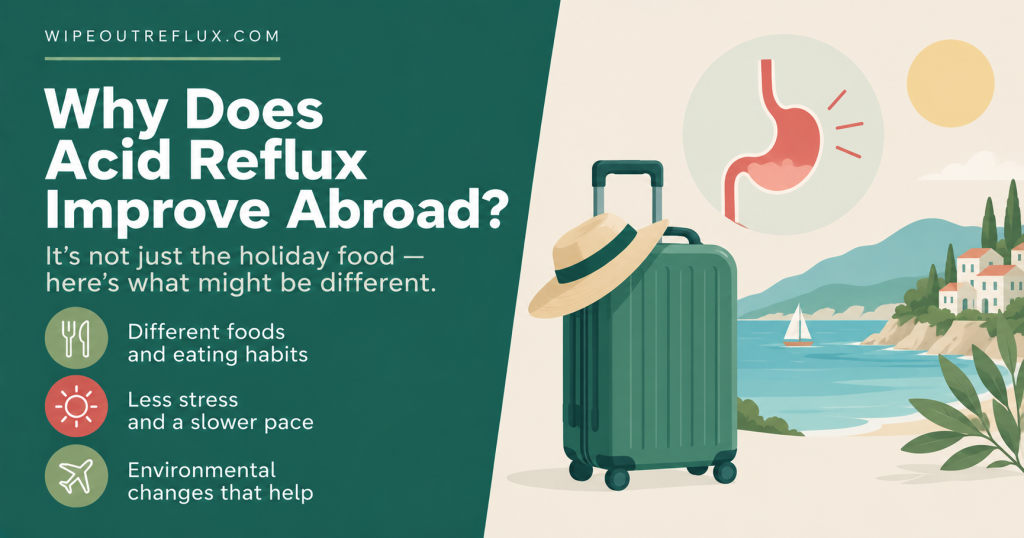
It’s one of the most common things readers tell me: “My acid reflux almost disappears when I’m abroad — why?” It’s a real pattern, and it isn’t in your head. But there’s no single magic in the water. What changes when you travel is a whole cluster of things at once: you eat less processed, more Mediterranean-style food; your portions shrink; you eat dinner earlier and walk it off instead of collapsing on the sofa; you’re more relaxed; and often you drink differently too. Each of those nudges reflux in the right direction, and together they can add up to a dramatic difference.
The one that’s easiest to prove is the food. When researchers pitted a plant-based Mediterranean diet (plus alkaline water) against acid-suppressing drugs for throat reflux, the diet did at least as well as the medication [Zalvan et al., JAMA Otolaryngology–Head & Neck Surgery, 2017]. So if your trip swaps a Western fried-and-processed pattern for fresh Mediterranean cooking, you’ve effectively started a proven reflux treatment without realising it.
Below I’ll unpack each reason your reflux eases abroad — and, just as importantly, why it sometimes gets worse on holiday, and how to bottle the good version and bring it home.
Key Takeaways
- Reflux improving abroad is real and multifactorial — it’s rarely one cause, but the sum of several changes happening together.
- Diet is the biggest, most provable factor: a Mediterranean, less-processed way of eating performed as well as acid-suppressing medication for reflux in a clinical study.
- Smaller portions and lighter, fresher food mean less pressure and fewer triggers — high-fat, fried, salty and carbonated items are the ones linked to more reflux.
- Earlier dinners matter enormously: going to bed within three hours of eating was linked to over seven times the odds of nighttime reflux.
- You move more on holiday — walking after meals instead of lying down helps clear reflux.
- Less soda, different or less alcohol, and a slower, less stressful pace all pull in the same direction.
- It doesn’t happen for everyone — big rich meals, more alcohol and late dining can make holiday reflux worse instead.
- The lesson isn’t “move abroad” — it’s that the holiday pattern is a template you can recreate at home.
1. The Food Is Fresher and Less Processed
This is the heavy hitter. Much of the classic Western diet — especially the American one — is built on ultra-processed, high-fat, energy-dense food. A systematic review of dietary patterns and reflux found that high-fat diets, fried and salty foods, carbonated drinks, citrus and high-glycemic foods were associated with a higher risk of reflux, while diets rich in vegetables and fiber were not [Heidarzadeh-Esfahani et al., Preventive Nutrition and Food Science, 2021]. Travel to somewhere with a fresher food culture — Mediterranean Europe is the classic example — and you naturally eat more vegetables, olive oil, fish and whole foods, and far less of the processed stuff.
That’s not a vague wellness claim. In a head-to-head study, people with throat reflux (LPR) put on a plant-based Mediterranean diet with alkaline water were more likely to get a clinically meaningful improvement in their symptoms than people given a PPI — about 63% versus 54% [Zalvan et al., JAMA Otolaryngology–Head & Neck Surgery, 2017]. So when a holiday flips your plate toward that pattern, you’re running a genuine intervention. It’s exactly why I point people to the Mediterranean diet for acid reflux as one of the best-evidenced approaches there is.
2. Your Portions Are Smaller
Portion sizes vary wildly between countries, and a big meal refluxes more than a small one no matter what’s on the plate — a fuller stomach means more pressure pushing up against the valve at the top. In many countries the default portion is simply smaller than the supersized Western norm, and meals are often spread across more, lighter courses rather than one giant plate. Less volume, less pressure, less reflux. This alone can explain a lot, especially for people whose main problem is quantity rather than any specific food.
3. You Eat Dinner Earlier — and Don’t Lie Down On It
This might be the single most underrated factor. In cultures where the day winds down slowly, dinner is often eaten and then followed by hours of being upright — a stroll, conversation, a leisurely evening — before bed. Contrast that with eating late and heading straight to the sofa or bed.
The timing genuinely matters: in one study, people who went to bed within three hours of dinner were about 7.5 times more likely to suffer nighttime reflux than those who left four hours or more [Fujiwara et al., American Journal of Gastroenterology, 2005]. A holiday that shifts you toward earlier eating and a long upright gap before bed is quietly fixing one of the biggest drivers of reflux — and it’s why so many people find their reflux is worst in the morning back home, where late dinners are the norm.
4. You Move More
Travel usually means walking — sightseeing, exploring, wandering after dinner rather than slumping. Gentle movement after a meal helps clear reflux and speeds the stomach along, whereas lying down does the opposite. It’s the same reason I recommend a short walk after eating as a simple, free habit. On holiday you do it without thinking.
5. You Drink Differently
Two things often shift on the drinks front. Many people drink far less soda abroad — carbonated drinks are linked to more reflux, both from the fizz raising pressure and from their acidity. And alcohol patterns change: some people drink less, while others swap spirits and beer for a little wine with a meal. Alcohol relaxes the valve at the top of the stomach, so if your intake drops, your reflux often eases — as I cover in does quitting alcohol help acid reflux. (This one cuts both ways, though — see below.)
6. You’re More Relaxed
Stress doesn’t create reflux out of nothing, but it amplifies how intensely you feel it and can worsen symptoms. A genuine break — away from work pressure, sleeping better, moving at a slower pace — tends to calm the whole system down. It’s hard to measure and easy to dismiss, but readers mention it too often for it to be nothing.
7. The “Prescribing” and Food-Culture Angle
There’s a subtler layer worth naming. Different countries approach reflux differently at the medical level — some are quicker to reach for long-term acid-suppressing drugs, others lean harder on diet and lifestyle first — and food environments are regulated differently too, from portion norms to the additives and oils used in everyday cooking. None of this is something you’d notice on a two-week trip directly, but it shapes the food you’re eating and the culture around it. The upshot for a traveller is the same: you land somewhere the default way of eating and living happens to be gentler on reflux.
When Reflux Gets WORSE Abroad
I want to be honest, because it’s not universal. For plenty of people, holiday is when reflux flares — and the reasons are the mirror image of everything above. All-inclusive buffets and big rich restaurant meals, more alcohol than usual, late dinners followed straight by bed, unfamiliar spicy or fried food, and disrupted routines can all light reflux up. That’s the holiday heartburn so many people know. Even the journey itself can contribute — I’ve written separately about acid reflux and flying and how cold weather can affect symptoms. So “abroad” isn’t automatically better; it depends entirely on whether your trip shifts the pattern toward lighter, earlier, calmer eating or away from it.
How to Bottle It and Bring It Home
Here’s the useful bit. If your reflux improves abroad, that’s not a mystery to shrug at — it’s a controlled experiment telling you exactly what works for your body. The holiday pattern is a template:
- Shift your main meal earlier and keep dinner lighter, leaving three-plus hours before bed.
- Lean your everyday eating toward the Mediterranean, less-processed pattern that eased things while you were away.
- Shrink portions — smaller plates, more courses if you like, but less volume at once.
- Walk after meals instead of sitting down.
- Watch the soda and be honest about alcohol.
None of that requires a plane ticket. It just requires making the holiday version of yourself the everyday one.
Conclusion
Reflux improving abroad isn’t magic — it’s the predictable result of eating fresher and lighter, in smaller portions, earlier in the evening, with more walking and less soda, alcohol and stress. The strongest single lever is the food, and the good news is you can recreate every part of the holiday pattern at home. The trick is turning a two-week accident into a permanent routine.
That’s exactly what the Wipeout Diet Plan is built to do — it takes the principles that quiet reflux abroad and turns them into a complete, liveable everyday framework. I designed it around LPR, the stubborn throat-based form, but because it works on the same underlying reflux mechanics it’s just as effective for classic GERD and heartburn. If you want a lighter place to start, the Wipeout Food Reference Guide is the essential companion — it maps which foods and drinks are safe for reflux and LPR and where they sit on the pH scale, so you can rebuild your “holiday plate” wherever you are.
Frequently Asked Questions
Why does my acid reflux disappear on holiday?
Usually because several things change at once: you eat fresher, less-processed, more Mediterranean-style food in smaller portions, you eat dinner earlier and stay upright longer, you walk more, and you’re more relaxed. Each of these reduces reflux, and together they can make a big difference — even though no single one is doing all the work.
Is it the food or the water abroad?
Mostly the food and the eating pattern, not the water itself. The shift toward fresh, Mediterranean-style, less-processed meals in smaller portions is well supported — a Mediterranean diet performed as well as acid-suppressing medication for reflux in one study. There’s no evidence that foreign tap water specifically cures reflux.
Why is my reflux worse when I travel instead of better?
Because travel can push the pattern the wrong way: big rich buffet or restaurant meals, more alcohol, late dinners followed straight by bed, and unfamiliar fried or spicy food. If your trip means heavier, later, boozier eating rather than lighter and earlier, reflux tends to flare — the classic holiday heartburn.
Does eating dinner earlier really help reflux?
Yes, significantly. Going to bed within three hours of dinner was linked to about 7.5 times the odds of nighttime reflux compared with leaving four or more hours. Eating earlier and staying upright afterwards — as people often do abroad — is one of the most effective changes you can make.
Is the Mediterranean diet good for acid reflux?
The evidence is strong. A plant-based Mediterranean diet plus alkaline water was at least as effective as a PPI for improving throat reflux symptoms in a clinical study. Its emphasis on vegetables, whole foods, fish and olive oil — and less fried, processed and fatty food — lines up well with what reduces reflux.
How can I keep the benefits when I get home?
Treat your holiday as a template. Eat your main meal earlier and keep dinner light with a three-plus hour gap before bed, shift everyday meals toward the fresher Mediterranean pattern, keep portions smaller, walk after eating, and watch soda and alcohol. You don’t need to travel to get the benefit — you need to make the holiday habits permanent.
Could stress be why my reflux is better away from home?
It can contribute. Stress doesn’t cause reflux on its own, but it can heighten symptoms, so a genuine break with better sleep and a slower pace often helps. It’s usually one piece of the picture alongside the dietary and timing changes, rather than the whole explanation.
Research & References
- [Zalvan et al., JAMA Otolaryngology–Head & Neck Surgery, 2017] — Compared a plant-based Mediterranean diet with alkaline water against PPI treatment for laryngopharyngeal reflux; the dietary group was at least as likely to achieve a clinically meaningful symptom improvement (about 63% vs 54%).
- [Heidarzadeh-Esfahani et al., Preventive Nutrition and Food Science, 2021] — Systematic review finding high-fat, fried, salty, carbonated and high-glycemic foods associated with greater reflux risk, while vegetable- and fiber-rich diets were not associated with increased risk.
- [Fujiwara et al., American Journal of Gastroenterology, 2005] — Case-control study finding that going to bed within three hours of dinner was associated with roughly 7.5 times the odds of gastro-esophageal reflux compared with a gap of four hours or more.

David Gray
12 years living with LPR · Consultant & researcher
I've lived with LPR for twelve years — the misdiagnoses, the PPI courses that did nothing, the slow work of figuring out what actually helps. Wipeout Reflux is where I translate the research into plain terms for people stuck in the same place. Every claim here is sourced to peer-reviewed work, and I consult one-to-one with LPR sufferers.