
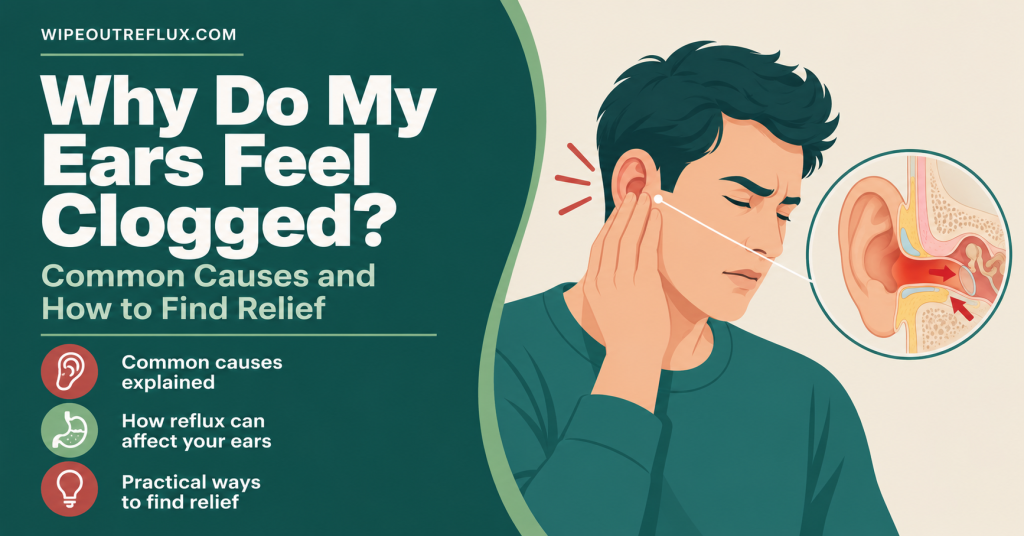
Your ears usually feel clogged for one of two reasons: something is blocking the ear canal, usually earwax, or the pressure behind your eardrum isn’t equalizing because your Eustachian tube isn’t opening properly. The Eustachian tube is a small channel that runs from your middle ear to the back of your nose. When it’s swollen or blocked by a cold, allergies, sinus congestion or a change in air pressure, the air behind the eardrum can’t balance with the air outside, and your ear feels full, muffled or “underwater.”
Most clogged ears are caused by earwax, a cold, allergies or flying, and they clear up on their own or with simple treatment. If your ears feel clogged with no wax, keep coming back, or are worse when you wake up, there’s one cause most guides leave out: reflux. Stomach contents that reach the back of the nose and throat can irritate the opening of the Eustachian tube.
One important exception: a sudden feeling of fullness with muffled hearing in one ear can be sudden hearing loss, which needs to be seen by a doctor within days, not weeks.
Key Takeaways
- Clogged ears come from either a blocked ear canal (usually earwax) or a pressure problem behind the eardrum (Eustachian tube dysfunction).
- Colds, allergies, sinus congestion and air pressure changes from flying or diving are the most common causes of Eustachian tube problems.
- If the clogged feeling comes with ear pain, fever or discharge, an ear infection is more likely.
- Clogged ears with no wax and no cold point to Eustachian tube dysfunction, which can be driven by allergies, sinus problems, jaw problems or reflux.
- Reflux that reaches the back of the nose can irritate the Eustachian tube. Pepsin, a stomach enzyme, has been found in middle-ear fluid.
- Ears that feel clogged mainly in the morning can be a sign of nighttime reflux, overnight congestion or sleeping on one side.
- Sudden muffled hearing in one ear, especially without a cold, needs urgent medical attention. Early treatment matters.
- Never use cotton swabs to clear wax. They push it deeper.
What Makes Your Ears Feel Clogged
It helps to picture three parts of your ear:
- The outer ear canal: the tube you can see, which ends at the eardrum. Earwax, water or swelling here blocks sound and feels like a plug.
- The middle ear: a small air-filled space behind the eardrum. For the eardrum to move freely, the air pressure in here must match the air outside.
- The Eustachian tube: the channel that connects the middle ear to the back of your nose. It opens briefly when you swallow or yawn, letting air in to balance the pressure, and lets fluid drain out.
When the Eustachian tube doesn’t open properly, air in the middle ear is slowly absorbed and pressure drops. The eardrum gets pulled inward and can’t vibrate normally. That’s the full, pressured, muffled feeling. Doctors call this dilatory Eustachian tube dysfunction, and an international expert consensus lists ear fullness or pressure, muffled hearing and ear discomfort as its typical symptoms [Schilder et al., Clinical Otolaryngology, 2015]. If it goes on long enough, fluid can build up behind the eardrum.
Common Causes of Clogged Ears
1. Earwax buildup
Earwax is the most common reason for a single blocked ear, especially if it came on after a shower or swim (water makes wax swell). Impacted wax can cause fullness, muffled hearing, itching, ringing or a feeling of pressure. Cotton swabs are a common reason wax becomes impacted, because they push it deeper. A clinical guideline on earwax advises against cotton swabs and ear candling and recommends softening drops, irrigation or removal by a clinician instead [Schwartz et al., Otolaryngology–Head and Neck Surgery, 2017].
2. A cold, flu or sinus infection
When you’re sick, the lining of your nose and throat swells and produces extra mucus, and the opening of the Eustachian tube swells with it. This is why ears so often feel clogged during or after a cold. It normally clears within a week or two as the swelling goes down, though it can take several weeks after a heavy cold.
3. Allergies
Hay fever, dust mite and pet allergies inflame the nose in the same way a cold does. If your ears feel clogged at certain times of year, or along with sneezing, a runny nose and itchy eyes, allergies are the likely cause. If your “allergies” don’t follow the seasons, have a look at LPR vs allergies.
4. Air pressure changes
Flying, diving, driving through mountains and even fast elevators can change the outside air pressure faster than your Eustachian tube can keep up. Descending in a plane is usually the worst part. If your tube is already swollen from a cold, allergies or reflux, it’s much harder to equalize. I cover this in acid reflux and flying.
5. Ear infection
A middle-ear infection usually causes pain, fullness and muffled hearing, sometimes with fever. An outer-ear infection (swimmer’s ear) causes pain, itching and sometimes discharge, and the ear often hurts when you pull on it. Both usually need treatment from a doctor.
6. Fluid behind the eardrum
When the Eustachian tube stays blocked, fluid can collect in the middle ear (otitis media with effusion, or “glue ear”). It’s common in children but happens in adults too. It causes a persistent full feeling and dulled hearing, often without much pain.
7. Jaw (TMJ) problems
Your jaw joint sits right in front of your ear, and the muscles that open the Eustachian tube work alongside your jaw muscles. Clenching, grinding and jaw joint problems can cause ear fullness, pressure and pain with a completely normal ear exam. Clues include jaw clicking, morning jaw ache and tenderness in front of the ear.
8. Sudden hearing loss and inner-ear problems
This is the one you shouldn’t miss. Sudden sensorineural hearing loss, where the inner ear or hearing nerve stops working properly, often shows up as a blocked or full ear. People often assume it’s wax or congestion. A clinical guideline stresses telling it apart from a simple blockage quickly, because treatment works best when started early [Chandrasekhar et al., Otolaryngology–Head and Neck Surgery, 2019]. A simple home check: hum. With a wax or middle-ear blockage, the hum usually sounds louder in the blocked ear. With inner-ear hearing loss, it sounds louder in the good ear. Either way, sudden hearing loss in one ear warrants a same-week appointment.
Ménière’s disease can also cause ear fullness, along with episodes of spinning vertigo, ringing and fluctuating hearing.
Why Do My Ears Feel Clogged but There’s No Wax?
If a doctor has looked in your ears and told you they’re clear, or wax drops have made no difference, the problem is almost certainly behind the eardrum rather than in the canal. The usual causes are:
- Eustachian tube dysfunction from congestion, allergies or chronic sinus problems
- Fluid behind the eardrum left over from a cold
- Jaw (TMJ) tension
- Patulous Eustachian tube, where the tube stays open instead of closed (see below)
- Inner-ear problems such as sudden hearing loss or Ménière’s disease
- Reflux reaching the back of the nose, a cause that’s often overlooked
That last one deserves its own section, because it’s often the answer when someone has had clogged ears for months, no wax, no infection and no allergies, and nobody has an explanation.
The Cause Nobody Mentions: Reflux and Clogged Ears
The opening of your Eustachian tube sits at the back of your nose, just above the throat. With laryngopharyngeal reflux (LPR, or silent reflux), stomach contents don’t just reach the esophagus. Small amounts travel up to the throat and, in some people, as far as the back of the nose. That puts acid and pepsin right next to the tube’s opening.
Here’s what the research shows:
- Pepsin turns up in middle-ear fluid. In a study of children having grommets inserted for glue ear, pepsin or its precursor was found in 83% of middle-ear fluid samples, at levels up to 1,000 times higher than in blood [Tasker et al., The Lancet, 2002]. A later systematic review found pepsin in an average of about 85% of middle-ear fluid samples, while noting that this doesn’t yet prove reflux causes the fluid [Miura et al., Otolaryngology–Head and Neck Surgery, 2012].
- Reflux can make the tube harder to open. In an animal model, repeatedly exposing the Eustachian tube to acid and pepsin raised the pressure needed to open it and impaired its ability to clear pressure [White et al., The Laryngoscope, 2002].
- Adults with LPR have worse middle-ear function. In 105 adults with fluid behind the eardrum, more reflux symptoms were linked to measurably poorer Eustachian tube function [Zhen et al., Frontiers in Neurology, 2022]. In a case-control study of 73 people with LPR and 73 matched controls, abnormal middle-ear pressure readings showed up in 54.8% of the reflux group compared with 6.85% of controls [Mukherjee and Chatterji, Indian Journal of Otolaryngology and Head & Neck Surgery, 2024].
To be honest about the evidence, most of it is about association, and much of the pepsin work was done in children. But the pattern fits what many of my readers describe: blocked, pressured ears alongside throat clearing, post-nasal drip, a hoarse voice or a lump in the throat, and all of it worse after big meals or first thing in the morning. I go deeper on the mechanism in acid reflux and Eustachian tube dysfunction.
Signs your clogged ears might be reflux-related
- Your ears have felt blocked for weeks or months with no wax, infection or clear allergy pattern
- It’s worse in the morning, after lying flat, or after large or late meals
- You also have throat clearing, mucus at the back of the throat, a hoarse voice, a chronic cough or a lump-in-the-throat feeling
- Sinus or nasal symptoms haven’t responded well to allergy treatment
- You’ve had reflux, heartburn or a sour taste at some point (although many people with LPR never get heartburn)
Reflux can also cause ear pain, both directly and as referred pain from the throat. See acid reflux ear pain and can acid reflux cause tinnitus if you also hear ringing. For the full list of throat and airway signs, see LPR symptoms.
Why Do My Ears Feel Clogged When I Wake Up?
Morning ear fullness that clears up during the day usually has one of four causes:
- Nighttime reflux. When you lie flat, gravity no longer helps keep stomach contents down, and you swallow far less while asleep, so less is cleared away. Reflux can then reach the throat and the back of the nose for hours. Eating within 3 hours of bed makes this much more likely [Fujiwara et al., American Journal of Gastroenterology, 2005]. See why acid reflux is worse in the morning.
- Overnight nasal congestion. Lying down increases blood flow to the nasal lining, so it swells. Dust mites in bedding and dry bedroom air add to this.
- Sleeping on one side. The ear you sleep on often feels more blocked, because congestion collects on the lower side.
- Jaw clenching and grinding at night. If you wake with a sore jaw or headache, this may be the cause.
If morning ear pressure comes with a sore or croaky throat, mucus to clear and a bad taste, reflux moves to the top of the list. Raising the head of your bed and finishing dinner earlier are the two simplest tests. Elevating the head of the bed is one of the few lifestyle changes with decent evidence for nighttime reflux [Kaltenbach et al., Archives of Internal Medicine, 2006]. See how to raise the head of your bed and the best sleeping position for silent reflux.
Why Do My Ears Feel Clogged and Hurt?
Fullness with pain changes the likely causes:
- Middle-ear infection: pain, pressure, muffled hearing, sometimes fever. Often follows a cold.
- Outer-ear infection: pain when you touch or pull the ear, itching, discharge.
- Barotrauma: pain and fullness after flying or diving.
- Jaw (TMJ) problems: aching in front of the ear, worse when chewing.
- Referred pain from the throat: the throat and ear share nerves, so throat irritation from reflux, tonsillitis or a sore throat can be felt in the ear.
Pain with fever, discharge, swelling behind the ear or severe pain should be seen by a doctor.
Why Do My Ears Feel Clogged When I’m Sick?
Colds, flu, COVID and sinus infections all swell the nasal lining and the Eustachian tube opening. Swallowing, yawning and steam help, and the feeling usually lifts as the illness clears. If your ears are still blocked several weeks after you’ve recovered, you may have fluid behind the eardrum, or another cause may be keeping the tube irritated. Some people find a cold sets off a run of reflux symptoms too. More on that in can a cold cause acid reflux.
Why Do My Ears Feel Clogged After Working Out?
There are a few likely causes:
- Straining and holding your breath during heavy lifts changes pressure in your chest, head and ears.
- A patulous Eustachian tube. This is the opposite problem: the tube stays open when it should be closed. It causes ear fullness and a strange echo of your own voice and breathing (autophony) [Schilder et al., Clinical Otolaryngology, 2015]. It’s often worse after exercise, weight loss or dehydration, and better when you lie down or put your head between your knees.
- Exercise-triggered reflux. Running, crunches and heavy lifting squeeze the stomach and can push reflux up, especially soon after eating. See exercise and acid reflux and weightlifting and acid reflux.
How to Unclog Your Ears
Quick fixes to try at home
- Swallow, yawn or chew gum. These open the Eustachian tube naturally. Sipping water while pinching your nose (the Toynbee maneuver) also works for some people.
- Gentle Valsalva. Close your mouth, pinch your nose and blow very gently until you feel a “pop.” Don’t force it, and skip it if you have a cold with thick mucus or ear pain.
- Steam. A hot shower or a bowl of steam loosens mucus and can reduce swelling around the tube.
- Warm compress. Helps with discomfort.
If it’s earwax
Use softening drops (olive oil or over-the-counter ear drops) for a few days. If that doesn’t work, a pharmacist, nurse or doctor can remove it with irrigation or microsuction. Don’t use cotton swabs or ear candles. Don’t use drops if you might have a perforated eardrum.
If it’s congestion or allergies
Saline nasal rinses, a steroid nasal spray and antihistamines can reduce swelling around the tube. Decongestant nasal sprays can help in the short term, but don’t use them for more than a few days because they can cause rebound congestion. Ask a pharmacist which suits you, particularly if you have high blood pressure.
If reflux could be involved
- Finish your last meal at least 3 hours before bed
- Raise the head of your bed by 6 to 8 inches
- Eat smaller meals and cut back on the main triggers: coffee, alcohol, chocolate, fizzy drinks, citrus, tomato, mint, and fatty or fried food
- Lower the overall acidity of your diet, because acid reactivates pepsin in the throat and nose
- Consider an alginate such as Gaviscon Advance after meals and at bedtime. See Gaviscon Advance.
Diet is where I’ve seen the biggest change in throat, nose and ear symptoms, which is why it’s the foundation of the Wipeout Diet Plan. If you also have sinus symptoms, read acid reflux and sinus congestion and silent reflux and post-nasal drip.
When to See a Doctor
Get seen promptly if you have:
- Sudden hearing loss or muffled hearing in one ear, especially without a cold. This is time-sensitive.
- Severe ear pain, fever, discharge or swelling behind the ear
- Spinning vertigo, especially with ringing and hearing changes
- Clogged ears lasting more than 2 to 3 weeks without improvement
- Blocked ear on one side only that keeps coming back, particularly with a blocked nose or nosebleeds on the same side
- Weakness or drooping on one side of the face
Conclusion
When your ears feel clogged, the cause is usually simple: earwax, a cold, allergies or a change in air pressure. In most of those cases, the Eustachian tube can’t open properly to balance pressure, and the feeling clears as the swelling goes down. Sudden muffled hearing in one ear is the exception that needs a doctor quickly. But if your ears have felt blocked for weeks with no wax, worse in the morning or after big meals, and especially if you also clear your throat a lot or feel mucus at the back of your nose, reflux deserves a look. It’s the cause most guides leave out, and the research linking pepsin to middle-ear problems keeps growing.
If reflux fits your picture, the Wipeout Diet Plan is the best place to start. It’s my full, step-by-step program for reducing the acid and pepsin that irritate your throat, nose and Eustachian tube, covering what to eat, what to drink and when to eat it. I originally built it for silent reflux, where ear, nose and throat symptoms like these are most common, but because it targets the same underlying causes, it works just as well for GERD and everyday heartburn.
As a lighter companion, the Wipeout Food Reference Guide lists the foods and drinks that are safe for acid reflux and LPR, along with their pH values, so you can cut out the hidden triggers while your ears and throat settle.
Frequently Asked Questions
Why do my ears feel clogged but I can still hear?
A mild pressure imbalance behind the eardrum can create a strong feeling of fullness without much hearing loss. This is typical of early Eustachian tube dysfunction from congestion, allergies or reflux. If hearing drops suddenly in one ear, see a doctor promptly.
How long does it take for clogged ears to go away?
After a cold or flight, a clogged ear usually clears in a few days to 2 weeks. Earwax clears once it’s softened or removed. If it lasts more than 2 to 3 weeks, see a doctor to check for fluid behind the eardrum or another cause.
Can acid reflux make your ears feel clogged?
It can. Reflux that reaches the back of the nose can irritate the opening of the Eustachian tube, and pepsin from the stomach has been found in middle-ear fluid. Studies also link silent reflux to poorer Eustachian tube and middle-ear function in adults. It’s most likely when ear fullness comes with throat clearing, hoarseness or post-nasal drip.
Why does only one ear feel clogged?
One-sided blockage is usually earwax, an infection, sleeping on that side or a congested nostril on that side. Sudden muffled hearing in one ear can be sudden hearing loss and needs urgent assessment. A one-sided blockage that keeps returning with nasal symptoms on the same side should also be checked.
How do I unclog my ears at night?
Swallow or yawn, try a gentle Valsalva, and use steam or a saline rinse before bed. If your ears are worse in the morning, raise the head of your bed and finish dinner at least 3 hours before lying down, in case nighttime reflux is involved.
Is it bad to pop your ears?
Gentle popping by swallowing, yawning or a soft Valsalva is fine. Forceful blowing can damage the ear, especially if you have an infection or thick mucus. If your ears won’t pop at all, or it hurts, see a doctor.
Can allergies make your ears feel clogged?
Yes. Allergies swell the lining of the nose, including around the opening of the Eustachian tube, so pressure in the middle ear can’t equalize. Antihistamines, steroid nasal sprays and saline rinses often help. If allergy treatment doesn’t work, consider other causes such as reflux.
Research & References
- [Schilder et al., Clinical Otolaryngology, 2015] — International expert consensus defining dilatory and patulous Eustachian tube dysfunction and their symptoms, including ear fullness, pressure, muffled hearing and hearing your own voice.
- [Schwartz et al., Otolaryngology–Head and Neck Surgery, 2017] — Clinical practice guideline on earwax impaction, advising against cotton swabs and ear candling and recommending softening drops, irrigation or manual removal.
- [Chandrasekhar et al., Otolaryngology–Head and Neck Surgery, 2019] — Clinical practice guideline on sudden hearing loss, stressing prompt assessment to distinguish it from blockage and early treatment.
- [Tasker et al., The Lancet, 2002] — Found pepsin or pepsinogen in 83% of middle-ear fluid samples from children with glue ear, at levels up to 1,000 times higher than in blood.
- [Miura et al., Otolaryngology–Head and Neck Surgery, 2012] — Systematic review reporting pepsin in an average of about 85% of middle-ear fluid samples, while noting cause and effect hasn’t been established.
- [White et al., The Laryngoscope, 2002] — Animal study showing repeated acid and pepsin exposure raised the Eustachian tube’s opening pressure and impaired its ability to clear pressure.
- [Zhen et al., Frontiers in Neurology, 2022] — In 105 adults with fluid behind the eardrum, more reflux symptoms were associated with measurably poorer Eustachian tube function.
- [Mukherjee and Chatterji, Indian Journal of Otolaryngology and Head & Neck Surgery, 2024] — Case-control study of 73 adults with LPR and 73 controls, finding abnormal middle-ear function in 54.8% of the reflux group compared with 6.85% of controls.
- [Fujiwara et al., American Journal of Gastroenterology, 2005] — Case-control study finding a dinner-to-bed time of under 3 hours was associated with markedly higher odds of reflux.
- [Kaltenbach et al., Archives of Internal Medicine, 2006] — Evidence review finding that raising the head of the bed and weight loss were among the lifestyle measures supported by evidence for reflux.

David Gray
12 years living with LPR · Consultant & researcher
I've lived with LPR for twelve years — the misdiagnoses, the PPI courses that did nothing, the slow work of figuring out what actually helps. Wipeout Reflux is where I translate the research into plain terms for people stuck in the same place. Every claim here is sourced to peer-reviewed work, and I consult one-to-one with LPR sufferers.