
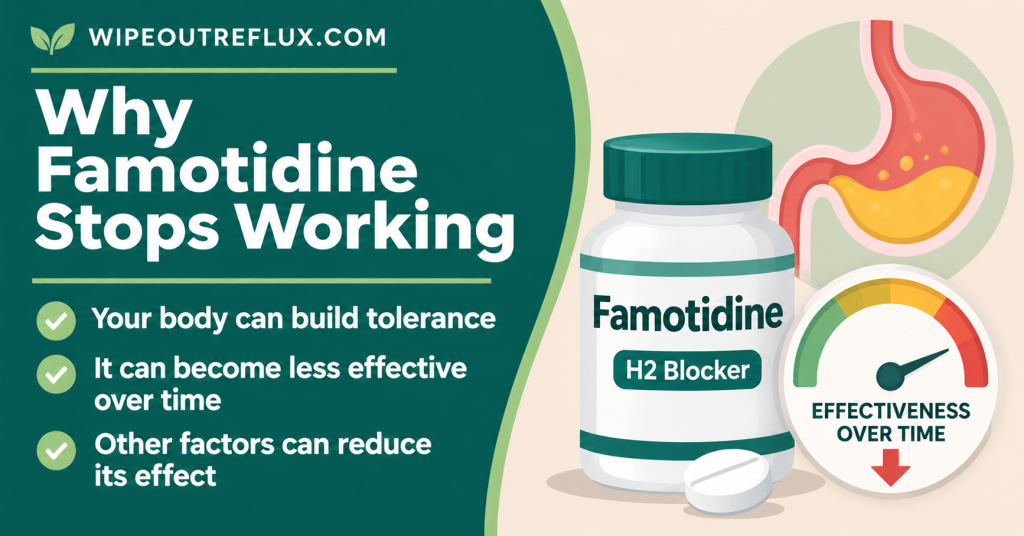
Famotidine often stops working because your body builds up tolerance to it, a process called tachyphylaxis. When you take famotidine regularly, its acid-blocking effect starts to fade within days. Studies show the drop is measurable by the second or third day of repeated dosing and continues over the following week or two, until a dose that once worked well does noticeably less.
This is a known property of all H2 blockers, not a sign that something is wrong with you. Famotidine only blocks one of the three signals that switch on acid production, and your stomach appears to compensate by leaning harder on the other two. The good news is that tolerance isn’t permanent. Taking breaks, using famotidine only when you need it, and pairing it with treatments that work differently can all help.
That said, tolerance isn’t the only reason famotidine can seem to stop working. Below I’ll cover how tolerance works, how to tell it apart from the other common reasons, and what to do about it.
Key Takeaways
- Tolerance (tachyphylaxis) to famotidine develops quickly with regular use, often noticeable by day 2 or 3.
- Famotidine’s effect on nighttime acid seems to fade especially fast.
- Added nightly to a PPI, famotidine’s extra benefit can disappear within about a week.
- The leading explanation is that the stomach compensates through the gastrin and nerve pathways that famotidine doesn’t block.
- PPIs like omeprazole don’t develop the same tolerance and get stronger over the first few days.
- Using famotidine on demand, before trigger meals or on high-risk nights, helps keep it effective.
- Famotidine may also seem to “stop working” because of non-acid reflux, pepsin in the throat, poor timing or a different diagnosis.
- Stopping after regular use can briefly increase acid, so tapering or switching to on-demand use is gentler.
What Is Famotidine Tolerance?
Tolerance means a drug has less effect when you take it repeatedly than it did the first time. With famotidine, it shows up as less acid suppression from the same dose. Doctors often use the word tachyphylaxis, which just means tolerance that develops rapidly.
It’s been shown consistently in studies using intragastric pH monitoring, where a small probe measures how acidic the stomach is over 24 hours. A review of these studies concluded that while a single first dose of an H2 blocker can work well for food-related heartburn, tolerance is consistently detectable with the second dose, and over-the-counter H2 blockers are best suited to occasional rather than frequent use [McRorie et al., World Journal of Gastrointestinal Pharmacology and Therapeutics, 2014].
How Fast Does It Happen?
Faster than most people expect. The research shows a fairly consistent pattern:
- Over 14 days, in people with frequent heartburn taking regular famotidine (10 mg or 20 mg doses), acid control dropped sharply by day 3 and then declined more gradually through to day 14. Omeprazole showed no such drop and became more effective over the same period [McRorie et al., World Journal of Gastrointestinal Pharmacology and Therapeutics, 2014].
- In a 14-day crossover study of healthy volunteers, both famotidine and ranitidine lost acid-blocking power with continuous use, and their strong effect on nighttime acid seen on day 1 had clearly weakened by day 14 [Komazawa et al., Journal of Gastroenterology and Hepatology, 2003].
- Compared directly with omeprazole, famotidine 20 mg twice daily was actually stronger on day 1, roughly equal by day 8, and weaker by day 15. The authors put this down to omeprazole’s effect building up while famotidine’s faded [Shimatani et al., Digestive Diseases and Sciences, 2007].
That crossover between the two drugs is the clearest picture of tolerance I know of. Famotidine starts strong and fades, while a PPI starts slower and builds. I go into how the two compare more broadly in famotidine vs omeprazole for acid reflux.
Tolerance when famotidine is added to a PPI
The same happens when famotidine is taken at night on top of a PPI to control overnight acid. When researchers added a bedtime H2 blocker to twice-daily omeprazole, it worked well at first. But after one week, there was no difference in acid control compared with omeprazole alone [Fackler et al., Gastroenterology, 2002]. The American College of Gastroenterology has noted the same risk of tachyphylaxis with a bedtime H2 blocker after several weeks [Katz et al., The American Journal of Gastroenterology, 2013].
Why Does Your Body Become Tolerant to Famotidine?
The exact mechanism isn’t fully understood, but the most widely accepted explanation comes down to how acid production is controlled.
The acid-making cells in your stomach, called parietal cells, respond to three main signals:
- Histamine, released by cells in the stomach lining
- Gastrin, a hormone released when you eat
- Acetylcholine, from the vagus nerve
Famotidine only blocks the histamine signal. The other two are left open. When acid levels fall, your body tries to restore its normal balance. It appears to do this by turning up the routes famotidine doesn’t block, and by adjusting how strongly the remaining histamine signal gets through.
Gastrin seems to be part of the story. In a 28-day study of nightly famotidine, the researchers concluded that the release of gastrin after meals may be involved in the development of tolerance [Teyssen et al., Scandinavian Journal of Gastroenterology, 1994].
This also explains why PPIs don’t develop the same tolerance. They block the proton pump itself, the final step every signal has to pass through, so turning up gastrin or nerve signals can’t get around them in the same way.
Is Famotidine Really Not Working, or Is It Something Else?
Before blaming tolerance, it’s worth ruling out the other common reasons famotidine might seem to fail. In my experience, these are often the real problem.
1. Your reflux isn’t mainly acidic
Famotidine reduces acid. It doesn’t stop reflux from happening. If a lot of your reflux is weakly acidic or non-acidic, as often happens after meals or when you’re already on acid suppression, famotidine won’t touch the symptoms that come from it. I explain this in non-acid reflux.
2. Your symptoms are in your throat (LPR)
If your symptoms are hoarseness, throat clearing, a lump in the throat, post-nasal drip or a chronic cough, you may have silent reflux, or LPR. The main problem here is pepsin, a digestive enzyme that comes up with reflux, sticks to the delicate tissue in your throat and gets reactivated by anything acidic, including food and drink. Famotidine doesn’t remove pepsin that’s already there, and it can’t stop dietary acids reactivating it. That’s why LPR so often doesn’t respond to acid suppression. I cover this in Pepcid (famotidine) for silent reflux.
3. Your timing is off
Famotidine takes about an hour to start working. If you take it after symptoms have started, or right as you sit down to a big meal, it may not be working in time. For meal-related symptoms, it works best 15 to 60 minutes before eating. For nighttime symptoms, after your evening meal or at bedtime. More in why take famotidine at night.
4. Your dose isn’t strong enough for your reflux
Famotidine is a moderate acid reducer. If you have erosive esophagitis, a hiatal hernia or frequent, severe reflux, it may simply not be powerful enough, regardless of tolerance.
5. It isn’t reflux
Burning and chest discomfort can come from other conditions, including functional heartburn, eosinophilic esophagitis, esophageal motility problems, gallbladder issues and, importantly, the heart. If medication isn’t helping at all, it’s worth checking the diagnosis. My articles on functional heartburn vs reflux hypersensitivity and eosinophilic esophagitis vs acid reflux are good starting points, and acid reflux medication not working covers this more broadly.
Signs it probably is tolerance
- Famotidine worked well when you first started
- You’ve been taking it daily or nightly for more than a few days
- The effect has faded gradually rather than stopping suddenly
- Occasional doses after a break seem to work better again
What to Do When Famotidine Stops Working
Switch to on-demand use
Tolerance builds with regular dosing, so the simplest fix is to stop taking famotidine automatically. Keep it for the times you know you need it: before a meal that usually triggers you, after a late dinner, on a night out, or during a flare. Used this way, it stays much closer to its first-dose strength.
Take a break
Tolerance appears to reverse once you stop. A period off regular famotidine can restore its effect for when you need it. If you stop after regular use, be aware of the next point.
Watch for rebound when you stop
Stopping an H2 blocker abruptly after regular use can cause a temporary rise in acid. In a study of 46 healthy people who took an H2 blocker for 34 days, nighttime acidity rose above their original levels in 42 of them after stopping. Interestingly, famotidine was the one H2 blocker in that study that didn’t cause a statistically significant rise in nighttime acid [Nwokolo et al., Gut, 1991].
Rebound can cause real symptoms. After two months of a nightly H2 blocker (ranitidine), 59% of previously symptom-free volunteers developed indigestion when they stopped, compared with 14% after placebo [Smith et al., The American Journal of Gastroenterology, 1999]. So if you’ve been taking famotidine every day, stepping down to every other day or as-needed is usually more comfortable than stopping overnight.
Add something that works differently
Tolerance is an acid-suppression problem, so adding a treatment that doesn’t rely on suppressing acid gets around it:
- Alginates form a physical raft on top of your stomach contents that blocks reflux, acidic or not, and don’t build tolerance. They’re particularly useful after meals and at bedtime. See alginates for acid reflux.
- Meal timing. Finishing your last meal three hours before bed gives your stomach time to empty before you lie down.
- Raising the head of your bed by six to eight inches uses gravity to keep stomach contents down overnight.
- A low-acid diet. Lowering the acid in what you eat and drink reduces how much pepsin gets reactivated in your throat and esophagus, which no medication can do. That’s the core of the Wipeout Diet Plan.
Talk to your doctor about other medication options
If you need acid suppression every day, famotidine may not be the right everyday tool. Your doctor may suggest a PPI, which doesn’t lose its effect the same way, or one of the newer acid blockers like vonoprazan, which I cover in Voquezna (vonoprazan) for acid reflux. My guide to alternatives to famotidine runs through the main options.
Taking a higher dose of over-the-counter famotidine to compensate isn’t a good idea without medical advice. The OTC limit is 2 tablets in 24 hours, for no more than 14 days.
Does Pepcid Complete Avoid Tolerance?
Pepcid Complete combines famotidine with antacids (calcium carbonate and magnesium hydroxide). The antacids neutralize acid that’s already in your stomach within minutes and don’t develop tolerance, so they help with immediate relief. But the famotidine part is the same drug and will still develop tolerance with regular use. I compare the two in Pepcid AC vs Pepcid Complete.
Conclusion
Famotidine stops working for a lot of people because the body adapts to it. Taken regularly, its acid-blocking effect drops noticeably within a few days and keeps fading over the following week or two, and when it’s added nightly to a PPI, its extra benefit can vanish within about a week. The most likely reason is that your stomach compensates through the gastrin and nerve pathways famotidine doesn’t block. It’s a normal, well-documented effect, and it’s why famotidine works best as an occasional, targeted tool rather than a daily one.
Before you write it off, though, check whether something else is going on. Non-acid reflux, pepsin in the throat, poor timing and a different diagnosis can all make famotidine look like it’s failed. The most reliable fix in every case is to rely less on acid suppression and more on measures that reduce reflux itself, like alginates, meal timing and a lower-acid diet.
The Wipeout Diet Plan is the most complete guide I’ve made for doing exactly that. I originally designed it around silent reflux, where pepsin keeps symptoms going long after medication has stopped helping, but since it targets the same root causes it works equally well for GERD and classic heartburn. It walks you through what to eat, what to avoid and how to time your meals, so you can use medication like famotidine when you really need it, not every day.
Frequently Asked Questions
Why does famotidine stop working?
Usually because of tolerance. With regular use, your body adapts and famotidine blocks less acid than it did at first. This can start within a couple of days. It can also seem to stop working if your reflux is non-acidic, your symptoms are from pepsin in the throat, the timing is wrong, or your symptoms aren’t from reflux.
How long does it take to build tolerance to famotidine?
Studies show tolerance is detectable by the second or third day of repeated dosing, with further decline over one to two weeks. When added nightly to a PPI, famotidine’s extra benefit was gone after about a week in one study.
Does famotidine tolerance go away?
Yes. Tolerance appears to reverse after a break from regular use. Switching to on-demand use or taking time off can help famotidine work better when you need it.
Can I take more famotidine to overcome tolerance?
Not without medical advice. Higher doses may not restore the original effect, and over-the-counter famotidine should be limited to 2 tablets in 24 hours for no more than 14 days. If you need more acid control, talk to your doctor about other options.
Do PPIs like omeprazole cause tolerance too?
Not in the same way. PPIs block the final step of acid production, so the stomach can’t easily work around them. Their effect actually builds over the first few days. However, stopping a PPI suddenly can cause rebound acid.
Is it safe to take famotidine every day?
Famotidine is generally well tolerated, and doctors do prescribe it daily. But because its effect fades with regular use, daily use for more than two weeks should be guided by a doctor, who may suggest a different approach.
What can I take instead when famotidine stops working?
Options include alginates like Gaviscon Advance, antacids for quick relief, or, through your doctor, a PPI or newer acid blockers like vonoprazan. Lifestyle and diet changes that reduce reflux itself work alongside any of these.
Research & References
- [McRorie et al., World Journal of Gastrointestinal Pharmacology and Therapeutics, 2014] — Review showing tolerance to H2 blockers is consistently detectable from the second dose; in a 14-day study famotidine’s acid control declined by day 3 while omeprazole’s did not.
- [Komazawa et al., Journal of Gastroenterology and Hepatology, 2003] — In healthy H. pylori-negative volunteers, the acid-inhibiting activity of famotidine and ranitidine declined over 14 days of continuous use, especially their nighttime effect.
- [Shimatani et al., Digestive Diseases and Sciences, 2007] — Famotidine 20 mg twice daily suppressed acid more than omeprazole 10 mg on day 1, similarly on day 8 and less on day 15, attributed to famotidine tolerance and omeprazole’s building effect.
- [Fackler et al., Gastroenterology, 2002] — Adding a bedtime H2 blocker to twice-daily omeprazole reduced nocturnal acid breakthrough initially, but there was no difference after one week due to tolerance.
- [Katz et al., The American Journal of Gastroenterology, 2013] — ACG GERD guideline noting a bedtime H2 blocker may cause tachyphylaxis after several weeks.
- [Teyssen et al., Scandinavian Journal of Gastroenterology, 1994] — 28-day study of nightly famotidine in healthy volunteers, concluding that post-meal gastrin release may be involved in the development of tolerance.
- [Nwokolo et al., Gut, 1991] — After 34 days of H2 blocker treatment, nighttime acidity rose above baseline in 42 of 46 subjects after abrupt withdrawal; the rise was not statistically significant after famotidine.
- [Smith et al., The American Journal of Gastroenterology, 1999] — After stopping two months of nightly ranitidine, 59% of previously symptom-free volunteers developed dyspepsia, compared with 14% after placebo.

David Gray
12 years living with LPR · Consultant & researcher
I've lived with LPR for twelve years — the misdiagnoses, the PPI courses that did nothing, the slow work of figuring out what actually helps. Wipeout Reflux is where I translate the research into plain terms for people stuck in the same place. Every claim here is sourced to peer-reviewed work, and I consult one-to-one with LPR sufferers.