
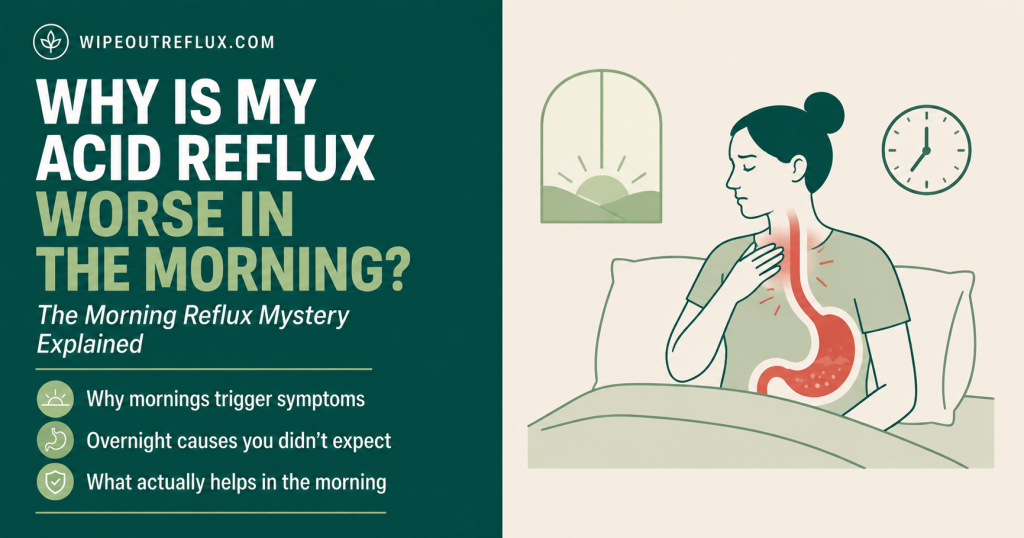
Because morning reflux isn’t a morning problem. It’s last night’s problem, presenting late.
Here’s the core of it. Standing up, your oesophagus clears an acid reflux episode in about 59 seconds. Lying down, it takes 137 seconds — and asleep it’s slower still, because clearance depends on swallowing saliva and you barely swallow when you’re unconscious. So every episode overnight lasts several times longer than the same episode would during the day. You then spend seven or eight hours accumulating that damage, and meet the result at 6am.
Two other things stack on top. Your stomach’s acid output follows a circadian rhythm that runs highest overnight rather than in the morning. And if you take a PPI, acid tends to break through around seven and a half hours after your evening dose — which, for most people, lands squarely in the small hours.
The useful part is that what time your symptoms hit tells you which mechanism is driving them, and each one has a different fix. There’s a section on that below.
Key Takeaways
- Acid clearance takes 58.6 seconds upright but 136.7 seconds lying down, and longer again during sustained sleep.
- Clearance depends on swallowed saliva neutralising the residual acid film — and you swallow very little while asleep.
- Gastric acid secretion follows a circadian rhythm that is higher in the evening and night than in the morning.
- On twice-daily PPIs, nocturnal acid breakthrough occurs in around three-quarters of people, at a median of 7.5 hours after the evening dose.
- Morning throat symptoms usually mean pepsin deposited overnight — which your first coffee or orange juice then reactivates.
- Taking omeprazole at the wrong time is a common and easily fixed cause of morning symptoms. It needs to be 30 to 60 minutes before breakfast.
- In sleep apnoea patients, CPAP cut oesophageal acid exposure from 6.3% of the night to 0.1% — so morning reflux plus snoring is worth investigating.
- Almost every fix for morning reflux happens the night before, not in the morning.
Reason 1: you spent eight hours unable to clear acid
This is the biggest one by a distance, and it’s worth understanding properly because everything else follows from it.
Clearing acid from your oesophagus happens in two stages. First, one or two peristaltic contractions push the volume back down — that part is quick and efficient. Then the thin film of acid left clinging to the lining has to be neutralised, and the only thing that does that is swallowed saliva. In the classic experiment, oesophageal pH doesn’t begin to rise until the first swallow arrives about 30 seconds later. Stimulate saliva and clearance speeds up; remove saliva and it essentially stops Helm et al., The New England Journal of Medicine, 1984.
Now apply that to being asleep. You’re horizontal, so gravity isn’t helping the first stage. And you’re barely swallowing, so the second stage — the part that actually neutralises the acid — is running at a fraction of its daytime rate.
The measured effect is large. Mean acid clearance time is 58.6 seconds upright versus 136.7 seconds recumbent Vikneswaran and Murray, BMC Gastroenterology, 2016. And when researchers instilled acid into the oesophagus of normal subjects while asleep rather than merely lying down, clearance was significantly slower again — speeding up the more the person woke Orr et al., Digestive Diseases and Sciences, 1981.
So: same reflux event, several times the exposure. Repeat across a night. That’s why night-time reflux causes disproportionate damage, and why you wake up feeling it. The saliva and bicarbonate system that protects you all day essentially clocks off at bedtime.
Reason 2: your stomach is at its most acidic overnight
Most people assume acid production tracks meals, so an empty overnight stomach should be quiet. It isn’t.
Unstimulated gastric acid secretion follows a circadian rhythm, and it runs higher in the evening and through the night than it does in the morning Moore and Englert, Nature, 1970.
Which is a genuinely unfortunate piece of design. Peak acid output coincides almost exactly with the window in which you’re least able to clear it, least able to feel it, and lying flat.
And if you’re on a PPI, there’s a specific gap
This one explains a lot of frustrated people.
Nocturnal acid breakthrough is defined as intragastric pH below 4 for at least 60 continuous minutes overnight, despite twice-daily acid suppression. In people taking PPIs twice daily, breakthrough lasting over an hour occurred in roughly three-quarters of individuals, at a median of 7.5 hours after the evening dose Peghini et al., The American Journal of Gastroenterology, 1998.
Do the arithmetic. Evening dose at 6pm, breakthrough around 1:30am. Dose at 7pm, breakthrough around 2:30am. Either way it lands in the hours before you wake — and it’s happening while you’re horizontal and not swallowing.
So “my medication works fine all day but I still wake up with it” isn’t you imagining things or the drug failing. It’s a known pharmacological gap with a name.
Reason 3: there’s nothing in your stomach to buffer it
Food absorbs and dilutes acid. After eight hours without eating, there’s nothing there but acid and whatever bile has refluxed back from the duodenum.
This is why some people get their worst symptoms on a completely empty stomach, which feels counterintuitive if you’ve been told reflux is about food — I’ve written about that specific pattern in heartburn when you haven’t eaten.
Reason 4: standing up moves everything
You’ve spent the night with refluxate pooled in your oesophagus and, if you have LPR, sitting on your larynx. Then you sit up, stand, bend to put socks on, and go and brush your teeth.
Each of those is a change in pressure and position, and it’s why so many people describe the same sequence: fine while lying still, then a burst of throat clearing, coughing or burning within a few minutes of getting up. Brushing your teeth and the gag reflex it sometimes triggers is a common flashpoint. So is the first bend at the waist.
Reason 5: the pepsin trap — why throats are worst in the morning
If your symptoms are throat-based rather than heartburn — hoarseness, a lump sensation, thick mucus, endless clearing — this is almost certainly your mechanism, and it’s the one I’d most want you to understand.
Pepsin is the stomach’s protein-digesting enzyme. When reflux reaches your throat, pepsin comes with it and lodges in the tissue, where it can sit for hours. Crucially, it becomes dormant at neutral pH but doesn’t wash away — and it reactivates whenever acid arrives, from any source.
Now picture your night. Reflux reaches your larynx repeatedly, depositing pepsin. By morning, that tissue is loaded with dormant enzyme.
Then you get up and have coffee. Or orange juice. Both are strongly acidic, and both pass directly over the tissue where the pepsin is waiting. That’s the reasoning behind the pH 5 threshold used in low-acid dietary approaches for stubborn LPR rather than GERD — dietary acid reactivates deposited pepsin Koufman, Annals of Otology, Rhinology and Laryngology, 2011.
So the classic pattern — wake up with a slightly rough throat, have breakfast, feel dramatically worse by 9am — isn’t the breakfast causing new reflux. It’s the breakfast switching on damage that was deposited overnight. Which is a completely different problem, and why swapping to a less acidic first drink often produces a bigger improvement than people expect. It’s also worth reading how pepsin reactivation actually works and how to neutralise it.
Reason 6: you might be taking your medication at the wrong time
Common, consequential, and free to fix.
Proton pump inhibitors only disable proton pumps that are actively secreting. Pumps are activated by a meal. So the drug has to be present in your blood at the moment your pumps switch on — which means 30 to 60 minutes before your first meal of the day, not with it, not after it, and not at bedtime.
Taken at the wrong time, a PPI can lose a substantial fraction of its effect. If you take yours at night or with breakfast and your mornings are bad, change that before concluding the drug doesn’t work — the detail is in when to take omeprazole. And bear in mind it takes around three days of consistent dosing to reach full effect, so don’t judge the change overnight; how long omeprazole takes to work covers that.
Reason 7: sleep apnoea
Worth taking seriously if the picture fits, because it’s frequently missed and the treatment is dramatic.
In obstructive sleep apnoea, each obstructed breath generates strongly negative pressure inside the chest as you strain against a closed airway. That pressure gradient effectively draws stomach contents upward.
When six patients with sleep apnoea and regular nocturnal reflux were treated with nasal CPAP, mean oesophageal acid exposure fell from 6.3% of the night to 0.1%. In the same study, the 30 seconds before a sharp drop in oesophageal pH were characterised by lower nadir intrathoracic pressure and more frequent arousal, movement and swallowing — though the researchers couldn’t tie reflux events directly to individual apnoeas Kerr et al., Chest, 1992.
It’s a small study, but a fall from 6.3% to 0.1% is not a subtle result.
Worth asking about if you have morning reflux plus any of: loud snoring, witnessed pauses in breathing, waking with a dry mouth or headache, daytime sleepiness, or waking up choking or gasping. The two conditions overlap heavily and each makes the other worse — more in sleep apnoea and acid reflux.
Reason 8: what you did last night
The obvious one, but with a detail people miss: the damage is delayed.
In healthy volunteers given 120 ml of scotch after their evening meal, seven of seventeen had prolonged reflux episodes averaging 47 minutes. Those episodes began around three and a half hours after the drink, and more than an hour after lying down. None occurred on control nights Vitale et al., Journal of the American Medical Association, 1987.
So the 9pm glass of wine doesn’t cause symptoms at 9pm. It causes them at 2am, and you notice at 7am. Same with a late, large or fatty dinner — the stomach is still full when you lie down, which is the entire argument for leaving three to four hours between eating and bed.
What time does it hit? A quick guide
Pay attention to the timing for a week — it’s genuinely diagnostic.
- You wake in the night, 1–4am, burning. Nocturnal acid breakthrough or peak circadian acid output. Look at PPI timing, whether a bedtime alginate helps, and how late you’re eating.
- Fine in the night, symptoms present the moment you wake. Accumulated overnight exposure. Bed elevation, left-side sleeping and earlier dinner are your levers.
- Fine on waking, bad within minutes of getting up. Mechanical — position and pressure moving pooled refluxate. Get up slowly, avoid bending, sip water before anything else.
- Fine until breakfast, then much worse. Pepsin reactivation if it’s throat symptoms, or a trigger food if it’s heartburn. Look hard at coffee and juice.
- Builds through the morning. More likely an empty-stomach or medication-timing issue than an overnight one.
- Every morning regardless, plus snoring and daytime sleepiness. Ask about sleep apnoea.
What to change — tonight, not tomorrow morning
Roughly in order of impact:
- Finish eating and drinking 3–4 hours before bed. The single highest-yield change, and it costs nothing.
- Raise the head of the bed 6 to 8 inches. Actually raise the bed — blocks under the legs or a proper wedge. Extra pillows bend you at the waist and can make things worse. See how to raise the head of your bed and wedge pillow options.
- Sleep on your left side. Measurably faster acid clearance than right side or supine, for free — the reasoning is in best sleeping position.
- No alcohol in the evening. Remember the 47 minutes, and that it arrives hours later.
- Consider an alginate after your evening meal. It forms a physical raft rather than suppressing acid, which suits a predictable overnight window — Gaviscon Advance is the usual choice.
- Fix your PPI timing. 30 to 60 minutes before breakfast.
- Change your first drink. Water before anything acidic. If you have throat symptoms, this is a bigger lever than it sounds.
- Rethink breakfast if it’s a trigger. There are reflux-friendly options that don’t set the day off badly — though note that even oatmeal doesn’t suit everyone.
Notice that seven of those eight happen before you go to sleep. That’s the point of the article.
Conclusion
Morning reflux is overnight reflux that you only became aware of when you woke up. The numbers make the case on their own: 59 seconds to clear an episode standing, 137 lying down, longer still asleep, across eight hours, while your stomach is at its circadian peak and — if you’re medicated — acid is breaking through around 7.5 hours after your evening dose. Nothing about that is a morning problem.
Which is good news, because it means the fixes are all things you do the night before, and most of them are free. Eat earlier, raise the bed, sleep on your left, skip the evening drink, and get your medication timing right. If your symptoms are throat-based, add one more: don’t put coffee or juice onto a larynx that spent the night collecting pepsin. That single change has surprised a lot of people.
Choosing a first drink and a breakfast that don’t reactivate what’s already there is exactly the kind of decision the Wipeout Food Reference Guide is built for — the essential reference for what’s allowed with acid reflux and LPR, with the pH value of each food and drink, so you can see instantly what sits above the pH 5 line and what doesn’t.
And if mornings are just the sharpest edge of a problem that runs all day, the Wipeout Diet Plan is the fuller approach — what to change in what order, how long to give each phase, and how to handle the overnight window specifically. I built it around LPR and silent reflux, the throat-based form where mornings are usually worst, but because it targets the same underlying mechanisms it works just as well for GERD and ordinary heartburn.
Frequently Asked Questions
Why is my acid reflux worse in the morning?
Mostly because of what happened overnight. Acid clearance takes 58.6 seconds upright but 136.7 seconds lying down, and longer while asleep because you barely swallow. Add peak circadian acid output overnight and an empty stomach with nothing to buffer it, and you wake up with the accumulated result.
Why do I wake up at 2am with heartburn?
Two likely reasons. Gastric acid secretion peaks overnight rather than in the morning. And if you take a PPI twice daily, nocturnal acid breakthrough affects around three-quarters of people at a median of 7.5 hours after the evening dose — which lands in the early hours.
Why is my throat worse in the morning?
Overnight reflux deposits pepsin in your throat tissue, where it sits dormant. It reactivates when acid arrives — including from your first coffee or orange juice. That’s why many people wake slightly rough and feel much worse after breakfast: the breakfast isn’t causing new reflux, it’s switching on damage already there.
Should I eat breakfast if I have morning reflux?
Usually yes — food buffers acid on an empty stomach. What matters is what you eat and drink. Start with water rather than coffee or juice, keep the first meal modest and low in fat, and see whether that changes things before deciding breakfast is the problem.
Can sleep apnoea cause morning acid reflux?
It can contribute significantly. Obstructed breaths generate strongly negative chest pressure that draws stomach contents upward. In one study, CPAP reduced oesophageal acid exposure from 6.3% of the night to 0.1%. Worth investigating if you also snore heavily, wake with a dry mouth or headache, or are sleepy during the day.
Does what time I take omeprazole matter?
Considerably. PPIs only disable pumps that are actively secreting, and pumps are switched on by eating, so the drug needs to be in your bloodstream when you eat. Take it 30 to 60 minutes before breakfast — not with food, not afterwards, and not at bedtime.
Why does brushing my teeth trigger reflux in the morning?
Partly mechanical — bending over the sink raises abdominal pressure — and partly the gag reflex, which can provoke a reflux episode directly. If it’s a reliable trigger, try brushing standing upright, waiting 20 to 30 minutes after getting up, and using a smaller brush head.
Will raising the head of my bed actually help?
It’s one of the few lifestyle measures with reasonable evidence behind it. Raise the whole bed 6 to 8 inches with blocks, or use a proper wedge. Extra pillows are counterproductive because they bend you at the waist and increase abdominal pressure.
Research & References
- Study of acid clearance from the oesophagus showing a two-stage process in which peristalsis removes essentially all refluxate volume and residual acid is then neutralised by swallowed saliva, with oesophageal pH not rising until the first swallow arrives, salivary stimulation shortening clearance and saliva aspiration abolishing it Helm et al., The New England Journal of Medicine, 1984.
- pH-impedance analysis reporting mean acid clearance times of 58.6 seconds in the upright position versus 136.7 seconds recumbent, against an overall mean of 98.7 seconds Vikneswaran and Murray, BMC Gastroenterology, 2016.
- Study instilling hydrochloric acid into the oesophagus of normal subjects while recumbent and awake versus asleep, finding acid clearance times significantly prolonged during sustained sleep and shortening as wakefulness increased Orr et al., Digestive Diseases and Sciences, 1981.
- Study establishing a circadian rhythm of unstimulated gastric acid secretion in humans, with secretion higher during the evening and night than during the morning Moore and Englert, Nature, 1970.
- Study of nocturnal recovery of gastric acid secretion in subjects taking proton pump inhibitors twice daily, finding nocturnal acid breakthrough of more than one hour in approximately three-quarters of individuals, at a median of 7.5 hours after the evening dose Peghini et al., The American Journal of Gastroenterology, 1998.
- Study of 6 patients with obstructive sleep apnoea and regular nocturnal reflux, finding that nasal CPAP reduced mean oesophageal acid exposure from 6.3 ± 2.1% to 0.1 ± 0.1% of the recording period, with lower nadir intrathoracic pressure and more frequent arousal, movement and swallowing in the 30 seconds preceding sharp falls in oesophageal pH, though no direct association with individual obstructive apnoeas was identified Kerr et al., Chest, 1992.
- Ambulatory pH monitoring study in 17 healthy volunteers finding that 120 ml of scotch whisky taken after the evening meal impaired supine oesophageal acid clearance, with 7 of 17 subjects experiencing prolonged reflux episodes averaging 47 minutes beginning around three and a half hours after ingestion, none of which occurred on control nights Vitale et al., Journal of the American Medical Association, 1987.
- Study of a low-acid diet in recalcitrant laryngopharyngeal reflux, using a pH 5 threshold on the basis that pepsin deposited in laryngeal tissue can be reactivated by hydrogen ions from ingested acid Koufman, Annals of Otology, Rhinology and Laryngology, 2011.

David Gray
12 years living with LPR · Consultant & researcher
I've lived with LPR for twelve years — the misdiagnoses, the PPI courses that did nothing, the slow work of figuring out what actually helps. Wipeout Reflux is where I translate the research into plain terms for people stuck in the same place. Every claim here is sourced to peer-reviewed work, and I consult one-to-one with LPR sufferers.