
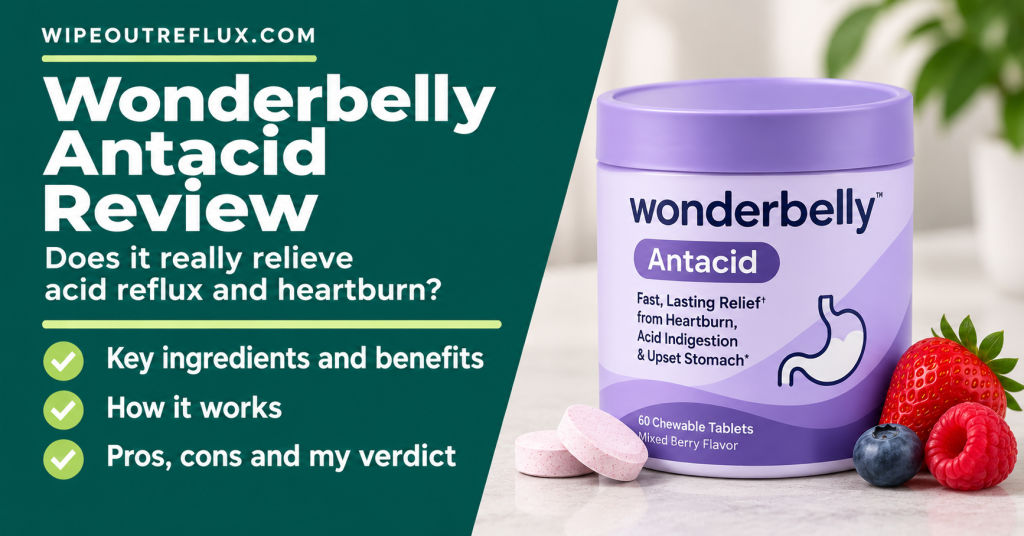
Wonderbelly antacid works, and it works the same way Tums does. Each chewable tablet contains 1,000 mg of calcium carbonate, which is the same active ingredient and the same dose as Tums Ultra Strength. The differences are in the inactive ingredients and the flavors: no artificial dyes, artificial sweeteners, talc or titanium dioxide, and dessert-style flavors like Strawberry Milkshake and Lemon Sorbet. It’s a good-quality antacid for occasional heartburn. It isn’t stronger than Tums, it still contains sugar, and like any antacid it only gives short-term relief.
Wonderbelly has grown fast, especially on social media, and the obvious question is whether it’s better than the regular drugstore options. Below I compare what’s actually in it with Tums, how long the relief lasts, who should be careful with calcium carbonate, and where it fits if your reflux is silent reflux rather than occasional heartburn.
Key Takeaways
- Wonderbelly Maximum Strength contains 1,000 mg of calcium carbonate per chewable tablet, the same as Tums Ultra Strength.
- Its selling point is its inactive ingredients: corn starch, natural flavors, sucrose, vegetable cellulose and vegetable magnesium stearate, with no dyes, artificial sweeteners, talc or titanium dioxide.
- It contains sugar (sucrose), so it isn’t sugar-free.
- Calcium carbonate starts neutralizing acid within minutes, but the effect lasts only about an hour.
- The label maximum is 7 tablets in 24 hours, and not at the maximum dose for more than 2 weeks without a doctor’s advice.
- Regular heavy use of calcium carbonate can cause milk-alkali syndrome, so count it toward your total calcium intake.
- It’s fine for occasional heartburn. For frequent heartburn, night-time reflux or silent reflux (LPR), an antacid alone isn’t enough.
- Its typical price is around $12 for 60 tablets, more per tablet than store-brand calcium carbonate.
What’s in Wonderbelly?
According to its Drug Facts label, Wonderbelly Maximum Strength Antacid contains:
- Active ingredient: calcium carbonate 1,000 mg per tablet (400 mg of elemental calcium)
- Inactive ingredients: corn starch, natural flavors, sucrose, vegetable cellulose, vegetable magnesium stearate
[Wonderbelly Maximum Strength Antacid label]
The brand markets it as free from artificial dyes, artificial sweeteners, talc, titanium dioxide and parabens, and as vegan, gluten-free and non-GMO. Flavors include Strawberry Milkshake, Lemon Sorbet, Tropical Fruit, Vanilla Bean and Sweet Mint, among others. It’s sold in 60-count bottles and smaller travel packs at major US retailers.
Wonderbelly vs Tums
| Wonderbelly Maximum Strength | Tums Ultra Strength | |
|---|---|---|
| Active ingredient | Calcium carbonate 1,000 mg | Calcium carbonate 1,000 mg |
| How it works | Neutralizes stomach acid | Neutralizes stomach acid |
| Artificial dyes | No | Yes, in many colored flavors |
| Talc | No | Yes, in many versions |
| Sugar | Yes (sucrose) | Yes in standard versions; sugar-free options exist |
| Label maximum | 7 tablets in 24 hours | Check your product’s label |
| Price | Higher per tablet | Lower, especially store brands |
The bottom line: for relieving heartburn, Wonderbelly and Tums Ultra Strength are pharmacologically identical. You’re paying for the cleaner inactive-ingredient list and the flavors. If avoiding dyes and talc matters to you, or you simply prefer the taste, that’s a reasonable choice. If not, a store-brand 1,000 mg calcium carbonate tablet does the same job for less. See are Tums safe for acid reflux?
How Well Does It Work?
Calcium carbonate is a base that chemically neutralizes acid already in your stomach, so it works fast. In a carefully controlled study, calcium carbonate (as Tums) began neutralizing acid within 30 minutes of a meal, but its effect lasted only about 60 minutes. By comparison, famotidine took about 90 minutes to start working but lasted at least 9 hours [Feldman, JAMA, 1996].
For real heartburn episodes, a 565-person trial found that an antacid relieved 62% of episodes, compared with 41% for placebo [Simon et al., American Journal of Therapeutics, 1995]. So antacids genuinely help, but they’re best for occasional, short-lived heartburn.
If you need longer relief, see Pepcid AC vs Pepcid Complete, which pairs an antacid with famotidine. If your reflux is worse lying down, an alginate such as Gaviscon Advance forms a protective raft that physically blocks reflux. See Tums vs Gaviscon.
How to Take Wonderbelly
- Chew 1 to 2 tablets as symptoms occur, following the directions on your pack.
- Don’t take more than 7 tablets in 24 hours.
- Don’t use the maximum dose for more than 2 weeks except under a doctor’s advice.
- Space it at least 2 hours from other medicines, because antacids can reduce the absorption of some drugs, including certain antibiotics, thyroid medication and iron. Ask a pharmacist if you take prescription medicines.
Side Effects and Who Should Be Careful
Common side effects
- Constipation: calcium tends to slow the bowels
- Gas and burping: calcium carbonate releases carbon dioxide as it neutralizes acid. See do antacids cause burping and gas?
Too much calcium
Taking large amounts of calcium carbonate regularly can cause milk-alkali syndrome: high blood calcium, alkalosis and kidney injury. It became one of the leading causes of hospital admissions for high calcium as calcium carbonate was promoted for heartburn and bone health [Beall & Scofield, Medicine, 1995]. At 400 mg of elemental calcium per tablet, the label maximum of 7 tablets is 2,800 mg of calcium a day, before you count food or supplements. Occasional use is fine, but it’s not something to chew all day, every day.
Check with your doctor first if you
- Have kidney disease or a history of kidney stones
- Take calcium or vitamin D supplements
- Take prescription medicines
- Have diabetes and are watching sugar intake (Wonderbelly contains sucrose)
- Find you need an antacid on most days
Pregnancy
Calcium carbonate antacids are among the most commonly used heartburn treatments in pregnancy, but check with your provider and stay within the label maximum. See can you take Tums while pregnant? and which antacids are safe in pregnancy?
Is Wonderbelly Good for Silent Reflux (LPR)?
Only to a limited extent. With silent reflux, the damage comes from stomach contents, including pepsin, reaching the throat, often without heartburn. An antacid neutralizes acid in the stomach for about an hour, but it doesn’t stop reflux from happening, and it doesn’t touch pepsin already lodged in throat tissue.
The flavors are worth a mention too. Some, like Lemon Sorbet, are designed to taste citrusy, and mint can relax the lower esophageal sphincter in some people. If you have LPR, a neutral flavor such as vanilla is the safer pick. For LPR, the more useful tools are an alginate after meals and at bedtime, and a low-acid diet. See the LPR diet.
My Verdict
Good for: occasional heartburn, people who want to avoid dyes, talc and artificial sweeteners, and anyone who finds standard antacids unpleasant to chew.
Not better than: Tums Ultra Strength or a store-brand 1,000 mg calcium carbonate tablet in terms of effectiveness. It’s the same medicine.
Not enough for: frequent heartburn, night-time reflux or silent reflux. If you’re reaching for antacids most days, the antacid is masking a pattern that needs a different approach.
Conclusion
Wonderbelly is a well-made calcium carbonate antacid with a cleaner ingredient list and nicer flavors than most drugstore brands. It’s the same active ingredient at the same 1,000 mg dose as Tums Ultra Strength, so it relieves heartburn just as quickly and for just as short a time. It still contains sugar, and calcium carbonate shouldn’t be used heavily day after day.
If you only get heartburn now and then, it’s a perfectly good choice. If you need it regularly, the bigger win is reducing how much reflux you have in the first place, and that comes down mostly to what and when you eat. The Wipeout Diet Plan gives you a step-by-step, low-acid way to eat that cuts reflux at the source. I built it around LPR, the hardest form of reflux to control, and it works just as well for GERD and everyday heartburn.
Frequently Asked Questions
Is Wonderbelly better than Tums?
Not in effectiveness. Both use 1,000 mg of calcium carbonate in their strongest versions. Wonderbelly’s advantages are its inactive ingredients (no dyes, talc or artificial sweeteners) and its flavors.
What is the active ingredient in Wonderbelly?
Calcium carbonate, 1,000 mg per tablet in the Maximum Strength version.
Does Wonderbelly contain sugar?
Yes. Sucrose is listed among the inactive ingredients, so it isn’t sugar-free.
How many Wonderbelly tablets can I take in a day?
No more than 7 tablets in 24 hours, and not at the maximum dose for more than 2 weeks unless a doctor advises it.
Is Wonderbelly safe during pregnancy?
Calcium carbonate antacids are commonly used in pregnancy, but ask your provider first and stay within the label limits.
How fast does Wonderbelly work?
Within minutes, because it neutralizes acid directly. The effect usually lasts about an hour.
Does Wonderbelly help with gas and bloating?
The antacid version doesn’t treat gas, and calcium carbonate can cause burping. Wonderbelly also sells a separate bloat and gas product with different ingredients.
Research & References
- The US Drug Facts label for Wonderbelly Maximum Strength Antacid, listing calcium carbonate 1,000 mg per tablet, the inactive ingredients, and the 7-tablet daily maximum [Wonderbelly Maximum Strength Antacid label].
- A randomized, double-blind crossover trial finding that calcium carbonate neutralized acid within 30 minutes but lasted about 60 minutes, while famotidine began after about 90 minutes and lasted at least 540 minutes [Feldman, JAMA, 1996].
- A randomized, placebo-controlled trial of 565 people with episodic heartburn finding that an antacid relieved 62% of episodes, compared with 41% for placebo [Simon et al., American Journal of Therapeutics, 1995].
- A case series and prevalence estimate showing that milk-alkali syndrome from calcium carbonate became a leading cause of hospitalization for hypercalcemia [Beall & Scofield, Medicine, 1995].

David Gray
12 years living with LPR · Consultant & researcher
I've lived with LPR for twelve years — the misdiagnoses, the PPI courses that did nothing, the slow work of figuring out what actually helps. Wipeout Reflux is where I translate the research into plain terms for people stuck in the same place. Every claim here is sourced to peer-reviewed work, and I consult one-to-one with LPR sufferers.