
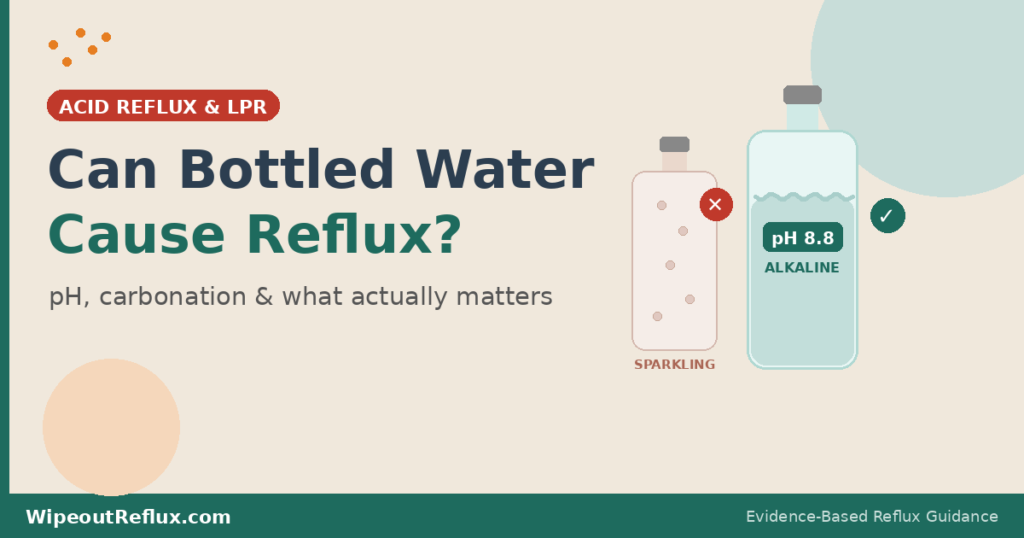
Plain still bottled water does not cause acid reflux in any direct sense — it contains no acid, no fat, and no compounds that relax the lower esophageal sphincter. But there are specific situations where drinking water, including bottled water, can worsen reflux symptoms. And the type of water you choose — its pH, whether it’s carbonated, and how much you drink at once — matters more than most people realise.
If you have acid reflux, GERD, or especially LPR (silent reflux), the pH of your drinking water is worth paying attention to — and the research on this is genuinely compelling.
Key Takeaways
- Plain still bottled water does not directly cause acid reflux, but drinking large amounts quickly — especially during or just after eating — can expand the stomach and trigger reflux episodes.
- Most bottled waters have a pH of around 6.5–7.5, which is close to neutral and won’t significantly affect reflux either way.
- Alkaline water at pH 8.8 has been shown in research to irreversibly inactivate pepsin — the enzyme responsible for tissue damage in LPR and GERD — making it a potentially valuable adjunct for reflux sufferers.
- Carbonated water reduces lower esophageal sphincter (LES) pressure by 30–50% for up to 20 minutes after drinking, making it a more significant concern for reflux than plain water.
- Flavoured water often contains citric acid, which can have a pH as low as 2.5–3 — this is far more likely to worsen reflux symptoms than any plain water.
- Drinking water very cold may irritate an already-inflamed throat lining in LPR sufferers — room temperature water is generally better tolerated.
- The best bottled water choice for acid reflux or LPR is a still, alkaline water with a pH of 8 or higher, consumed in moderate amounts and not gulped rapidly during meals.
Can Bottled Water Cause Acid Reflux?
The short answer is that plain still bottled water is very unlikely to cause or worsen acid reflux by itself. Unlike coffee, alcohol, tomatoes, or citrus, water contains nothing that triggers acid production, relaxes the LES, or irritates the esophageal lining.
That said, there are specific circumstances where water consumption — including from a bottle — can contribute to reflux symptoms. Understanding these situations helps you avoid them without unnecessarily limiting your hydration.
When Bottled Water Can Worsen Reflux
Drinking Too Much During or After Eating
The most common water-related cause of reflux is drinking large volumes during or immediately after a meal. When the stomach fills — with food, liquid, or both — it distends and the pressure inside rises. That increased intragastric pressure pushes against the lower esophageal sphincter (LES), the muscular valve that keeps stomach contents from rising back up. When the pressure gets high enough, the LES can be forced open, allowing acid and pepsin to reflux upward.
Research has confirmed this mechanism directly: larger liquid volumes are associated with significantly more reflux episodes and greater total acid exposure time compared to smaller, more frequent portions [Wu et al., Journal of Gastroenterology and Hepatology, 2014]. This applies to water just as it does to food — the stomach doesn’t distinguish between the two when it comes to volume and pressure.
The practical fix: avoid drinking large glasses of water during meals. Small sips are fine. Save larger amounts for between meals, at least 20–30 minutes before or after eating.
Drinking Water Too Quickly
Drinking a large amount of water in a short window — a full glass in under a minute, for example — can rapidly expand the stomach and spike intragastric pressure in much the same way that a large meal does. This is especially relevant for people with GERD or LPR whose LES is already more prone to inappropriate relaxation.
Sipping water slowly over time is far less likely to cause a problem than gulping it down in one go. If you’re thirsty and want to rehydrate quickly, spreading it across 10–15 minutes rather than consuming it all at once significantly reduces the reflux risk.
The pH of Your Bottled Water
This is a factor most people never consider — and for people with LPR in particular, it’s worth understanding properly.
Most bottled and tap waters sit at a pH of around 6.5–7.5, which is close to neutral. At this pH range, water has very little effect on pepsin stability and is essentially neutral for reflux purposes. It won’t actively help your reflux, but it won’t worsen it either.
However, if you switch from a higher-pH water to a more acidic one without realising, that shift can matter. Because the pH scale is logarithmic, a water at pH 6 is 10 times more acidic than one at pH 7, and 100 times more acidic than one at pH 8. For most people this makes little difference, but for those with sensitive or severe reflux — particularly LPR — even this change in their usual water source can occasionally worsen symptoms.
Always check the label of bottled water for its pH. Most brands list it, and it’s worth knowing whether you’re drinking something acidic or alkaline.
Cold Water and Throat Irritation
If you have LPR — where reflux reaches and irritates the throat, larynx, and voice box — very cold drinks can aggravate an already inflamed tissue lining. The immediate sensation may feel soothing, but cold liquid can cause a reflex constriction and leave the mucosal lining more sensitive and reactive in the short period that follows.
This isn’t universal — some people find cold water helpful during a reflux episode — but if you’ve noticed that icy drinks seem to worsen your throat symptoms, switching to room temperature water is a simple and worthwhile adjustment. For more on how LPR affects the throat and what helps, see my complete guide to LPR.
Alkaline Water and Acid Reflux: What the Research Shows
This is where the bottled water and reflux story gets genuinely interesting — especially for LPR sufferers.
Pepsin is the enzyme that causes much of the mucosal damage in reflux disease. In GERD, it damages the esophageal lining. In LPR, it damages the larynx, throat, and vocal cords. Pepsin remains stable at neutral pH and can be reactivated by any acidic food or drink — even a single sip of something below pH 5 can trigger it to resume its damaging enzymatic activity in tissue where it shouldn’t be.
A key study published in the Annals of Otology, Rhinology & Laryngology found that water at pH 8.8 irreversibly inactivated human pepsin — permanently denaturing it so it could no longer cause harm — while also demonstrating far superior acid-buffering capacity compared to conventional-pH waters [Koufman & Johnston, Annals of Otology, Rhinology & Laryngology, 2012]. This means that alkaline water at pH 8.8 doesn’t just fail to worsen reflux — it may actively help by neutralising pepsin already present in the throat and esophagus.
This makes the choice of bottled water much more relevant than most articles suggest. Switching from a pH 6.5–7 water to a pH 8–9 alkaline water is one of the simplest, lowest-effort dietary changes a person with LPR or GERD can make. For more on this, see my dedicated article on alkaline water for acid reflux and LPR.
Is Mineral Water Good for Acid Reflux?
Mineral water is generally a good choice for acid reflux, with one important detail: check the pH. Natural mineral waters vary considerably — some are mildly acidic (around pH 5.5–6.5), while others, particularly bicarbonate-rich sparkling or still mineral waters, can be alkaline (pH 7.5–8.5).
Bicarbonate-rich mineral waters are the most beneficial for reflux because bicarbonate actively buffers acid in the stomach and esophagus. Still mineral water with high bicarbonate content — rather than sparkling — is the better choice for reflux since it avoids the carbonation issue discussed below.
If you’re buying mineral water, look at the label for pH and bicarbonate content. A pH above 7.5 combined with meaningful bicarbonate (above 1,000 mg/L) indicates a water that may actively support reflux management rather than simply being neutral.
Carbonated Water and Acid Reflux
Sparkling and carbonated water deserves its own section because it behaves very differently to still water when it comes to reflux.
Research has shown that carbonated beverages produce a sustained reduction of 30–50% in lower esophageal sphincter pressure and length lasting up to 20 minutes after consumption [Boulant et al., Journal of Clinical Gastroenterology, 2006]. In 62% of volunteers tested, this reduction was large enough to push the LES into the range normally considered diagnostically incompetent — meaning the valve was barely functioning as a barrier. Plain still water caused no such reduction.
The carbonation itself — not just the acidity — drives this effect. The CO₂ gas causes gastric distension and belching, which creates upward pressure that can carry acid and pepsin into the esophagus and throat. Plain sparkling water (without flavouring or sweeteners) is less acidic than cola or citrus sparkling drinks, but it still carries this mechanical pressure risk.
If you have GERD or LPR, I’d recommend switching to still water rather than sparkling. It’s one of the easier dietary changes to make and removes a genuine mechanical risk factor for reflux episodes.
Flavoured Water and Acid Reflux
Flavoured water is often marketed as a healthy choice, but from a reflux perspective it’s far more concerning than plain still water. Most commercially flavoured waters contain citric acid as a preservative and flavour enhancer, which can bring the pH down to 2.5–4 — well into the range that activates pepsin and directly irritates the esophageal and laryngeal mucosa.
Always check the ingredients of flavoured water before drinking it. If citric acid, ascorbic acid, or any fruit juice is listed, the product is acidic and should be treated with the same caution as fruit juice. This applies to many “wellness” and vitamin water products too — the health branding doesn’t change the pH.
If you want to flavour your water, adding a thin slice of cucumber or a small piece of fresh ginger is a reflux-safe way to make plain water more interesting without introducing acidity.
Is Bottled Water Acidic?
It depends entirely on the brand and source. Bottled water pH typically ranges from around 5.5 to 9.5, though most mainstream still water brands sit between 6.5 and 7.5. A few well-known examples:
- Evian — approximately pH 7.2
- Volvic — approximately pH 7.0
- Fiji Water — approximately pH 7.3
- Essentia — approximately pH 9.5 (ionized alkaline)
- Smartwater — approximately pH 7.0
- Acqua Panna — approximately pH 8.0
The pH is usually listed on the bottle’s label or on the brand’s website. For acid reflux and especially LPR, aim for still water with a pH of 8 or above where possible.
Final Thoughts
Plain still bottled water does not cause acid reflux — but how you drink it, how much you drink at once, and what type of water you choose can all influence your symptoms. The key practical points: drink water slowly and between meals rather than during them, avoid carbonated and flavoured waters if your reflux is significant, and consider switching to an alkaline still water with a pH of 8 or above — particularly if you have LPR where pepsin inactivation is a real therapeutic goal.
Water choice is one of the simpler, lower-effort interventions in reflux management, and it’s one that the Wipeout Diet Plan covers in detail alongside everything else — from which foods to eat and avoid, to meal timing, portion strategy, and the dietary patterns that consistently make the biggest difference for LPR and GERD. If you’d like personalised guidance on how these factors apply to your specific situation, feel free to book a one-to-one consultation with me.
Frequently Asked Questions
Does bottled water make acid reflux worse?
Plain still bottled water generally doesn’t worsen acid reflux. The exceptions are: drinking large amounts quickly during or after meals (which distends the stomach), drinking carbonated water (which reduces LES pressure), or drinking flavoured water containing citric acid (which is directly acidic). Choosing a still, alkaline bottled water is the safest and potentially most beneficial option for reflux sufferers.
What pH bottled water is best for acid reflux?
A pH of 8 or above is ideal. At pH 8.8 specifically, research has shown that water can permanently inactivate pepsin — the enzyme responsible for much of the tissue damage in GERD and LPR. Look for still alkaline waters like Essentia (pH 9.5), Acqua Panna (pH 8.0), or locally available alkaline spring waters with pH listed on the label.
Is sparkling water bad for acid reflux?
Sparkling water is more problematic than still water for reflux. The carbonation causes gastric distension and has been shown to reduce LES pressure by 30–50% for up to 20 minutes. This doesn’t mean a single sip of sparkling water will cause a severe flare, but if you’re having regular reflux symptoms, switching to still water is a worthwhile step. For more, check my article on alkaline water and LPR.
Can drinking a lot of water cause acid reflux?
Yes, if consumed too quickly or in large volumes during meals. The mechanism is gastric distension — the stomach expands with liquid volume, increasing internal pressure on the LES until it opens. Drinking water gradually between meals avoids this problem. See my article on drinking a lot of water and acid reflux for more detail.
Is hot water better than cold water for acid reflux?
Room temperature or warm water tends to be better tolerated than icy cold water for people with LPR, where the throat and larynx are already inflamed. Very cold water can irritate the mucosal lining and leave it more reactive. Some people also find hot water soothing. See my article on hot water and acid reflux for a detailed look at this.
Can drinking bottled water cause stomach problems?
In the vast majority of cases, no. If you’ve noticed stomach discomfort after drinking bottled water, the most likely culprits are: drinking too much too quickly, switching to a water with a significantly different pH from your usual, or the water being carbonated or flavoured. Plain still water from a reputable brand is extremely unlikely to cause stomach issues on its own.
Related Articles
- Alkaline Water for Acid Reflux and LPR
- Does Drinking Hot Water Help Acid Reflux?
- Can Drinking a Lot of Water Cause Acid Reflux?
- The Complete Guide to LPR (Silent Reflux)
- The Stomach Sphincter and LPR: Why the Valve Matters
- LPR Foods to Avoid
- The Ultimate Guide to Acid Reflux
Research Sources
pH 8.8 alkaline water irreversibly inactivates human pepsin in vitro and demonstrates significantly greater acid-buffering capacity than conventional-pH waters, suggesting therapeutic benefits for reflux disease [Koufman & Johnston, Annals of Otology, Rhinology & Laryngology, 2012]. Larger liquid meal volumes are associated with significantly more reflux episodes and greater total esophageal acid exposure time compared to smaller volumes, due to gastric fundus distension [Wu et al., Journal of Gastroenterology and Hepatology, 2014].
Carbonated beverages produce a sustained reduction of 30–50% in lower esophageal sphincter pressure and length lasting up to 20 minutes after consumption, an effect not seen with plain still water [Boulant et al., Journal of Clinical Gastroenterology, 2006]. A separate study confirmed that ingestion of a carbonated beverage significantly increases transient lower esophageal sphincter relaxation frequency in healthy subjects [Sankineni et al., Neurogastroenterology & Motility, 2012].

David Gray
12 years living with LPR · Consultant & researcher
I've lived with LPR for twelve years — the misdiagnoses, the PPI courses that did nothing, the slow work of figuring out what actually helps. Wipeout Reflux is where I translate the research into plain terms for people stuck in the same place. Every claim here is sourced to peer-reviewed work, and I consult one-to-one with LPR sufferers.