
Millions of people with a persistent cough, wheezing or breathing difficulties have been told it’s asthma. But a new survey suggests that for a huge number of them, the real cause could actually be acid reflux — a digestive problem most people would never think to connect to their breathing.
If you’ve spent months or years dealing with a cough that won’t go away, wheezing, or a feeling that you can’t quite get enough air — and the asthma treatment you’ve been given hasn’t really done the job — there may be a reason for that.
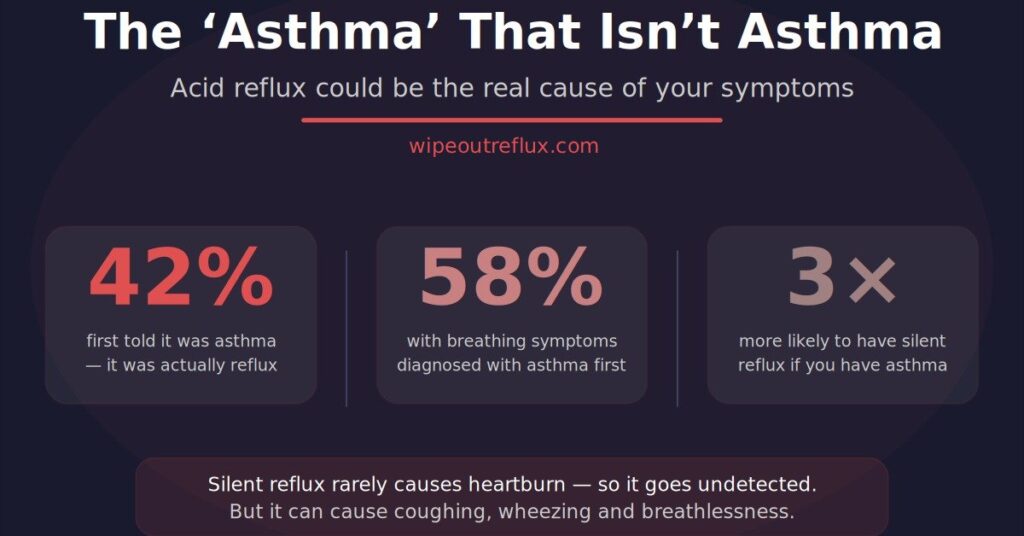
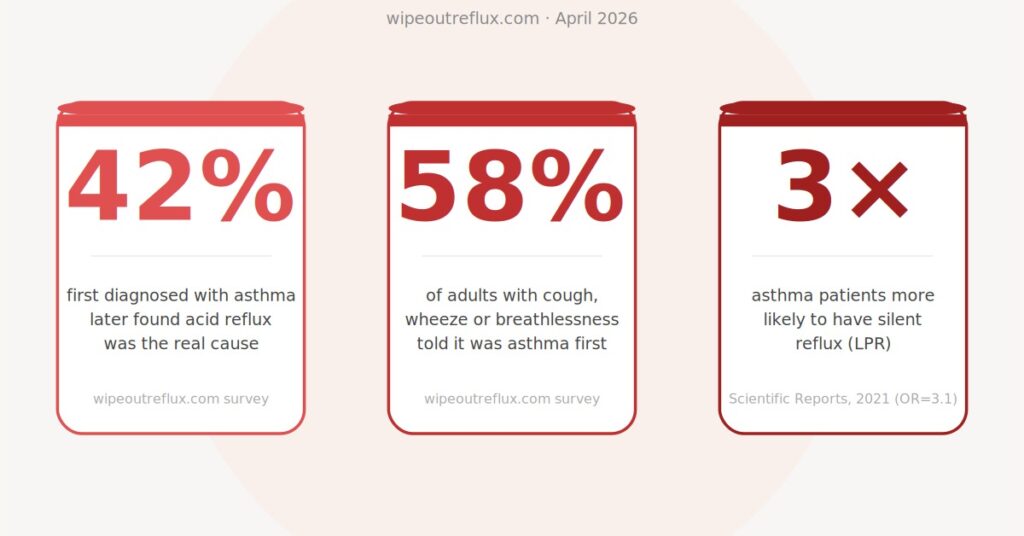
New research from wipeoutreflux.com has found that 42% of people who were first told they had asthma later discovered that acid reflux was actually the real or major cause of their symptoms. And 58% of adults with breathing-related symptoms — coughing, wheezing, shortness of breath — were initially diagnosed with asthma in the first place.
Nearly half of all asthma diagnoses in people with these kinds of symptoms may be missing the real picture.
First — What Actually Is Acid Reflux?
Most people have experienced acid reflux at some point. You eat a big meal, or have a glass of wine, and a while later you feel a burning sensation rising up from your stomach into your chest or throat. That burning is stomach acid travelling in the wrong direction — up, instead of staying where it belongs.
It’s uncomfortable. But for most people it’s occasional, manageable, and goes away on its own or with an antacid.
Now here’s where it gets interesting — and where the confusion with asthma begins.
The Type of Acid Reflux Most People Have Never Heard Of
There is a form of acid reflux that behaves very differently from the classic version. Doctors call it laryngopharyngeal reflux — or LPR for short. Most people call it silent reflux. And the reason it’s called silent is simple: it usually causes no heartburn at all.
With this type of reflux, stomach acid travels further than usual — all the way up past the chest, through the throat, and into the voice box and airway. But because it doesn’t pool in the oesophagus the way classic reflux does, there’s no burning sensation. No obvious sign that acid is involved.
So what do you get instead?
- A persistent dry cough — often worse in the morning or when lying down
- Wheezing or a feeling of tightness in the chest
- Shortness of breath, especially when breathing in
- A hoarse or croaky voice, particularly first thing in the morning
- The constant feeling of something stuck in your throat
- Needing to clear your throat repeatedly throughout the day
- Post-nasal drip — that feeling of mucus running down the back of your throat
Look at that list carefully. These are also the symptoms of asthma.
It is not difficult to understand how, when a patient walks into a GP surgery describing these symptoms, asthma becomes the first — and sometimes only — diagnosis considered.
‘I Spent Years on Inhalers That Didn’t Work’
David Gray, who founded wipeoutreflux.com after struggling for years with undiagnosed silent reflux himself, has spoken to thousands of people who have been through exactly this experience.
“The pattern I see again and again is someone who has been on asthma medication for years, sometimes over a decade, and it’s never really worked properly,” he says. “Their symptoms improve a little but never fully resolve. They keep going back to the GP. The inhaler dose goes up. Nothing fundamentally changes.”
“When these people are eventually assessed for silent reflux, everything starts to make sense. The cough, the wheezing, the breathing difficulty — it was reflux the whole time. And once they address the reflux properly, through diet changes and the right treatment, the respiratory symptoms often improve dramatically. Some people find they don’t need their inhaler at all any more.”
But How Does a Stomach Problem Cause Breathing Symptoms?
This is the question most people ask — and it’s a fair one. It doesn’t seem obvious that something going wrong in your digestive system would show up as a cough or wheezing.
But the connection is well established in medical research, and there are a few different ways it happens.
The nerve link. Your throat, oesophagus and airways all share the same major nerve — the vagus nerve. When acid irritates the oesophagus, it can send a signal through this shared nerve that causes the airways to tighten. The result is a wheeze or feeling of breathlessness — with no acid anywhere near the lungs.
Tiny amounts reaching the airway. With silent reflux, stomach contents travel all the way up to the throat. From there, small amounts can occasionally be breathed in without you realising. These microscopic quantities are enough to irritate and inflame the airway — producing exactly the kind of symptoms associated with asthma.
A knock-on inflammatory effect. The throat and the lungs are more connected than most people realise. When the throat is constantly inflamed by reflux, it can worsen inflammation further down in the airways too. Treating the throat problem can help calm the whole system.
Clinical research backs all of this up. Studies have found that up to 75% of people with asthma also have signs of acid reflux when properly tested — far higher than in the general population. A 2021 study found that asthma patients are approximately three times more likely to have silent reflux than people without asthma. And when reflux is properly treated in people who have both conditions, around 70% see genuine improvement in their breathing symptoms.
There’s a Catch — Some Asthma Medication Makes Reflux Worse
This is the part that makes the situation particularly difficult — and particularly unfair — for people caught in the middle of it.
Some asthma medications, including a common type found in the reliever inhalers that most asthma patients carry, work by relaxing muscles in the airway to help open them up. The problem is that they also relax a small muscle at the top of the stomach — the valve that is supposed to keep acid where it belongs.
In other words: for someone whose breathing symptoms are actually being caused by undiagnosed acid reflux, the medication prescribed to treat what doctors think is asthma can make the reflux worse. Which makes the symptoms worse. Which means the inhaler gets used more. Which makes the reflux worse still.
It’s a cycle that can go on for years — and no one realises what’s happening.
Why Is This Being Missed?
It is a reasonable question. Doctors are, by and large, doing their best. So why is this happening so widely?
Part of the answer is simply that silent reflux is genuinely difficult to recognise. Because it doesn’t cause heartburn — the symptom most people associate with acid reflux — neither patients nor their doctors are thinking about the digestive system when breathing symptoms appear. The presentation looks like a respiratory problem, so it gets treated like one.
Part of the answer is also that awareness of silent reflux among doctors is lower than it should be. A survey of over 500 ear, nose and throat specialists — the doctors most likely to encounter it — found that only one in three felt confident in their knowledge of the condition. If the specialists aren’t sure, GPs working under significant time pressure have even less to go on.
And there is no quick, simple test that can be done in a standard appointment. Properly confirming silent reflux requires specialist equipment. So unless a doctor is specifically looking for it — and knows to look — it tends to get missed.
How to Know If This Could Affect You
You do not need to be a medical expert to get a sense of whether silent reflux might be involved in your symptoms. Ask yourself the following:
- Do you have a cough that has lasted for weeks or months, with no obvious cause?
- Is your voice hoarse or croaky, especially in the morning?
- Do you frequently need to clear your throat?
- Does your breathing difficulty feel more like something is blocking the air coming in, rather than the classic asthmatic difficulty breathing out?
- Have you been on asthma treatment for some time, but your symptoms have never fully resolved?
- Do your symptoms tend to be worse after eating, when lying down, or when you wake up?
If several of these apply to you, it is worth raising the possibility of acid reflux with your GP, and asking whether a referral to an ear, nose and throat specialist might be appropriate.
There is also a free self-assessment tool called the Reflux Symptom Index — a short questionnaire that can give you a clear indication of whether silent reflux is likely to be involved. It takes less than two minutes and is available free at wipeoutreflux.com.
The Good News
If acid reflux turns out to be behind your symptoms, the treatment picture is actually quite encouraging.
Silent reflux responds well to a combination of dietary changes — cutting out the acidic and fatty foods that trigger reflux — alongside the right medication and some simple lifestyle adjustments, like not eating within a few hours of going to bed and raising the head of your bed slightly. A structured resource like the Wipeout Diet Plan, alongside the Wipeout Reflux Food Reference Guide for checking individual foods, takes the guesswork out of that first step.
Many people who have been struggling with respiratory symptoms for years find that once the reflux is properly identified and treated, the breathing problems improve significantly — sometimes completely.
“The thing that frustrates me most about this situation is that the condition is genuinely very manageable once you know what you’re dealing with,” says David Gray. “People are not suffering from something untreatable. They’re suffering from something undiagnosed. Those are very different problems — and the second one has a solution.”
What This Means for the Bigger Picture
Around 5.4 million people in the UK are currently receiving treatment for asthma. In the United States, the figure is around 25 million.
If the survey findings are even broadly representative, the number of people within those populations who are missing a silent reflux diagnosis — or receiving an asthma diagnosis that is incomplete without one — is potentially very large indeed.
This is not about saying asthma is being overdiagnosed, or that doctors are getting it systematically wrong. Asthma is a real condition that affects millions of people and deserves proper treatment. But when the symptoms of acid reflux so closely mirror the symptoms of asthma, and when awareness of silent reflux remains so limited even among specialists, the risk of one being missed behind the other is significant.
For anyone whose breathing symptoms have never quite been explained to their satisfaction — or whose asthma treatment has never quite worked the way it should — it may be time to ask a different question.
Not “how do I manage my asthma better?”
But “is asthma actually what this is?”
David Gray is the founder of wipeoutreflux.com, a resource for people with acid reflux and silent reflux. The site provides free information, a free self-assessment tool, and access to private consultations. Visit wipeoutreflux.com to take the free Reflux Symptom Index test.
Survey note: Data collected by wipeoutreflux.com, April 2026, among adults self-reporting respiratory symptoms including wheezing, chronic cough and/or shortness of breath.
Key clinical sources: Harding SM, Journal of Allergy and Clinical Immunology, 1999; Haddad RI et al., Scientific Reports (Nature), 2021; Awad BI et al., Annals of Otology, Rhinology and Laryngology, 2025; Bayrak AH et al., PubMed PMID 16939995.

David Gray
12 years living with LPR · Consultant & researcher
I've lived with LPR for twelve years — the misdiagnoses, the PPI courses that did nothing, the slow work of figuring out what actually helps. Wipeout Reflux is where I translate the research into plain terms for people stuck in the same place. Every claim here is sourced to peer-reviewed work, and I consult one-to-one with LPR sufferers.