
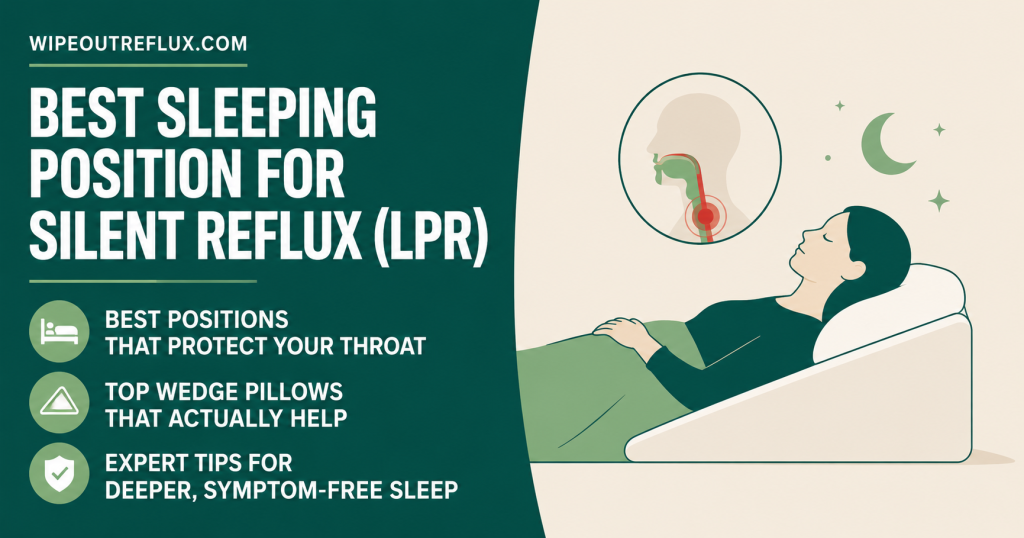
If you have silent reflux (LPR), what happens when you lie down at night matters more than most people realise. Unlike typical acid reflux, LPR sends stomach acid and pepsin all the way up to your throat and voice box—often without any heartburn at all. That makes it notoriously sneaky, and it’s also why your sleeping position can make a dramatic difference to how you feel the next morning.
The short answer: the best sleeping position for silent reflux is on your left side with your head and upper body elevated by at least 6–8 inches. This combination uses gravity to keep acid where it belongs, reduces reflux events during sleep, and has solid clinical research behind it.
In this article, I’ll explain exactly why position matters, walk through what the research says, and recommend five of the best wedge pillows available right now—so you can finally wake up without that familiar burning throat, morning cough, or persistent hoarseness.
Key Takeaways
- The left side is the scientifically supported sleeping position for reducing nocturnal acid reflux and LPR symptoms.
- Sleeping on your right side significantly increases acid exposure to the esophagus and throat.
- Head elevation of 6–8 inches (15–20 cm) is the clinically recommended target for reflux management during sleep.
- Combining left-side sleeping with elevation provides the greatest reduction in nocturnal acid events—research shows up to 71% less exposure compared to sleeping flat.
- Stacked regular pillows collapse and shift overnight and are not an effective substitute for a wedge pillow.
- Silent reflux symptoms—coughing, hoarseness, throat clearing, post-nasal drip—often worsen overnight and first thing in the morning.
- A wedge pillow is one of the most effective drug-free tools for managing LPR at night.
- Positional changes work best alongside a well-structured reflux diet and sensible evening habits.
Why Sleep Position Is Critical for Silent Reflux
Silent reflux—also called laryngopharyngeal reflux (LPR)—is different from typical GERD in one important way: the acid doesn’t just stop at the esophagus. It travels past the upper esophageal sphincter (UES) and reaches the throat, voice box, and sometimes the sinuses. That’s why LPR symptoms are mostly throat-based rather than stomach-based—think chronic cough, hoarseness, constant throat clearing, a sensation of something stuck in the throat, or post-nasal drip that never quite resolves.
At night, gravity is working against you. When you lie flat, there’s nothing stopping acid from pooling in the esophagus and creeping toward the throat. The lower esophageal sphincter (LES) is the primary gatekeeper between your stomach and esophagus, but it doesn’t always seal perfectly—particularly if you’ve eaten recently, you’re carrying extra weight, or you have a hiatal hernia. LPR patients are especially vulnerable at night because the UES also relaxes during sleep, giving acid a clearer route to the larynx.
This is why so many people with silent reflux wake up with a sore, tight throat, excess mucus, or a cough that seems completely disconnected from heartburn. Getting your sleeping position right is one of the most practical, evidence-backed, drug-free changes you can make. If you’re still unsure whether you have LPR, it’s worth reading about LPR symptoms and how silent reflux is diagnosed.
The Best Sleeping Position for Silent Reflux
Sleep on Your Left Side
Left-side sleeping is consistently the most protective position for reflux, and the research here is clear. A 2023 systematic review and meta-analysis confirmed that sleeping on the left side—known as the left lateral decubitus position—significantly reduced both acid exposure time and acid clearance time compared to right-side and back sleeping in GERD and reflux patients [Simadibrata et al., World Journal of Clinical Cases, 2023].
Why does the left side help? It comes down to anatomy. When you lie on your left side, the stomach sits below the gastroesophageal junction—meaning acid has to work uphill to reach the esophagus. The angle of the junction also shifts, making it harder for stomach contents to escape. On the right side, the stomach rotates so the junction dips lower, and acid has a much easier path into the esophagus and beyond.
This isn’t a trivial difference. Across multiple studies, switching from right-side or back sleeping to left-side sleeping has been associated with reductions of 13–76% in reflux episodes. For silent reflux specifically, reducing esophageal acid events also means less chance of acid reaching the larynx.
Elevate Your Head and Upper Body
Elevation is the second critical component. Raising the head of the bed—ideally by 6–8 inches (15–20 cm)—uses gravity to keep stomach contents down throughout the night. A systematic review published in BMC Family Practice found that head-of-bed elevation consistently improved reflux symptoms across multiple controlled trials, with one high-quality crossover trial showing a clinically meaningful reduction in symptom scores at six weeks [Albarqouni et al., BMC Family Practice, 2021]. A separate controlled study found that bed head elevation reduced esophageal acid exposure, shortened acid clearance time, and improved sleep disturbance in 65% of nocturnal reflux patients [Khan et al., Journal of Gastroenterology and Hepatology, 2012].
The key is achieving genuine, sustained elevation throughout the night—not just starting elevated and flattening out. That’s where a proper wedge pillow becomes essential.
The Winning Combination: Left Side Plus Elevation
For silent reflux specifically, combining both strategies produces the best outcomes. A prospective cohort study of 27 patients with diagnosed LPR found that sleeping on an inclined wedge in the left lateral position produced clinically significant improvements in reflux symptoms in 96% of participants after 28 consecutive nights [Tierney et al., American Journal of Otolaryngology, 2017]. That is a remarkable result for a non-pharmacological intervention. Research suggests this combination can reduce nocturnal esophageal acid exposure by up to 71% compared to sleeping flat.
The practical takeaway: use a wedge pillow and position yourself on your left side. That combination addresses both the angle and the gravitational dynamics that drive nighttime LPR.
Sleeping Positions to Avoid with Silent Reflux
Right-side sleeping is the most problematic position for reflux. When you lie on your right side, the gastroesophageal junction sits lower than the stomach, allowing acid to pool right at the entry to the esophagus. Multiple studies have confirmed that acid exposure time is significantly higher on the right side compared to the left—one pH-monitoring study found acid exposure time was zero in the left position but measurably elevated on the right.
Sleeping flat on your back is also a poor choice for LPR. Without any gravitational help, acid can pool in the esophagus and reach the throat more easily. If you naturally drift onto your back during sleep, a higher-elevation wedge pillow (10–12 inches) combined with a body pillow to help maintain positioning can make a real difference.
Stomach sleeping is generally not associated with the same reflux risk, but it places significant strain on the neck and lower back and is difficult to maintain comfortably for most people through the night.
Why a Wedge Pillow Works Better Than Stacked Regular Pillows
Many people try to prop themselves up using two or three regular pillows stacked together. It’s understandable—but it doesn’t work reliably for two reasons.
First, stacked pillows flatten and shift during the night. The elevation you started with won’t be the elevation you end up with after a few hours of movement. Second, they tend to elevate only the head and neck rather than the full upper torso—so the torso-to-stomach angle doesn’t meaningfully change, and neither does the reflux risk.
A wedge pillow creates a consistent incline from the hips to the head, maintaining the 30–45 degree angle your body needs to keep acid down. The foam holds its shape all night, and most models are wide enough to allow you to shift onto your left side without rolling off the edge. If you’re unsure about other lifestyle factors that affect how well positional therapy works, it’s worth reviewing the wider picture on how acid reflux and sleep interact.
5 Best Wedge Pillows for Silent Reflux
These five options cover different sleep styles, budgets, and body types. All provide the 7.5–12 inch elevation range recommended for managing reflux during sleep, and all allow you to sleep in the left lateral position comfortably.
Kölbs Bed Wedge Pillow with Memory Foam Top – Best Overall
The Kölbs is one of the most established and consistently recommended wedge pillows for acid reflux, and it earns that reputation. The 7.5-inch height puts you into the elevation range most studies reference for reflux management, while the two-layer construction—a 1.5-inch memory foam topper over a high-density medical-grade foam core—balances comfort and structural support throughout the night.
One of its practical strengths is the extra-wide design, which gives you enough room to shift onto your left side without feeling constrained. The Jacquard pillow cover is removable, machine washable, and looks more like a bedroom accessory than a medical device—a small but meaningful point if you share a bed. It’s also available in a 12-inch height option for those who need a steeper incline. A reliable, proven choice for most silent reflux sleepers.
Bedluxe Bed Wedge Pillow – Best for Cooling Comfort
The Bedluxe stands out for its temperature management. If you tend to sleep hot—which many people find is worse on a foam surface—the gel-infused cooling memory foam top layer helps regulate heat and improve airflow through the night. It’s available in multiple height options, giving you some flexibility in how steep an incline you prefer.
The breathable, removable cover is machine washable, and the pillow features two built-in side pockets for keeping a glass of water or your phone within reach without disrupting your position. CertiPUR-US and Oeko-Tex Standard 100 certified, so the materials have been independently verified for safety. The carry handle is a practical detail if you plan to move it between rooms.
Vekkia 34″ Extra-Long Wedge Pillow – Best for Tall Sleepers
Standard wedge pillows are typically 24–26 inches in length, which leaves taller sleepers with unsupported mid-back and arms. The Vekkia Extra-Long addresses this by extending the surface to 34 inches—giving full torso, back, and arm support that shorter options simply can’t provide. At 7.5 inches in height, it still sits in the optimal elevation range for reflux management.
This is also an excellent option if shoulder discomfort has been making left-side sleeping feel uncomfortable. The extended length means your top arm rests on the pillow rather than hanging awkwardly in mid-air. The double side pockets and removable, machine-washable cover complete a solid, well-thought-out design. If you’re tall or broad-shouldered and have struggled with standard wedge pillows, this is likely the fix.
Sleepnitez 8″ Bed Wedge Pillow – Best Premium Memory Foam
The Sleepnitez earns its premium status through one genuinely differentiating feature: a 3.25-inch memory foam top layer. Most wedge pillows use around one inch of memory foam; the Sleepnitez uses more than three times that depth. The practical result is that the pillow actually moulds and conforms to your body rather than simply sitting under it—which makes a real difference for shoulder and back comfort when side sleeping for extended periods.
The 8-inch height provides a slightly steeper incline than the standard 7.5-inch options, which suits those with more severe nighttime symptoms. The Tencel cover is silky, breathable, and washable. One clever design detail: the thin end of the wedge tapers to just 0.2 inches, creating a smooth transition onto the mattress without the abrupt step that makes some wedge pillows uncomfortable. It’s FSA/HSA eligible, which may help offset the higher price point.
WGAKCED 3-Piece Adjustable Wedge Pillow Set – Best Adjustable
The WGAKCED takes a different approach to the single-piece wedge with its modular three-component design. The system comprises a memory foam head pillow and two high-density foam base sections (5.5 inches and 6.5 inches), held together with Velcro straps in whatever configuration works best for you. Height is adjustable anywhere from 5.5 inches up to a full 12-inch elevation, covering the full spectrum from gentle incline to steep elevation.
This flexibility is particularly useful if you’re still figuring out which angle helps your symptoms most, or if your needs change depending on what you’ve eaten or how you’re feeling. The 10-in-1 configuration options also mean it functions well as a seated reading support or laptop prop during the day. If you want to experiment with elevation before committing to a fixed height, this is the smartest starting point.
Other Nighttime Habits That Help Silent Reflux
A wedge pillow is the single most impactful sleep-related change you can make, but a few additional habits work well alongside it:
- Stop eating at least 3 hours before bed. Lying down with a full stomach increases pressure on the LES and makes reflux events more likely regardless of your sleeping position.
- Avoid alcohol and late-night caffeine. Both relax the lower esophageal sphincter and worsen nocturnal reflux events.
- Wear loose clothing to bed. Tight waistbands increase intra-abdominal pressure, which drives acid upward.
- Keep evening meals reflux-friendly. High-fat, fried, or spicy foods take longer to digest and increase acid production into the night.
- Avoid large amounts of liquid before bed. A full stomach from fluid alone can increase reflux risk, particularly if you have a hiatal hernia.
For a complete reference guide to which foods and drinks are safe for silent reflux—along with their pH values—the Essential Reflux Food List is an essential companion resource to keep to hand, especially when planning meals in the hours before sleep.
The Bottom Line
If silent reflux is disrupting your sleep and leaving you with a sore throat or cough every morning, your sleeping position is one of the most effective things you can change—and the evidence is clear on what works: left side, elevated, every night.
A good wedge pillow is the most reliable way to achieve and hold that position throughout the night without effort. The five options I’ve reviewed above cover everything from budget-friendly cooling comfort through to premium memory foam and full adjustability—so there’s something in that list for every type of sleeper.
That said, positional therapy works best as part of a broader approach. Getting your LPR diet right—particularly in the evening hours—dramatically reduces the acid load your body is dealing with when you lie down. The Wipeout Diet Plan goes into depth on this: it’s the structured approach I used to manage my own LPR symptoms, and it covers diet, lifestyle, and long-term management in a way that positional therapy alone cannot replicate.
For quick, practical reference on which foods are safest for silent reflux along with pH values, the Essential Reflux Food List is the resource I’d recommend keeping close—especially when planning meals in the two to three hours before bed.
Frequently Asked Questions
What is the best sleeping position for silent reflux?
The best sleeping position for silent reflux is on your left side with your head and upper body elevated by 6–8 inches using a wedge pillow. This uses both gravitational and anatomical advantages to reduce the likelihood of acid reaching the esophagus and throat during the night.
Is it bad to sleep on my right side if I have LPR?
Yes—right-side sleeping is the worst position for acid reflux and LPR. When you lie on your right side, the gastroesophageal junction sits lower than the stomach, allowing acid to pool at the entry to the esophagus. Multiple studies have consistently found significantly higher acid exposure times on the right side compared to the left.
How high should a wedge pillow be for silent reflux?
The clinically referenced target is 6–8 inches (15–20 cm) of elevation. In practice, a 7.5–8 inch wedge pillow achieves this for most people. If your symptoms are more severe or you tend to slide back onto your back at night, a 10–12 inch option may be more effective, though it can take a few nights to adjust to the steeper incline.
Can stacked regular pillows replace a wedge pillow for reflux?
No, and this is a common misconception. Regular pillows flatten and shift during the night, and they elevate only the head and neck rather than the entire upper torso. A wedge pillow creates a sustained, consistent incline from the hips upward—which is what actually changes the gravitational dynamics and reduces acid exposure during sleep.
Does left-side sleeping really make a measurable difference for LPR?
Yes—there’s solid published research supporting it. A 2023 systematic review confirmed that left-side sleeping significantly reduces acid exposure time and acid clearance time compared to both right-side and back sleeping. For LPR specifically, a 2017 prospective study found that left-side elevation on a wedge improved self-reported LPR symptoms in 96% of participants over 28 nights.
Should I use a wedge pillow even if I’m taking medication for silent reflux?
Absolutely. Medication addresses acid production or provides a protective barrier, but it doesn’t change the physical dynamics of sleeping flat. A wedge pillow addresses the mechanical side of LPR—preventing acid from reaching the throat—completely independently of medication. Using both together is a more complete approach than either alone.
When should I see a doctor about nighttime silent reflux?
If positional changes don’t produce any improvement after several weeks, or if you’re experiencing severe symptoms such as waking up choking, persistent hoarseness that’s getting worse, or difficulty swallowing, it’s important to speak with a GP or ENT specialist. Ongoing acid exposure to the larynx can cause damage over time, and it’s always worth getting a proper diagnosis if you haven’t already.
Research Sources
[Tierney et al., American Journal of Otolaryngology, 2017] — A prospective cohort study of 27 patients with diagnosed LPR finding that sleeping on an inclined wedge in the left lateral position for 28 nights produced clinically meaningful symptom improvements in 96% of participants, as measured by the Reflux Symptom Index and Nocturnal GERD Symptom Severity questionnaire.
[Simadibrata et al., World Journal of Clinical Cases, 2023] — A systematic review and meta-analysis confirming that left lateral decubitus sleeping significantly reduces both acid exposure time and acid clearance time compared to right-side and supine sleeping in GERD patients, and that increasing time in the left position improves nocturnal reflux symptoms.
[Albarqouni et al., BMC Family Practice, 2021] — A systematic review of five controlled trials evaluating head-of-bed elevation for GERD, finding consistent improvements in reflux symptoms across included studies, including a clinically meaningful reduction in symptom scores at six weeks in a high-quality crossover trial.
[Khan et al., Journal of Gastroenterology and Hepatology, 2012] — A controlled clinical study showing that bed head elevation using a 20 cm block reduced esophageal acid exposure time, shortened acid clearance time, and improved sleep disturbance in 65% of patients with nocturnal reflux over a seven-day period.

David Gray
12 years living with LPR · Consultant & researcher
I've lived with LPR for twelve years — the misdiagnoses, the PPI courses that did nothing, the slow work of figuring out what actually helps. Wipeout Reflux is where I translate the research into plain terms for people stuck in the same place. Every claim here is sourced to peer-reviewed work, and I consult one-to-one with LPR sufferers.