
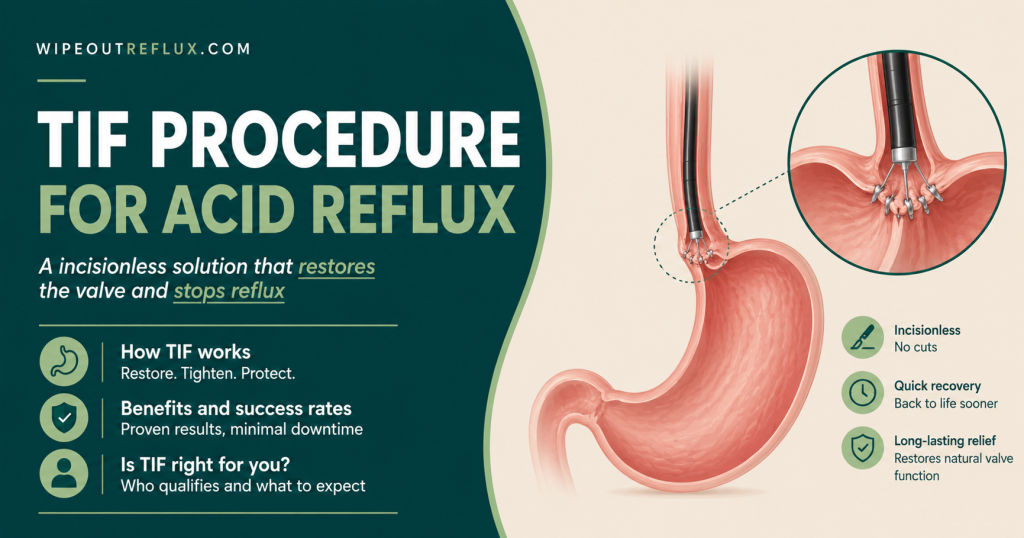
The TIF procedure sits in an interesting middle ground for acid reflux — more than medication, less than surgery. Its full name is transoral incisionless fundoplication, and the clue is in the word “incisionless”: the whole thing is done through your mouth, with no cuts on your abdomen at all. A surgeon uses a device called EsophyX, passed down the throat, to rebuild your body’s own anti-reflux valve from the inside.
For the right person, TIF is appealing: no external scars, a quick recovery, and — unlike the older Nissen operation — you keep the ability to belch and vomit normally. It also has decent evidence behind it, including for the throat-type symptoms that matter in silent reflux. But it comes with an honest catch around durability, and it is not the right choice for everyone, particularly people with a large hiatal hernia or severe reflux.
I have managed my own LPR for over eight years, so let me walk through how TIF actually works, what the evidence genuinely shows, who it suits, and where its limits lie.
Key Takeaways
- TIF is an incisionless procedure done through the mouth with the EsophyX device — no abdominal cuts.
- It rebuilds your anti-reflux valve by folding and fastening the top of the stomach to recreate a natural barrier at the gastro-oesophageal junction.
- It does not reduce acid. Like all fundoplications, it fixes the mechanical barrier, not the stomach’s chemistry.
- The evidence is good short-to-medium term. Randomised trials show it controls regurgitation and throat-type symptoms well and gets many people off PPIs.
- Durability is the honest weak point. A meaningful proportion of patients drift back to some PPI use over the years.
- It suits proven GERD with a small or absent hiatal hernia. Larger hernias need a combined procedure (cTIF); severe reflux is better served by surgery.
- It preserves belching and vomiting and does not burn bridges — you can still have surgery later if needed.
What Is the TIF Procedure?
TIF stands for transoral incisionless fundoplication. “Fundoplication” means folding the fundus — the upper part of the stomach — to reinforce the valve where the stomach meets the oesophagus. The traditional version (Nissen or Toupet fundoplication) does this through keyhole surgery on the abdomen. TIF achieves a similar goal endoscopically, entirely through the mouth.
Under general anaesthetic, the surgeon passes the EsophyX device down your oesophagus alongside a camera. From inside the stomach, they fold the tissue and secure it with rows of small polypropylene fasteners, building a partial wrap — typically around 270 degrees and a couple of centimetres long. The current technique is known as TIF 2.0. The result is a reconstructed flap valve with no incisions and no alteration to your external anatomy.
How the TIF Procedure Works
Understanding the mechanism makes the strengths and limits obvious.
It rebuilds the flap valve
A healthy stomach has a natural flap-valve arrangement at the top that helps keep contents down — created partly by the sharp angle where the oesophagus enters the stomach (the angle of His). In many people with reflux, this is blunted or lost. TIF recreates it: by wrapping and fastening the fundus around the lower oesophagus, it steepens that angle and rebuilds a valve that resists backflow. If you want the background on why this barrier fails, I cover it in my guide to the stomach sphincter and reflux.
It tightens the junction and reduces reflux events
By reconstructing the valve, TIF reduces the “give” at the gastro-oesophageal junction, which cuts down on the transient relaxations that let reflux through. The net effect is fewer reflux episodes reaching the oesophagus.
It does not touch your acid
This is the key conceptual point. TIF is a purely mechanical fix — it does nothing to how much acid your stomach makes. That is why it can help with regurgitation and non-acid reflux that PPIs leave untouched, but also why the goal is a better barrier rather than less acid.
You keep normal functions
Because TIF creates a partial rather than a full wrap, most people retain the ability to belch and vomit, and it tends to avoid the gas-bloat that can follow a full Nissen wrap.
What the Evidence Says
TIF is reasonably well studied, so let me give you the honest picture — the genuine benefits and the real caveats.
It beats sham and PPIs for regurgitation
In the sham-controlled RESPECT trial, patients with troublesome regurgitation despite daily PPIs were randomised to TIF or a sham procedure plus omeprazole. Troublesome regurgitation was eliminated in 67% of the TIF group compared with 45% of the sham-plus-PPI group [Hunter et al., Gastroenterology, 2015]. A separate randomised sham-controlled trial similarly supported TIF’s ability to control chronic GERD [Håkansson et al., Alimentary Pharmacology and Therapeutics, 2015].
It controls symptoms and helps throat-type symptoms too
This part matters for silent reflux. In the TEMPO randomised trial, at three years TIF eliminated troublesome regurgitation in 90% of patients and controlled atypical symptoms in 88%. Crucially, the Reflux Symptom Index — the score used to track LPR-type throat symptoms — improved dramatically, from 22.2 on PPIs before the procedure to around 4 afterwards, and about 70% of patients were off daily PPIs [Trad et al., Surgical Endoscopy, 2017]. Those benefits were reported to remain stable and cost-effective at five years [Trad et al., Surgical Innovation, 2018].
The honest caveat on durability and acid
Here is where I have to be balanced. A systematic review and meta-analysis of 18 studies found TIF clearly improved response rates versus PPIs or sham, but that its effect on objective oesophageal acid exposure was not significantly improved, and — importantly — PPI use crept back up over time, with most patients resuming some PPI treatment (usually at a lower dose) during longer-term follow-up [Huang et al., Surgical Endoscopy, 2017]. In plain terms: TIF is good at improving symptoms, more modest at normalising acid on paper, and its effect tends to wane over the years for a meaningful share of patients.
Much of the strong trial data also comes from studies funded by the device manufacturer, which is worth bearing in mind when weighing it up.
Who the TIF Procedure Suits
Drawing on the trial criteria and how it is used in practice, TIF tends to suit someone with:
- Objectively proven GERD — abnormal acid exposure confirmed on pH testing, not just symptoms. As with any procedure, testing (such as Restech or a Peptest as part of the workup) should come first.
- A small or absent hiatal hernia (traditionally 2 cm or less).
- A partial response to PPIs, or a strong wish to get off them — read about getting off PPIs and acid rebound if that is your goal.
- Troublesome regurgitation, which TIF handles well.
- A preference for a minimally invasive, reversible-in-spirit option that leaves surgery on the table for later.
For people with a hiatal hernia larger than 2 cm, there is a combined approach called cTIF, where a surgeon first repairs the hernia laparoscopically and then performs the TIF in the same sitting. That has widened who can be considered.
Who Should Think Twice
TIF is not the answer for everyone. Be cautious, or look at alternatives, if you have:
- A large hiatal hernia that is not being repaired at the same time — standard TIF alone is not designed for this.
- Severe reflux or severe oesophagitis. More aggressive disease is generally better served by a full surgical fundoplication, which gives more robust, durable control.
- Barrett’s oesophagus, which needs ongoing surveillance regardless of any procedure.
- Significant oesophageal motility problems.
- Symptoms not confirmed to be caused by reflux. If testing does not tie your symptoms to reflux, rebuilding the valve will not help — which is exactly why the workup matters.
If your medication is only partly working, it is worth understanding why before considering any procedure — I cover the common reasons acid reflux medication does not work, because some are fixable without intervention.
TIF and LPR / Silent Reflux
This is where TIF is genuinely interesting for my readers. Unlike some reflux procedures, several TIF trials specifically tracked atypical and throat-type symptoms using the Reflux Symptom Index, and reported strong improvement — the TEMPO data above showed RSI scores falling from the low 20s to around 4. That, plus its strong control of regurgitation (the volume reflux that reaches the throat), makes it more relevant to LPR than a purely heartburn-focused device.
That said, I would keep two honest points in mind. First, silent reflux symptoms are often driven by reflux that is only weakly acidic or non-acidic, so confirming that reflux is genuinely behind your symptoms — through proper testing — is essential before considering a procedure. My guide on GERD vs LPR explains why that distinction is so important. Second, the durability caveat applies here too: symptom control can fade over the years.
The Downsides and the Durability Question
No procedure is free of trade-offs, and TIF has a few worth knowing honestly.
Short-term discomfort is common: sore throat, chest or shoulder pain, difficulty swallowing, and nausea for a few days after the procedure, which usually settle quickly.
Serious complications are uncommon but real — rare cases of bleeding or perforation have been reported, which is why TIF should be done by an experienced operator.
Durability is the big one. As the meta-analysis showed, the effect can weaken over time, and a significant proportion of patients drift back to some PPI use over several years. The upside is that TIF does not burn bridges — it can be repeated, and it does not prevent a later laparoscopic fundoplication if you need one.
TIF vs LINX vs Fundoplication vs PPIs
To place it simply: PPIs reduce acid but do nothing to the faulty valve. A full Nissen fundoplication rebuilds the barrier most robustly and durably, but is the most invasive and most prone to gas-bloat. TIF is the least invasive of the barrier-restoring options — no incisions, quick recovery, preserved belching and vomiting — but with the most durability uncertainty. If you are weighing procedures, it is worth comparing TIF with the Stretta procedure and the broader range of reflux surgery options, since the best fit depends heavily on your anatomy, hernia size, and how severe your reflux is.
Conclusion
The TIF procedure is a genuinely clever, minimally invasive way to rebuild the anti-reflux valve without a single incision. For the right candidate — proven GERD, a small or absent hiatal hernia, troublesome regurgitation, and a wish to move on from daily PPIs — it can deliver real, well-documented symptom relief, including for the throat-type symptoms that matter in silent reflux. And because it preserves normal function and leaves surgery available for later, it is a low-commitment step into the procedural world.
The honest counterweight is durability. TIF is better at improving symptoms than at normalising acid exposure on paper, and its benefit can fade for a meaningful share of patients over the years, with some drifting back to PPIs. It is also not the tool for severe reflux or a large unrepaired hiatal hernia. So the workup — proper reflux testing and a candid conversation with an experienced specialist — matters as much as the procedure itself.
One last reflection from my own journey: any procedure fixes the valve, but it never changes what you eat or how you eat — and those triggers keep shaping how you feel. Plenty of people bring their reflux under control, and sidestep procedures entirely, by getting the fundamentals right first. That is exactly what my Wipeout Diet Plan is built to do, in the depth this condition needs, and the Wipeout Food Reference Guide is the essential companion that shows exactly which foods and drinks are reflux-friendly and their pH values. Whether or not you ultimately choose TIF, getting that foundation in place is never wasted — and for many people, it is enough on its own.
Frequently Asked Questions
How does the TIF procedure stop acid reflux?
It rebuilds the anti-reflux valve at the top of the stomach. Using the EsophyX device through the mouth, the surgeon folds and fastens the fundus around the lower oesophagus to recreate a natural barrier, steepening the angle where the two meet so reflux is less able to escape. It does not reduce stomach acid.
Is TIF the same as a Nissen fundoplication?
The goal is similar — reinforcing the valve — but the method differs. Nissen is done through keyhole abdominal surgery and creates a full wrap. TIF is done through the mouth with no incisions and creates a partial wrap, which preserves belching and vomiting and avoids much of the gas-bloat.
How long does TIF last?
Trials show good symptom control at three to five years, but durability is its main weak point. A significant proportion of patients drift back to some PPI use over the years. The procedure can be repeated, and it does not prevent later surgery if needed.
Does TIF help LPR or silent reflux?
Several TIF trials tracked throat-type symptoms using the Reflux Symptom Index and reported strong improvement, and TIF controls regurgitation well — both relevant to LPR. But confirming that reflux is genuinely causing your symptoms through proper testing is essential first, and the durability caveat applies.
What is cTIF?
cTIF is a combined procedure for people with a hiatal hernia larger than 2 cm. A surgeon first repairs the hernia laparoscopically, then performs the TIF in the same sitting. It extends the procedure to patients who would not qualify for standard TIF alone.
Is the TIF procedure safe?
It has a good safety profile overall, with most side effects — sore throat, chest or shoulder pain, difficulty swallowing — being short-lived. Serious complications like bleeding or perforation are uncommon but possible, which is why it should be done by an experienced operator.
Who is not a good candidate for TIF?
People with a large unrepaired hiatal hernia, severe reflux or oesophagitis, significant motility problems, or symptoms not confirmed to be caused by reflux. More severe disease is generally better managed with a full surgical fundoplication.
Research Sources
- [Hunter et al., Gastroenterology, 2015] — The sham-controlled RESPECT trial found transoral fundoplication eliminated troublesome regurgitation in 67% of patients versus 45% for sham plus PPI at six months.
- [Håkansson et al., Alimentary Pharmacology and Therapeutics, 2015] — A randomised sham-controlled trial supporting the efficacy of transoral incisionless fundoplication in controlling chronic GERD.
- [Trad et al., Surgical Endoscopy, 2017] — The 3-year TEMPO trial report found TIF eliminated troublesome regurgitation in 90% of patients, controlled atypical symptoms in 88%, markedly improved Reflux Symptom Index scores, and kept about 70% of patients off daily PPIs.
- [Trad et al., Surgical Innovation, 2018] — The 5-year TEMPO follow-up reported that TIF 2.0 was safe, durable, and cost-effective in a US patient population.
- [Huang et al., Surgical Endoscopy, 2017] — A systematic review and meta-analysis of 18 studies found TIF improved response rates versus PPIs or sham, but did not significantly improve objective acid exposure, with PPI use increasing again over longer-term follow-up.

David Gray
12 years living with LPR · Consultant & researcher
I've lived with LPR for twelve years — the misdiagnoses, the PPI courses that did nothing, the slow work of figuring out what actually helps. Wipeout Reflux is where I translate the research into plain terms for people stuck in the same place. Every claim here is sourced to peer-reviewed work, and I consult one-to-one with LPR sufferers.