
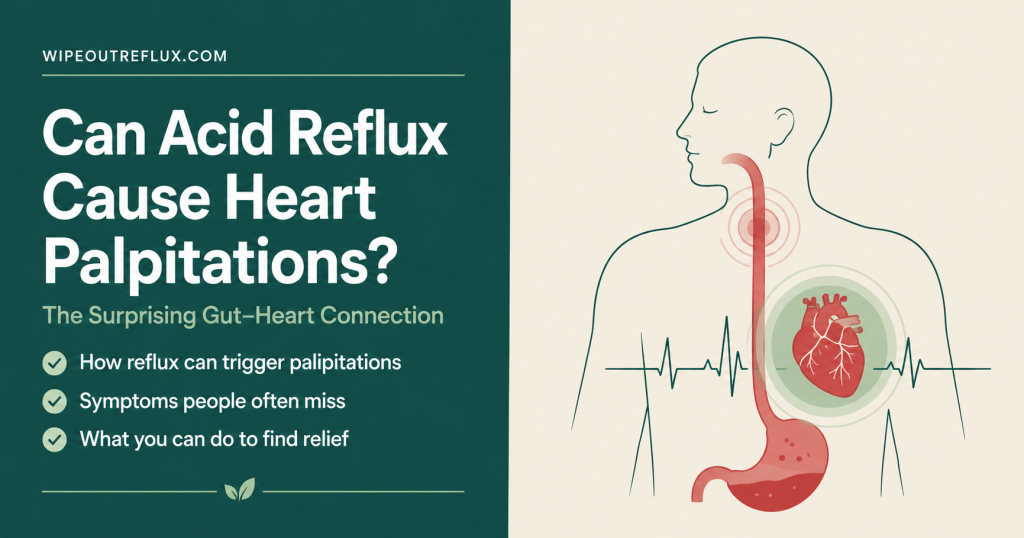
Yes — and it’s far more common than most people realise. I’ve spoken with hundreds of reflux sufferers who’ve experienced that unsettling flutter or racing sensation in their chest after eating, only to be told by their doctor that their heart is fine. The explanation, in most cases, comes down to one thing: the vagus nerve.
When stomach acid irritates the esophagus, it doesn’t just cause local discomfort. It triggers your nervous system in ways that can directly affect your heart rate and rhythm. This is called the esophagocardiac reflex, and it’s one of the most underappreciated connections in reflux medicine.
In this article, I’ll explain exactly how acid reflux triggers palpitations, what the research shows about the GERD–heart connection, when you should be concerned, and what actually helps.
Key Takeaways
- Acid reflux can cause heart palpitations through a well-documented mechanism called the esophagocardiac reflex, driven by the vagus nerve.
- The vagus nerve runs directly alongside the esophagus and plays a central role in regulating heart rate and rhythm — irritate one, and you affect the other.
- Acid exposure in the esophagus activates nerve receptors that send signals through the vagus nerve, producing skipped beats, racing heart, or irregular rhythm.
- Research shows people with GERD have a meaningfully higher risk of atrial fibrillation (AF) compared to the general population.
- Hiatal hernia can add a physical dimension to palpitations by compressing cardiac structures and the vagus nerve through the diaphragm.
- LPR (silent reflux) can trigger palpitations through the same vagal pathway, even without obvious heartburn.
- Common shared triggers — caffeine, alcohol, large meals, and lying down after eating — drive both reflux and cardiac symptoms simultaneously.
- Palpitations from reflux are usually benign, but chest pain, breathlessness, fainting, or prolonged rapid heart rate always need urgent medical review.
What Are Heart Palpitations?
Heart palpitations are the sensation of your heart beating irregularly, too hard, too fast, or skipping beats. They’re extremely common and, in the vast majority of cases, not dangerous. You might feel them as a sudden flutter in your chest, a heavy thud, a missed beat, or a brief racing episode that stops on its own.
Palpitations have many triggers — stress, dehydration, caffeine, hormonal shifts, and digestive issues among them. When they happen alongside reflux symptoms, people often assume they’re experiencing something cardiac. In many cases, the gut is the real cause. The challenge is knowing which is which.
The Vagus Nerve: The Bridge Between Your Gut and Your Heart
To understand why reflux causes palpitations, you need to understand the vagus nerve — and once you do, the connection clicks into place immediately.
The vagus nerve is the longest nerve in the body. It runs from your brainstem all the way down through your neck and chest, passing directly alongside the esophagus, before branching into the abdomen. It regulates an enormous range of functions: heart rate, digestion, gut motility, the inflammatory response, and more.
Critically, the vagus nerve is bidirectional. It carries signals from the brain downward, but it also carries signals from the body back to the brain — including the heart. This means that irritation anywhere along the esophagus can send electrical signals upward through the vagus nerve that reach your cardiac control centres.
When acid repeatedly contacts the esophageal lining, it activates acid-sensitive nerve endings wired into this vagal pathway. The resulting signal can alter heart rhythm directly — sometimes slowing the heart, sometimes causing ectopic beats or a brief racing sensation. This is the esophagocardiac reflex in action [Wright et al., Gastroenterology, 1990].
How Acid Reflux Triggers Heart Palpitations
There are several specific mechanisms at work here, and understanding each one helps explain why palpitations can occur in different situations:
Esophageal Acid Exposure and Vagal Firing
The inner lining of the esophagus contains chemoreceptors — nerve endings that detect acid. When acid rises from the stomach into the esophagus, these receptors fire, sending signals through the vagus nerve. Depending on how the signal is interpreted at the cardiac level, you might experience premature ventricular contractions (PVCs), supraventricular beats, a brief tachycardia, or the classic “skipped beat” sensation.
Research using esophageal acid infusion has shown measurable cardiac rhythm changes in susceptible individuals, confirming that acid exposure alone — without any structural cardiac problem — is enough to alter heart rhythm [Bortolotti et al., Diseases of the Esophagus, 2001].
Esophageal Distension and Stretch Receptors
It isn’t only acid that triggers this reflex. The physical stretching of the esophagus — from a large meal, significant gas, or bloating — activates stretch receptors that feed into the same vagal pathways. This explains why palpitations often occur after a big meal even when obvious heartburn isn’t present. The distension itself is the trigger, and it’s enough to alter heart rate and rhythm in susceptible people.
Hiatal Hernia and Mechanical Compression
If you have a hiatal hernia — where part of the stomach pushes upward through the diaphragm into the chest cavity — the anatomy becomes more complicated. The herniated stomach can press against surrounding structures, including the vagus nerve and, in larger hernias, even the pericardium (the membrane around the heart). This mechanical compression increases the risk of both reflux and palpitations occurring together, and it adds a physical dimension to the reflex mechanism.
Cardiologists investigating unexplained atrial fibrillation now routinely check for hiatal hernia, particularly in younger patients without obvious cardiac risk factors. The anatomical proximity makes the connection more than coincidental.
Systemic Inflammation from Chronic GERD
Chronic, untreated GERD produces persistent low-grade inflammation in the esophagus. That inflammatory response isn’t entirely local — circulating inflammatory mediators can affect cardiac electrical activity over time. This is a slower-acting mechanism compared to the acute vagal reflex, but it may partly explain why people with long-standing GERD have elevated rates of cardiac arrhythmia compared to those without it.
GERD and Atrial Fibrillation: What the Research Shows
The most clinically significant cardiac association with reflux isn’t benign palpitations — it’s atrial fibrillation (AF). AF is a more serious arrhythmia involving chaotic electrical activity in the upper chambers of the heart. It increases the risk of stroke, reduces cardiac efficiency, and often causes significant palpitations, breathlessness, and fatigue.
Multiple studies have established a meaningful link between GERD and AF. Patients with GERD consistently show higher rates of AF compared to matched controls, and the proposed mechanism mirrors the vagal pathway described above. The esophagus sits in direct anatomical contact with the posterior wall of the left atrium — the chamber most commonly involved in AF. Acid irritation, inflammation, and vagal stimulation from the adjacent esophagus can directly affect the atrial tissue.
What’s particularly interesting is that treating GERD effectively may reduce AF burden in some patients. Studies have found that acid suppression therapy — particularly PPIs — was associated with reduced AF recurrence in patients where reflux appeared to be a contributing factor [Sinha et al., Cureus, 2025].
This isn’t a fringe idea. Some electrophysiologists now routinely investigate GERD and hiatal hernia in patients presenting with AF that doesn’t respond well to standard treatment.
LPR and Heart Palpitations
If you have LPR (laryngopharyngeal reflux), you might experience palpitations without the typical heartburn that signals GERD. LPR involves acid and pepsin travelling all the way up to the throat and larynx, and because the main symptoms are throat-based — chronic throat clearing, hoarseness, a lump sensation, or persistent cough — the cardiac connection rarely gets discussed.
But LPR still involves esophageal acid exposure. The vagus nerve doesn’t care whether your dominant symptom is heartburn or a persistent cough. Any significant acid irritation along the esophagus can trigger the same vagal response and produce palpitations.
I’ve experienced this myself. During bad LPR flares, I noticed palpitations — usually in the evenings when acid was more active. Once the LPR came under control, the palpitations resolved with it. The connection between the two became obvious once I understood the mechanism, even though nobody had ever explained it to me that way.
If you’re managing LPR alongside unexplained palpitations, addressing the reflux is the most direct route to addressing both. My complete LPR guide covers the full picture of how silent reflux works and why effective treatment matters beyond just throat symptoms.
Shared Triggers That Drive Both Reflux and Palpitations
One reason reflux and palpitations so frequently co-occur is that many common dietary and lifestyle triggers drive both simultaneously. If you can identify and reduce these, you’ll often see improvement in both problems at once:
- Caffeine — relaxes the lower esophageal sphincter (allowing acid up) and directly stimulates cardiac activity, increasing heart rate and promoting ectopic beats.
- Alcohol — irritates the esophageal lining, increases acid production, and is independently a well-known trigger for palpitations and AF episodes.
- Large meals — cause both physical esophageal distension and increased acid output, triggering the vagal reflex through volume alone.
- High-fat foods — delay gastric emptying, prolonging acid exposure, and promote systemic inflammation over time.
- Lying down after eating — dramatically increases acid reflux and simultaneously alters vagal tone through the change in body position.
- Stress and anxiety — amplifies acid production, slows gut motility, and directly affects heart rhythm through the autonomic nervous system. The gut-brain axis runs both ways.
- Chocolate and peppermint — both relax the lower esophageal sphincter and are frequent triggers in sensitive individuals.
Getting these triggers under control is one of the most effective things you can do. If you want a structured, evidence-based approach to dietary management, the Wipeout Diet Plan walks you through exactly what to eat and avoid — and the principles apply whether your main issue is GERD, LPR, or a combination of both.
When Should You See a Doctor?
This is important. While palpitations driven by reflux are typically benign, there are situations where they could signal something more serious that needs proper investigation. Seek urgent medical attention if your palpitations are accompanied by:
- Chest pain or pressure (especially if it radiates to the arm, jaw, or back)
- Shortness of breath
- Dizziness, lightheadedness, or fainting
- Palpitations lasting more than a few minutes without resolving
- A sustained heart rate above 150 bpm
- A new, irregular pulse pattern you haven’t experienced before
These symptoms can indicate a cardiac arrhythmia that needs proper investigation — not a reflux issue. Rule out a cardiac cause first. If a cardiologist has already cleared you and you’re looking to reduce palpitations through better reflux management, everything below is for you.
How to Reduce Reflux-Related Palpitations
The most direct route to reducing these palpitations is to reduce acid reflux itself. When acid exposure drops, so does vagal irritation, and so do the palpitations. Here’s what actually helps:
Eat Smaller, More Frequent Meals
Large meals are a double trigger — they increase acid output and cause the esophageal distension that fires the vagal reflex. Eating smaller portions throughout the day reduces both the acid burden and the stretch-receptor activation. This single change often produces a noticeable improvement in post-meal palpitations.
Stop Eating 3–4 Hours Before Lying Down
Lying down with a full or partially-full stomach dramatically increases reflux. Many people notice palpitations are worst in the evening or when they go to bed, and this timing is not a coincidence — it’s acid rising the moment they become horizontal. Giving your stomach adequate time to empty before bed removes this trigger entirely.
Eliminate Key Triggers Systematically
Caffeine and alcohol are the highest-impact triggers for both reflux and palpitations, and reducing them often produces rapid improvement in both. Fatty and fried foods, chocolate, peppermint, and carbonated drinks are worth addressing next. Work through them one at a time so you can identify which are driving your symptoms most.
Elevate the Head of Your Bed
Raising the head of your bed by 6–8 inches using a wedge pillow or bed risers reduces nighttime acid reflux significantly. Less overnight acid exposure means less chronic vagal irritation, and many people find their nighttime and early-morning palpitations improve noticeably within a few weeks.
Address Stress Actively
Stress drives both acid production and cardiac sensitivity through the autonomic nervous system. Diaphragmatic breathing, gentle movement, and reducing anxiety around symptoms can calm both systems. This isn’t a substitute for dietary changes, but it supports them — and the nervous system responds to both reflux management and stress reduction as complementary inputs.
Consider Acid Suppression Therapy
If lifestyle changes alone aren’t providing enough control, PPIs or H2 blockers can reduce acid exposure and, in turn, reduce the vagal stimulation that drives palpitations. For people with reflux-associated AF, effective acid suppression has been associated with fewer arrhythmia episodes in some studies [Nishida et al., Journal of Arrhythmia, 2019]. This is worth discussing with your doctor if your palpitations are significant and your reflux is poorly controlled.
Frequently Asked Questions
Can acid reflux cause heart palpitations at night?
Yes — nighttime is when reflux-related palpitations are most common. Lying down removes gravity from the equation, making it much easier for acid to travel up the esophagus. The prolonged acid exposure during sleep irritates the vagus nerve more than brief daytime episodes, which is why many people report waking with a racing or skipping heart. Elevating your head and avoiding eating late in the evening are the two most effective changes for this specific pattern.
Can LPR cause palpitations without heartburn?
Yes. LPR involves acid exposure throughout the esophagus even when heartburn isn’t the dominant symptom. The vagus nerve responds to that esophageal irritation regardless of whether you feel it as a burning sensation in your chest. If you have unexplained palpitations alongside throat symptoms — hoarseness, throat clearing, a globus sensation — LPR is worth investigating.
How do I know if my palpitations are from reflux or from my heart?
The pattern is usually the clearest indicator. If palpitations consistently occur after eating, when lying down, during reflux flares, and improve as reflux improves, a digestive cause is likely. A cardiologist can rule out structural heart issues with an ECG, echocardiogram, or Holter monitor. Always get checked if you’re unsure — it’s important to rule out a cardiac cause before attributing palpitations to reflux.
Can treating GERD reduce atrial fibrillation?
In some patients, yes. Research suggests that effective GERD treatment — particularly acid suppression therapy — may reduce AF recurrence in patients where reflux appears to be a contributing driver. This isn’t universal, and AF has many causes, but for people where the two conditions are clearly linked, managing the reflux can have a meaningful cardiac benefit.
Does omeprazole help with reflux-related palpitations?
For some people, yes. By reducing acid production, omeprazole and similar PPIs reduce the acid exposure that triggers vagal stimulation. Whether this translates directly to fewer palpitations depends on how much of your burden is reflux-driven. If palpitations occur primarily after meals, when lying down, or during known acid flares, PPIs are more likely to help. If palpitations are frequent and don’t clearly track with reflux episodes, a cardiac evaluation is the better starting point.
Can bloating and gas cause palpitations?
Yes. Significant abdominal bloating pushes the diaphragm upward, compressing thoracic structures and stimulating the vagus nerve — sometimes independently of acid reflux. Trapped gas in the upper colon (a pattern sometimes called splenic flexure syndrome) can cause referred chest discomfort and palpitations that feel cardiac but originate entirely in the gut. Addressing gut motility and gas production often helps both the bloating and the associated palpitations.
Are reflux-related palpitations dangerous?
In most cases, no. Benign palpitations triggered by vagal stimulation — such as occasional premature beats or brief racing episodes after meals — are generally harmless. The exception is if reflux is contributing to true atrial fibrillation in a susceptible person, which does warrant proper medical management and shouldn’t be left untreated. Any palpitations accompanied by chest pain, breathlessness, or fainting should be assessed urgently rather than attributed to reflux.
Conclusion
The link between acid reflux and heart palpitations is one of the most common — and most commonly missed — aspects of living with GERD or LPR. For years, people are told their heart is fine and sent home without an explanation for why their chest feels chaotic after eating. Once you understand the vagus nerve and the esophagocardiac reflex, the pattern makes complete sense.
What I find genuinely reassuring about this connection is that it points toward a clear solution. The palpitations aren’t a separate problem requiring a separate treatment — they’re a downstream consequence of the reflux itself. Get the acid under control, and in most cases, the palpitations follow. That was my experience, and it’s consistent with what the research shows.
The most effective place to start is your diet. Reducing the triggers that drive acid exposure — and building a consistent, reflux-friendly eating pattern — removes the underlying stimulus for those vagal responses. If you want a comprehensive, structured approach to doing that, the Wipeout Diet Plan covers everything in depth: what to eat, what to avoid, timing, portion strategies, and how to adapt the approach to your specific symptoms. For a quick, practical reference to individual foods and their pH values, the Wipeout Food Reference Guide is an essential companion that you’ll come back to repeatedly.
Start with the reflux. The rest tends to follow.
Research Sources
[Wright et al., Gastroenterology, 1990] — Prospective study in 136 patients demonstrating that intraesophageal acid infusion produces significant, graded reductions in heart rate via a vagally mediated esophagocardiac reflex — abolished by atropine — providing the foundational human evidence for the reflux–palpitation mechanism.
[Bortolotti et al., Diseases of the Esophagus, 2001] — Investigated the esophagocardiac inhibitory reflex in patients with non-cardiac chest pain, finding that esophageal wall distension consistently triggers measurable cardiac rhythm changes, confirming the clinical relevance of the reflex in susceptible individuals.
[Sinha et al., Cureus, 2025] — Systematic review and meta-analysis of seven studies finding that GERD is associated with a significantly increased risk of atrial fibrillation (RR: 1.27), with two Mendelian randomization studies providing genetic evidence of a potential causal relationship and proposed mechanisms including vagal pathways and left atrial inflammation.
[Nishida et al., Journal of Arrhythmia, 2019] — Comprehensive review of the bidirectional relationship between GERD and atrial fibrillation, examining autonomic nerve influence, mechanical compression from esophageal proximity to the left atrium, and evidence that proton pump inhibitor therapy may reduce AF burden in patients with coexisting GERD.

David Gray
Content Researcher & Author
David Gray founded Wipeout Reflux to address a critical gap in reflux management. His research synthesizes over 100 peer-reviewed studies on laryngopharyngeal reflux (LPR), pepsin biology, and GERD pathophysiology. For LPR specifically—a condition most physicians misdiagnose—his work focuses on pepsin reactivation and why standard PPI therapy fails most patients. He develops evidence-based protocols targeting root causes of both LPR and GERD, integrating emerging research on sphincter dysfunction, dietary interventions, and newer clinical approaches. Wipeout Reflux represents practical application of clinical science for patients seeking real solutions.