
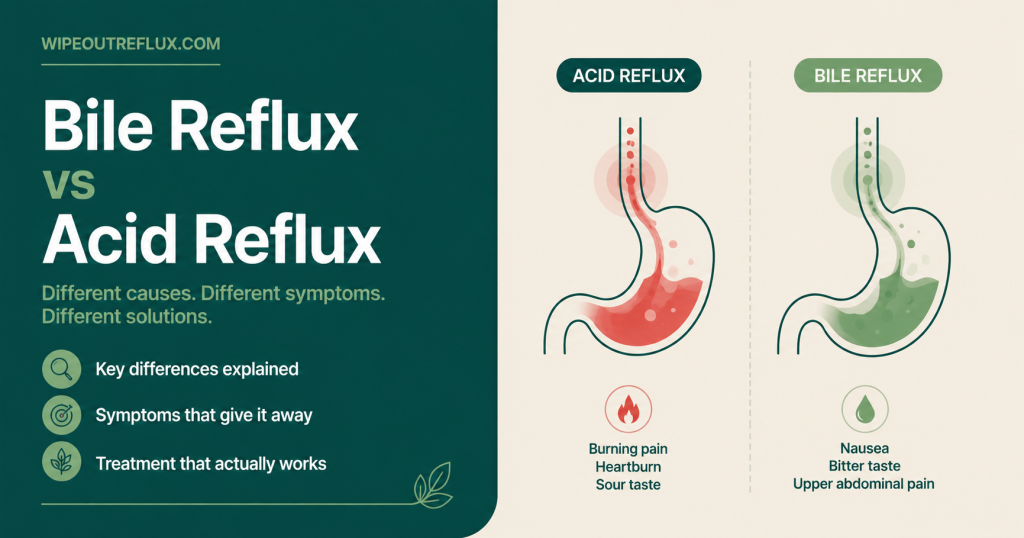
If you’ve been dealing with reflux symptoms that don’t fully respond to standard acid-suppressing medication, or if you’re trying to understand why your treatment plan isn’t working as well as expected, the distinction between bile reflux and acid reflux matters more than most people realise. They feel similar. They can both cause heartburn, nausea, and oesophageal damage. But they have completely different origins — and that difference has significant implications for how each is managed.
Acid reflux happens when stomach acid travels up into the oesophagus. Bile reflux happens when bile — a digestive fluid produced by the liver and stored in the gallbladder — flows backward from the small intestine into the stomach and, in some cases, the oesophagus. The two can occur independently or, more commonly, together.
In this guide I’ll explain exactly what each type is, how they differ in symptoms and causes, why they respond differently to treatment, and what the research says about managing them effectively.
Key Takeaways
- Acid reflux is caused by stomach acid entering the oesophagus; bile reflux involves bile from the small intestine flowing into the stomach or oesophagus
- The two often occur simultaneously — research shows mixed acid and bile reflux is the most prevalent pattern in GERD patients
- Symptoms of both overlap significantly, making them clinically difficult to tell apart without testing
- PPIs (proton pump inhibitors) reduce stomach acid but have limited effect on bile reflux — a key reason why many people don’t get full symptom relief
- Bile reflux is harder to control through diet and lifestyle changes alone; it frequently requires medical management
- Both bile and acid reflux are associated with Barrett’s oesophagus — combined exposure is linked to greater tissue damage than either alone
- Dietary changes work best for managing the acid component; a low-acid, plant-forward approach is supported by clinical evidence
- If your symptoms persist on PPIs, bile reflux is a strong candidate for investigation
What Is Acid Reflux (GERD)?
Acid reflux occurs when the lower oesophageal sphincter (LOS) — the muscular valve between the stomach and oesophagus — relaxes at the wrong moment, allowing stomach contents to flow upward. The primary culprit is stomach acid (hydrochloric acid), along with pepsin, a digestive enzyme that causes significant tissue damage to the oesophagus and larynx.
When acid reflux becomes chronic and produces regular symptoms or tissue damage, it’s classified as GERD (gastroesophageal reflux disease). Classic GERD symptoms include heartburn, regurgitation, and in the case of LPR (laryngopharyngeal reflux), upper airway symptoms like chronic throat clearing, hoarseness, and a lump in the throat feeling — all without obvious heartburn.
Acid reflux responds well to dietary modifications, lifestyle changes, and acid-suppressing medication like PPIs. The Essential Reflux Food List is a useful starting point for identifying which foods are safe and their pH values — particularly important when managing the dietary side of GERD.
What Is Bile Reflux?
Bile reflux — also called duodenogastroesophageal reflux (DGER) — occurs when bile travels backward from the small intestine (duodenum) into the stomach, and sometimes further up into the oesophagus. Unlike acid reflux, bile is alkaline in nature. It’s produced by the liver and contains bile acids, which are designed to help digest fats — but which are corrosive to the stomach lining and oesophagus when they end up where they don’t belong.
Bile reflux can happen in otherwise healthy people, but it’s more common after certain upper gastrointestinal surgeries — particularly gastric bypass or removal of the gallbladder — which can alter the anatomy and pressure dynamics that normally keep bile moving in the right direction. It can also occur due to a weakened pyloric valve (the valve between the stomach and duodenum) or dysfunctional gut motility.
Crucially, because bile is alkaline, antacids and PPIs do not neutralise it. This is why bile reflux is often suspected when people continue to have significant symptoms despite taking acid-suppressing medication.
Bile Reflux vs Acid Reflux: The Key Differences
Where Each Comes From
Acid reflux originates in the stomach — specifically from gastric acid produced there. Bile reflux originates in the small intestine (duodenum), with the bile travelling upstream through the pyloric valve into the stomach and beyond. This upstream origin is part of why it’s harder to control: the pyloric valve is a less tight seal than the LOS, and its function depends heavily on normal gut motility.
Symptoms
The symptoms of bile reflux and acid reflux overlap considerably, which is why they’re clinically difficult to distinguish on symptoms alone. Both can cause:
- Heartburn and chest burning
- Regurgitation
- Upper abdominal pain or discomfort
- Nausea
- Sore throat and hoarseness
However, bile reflux has a few more distinctive features that can raise suspicion:
- Nausea that is more persistent and severe than typical acid reflux
- Bile-coloured (yellow-green) vomiting — a fairly specific indicator when present
- Upper abdominal pain that doesn’t respond to antacids or PPIs
- Symptoms that are worse or unchanged despite acid-suppressing treatment
- A bitter, bilious taste in the mouth rather than the sour, acidic taste of acid reflux
Why PPIs Help Acid Reflux but Not Bile Reflux
This is perhaps the most clinically important distinction. PPIs work by reducing the production of stomach acid. When acid is the primary driver of reflux symptoms and damage, this is effective. But when bile is the problem — or part of the problem — PPIs do nothing to reduce bile production, change bile composition, or prevent bile from refluxing from the duodenum into the stomach.
Research examining GERD patients who remained symptomatic on PPI therapy found that many had significant bile reflux alongside or independently from acid reflux, suggesting that inadequate control of bile reflux is a primary driver of treatment failure [Tack et al., American Journal of Gastroenterology, 2004]. A separate study found that the high rate of PPI non-response in GERD patients could be substantially explained by the presence of uncontrolled duodenogastroesophageal reflux [Monaco et al., World Journal of Gastroenterology, 2009].
This is a key reason why persistent symptoms on PPIs should trigger investigation for bile reflux rather than simply increasing the PPI dose.
How Each Is Diagnosed
Acid reflux is typically diagnosed through symptom assessment, a trial of PPIs, upper endoscopy, or 24-hour pH monitoring of the oesophagus. Bile reflux is more complex to confirm. It requires ambulatory bilirubin monitoring (using a device called Bilitec, which measures bilirubin in the refluxate), or in some cases multichannel intraluminal impedance-pH monitoring, which can detect non-acid reflux episodes. Bile-stained changes visible on endoscopy can also suggest bile reflux gastritis.
Can You Have Both Acid and Bile Reflux at the Same Time?
Yes — and this is actually the norm rather than the exception. Research using simultaneous 24-hour acid and bilirubin monitoring found that combined exposure to both acid and bile was the most prevalent reflux pattern across the full spectrum of GERD, with the proportion increasing in more severe disease states [Vaezi & Richter, Gastroenterology, 1996]. Studies using simultaneous acid and bile monitoring in GERD patients have confirmed that mixed reflux is the chief pattern, with bile reflux either alone or combined with acid contributing significantly to mucosal injury [GadEl Hak et al., Hepatogastroenterology, 2008].
This coexistence is one of the reasons reflux management is more complex than simply taking a PPI and expecting full resolution. When both types are present, controlling the acid component may reduce overall symptoms substantially, but leave a residual bile-driven component that continues to cause irritation and damage.
The Bile Reflux–Barrett’s Oesophagus Connection
One of the more important clinical reasons to take bile reflux seriously is its relationship with Barrett’s oesophagus — a condition where the lining of the lower oesophagus changes to resemble intestinal tissue, which carries an elevated risk of developing into oesophageal cancer. While acid reflux is the primary driver of Barrett’s in most cases, research has shown that combined exposure to both acid and bile is associated with greater mucosal damage and a higher prevalence of Barrett’s than acid alone.
This means that people with GERD who also have bile reflux — even if managed on PPIs — may face greater oesophageal risk than those with acid reflux alone. It’s one reason why persistent symptoms despite treatment warrant investigation rather than just dose escalation.
How to Manage Acid Reflux vs Bile Reflux
Managing the Acid Component
Acid reflux responds well to a structured dietary and lifestyle approach. The evidence supports a low-acid, plant-forward diet as clinically effective — in some cases performing comparably to PPI therapy for symptom relief [Zalvan et al., JAMA Otolaryngology-Head and Neck Surgery, 2017]. The key dietary principles are:
- Avoiding high-acid foods and drinks — citrus, tomatoes, vinegar, carbonated drinks, alcohol, and caffeine
- Reducing high-fat meals, which slow gastric emptying and promote reflux
- Eating smaller portions and stopping eating 3–4 hours before bed
- Elevating the head of the bed and sleeping on the left side for overnight reflux
The Essential Reflux Food List gives a clear, pH-referenced breakdown of which foods are safe and which to avoid — a practical daily reference when you’re adjusting your diet. For a comprehensive, step-by-step approach to managing both LPR and GERD through diet, the Wipeout Diet Plan provides the deeper structure and progression most people need.
Alkaline water (pH 8.8+) is also worth considering — it can deactivate pepsin deposited on laryngeal tissue and provides some buffering of oesophageal acid. My guide on alkaline water and acid reflux covers the evidence and practical guidance in detail.
Managing the Bile Component
Bile reflux is significantly harder to manage through diet and lifestyle changes alone. Unlike acid, bile cannot be neutralised by antacids or reduced by PPIs. The approaches that have evidence behind them include:
- Ursodeoxycholic acid (UDCA) — an oral medication that changes the composition of bile to be less irritating to the stomach and oesophageal lining. It doesn’t stop bile from refluxing, but it makes the refluxed bile less damaging
- Sucralfate — forms a protective coating over the oesophageal and stomach lining, offering some protection against bile acid damage
- Baclofen — a muscle relaxant that can reduce the frequency of transient lower oesophageal sphincter relaxations and may reduce both acid and bile reflux episodes
- Prokinetic agents — medications that improve gastric emptying and motility, reducing the opportunity for duodenal contents to back up into the stomach
- Surgery — in severe or refractory cases, procedures such as Roux-en-Y diversion redirect bile away from the stomach entirely
Some lifestyle measures still help with bile reflux at the margins — eating smaller meals, avoiding eating before bed, and elevating the head of the bed all reduce the overall volume and opportunity for reflux — but these are supportive rather than curative. Medical management is usually necessary.
When to See a Doctor
You should seek medical review for reflux symptoms if:
- Your symptoms don’t improve significantly after 4–8 weeks of dietary and lifestyle changes
- You’re experiencing symptoms despite taking PPIs as prescribed
- You have persistent nausea, bilious vomiting, or bile-coloured vomit
- You’re losing weight unexpectedly
- You have difficulty or pain when swallowing
- You notice blood in vomit or stools, or black/tarry stools
- You’ve had previous upper GI surgery that may have altered your anatomy
A gastroenterologist can arrange upper endoscopy to look for mucosal damage, bile-stained gastric changes, and signs of Barrett’s oesophagus. Combined pH and bilirubin monitoring can confirm whether bile reflux is occurring and to what degree.
Frequently Asked Questions
How do I know if I have bile reflux or acid reflux?
The symptoms overlap significantly and cannot be reliably distinguished on symptoms alone. The strongest clinical clue for bile reflux is persistent symptoms despite PPI therapy — particularly if accompanied by bilious nausea or yellow-green vomiting. Confirmation requires ambulatory bilirubin monitoring or combined pH-impedance testing, usually arranged by a gastroenterologist.
Can acid reflux turn into bile reflux?
The two are separate conditions with different origins, so one doesn’t convert into the other. However, the same underlying factors that weaken the lower oesophageal sphincter and impair gut motility can promote both simultaneously. As GERD progresses in severity, bile reflux tends to become more prevalent alongside it.
Do PPIs make bile reflux worse?
PPIs don’t directly worsen bile reflux, but they can create conditions where bile becomes more prominent in the refluxate. By reducing acid production, PPIs raise gastric pH — and in a less acidic stomach environment, bile reflux events become relatively more significant, because there’s less acid to dilute the bile. This doesn’t mean you should stop taking PPIs if prescribed, but it does illustrate why PPIs alone are often insufficient for mixed reflux.
Does diet help with bile reflux?
Diet has a limited effect on bile reflux specifically, though it can help manage the acid component that frequently coexists with it. Eating smaller meals, avoiding fatty foods (which stimulate bile production), and not eating close to bedtime are all helpful in reducing reflux pressure generally. But diet alone cannot prevent bile from entering the stomach if the pyloric valve is dysfunctional.
Is bile reflux dangerous?
Left unmanaged, chronic bile reflux can cause inflammation of the stomach lining (bile reflux gastritis), oesophageal damage, and — particularly when combined with acid reflux — an increased risk of Barrett’s oesophagus. This doesn’t mean it’s immediately dangerous, but it does warrant proper investigation and management rather than symptomatic treatment alone.
Can you have bile reflux after gallbladder removal?
Yes. Gallbladder removal (cholecystectomy) changes how bile enters the digestive system — instead of being stored and released in controlled amounts, bile flows continuously into the duodenum. This can increase the volume of bile in the digestive tract and raise the likelihood of duodenogastric reflux, making bile reflux more common after this surgery.
What’s the best treatment for bile reflux?
There is no single definitive treatment. Ursodeoxycholic acid, sucralfate, baclofen, and prokinetic agents all have evidence supporting their use. Surgery (Roux-en-Y diversion) is the most reliable long-term option for severe cases but is reserved for those who fail medical management. Treatment is usually tailored to the severity of symptoms, the degree of mucosal damage, and the patient’s overall health.
Conclusion
Bile reflux and acid reflux share a lot of surface-level similarities but are fundamentally different conditions that require different approaches. Acid reflux responds well to dietary changes, lifestyle modifications, and acid-suppressing medication. Bile reflux is harder to control — diet helps at the margins, but medical management is typically necessary, and purely relying on PPIs will leave it largely untreated.
The most clinically important takeaway is this: if your reflux symptoms persist despite PPIs, bile reflux should be investigated rather than ignored. Mixed acid and bile reflux is extremely common in GERD patients, and managing only the acid component leaves a significant driver of symptoms and damage unaddressed.
For the acid and LPR side of your reflux management, a structured dietary approach makes a substantial difference. The Wipeout Diet Plan provides a comprehensive, step-by-step framework built around what the evidence actually supports. And for a practical reference on which foods and drinks are reflux-safe and their pH values, the Essential Reflux Food List is a tool worth having to hand throughout the process.
If bile reflux is suspected, the next step is a conversation with your doctor or gastroenterologist about the right diagnostic workup and treatment options for your situation.
Research & References
Vaezi & Richter, Gastroenterology, 1996 — A foundational study using simultaneous 24-hour acid and bilirubin monitoring in GERD patients and Barrett’s oesophagus patients, demonstrating that combined acid and bile reflux is the most prevalent pattern and that both show a graded increase in severity across the GERD spectrum.
Tack et al., American Journal of Gastroenterology, 2004 — Examined GERD patients who remained symptomatic on single-dose PPI therapy, finding that a substantial proportion had significant bile reflux either alone or alongside acid reflux, providing evidence that bile reflux is a key driver of PPI treatment failure.
GadEl Hak et al., Hepatogastroenterology, 2008 — Studied 91 GERD patients using simultaneous acid and bilirubin monitoring, confirming that mixed acid and bile reflux is the chief reflux pattern, and that bile reflux contributes to the severity of mucosal injury including in Barrett’s oesophagus.
Monaco et al., World Journal of Gastroenterology, 2009 — Prospective study of 65 GERD patients with persistent symptoms despite high-dose PPI therapy, finding that inadequate control of duodenogastroesophageal reflux was a primary explanation for poor treatment response, particularly in patients with more advanced oesophagitis grades.
Zalvan et al., JAMA Otolaryngology-Head and Neck Surgery, 2017 — Compared a Mediterranean and alkaline dietary approach against PPI therapy for LPR, finding dietary intervention achieved outcomes comparable to medication for symptom reduction — supporting a low-acid diet as a first-line strategy for the acid reflux component of mixed reflux.

David Gray
12 years living with LPR · Consultant & researcher
I've lived with LPR for twelve years — the misdiagnoses, the PPI courses that did nothing, the slow work of figuring out what actually helps. Wipeout Reflux is where I translate the research into plain terms for people stuck in the same place. Every claim here is sourced to peer-reviewed work, and I consult one-to-one with LPR sufferers.