
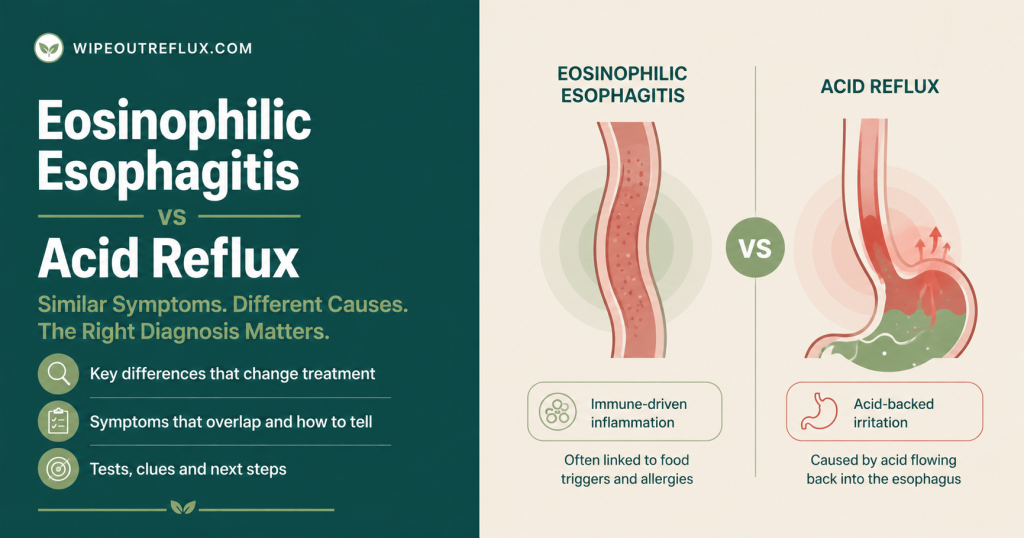
Eosinophilic esophagitis (EoE) and acid reflux are two distinct conditions that share enough symptoms to be regularly confused with each other — and that confusion can lead to years of ineffective treatment. If you’ve been taking PPIs or other acid suppressants and getting little to no relief, EoE is one of the conditions worth understanding.
The core difference comes down to cause. Acid reflux and GERD are driven by stomach acid repeatedly entering the esophagus. EoE is an immune-mediated condition — a chronic allergic response in which specific white blood cells called eosinophils accumulate in the esophageal lining, causing inflammation, swelling, and eventually structural damage. Stomach acid isn’t the trigger. Food allergens are.
Because the symptoms overlap significantly — heartburn, chest discomfort, trouble swallowing — EoE is frequently misdiagnosed as GERD, sometimes for years. Getting the right diagnosis isn’t just academic: the two conditions have fundamentally different treatment approaches, and treating EoE like acid reflux won’t resolve it.
Key Takeaways
- EoE is an immune/allergic condition caused by eosinophils infiltrating the esophageal lining — it is not caused by stomach acid.
- Acid reflux (GERD/LPR) is caused by stomach acid and pepsin entering the esophagus or throat.
- Both conditions can cause heartburn, chest pain, and difficulty swallowing — which is why EoE is regularly misdiagnosed as GERD.
- In one study of 261 EoE patients, 41.8% had received a prior misdiagnosis, with GERD being the most common — affecting 25.7% of all cases — and the median diagnostic delay was three years.
- EoE is predominantly associated with young males, atopic conditions (asthma, eczema, food allergies), and dysphagia rather than heartburn.
- Biopsy is essential to confirm EoE: the diagnostic threshold is 15 or more eosinophils per high-power field in esophageal tissue.
- Treatment for EoE centres on food elimination diets, swallowed topical steroids, and in refractory cases, biological therapy with dupilumab — not standard acid suppressants.
- EoE and acid reflux can coexist, and some patients have both conditions simultaneously, which makes diagnosis more complex.
What Is Eosinophilic Esophagitis?
EoE is a chronic, immune-mediated inflammatory disease of the esophagus. In a healthy esophagus, eosinophils — a type of white blood cell involved in allergic responses — are not normally present. In EoE, they infiltrate the esophageal lining in high numbers, causing significant inflammation and, over time, structural changes including thickening, narrowing (strictures), and fibrosis that impair the esophagus’s ability to move food normally.
The condition is driven by food antigens — specific proteins in foods that trigger an abnormal immune response. The most common culprits are milk, wheat, egg, soy, nuts, and seafood, though any food can be a trigger in individual cases. Environmental allergens may also play a role.
It’s strongly associated with other atopic (allergic) conditions. Many people with EoE also have asthma, eczema, hay fever, or food allergies — which is an important clinical clue. The condition was once considered rare but has been rising rapidly in incidence over recent decades, and is now diagnosed at a prevalence of up to 50 cases per 100,000 people in some regions [Arias & Lucendo, Journal of Investigational Allergology and Clinical Immunology, 2014].
How Common Is EoE — and Is It Being Missed?
EoE is more common than most people realise, and it’s becoming more prevalent. A systematic review and meta-analysis of population-based studies found a pooled global prevalence of 34.4 cases per 100,000 people, with higher rates in adults than children and a consistently rising incidence trend across industrialised countries [Navarro et al., Alimentary Pharmacology & Therapeutics, 2019].
Despite this, it remains substantially underdiagnosed — partly because it mimics reflux disease so closely, and partly because it requires endoscopy and biopsy to confirm. A study of 261 EoE patients found that the median time between first symptoms and correct diagnosis was three years, and 41.8% of patients had received a previous misdiagnosis. GERD was the single most common misdiagnosis, affecting 25.7% of all patients in the cohort [Barni et al., Digestive and Liver Disease, 2021].
That three-year average delay matters clinically. Untreated or inadequately treated EoE allows the inflammatory process to continue, which gradually leads to fibrosis and esophageal remodelling — the structural changes that make the condition harder to treat and more likely to cause food impaction emergencies.
Symptoms: Where EoE and Acid Reflux Overlap
The symptom overlap is real, and it’s the primary reason these two conditions are confused. Both EoE and acid reflux can cause:
- Heartburn and chest burning or discomfort
- Difficulty swallowing (dysphagia)
- Regurgitation
- Chest pain unrelated to the heart
- Nausea and abdominal discomfort
- Symptoms that seem to worsen after eating
This overlap is what sends many EoE patients down the reflux pathway first — they’re prescribed PPIs, experience partial or inconsistent improvement, and continue on a treatment that isn’t addressing the actual problem.
Symptoms: Key Differences That Point to EoE
While the symptom lists overlap, there are patterns that should prompt consideration of EoE over acid reflux:
Dysphagia is the dominant symptom in EoE. In adults with EoE, difficulty swallowing — particularly with solid foods — is the cardinal symptom. Food feels like it’s sticking, moving slowly, or getting caught in the chest. This can progress to the point where people unconsciously start modifying their diet to eat softer foods, chew more carefully, or drink water with every bite. In GERD, dysphagia does occur (usually from peptic stricture or esophageal spasm) but it’s not the primary presentation — heartburn and regurgitation are.
Food bolus impaction. This is a medical emergency where food gets completely stuck in the esophagus and can’t pass. It requires emergency endoscopy to remove. While it can occasionally happen with severe GERD-related stricture, food impaction is a hallmark complication of EoE and may be the first clear sign that EoE — not just reflux — is present.
Atopic history. EoE is strongly associated with allergic conditions. If someone with reflux-like symptoms also has asthma, eczema, hay fever, or known food allergies, EoE should be considered in the differential. This association is not seen with standard acid reflux.
Male predominance, younger age. EoE affects males at a ratio of roughly 3:1 over females, and most commonly presents in children, adolescents, and young to middle-aged adults. GERD affects both sexes fairly equally and becomes more prevalent with age and weight gain.
Poor response to PPIs. While PPIs can partially improve EoE through anti-inflammatory mechanisms independent of acid suppression, they don’t resolve it fully. If acid reflux symptoms aren’t meaningfully improving on standard or high-dose PPIs after 8–12 weeks, EoE should be on the list of possibilities. My article on acid reflux medication not working covers the range of reasons PPIs underperform.
Causes: Completely Different Underlying Mechanisms
This is where EoE and acid reflux fundamentally diverge.
Acid reflux — whether standard GERD or LPR — occurs when the lower or upper esophageal sphincter fails to keep stomach contents in the stomach. Acid and pepsin travel upward, damaging the esophageal or laryngeal lining through chemical injury. The triggers are primarily dietary (fatty foods, acidic foods, alcohol, caffeine), structural (hiatal hernia, sphincter weakness), positional (lying flat), and lifestyle-related (obesity, eating late at night). It’s a mechanical and chemical problem. You can read about the LPR variant specifically in my complete guide to LPR.
EoE, by contrast, is an immune-mediated condition. When specific food antigens reach the esophageal mucosa, the immune system mounts an abnormal allergic response. This recruits eosinophils — normally involved in fighting parasites and responding to allergens — into the esophageal lining, where they cause inflammation and tissue damage. Stomach acid is not the driver; removing acid from the equation doesn’t stop the eosinophilic infiltration.
Think of it this way: GERD is like chemical burns from repeated acid exposure. EoE is more like a chronic allergic reaction happening inside the esophageal wall, triggered by specific foods rather than by acid.
How EoE Is Diagnosed — and Why It’s So Often Missed
The only way to definitively diagnose EoE is through endoscopy with biopsy. Blood tests, symptom questionnaires, and pH monitoring can’t confirm it. During an upper endoscopy, the gastroenterologist or endoscopist takes multiple tissue samples from different levels of the esophagus, which are then examined under a microscope. A finding of 15 or more eosinophils per high-power field in at least one biopsy sample is the established diagnostic threshold.
This requirement for endoscopy is one reason EoE is delayed in diagnosis. Patients with reflux-like symptoms are often treated empirically with PPIs without endoscopic investigation — which seems reasonable at first, but masks the diagnosis if EoE is present (since PPIs have anti-inflammatory properties that can partially suppress eosinophilic infiltration).
Research comparing 151 EoE patients to 226 GERD patients identified the features that most reliably distinguish the two on endoscopy and biopsy: EoE was independently predicted by younger age, dysphagia, documented food allergies, esophageal rings, linear furrows, white plaques or exudates on endoscopy, absence of hiatal hernia, higher eosinophil counts, and eosinophil degranulation on biopsy. Together, these variables achieved excellent diagnostic discrimination between the two conditions [Collins et al., Gastroenterology, 2009].
The endoscopic appearance of the two conditions also differs. In EoE, the endoscopist typically sees:
- Rings — concentric rings giving the esophagus a corrugated or trachea-like appearance (sometimes called “trachealization”)
- Linear furrows — vertical lines along the esophageal lining
- White plaques or exudates — small white dots or patches representing eosinophil microabscesses
- Narrow caliber esophagus — a lumen that appears tighter than normal
- Mucosal fragility — tissue that tears easily during endoscopy
In GERD, the findings are quite different: erosions and ulcerations in the distal esophagus near the gastroesophageal junction, hiatal hernia, and sometimes Barrett’s changes. The EoE pattern of rings and furrows distributed throughout the esophagus is not typical of GERD.
EoE Treatment vs Acid Reflux Treatment
This is where the distinction becomes practically essential. Treating EoE like acid reflux — with standard acid suppression and dietary changes targeting trigger foods — won’t adequately resolve the condition.
Acid Reflux Treatment
Standard management of GERD and LPR centres on reducing acid production (PPIs, H2 blockers), forming a physical barrier against reflux (alginate therapy like Gaviscon Advance), dietary modifications to reduce trigger foods, lifestyle changes (weight loss, sleep positioning, meal timing), and in severe cases, surgical intervention. The goal is to reduce acid and pepsin reaching sensitive tissue. You can explore the full range of approaches in my guide on silent reflux treatment.
EoE Treatment
EoE management is fundamentally different in intent — the goal is to suppress the immune/allergic response, not stomach acid production. The main approaches are:
Elimination diets. The most effective non-medication treatment for EoE. The six-food elimination diet (removing milk, wheat, eggs, soy, nuts, and seafood — the most common food triggers) has remission rates of 40–70% depending on how many foods are eliminated. An elemental diet, which replaces all intact protein with amino acid-based formula, achieves remission in up to 96% of patients — but compliance is extremely challenging [Lucendo & De Rezende, United European Gastroenterology Journal, 2014].
Swallowed topical corticosteroids. Fluticasone or budesonide, swallowed rather than inhaled, coat the esophageal lining and reduce local eosinophilic inflammation. These are distinct from systemic steroids and have a more targeted effect, though long-term use carries some risk of local side effects including candida infection.
PPIs. PPIs are used in EoE treatment, but not primarily for acid suppression. They have anti-inflammatory properties — including reducing expression of eotaxin-3, a chemokine that recruits eosinophils — that make them useful as part of EoE management. High-dose PPIs achieve histologic remission in approximately half of EoE patients. This is why PPI response no longer rules out EoE as a diagnosis, as was historically the case [Cheng & Souza, Gastroenterology Clinics of North America, 2014].
Dupilumab. A biologic medication that blocks IL-4 and IL-13 signalling — key cytokines driving the type 2 immune response in EoE. Dupilumab is FDA-approved for EoE and is reserved for patients who don’t respond adequately to diet, steroids, or PPIs. Phase 3 trials showed approximately 60% of patients achieved histologic remission, and improvements in swallowing symptoms were significant.
Esophageal dilation. For patients who have developed strictures or significant narrowing, mechanical dilation during endoscopy can widen the esophagus and provide symptomatic relief. It doesn’t treat the underlying inflammation but helps restore function in more advanced cases.
Can You Have Both EoE and Acid Reflux?
Yes — and this is where the clinical picture becomes more complex. EoE and GERD are not mutually exclusive. A subset of patients has both conditions simultaneously, and they can interact with each other: acid exposure may damage the esophageal mucosal barrier, making it more permeable to food antigens and potentially worsening the allergic response that drives EoE.
The notion that EoE and GERD can be cleanly distinguished by whether or not a patient responds to PPIs is outdated. As research has shown, PPIs can improve EoE through mechanisms entirely separate from acid suppression, meaning PPI response doesn’t rule EoE in or out [Cheng & Souza, Gastroenterology Clinics of North America, 2014]. Current clinical guidelines no longer use PPI non-response as a diagnostic criterion for EoE.
For patients with both conditions, management needs to address both components. Standard reflux management remains relevant, but EoE-specific treatments (elimination diet, swallowed steroids) also need to be part of the plan. This is why specialist input — from an allergist, gastroenterologist, or both — is important in ambiguous or treatment-resistant cases.
If you’re trying to get off PPIs that aren’t solving your symptoms, the guide on getting off PPIs and acid rebound is worth reading alongside a conversation with your doctor about whether EoE needs to be ruled out first.
Frequently Asked Questions
How do I know if I have EoE or acid reflux?
You can’t tell from symptoms alone — there’s too much overlap. The definitive answer requires endoscopy with biopsy. Clinical clues that suggest EoE include dysphagia as the dominant symptom (especially with solid foods), a history of food impaction, known food or environmental allergies, asthma or eczema, young age and male sex, and poor response to standard PPI therapy. If any of these apply and your reflux symptoms aren’t responding to treatment, it’s worth discussing endoscopy with your doctor.
Can EoE cause heartburn?
Yes — heartburn is not exclusive to acid reflux. EoE can cause heartburn-like chest burning and discomfort, which is part of why it’s misdiagnosed as GERD. The difference is that in EoE, the burning is caused by eosinophilic inflammation in the esophageal wall rather than by stomach acid. Standard antacids may take the edge off briefly but won’t treat the underlying inflammation.
Will a PPI fix EoE?
Partially, in some cases. High-dose PPIs achieve histologic remission in roughly half of EoE patients, not through acid suppression but through anti-inflammatory mechanisms. However, they don’t resolve the food-antigen trigger, and stopping PPIs usually leads to relapse. EoE typically requires dietary intervention and/or topical corticosteroids for sustained management. A PPI alone is rarely sufficient.
Is EoE dangerous if left untreated?
Yes, over time. Chronic eosinophilic inflammation leads to fibrosis, esophageal remodelling, and strictures — narrowing of the esophagus that makes swallowing increasingly difficult and raises the risk of food impaction emergencies, where food becomes completely stuck and requires urgent endoscopic removal. Early diagnosis and treatment significantly reduces the risk of these structural complications.
What foods trigger EoE?
The most common EoE food triggers are milk (the most prevalent), wheat, eggs, soy, nuts, and seafood. These are the six foods targeted in the standard six-food elimination diet. However, triggers are individual — not everyone reacts to all six, and identifying specific triggers usually requires a structured elimination and reintroduction protocol under medical supervision. This is quite different from the broad dietary approach for acid reflux, where the target is reducing acidic, fatty, and irritating foods.
Can children get EoE?
Yes — EoE affects all age groups, including infants and young children. In children, symptoms tend to differ from adults: young children often present with feeding difficulties, failure to thrive, vomiting, and food refusal rather than dysphagia. In adolescents and adults, dysphagia becomes the dominant symptom. EoE is one of the more common causes of unexplained feeding problems and failure to thrive in children.
Is EoE related to LPR or silent reflux?
EoE and LPR are distinct conditions with different causes, but they can coexist and produce overlapping upper airway symptoms including throat discomfort, chronic cough, and post-nasal drip. LPR involves acid and pepsin reaching the larynx and throat — you can read more about the differences in my guide on GERD vs LPR. If you have upper airway symptoms that aren’t responding to standard reflux management, both conditions may need to be evaluated.
Conclusion
EoE and acid reflux share enough symptoms to be genuinely confusing — for patients and clinicians alike. The three-year average diagnostic delay for EoE, and the frequency with which it’s misdiagnosed as GERD, reflect just how closely these conditions can resemble each other on the surface.
But underneath the surface, they are fundamentally different. Acid reflux is a mechanical and chemical problem — acid where it shouldn’t be. EoE is an immune-mediated allergic process — an abnormal inflammatory response to dietary proteins, happening inside the esophageal wall. That difference in mechanism drives a complete difference in treatment. The elimination diets, topical steroids, and biologics used in EoE are not what you’d use for GERD, and vice versa.
If your reflux symptoms have been persistent, dominated by swallowing difficulties, or unresponsive to acid suppression — and particularly if you have a background of atopic conditions — EoE is worth raising with your doctor. Endoscopy with biopsy is the only way to know for certain, and getting the right diagnosis can change your treatment path significantly.
For those managing confirmed acid reflux or LPR, understanding your dietary triggers is one of the most effective starting points. The Wipeout Food Reference Guide covers the foods and drinks that are safe for acid reflux and LPR with their pH values — a practical tool for rebuilding your diet with confidence. For a comprehensive approach to understanding and managing reflux from root cause to treatment, the Wipeout Diet Plan goes into far greater depth across all the key areas.
Research Sources
1. A study comparing 151 EoE patients to 226 GERD patients identified the endoscopic, clinical, and histologic features that most reliably distinguish the two conditions. Features independently predicting EoE included younger age, dysphagia, food allergies, esophageal rings, furrows, white plaques, absence of hiatal hernia, and eosinophil degranulation on biopsy [Collins et al., Gastroenterology, 2009].
2. This epidemiological review documented the rising prevalence of EoE in industrialised countries, reaching up to 50 cases per 100,000 in some regions, with incidence increasing markedly over the preceding two decades — reflecting both genuine disease increase and improved clinical recognition [Arias & Lucendo, Journal of Investigational Allergology and Clinical Immunology, 2014].
3. A systematic review and meta-analysis of population-based studies calculated a pooled global EoE prevalence of 34.4 per 100,000 (higher in adults at 42.2 per 100,000) and a pooled incidence of 6.6 per 100,000 per year, confirming a consistently rising trend across geographic regions [Navarro et al., Alimentary Pharmacology & Therapeutics, 2019].
4. A retrospective study of 261 EoE patients found a median diagnostic delay of 36 months from symptom onset to diagnosis. Among these, 41.8% had received a prior misdiagnosis, with GERD being the most frequent — accounting for 25.7% of all patients in the cohort [Barni et al., Digestive and Liver Disease, 2021].
5. This review discussed how EoE and GERD interact and are not mutually exclusive, and why using PPI non-response as a diagnostic criterion for EoE is based on an incorrect assumption — PPIs reduce EoE through anti-inflammatory mechanisms independent of acid suppression, meaning PPI response neither confirms GERD nor rules out EoE [Cheng & Souza, Gastroenterology Clinics of North America, 2014].
6. A review of dietary therapy for EoE found that an elemental diet (all protein replaced with amino acid formula) produces remission in up to 96% of patients, while six-food elimination diets achieve 40–70% remission depending on the number of foods removed — establishing dietary intervention as the most effective non-pharmacological treatment for EoE [Lucendo & De Rezende, United European Gastroenterology Journal, 2014].

David Gray
Content Researcher & Author
David Gray founded Wipeout Reflux to address a critical gap in reflux management. His research synthesizes over 100 peer-reviewed studies on laryngopharyngeal reflux (LPR), pepsin biology, and GERD pathophysiology. For LPR specifically—a condition most physicians misdiagnose—his work focuses on pepsin reactivation and why standard PPI therapy fails most patients. He develops evidence-based protocols targeting root causes of both LPR and GERD, integrating emerging research on sphincter dysfunction, dietary interventions, and newer clinical approaches. Wipeout Reflux represents practical application of clinical science for patients seeking real solutions.