
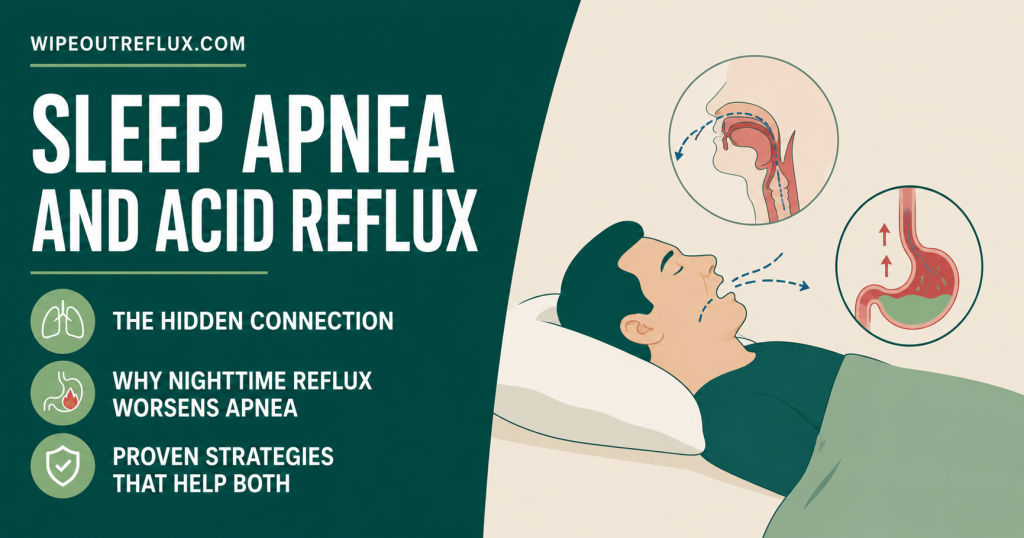
If you have acid reflux or silent reflux (LPR) and you also snore loudly, wake up tired no matter how long you sleep, or feel like you’re gasping during the night—there’s a good chance the two problems are connected. Sleep apnea and acid reflux aren’t just conditions that happen to coexist. They actively drive each other. Understanding that relationship can change how you approach both.
The short version: obstructive sleep apnea (OSA) creates physical pressure changes in the chest that pull stomach acid up into the esophagus and throat. Acid reflux and LPR then inflame and narrow the upper airway, making the apnea worse. It’s a cycle, and it runs in both directions. Research now confirms a bidirectional causal relationship—not just a coincidence of shared risk factors.
In this article I’ll break down exactly how the two conditions interact, why LPR patients are especially vulnerable, what the research shows, and what practically makes a difference when you’re dealing with both at once.
Key Takeaways
- Obstructive sleep apnea (OSA) and acid reflux have a confirmed bidirectional causal relationship—each can cause and worsen the other.
- During apnea events, the violent effort to breathe against a blocked airway creates strong suction forces that pull acid up into the esophagus.
- Around 78% of OSA patients have been found to experience nocturnal acid reflux symptoms.
- Silent reflux (LPR) affects roughly 45–49% of people with OSA—far higher than the general population rate.
- Acid reaching the throat inflames and swells upper airway tissues, narrowing the airway and making sleep apnea worse.
- CPAP therapy—the primary treatment for OSA—has been shown to reduce reflux symptoms by up to 62% as a secondary benefit.
- Obesity, supine sleeping, alcohol, and late eating are shared risk factors that worsen both conditions simultaneously.
- Addressing both conditions together—rather than treating each in isolation—produces better outcomes for both.
How Sleep Apnea Physically Causes Acid Reflux
To understand why sleep apnea and reflux are so closely linked, you need to understand what actually happens during an apnea event. In obstructive sleep apnea, the muscles at the back of the throat relax and the airway partially or completely collapses. When this happens, the sleeper can’t breathe normally. The body responds by trying to force air through the obstruction—and that effort creates a large, sudden drop in pressure inside the chest cavity.
That pressure drop doesn’t just affect the lungs. The negative intrathoracic pressure acts like a suction force on the esophagus, physically pulling stomach contents upward. At the same time, the struggling effort to breathe increases pressure in the abdomen, squeezing the stomach from below. Caught between two opposing pressures, the lower esophageal sphincter (LES)—the valve that normally keeps acid in the stomach—gets overwhelmed. Acid escapes upward, often repeatedly throughout the night.
The Role of Transient LES Relaxations
It doesn’t stop there. Sleep apnea also appears to increase the frequency of transient lower esophageal sphincter relaxations (TLESRs)—brief, spontaneous openings of the LES that are unrelated to swallowing. TLESRs are the main mechanism behind reflux events even in people without OSA. In someone with apnea, the combination of arousal events, pressure fluctuations, and increased TLESRs creates a sustained environment where reflux can happen multiple times per hour throughout the night, completely during sleep and often without any heartburn sensation at all.
Arousal Events and Acid Clearance
Each time an apnea event triggers an arousal—where the brain briefly wakes the body to restore breathing—the normal sleep architecture is disrupted. This matters for reflux because the body’s mechanisms for clearing acid from the esophagus (swallowing, salivation, and peristalsis) are dramatically reduced during sleep. The more arousal events, the longer acid can sit in the esophagus and the greater the chance it travels further upward toward the throat. For people with laryngopharyngeal reflux, where even tiny amounts of acid reaching the larynx can cause damage, this repeated overnight acid exposure becomes a significant problem.
How Acid Reflux and LPR Make Sleep Apnea Worse
The other side of this relationship is equally important. Acid that reaches the upper airway—the throat, larynx, and pharynx—doesn’t just cause reflux symptoms like hoarseness and throat clearing. It triggers a genuine inflammatory response in the tissues of the upper airway itself. Over time, chronic acid exposure causes mucosal swelling, thickening of the tissue, and edema. In an airway that’s already vulnerable to collapse during sleep, this additional inflammation narrows the available space and makes obstruction significantly more likely.
LPR and Upper Airway Inflammation
This is where LPR becomes particularly problematic. Unlike typical GERD, where acid largely stays in the esophagus, LPR deposits acid and pepsin directly onto laryngeal and pharyngeal tissue. Pepsin—the digestive enzyme that travels with stomach acid—can be activated by even mildly acidic conditions and continues to damage throat tissue long after the reflux event itself. The result is an inflamed, irritated upper airway that may contribute to increased airway resistance during sleep and a lower threshold for airway collapse.
This mechanism helps explain why people with LPR symptoms—chronic cough, post-nasal drip, hoarseness, and throat clearing—are disproportionately represented among sleep apnea patients. If you’ve been managing LPR symptoms without much improvement, it’s worth considering whether undiagnosed OSA might be sustaining the cycle from the other direction.
Microaspiration and Vagal Reflexes
A secondary mechanism involves microaspiration—tiny amounts of acid that are inhaled into the lungs rather than swallowed. This can trigger a vagally-mediated reflex causing bronchospasm and airway narrowing. People with sleep apnea and nocturnal reflux often report a chronic night-time cough or waking with a choking sensation, which can be a sign of microaspiration rather than simply a dry room or post-nasal drip.
What the Research Shows
The clinical evidence for this relationship has grown substantially over the last decade. A 2023 Mendelian randomization study—a study design that can establish causal relationships rather than just correlations—found that OSA was causally associated with GERD (OR: 1.19), and that GERD in turn was causally associated with OSA (OR: 1.44). The data came from over 600,000 individuals, making it one of the most robust analyses to date [Zhu et al., Frontiers in Genetics, 2023].
For the LPR connection specifically, a 2022 meta-analysis of 27 studies found that nearly half of all patients with obstructive sleep apnea also had laryngopharyngeal reflux—a rate far above what would be expected by chance alone. The same analysis found that reflux symptom scores and reflux finding scores correlated positively with apnea-hypopnea index (AHI) severity, meaning worse apnea was associated with worse LPR [He et al., Nature and Science of Sleep, 2022].
On the treatment side, a prospective study of 85 veterans with diagnosed OSA found that 78% had nocturnal acid reflux symptoms at baseline. Among those who adhered to CPAP therapy, heartburn scores decreased by 62%—without any acid-reducing medication. Importantly, the benefit scaled with CPAP adherence: the more nights and hours of use, the greater the reflux improvement [Tamanna et al., Journal of Clinical Sleep Medicine, 2016].
An earlier meta-analysis of OSA patients and LPR similarly found a 45.2% incidence of LPR in this patient group, further establishing that the co-occurrence is not coincidental [Magliulo et al., American Journal of Otolaryngology, 2018].
Shared Risk Factors That Drive Both Conditions
Part of the reason OSA and reflux co-occur so frequently is that they share several key risk factors. These aren’t just conditions that happen to affect the same people—they’re driven by the same underlying factors, which is why targeting shared risk factors is so effective:
- Obesity. Excess weight increases intra-abdominal pressure, which pushes acid upward, while fatty deposits around the neck and throat narrow the upper airway. Obesity is the single most important modifiable risk factor for both OSA and GERD.
- Supine sleeping. Lying flat favours both airway collapse and acid migration from the stomach to the esophagus. Both conditions improve with positional changes and head elevation—you can read more about the best sleeping position for silent reflux and how a wedge pillow helps.
- Alcohol. Alcohol relaxes the lower esophageal sphincter and the upper airway muscles simultaneously, worsening both reflux and apnea events.
- Late-night eating. A full stomach at bedtime increases reflux events and can contribute to diaphragmatic pressure changes that worsen breathing during sleep.
- Smoking. Damages the protective mucosal lining of the esophagus and upper airway, and reduces LES pressure.
Could Sleep Apnea Be Behind Your Reflux Symptoms?
This is a question worth taking seriously. Many people with GERD or LPR who don’t fully respond to dietary changes or medication may have undiagnosed obstructive sleep apnea sustaining their reflux from the pressure side. Clues that OSA might be involved include:
- Acid reflux or throat symptoms that are noticeably worse in the morning than during the day
- A bed partner reporting loud snoring, gasping, or observed breathing pauses during sleep
- Waking with headaches, particularly at the back of the head
- Persistent daytime fatigue regardless of how many hours you sleep
- Difficulty losing weight despite attempts, which perpetuates the cycle
- LPR symptoms (hoarseness, cough, throat clearing) that don’t resolve with diet and medication alone
If several of these apply to you, it’s worth raising sleep apnea with your GP. A referral for a sleep study (polysomnography) or a home sleep test is often straightforward to arrange. Diagnosing and treating OSA can dramatically change the trajectory of both conditions.
What Actually Helps When You Have Both Conditions
CPAP Therapy
If you’ve been diagnosed with OSA, CPAP is the most effective treatment—and the reflux data suggests it’s doing more work than most people realise. By eliminating apnea events, CPAP removes the primary driver of nighttime negative pressure spikes that pull acid into the esophagus. The 62% reduction in heartburn scores seen in CPAP-adherent patients is a meaningful result, and it occurs without any additional acid medication. Adherence matters enormously here: minimum effective use is generally considered at least four hours per night. Many people find that once they adjust to the mask and pressure, their reflux symptoms begin to improve alongside their sleep quality.
Sleeping Position
Left-side sleeping with head elevation is beneficial for both conditions. The left lateral position reduces acid exposure in the esophagus by keeping the gastroesophageal junction above the level of the stomach. Head elevation also reduces the likelihood of acid migration to the throat. For OSA specifically, sleeping on the side rather than the back reduces upper airway collapse events significantly in many patients—particularly those with positional OSA, where apnea is worse when lying supine. A wedge pillow is the most reliable way to maintain both of these elements throughout the night.
Diet and Lifestyle Changes
Given that obesity is a shared risk factor, weight management has the largest potential impact on both conditions. Dietary changes that reduce reflux events—avoiding late meals, cutting alcohol, reducing fatty and acidic foods—also reduce the nightly acid load that OSA events then push upward. Getting the evening diet right is particularly important because reflux symptoms caused by OSA mostly occur during sleep, so what you’ve eaten in the final three hours before bed matters more than people typically realise.
For a practical resource on exactly which foods and drinks are safe for acid reflux and LPR along with their pH values, the Essential Reflux Food List is a useful guide to keep close when planning meals—especially in the evening hours.
Treating Both Conditions Together
Perhaps the most important practical point is that treating only one condition often produces partial results. If your GERD isn’t fully controlled by PPIs and diet alone, that might be because OSA is generating new acid exposure events every night. If your sleep apnea symptoms are persisting despite CPAP, it’s possible that reflux-driven upper airway inflammation is maintaining some of the obstruction. The two conditions reinforce each other, and the most complete approach addresses both simultaneously.
Frequently Asked Questions
Can sleep apnea cause acid reflux even if I don’t feel heartburn?
Yes—and this is particularly relevant for LPR. During apnea events, acid is pushed up into the esophagus and potentially the throat without necessarily causing the burning sensation associated with heartburn. Many people experience purely throat-based symptoms—hoarseness, coughing, throat clearing, or post-nasal drip—as a result of OSA-driven reflux, with no classic heartburn at all. Silent reflux (LPR) is notoriously easy to miss because the main symptoms don’t feel like reflux.
What percentage of sleep apnea patients have acid reflux?
Research suggests approximately 78% of OSA patients experience nocturnal acid reflux symptoms. The overlap is substantial and considered to go well beyond shared risk factors—the mechanical pressure events of apnea appear to directly drive reflux events during sleep.
Does CPAP help with acid reflux?
Yes, for many people. A study of OSA patients found that CPAP therapy with adequate adherence reduced heartburn scores by 62% on average—without any additional acid-suppressing medication. The effect works by eliminating the negative pressure spikes that physically drive acid upward during apnea events.
What is the connection between sleep apnea and LPR specifically?
Meta-analyses suggest that roughly 45–49% of OSA patients also have laryngopharyngeal reflux. The mechanisms run in both directions: OSA-driven pressure events push acid past the upper esophageal sphincter into the throat; and LPR-related inflammation of laryngeal and pharyngeal tissue narrows the upper airway and lowers the threshold for obstruction during sleep.
Should I see a gastroenterologist or a sleep specialist first?
If you have significant symptoms of both conditions, it’s worth raising both with your GP and asking for appropriate referrals. A sleep study is needed to diagnose OSA, while GERD and LPR are typically evaluated by a gastroenterologist or ENT specialist. If both are suspected, addressing OSA first—or both concurrently—tends to produce the best overall outcomes.
Does losing weight help both sleep apnea and acid reflux?
Yes—weight loss is one of the few interventions that can meaningfully improve both conditions at once. Reducing abdominal and neck fat lowers intra-abdominal pressure (reducing reflux), reduces the mechanical load on the upper airway (reducing apnea events), and improves overall sleep architecture. Even modest weight loss—5–10% of body weight—can produce measurable improvements in both AHI and reflux symptom frequency.
Can treating acid reflux improve sleep apnea?
Potentially, particularly in patients whose OSA is being sustained partly by reflux-driven upper airway inflammation. Reducing acid exposure with medication, dietary changes, and positional therapy can reduce laryngeal and pharyngeal mucosal swelling over time. While this is unlikely to resolve significant structural OSA on its own, it may reduce airway resistance and improve the response to other OSA treatments.
The Bottom Line
Sleep apnea and acid reflux are not just two separate conditions that happen to appear together. They’re mechanically linked in ways that mean each one actively sustains the other. If you’re dealing with persistent reflux or LPR that doesn’t fully respond to the usual interventions, OSA is a real possibility worth investigating—particularly if you recognise the telltale signs of poor sleep quality, snoring, or morning fatigue.
The most complete approach to both conditions covers the same ground: left-side sleeping with head elevation, evening diet management, weight management where relevant, and addressing the OSA directly through CPAP if diagnosed. Getting the diet right is foundational to everything else—and the Wipeout Diet Plan covers this in depth, including the dietary and lifestyle framework I used to manage my own LPR, which becomes particularly important once you understand how much overnight diet choices affect both conditions.
For quick reference on which foods and drinks are safe for acid reflux and LPR along with pH values, the Essential Reflux Food List is a useful practical companion—especially when planning the last meal of the day.
Research Sources
[Zhu et al., Frontiers in Genetics, 2023] — A bidirectional two-sample Mendelian randomization study using data from over 600,000 individuals establishing that OSA is causally associated with GERD (OR: 1.19) and that GERD is causally associated with OSA (OR: 1.44), confirming the bidirectional nature of the relationship beyond shared risk factors.
[He et al., Nature and Science of Sleep, 2022] — An updated meta-analysis of 27 studies finding that the prevalence of laryngopharyngeal reflux in obstructive sleep apnea-hypopnea syndrome patients is 49%, with reflux symptom and finding scores positively correlated with apnea-hypopnea index severity.
[Tamanna et al., Journal of Clinical Sleep Medicine, 2016] — A prospective study of 85 OSA patients finding that 78% had nocturnal acid reflux symptoms at baseline, and that CPAP therapy with adequate adherence reduced heartburn scores by an average of 62% without any acid-reducing medication.
[Magliulo et al., American Journal of Otolaryngology, 2018] — A literature review and meta-analysis of 10 studies covering 870 OSA patients, demonstrating a 45.2% incidence of laryngopharyngeal reflux in the OSA population and a significantly higher BMI in LPR-positive compared to LPR-negative OSA patients.

David Gray
12 years living with LPR · Consultant & researcher
I've lived with LPR for twelve years — the misdiagnoses, the PPI courses that did nothing, the slow work of figuring out what actually helps. Wipeout Reflux is where I translate the research into plain terms for people stuck in the same place. Every claim here is sourced to peer-reviewed work, and I consult one-to-one with LPR sufferers.