
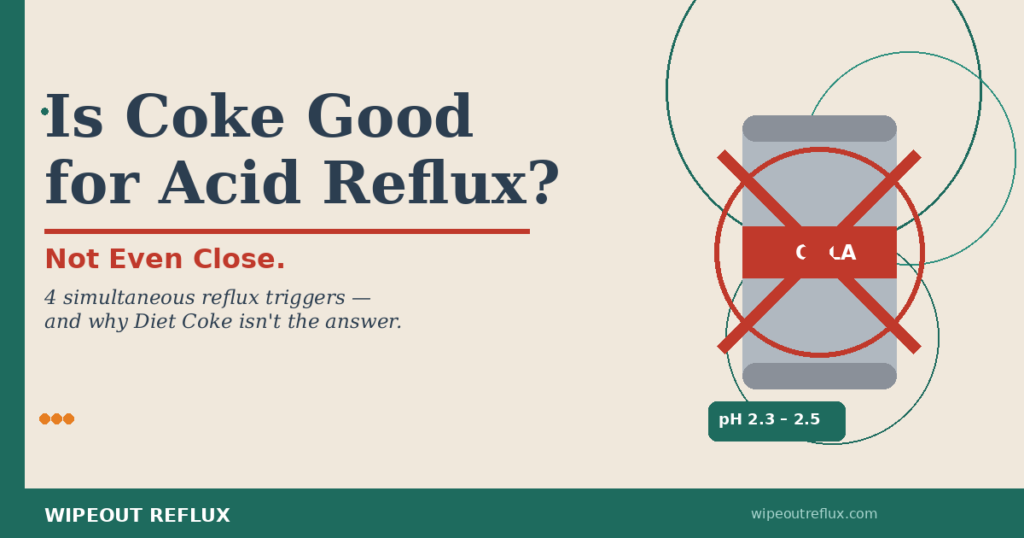
No — Coke is not good for acid reflux. Coca-Cola stacks together four separate reflux triggers in a single drink: extreme acidity (pH ~2.3–2.5), carbonation that expands gas in the stomach, caffeine that weakens the lower esophageal sphincter (LES), and high sugar content. Every one of those properties works against the valve that keeps acid where it belongs.
There’s a persistent idea that Coke can settle an upset stomach, and for some people that experience feels real. But the brief comfort it offers is typically outweighed by the reflux it provokes — and for anyone with GERD or LPR (silent reflux), the case against Coke is especially strong.
Below I’ll break down exactly why Coke is such a problem, what the research says, and what to drink instead when you’re looking for relief.
Key Takeaways
- Coke has a pH of approximately 2.3–2.5 — comparable in acidity to stomach acid — and directly acidifies the esophagus on the way down.
- Carbonation expands gas inside the stomach, increasing intra-gastric pressure and triggering transient lower esophageal sphincter relaxations (TLESRs) — the main mechanism behind most reflux episodes.
- Caffeine in Coke significantly lowers LES pressure, making it easier for acid to reflux upward into the esophagus and throat.
- Large prospective data from the Nurses’ Health Study II found that soda intake was associated with a 29% higher risk of GER symptoms in women who consumed it most frequently.
- Diet Coke and Coke Zero remove the sugar but keep the carbonation, caffeine, and extreme acidity — making them just as problematic for reflux as regular Coke.
- LPR (silent reflux) sufferers face a double hit from Coke: the carbonation-driven belching delivers an aerosol of pepsin and acid directly to the throat and larynx.
- Alkaline water, chamomile tea, and plain still water are the best replacement options when you need to manage reflux symptoms.
Why Coke Is Bad for Acid Reflux: The Four Triggers
Most drinks cause reflux through one mechanism. Coke manages four simultaneously, which is why it’s consistently one of the worst choices for anyone dealing with GERD or LPR. Here’s each one broken down.
1. Extreme Acidity
Coke has a pH of roughly 2.3–2.5 depending on the formulation. To put that in context, the pH scale runs from 0 (most acidic) to 14 (most alkaline), with 7 being neutral. Stomach acid sits around pH 1.5–3.5 — so Coke is in a similar range. When you drink it, you’re essentially pouring a highly acidic liquid directly onto any tissue that’s already been irritated or inflamed by reflux. If your esophagus or throat is already sensitised from prior acid exposure, Coke can trigger immediate discomfort even before it reaches the stomach.
For LPR sufferers, this is particularly relevant. The tissues of the throat and larynx have almost no acid-buffering capability — unlike the esophageal lining, which at least has some protection. Even a small amount of acidic liquid making contact with those tissues can provoke or worsen symptoms like throat clearing, hoarseness, and the burning sensation behind the sternum.
2. Carbonation and Gas Pressure
Carbonation is perhaps the most mechanically direct problem. When you drink any carbonated beverage, the dissolved CO₂ comes out of solution in your stomach, rapidly expanding the volume of gas inside it. That gas creates distension — your stomach stretches — and the resulting pressure pushes upward against the LES.
Research measuring this effect directly found that drinking a carbonated cola drink increased the frequency of transient lower esophageal sphincter relaxations (TLESRs) compared to plain water [Mone et al., Neurogastroenterology & Motility, 2012]. TLESRs are the primary physiological mechanism behind the vast majority of reflux episodes — they’re the moments when the valve briefly relaxes and allows stomach contents to flow upward. Carbonation actively increases how often this happens.
A systematic review of the literature on carbonated beverages and GERD confirmed that carbonated drinks lead to a transient reduction in LES basal pressure and a short-term decline in intra-esophageal pH following consumption [Cuomo et al., Alimentary Pharmacology & Therapeutics, 2010]. Those are exactly the two conditions that allow acid to reflux.
3. Caffeine
A standard 330ml can of Coke contains around 34mg of caffeine — less than a coffee but enough to have a measurable effect on the LES. Caffeine’s mechanism is direct: it reduces basal LES pressure, making the valve less capable of staying shut between swallows. The effect is well-documented and was confirmed in a study showing that caffeine at doses comparable to typical consumption significantly lowered LES pressure at 10, 15, 20, and 25 minutes after ingestion [Lohsiriwat et al., Diseases of the Esophagus, 2006].
For someone whose lower esophageal sphincter is already weakened or struggling, adding a caffeine load on top of carbonation-driven pressure is a compounding problem. The two together create conditions where acid reflux is not just possible — it’s likely.
4. Sugar
A regular can of Coke contains about 35g of sugar. High sugar intake is linked to worsened GERD symptoms, partly because it can slow gastric emptying — meaning food and acid stay in the stomach longer, creating more opportunity for reflux. Sugar also feeds the fermentation processes that produce gas, which circles back to the carbonation problem: Coke brings its own CO₂ and then creates conditions for more gas production after the fact.
Large-scale prospective data from the Nurses’ Health Study II — which tracked over 48,000 women — found that soda intake was associated with a statistically significant increased risk of GER symptoms. Women consuming the highest amounts of soda had a 29% higher hazard ratio for developing reflux symptoms compared to those who consumed none. Substituting 2 servings of soda per day with water was associated with a meaningful reduction in that risk [Mehta et al., The American Journal of Gastroenterology, 2020].
What About Diet Coke and Coke Zero?
This is a question I get asked a lot, and the honest answer is that Diet Coke and Coke Zero aren’t meaningfully better for acid reflux than regular Coke.
Yes, removing the sugar eliminates one of the four triggers. But the other three — extreme acidity, carbonation, and caffeine — remain entirely intact. Diet Coke has a pH of around 3.1–3.4, which is slightly less acidic than regular Coke but still firmly in the problematic range. Coke Zero is similarly acidic. Both are still carbonated, and both still contain caffeine.
There’s also the question of artificial sweeteners. Aspartame and acesulfame-K (used in Coke Zero and Diet Coke) can affect gut motility and microbiome composition in ways that aren’t fully understood. For some people with sensitive digestive systems, these may add another layer of irritation on top of the core reflux triggers the drinks share with regular Coke.
If you’re switching from Coke to Diet Coke or Coke Zero and hoping that will manage your acid reflux or GERD, it’s unlikely to make a significant difference. The carbonation and caffeine are doing more damage than the sugar in this context.
Coke and LPR (Silent Reflux): A Specific Problem
If you have LPR rather than classic GERD, Coke deserves particular attention because the carbonation adds a mechanism that makes LPR symptoms considerably worse.
When carbonation causes gas to build up in the stomach and triggers belching, the belch doesn’t just release gas. It releases an aerosol — a fine mist of gastric contents including stomach acid, pepsin, and bile — that travels up the esophagus and into the throat and larynx. Pepsin is the digestive enzyme produced by the stomach, and it remains biologically active in mildly acidic environments. When it lands on the tissue of your throat, it continues to digest — causing exactly the kind of chronic irritation that produces LPR symptoms like throat clearing, hoarseness, globus sensation (the feeling of something stuck in your throat), and post-nasal drip.
Because this mechanism is driven by gas and belching rather than pure acid, it partially explains why PPIs — which reduce acid but don’t stop belching — often fail to fully resolve LPR symptoms. Coke, with its carbonation creating gas and its acidity making the aerosol more damaging, is one of the worst possible drinks for someone with LPR.
Can Coke Ever Help an Upset Stomach?
There are people who swear by flat Coke for an unsettled stomach, and I don’t think this is entirely made up. But the mechanism is specific, limited, and doesn’t apply to acid reflux.
The idea is that if someone has temporarily low stomach acid — perhaps due to illness, nausea, or post-viral digestive disruption — the acidity of Coke might briefly help the stomach break down food more effectively. The sugar may also provide a quick energy source when someone is mildly dehydrated or unwell. And if the Coke has gone flat (losing most of its carbonation), it at least removes one of the major reflux triggers.
But none of this applies to someone with reflux. The problem in acid reflux is acid coming up — not insufficient acid going down. Adding more acid via Coke doesn’t help that equation. And even if it offered some transient comfort, the mechanical pressure from carbonation and the LES-weakening effect of caffeine would almost certainly provoke further reflux within the hour.
My recommendation: don’t use Coke as a remedy for an upset stomach, and certainly don’t use it as a remedy for acid reflux, whether that’s occasional heartburn, ongoing GERD, or LPR.
What to Drink Instead
If you’re looking for drinks that genuinely help reflux rather than aggravate it, here are the options I’d point you toward.
Alkaline Water
Alkaline water with a pH above 8 can help neutralise excess stomach acid and is one of the best go-to drinks for someone with reflux. Unlike Coke, it adds no acid, no gas, and no caffeine. It also helps maintain adequate hydration, which is important for overall digestive health. For more on this, check our article on alkaline water and acid reflux.
Chamomile Tea
Chamomile has anti-inflammatory properties and is one of the gentlest drinks for the esophagus and stomach. It’s non-acidic, non-carbonated, and caffeine-free — the opposite of Coke in every relevant way. It can be drunk regularly throughout the day as a calming option. See our full write-up on chamomile tea and acid reflux.
Plain Still Water
Still water is reliably safe for reflux. It helps dilute stomach acid, supports gastric motility, and doesn’t introduce any of the triggers that Coke brings. If your throat is irritated from LPR, sipping plain room-temperature water regularly through the day can help wash pepsin off the throat lining before it causes further damage.
Baking Soda and Water
For immediate relief during a reflux flare, mixing a small amount of baking soda (sodium bicarbonate) with water creates an alkaline solution that can temporarily neutralise stomach acid. It shouldn’t be used regularly — the sodium content is too high for that — but as an occasional intervention it can be effective. Full details in our article on baking soda for heartburn.
Marshmallow Root or Fennel Tea
Both of these herbal teas have soothing properties for the digestive tract. Marshmallow root contains mucilage that coats the esophageal lining, while fennel has traditionally been used to ease bloating and gas — which makes it a particularly useful choice if carbonation-driven distension is part of your symptom picture.
The Bottom Line
Coke is one of the most reliably problematic drinks you can choose if you have acid reflux. It doesn’t just tick one box — it hits every major reflux trigger at once, and does so in amounts that are more than trivial. The extreme acidity, the carbonation pressure, the caffeine effect on the LES, and the sugar all compound each other. For people with LPR in particular, the carbonation-driven aerosol effect makes Coke a genuine aggravator of throat symptoms in a way that goes beyond simple heartburn.
Switching to Diet Coke or Coke Zero doesn’t solve the underlying problem. The core triggers remain, and the swap is unlikely to move the needle on your symptoms.
If you’re finding that drinks and dietary choices are central to your reflux — which in my experience they almost always are — then the approach needs to go further than swapping one drink for another. The Wipeout Diet Plan is built around exactly this kind of detail: understanding which foods and drinks are driving your individual symptoms, and building a framework around the choices that actively support healing rather than simply reducing the worst offenders. If you’re managing reflux reactively and still struggling, it’s worth looking at the full picture of what you’re eating and drinking — not just cutting out Coke.
For personalised guidance on your specific situation, a one-to-one consultation is always available if you want help putting it all together.
Frequently Asked Questions
Is Coke bad for acid reflux?
Yes. Coke is one of the worst drinks for acid reflux because it combines four major triggers simultaneously: extreme acidity (pH ~2.3–2.5), carbonation that increases stomach pressure and triggers LES relaxations, caffeine that weakens the LES, and high sugar content. Each of these independently worsens reflux; together they compound each other significantly.
Can Coke help acid reflux or an upset stomach?
In very specific circumstances — such as when someone has temporarily low stomach acid due to illness — the acidity of Coke might briefly ease digestive discomfort. However, this is not the same as acid reflux, and Coke should not be used as a remedy for reflux. Any short-lived benefit is typically outweighed by the reflux it provokes through carbonation and caffeine effects on the LES.
Is Diet Coke or Coke Zero better for acid reflux?
Not meaningfully. Diet Coke and Coke Zero remove the sugar but retain the carbonation, caffeine, and extreme acidity that are the primary reflux triggers in Coke. Their pH is only slightly less acidic (around 3.1–3.4), and they still cause carbonation-driven LES relaxations and caffeine-related LES pressure reduction. Switching from regular Coke to the diet versions is unlikely to make a significant difference to reflux symptoms.
Why does Coke make my acid reflux worse?
Most likely because of the carbonation. The CO₂ in Coke expands in your stomach, causing distension that pushes up against the LES and triggers it to relax at the wrong times — allowing stomach contents to reflux upward. The caffeine adds to this by reducing how much pressure the LES can maintain. If you also have LPR, the belching caused by carbonation carries an aerosol of acid and pepsin up to your throat, which is particularly irritating to those tissues.
What is the pH of Coke?
Regular Coca-Cola has a pH of approximately 2.3–2.5, making it extremely acidic — in a similar range to stomach acid itself (pH 1.5–3.5). Diet Coke is slightly less acidic at around 3.1–3.4. For context, plain water is neutral at pH 7, and most herbal teas sit between 6 and 7.
What drinks are safe for acid reflux?
The best options are plain still water, alkaline water (pH 8+), chamomile tea, marshmallow root tea, and fennel tea. These drinks are non-acidic, non-carbonated, and caffeine-free — avoiding all the major triggers that make Coke so problematic. Avoiding carbonated drinks entirely is recommended by the American College of Gastroenterology as part of GERD lifestyle management.
Related Articles
- Is Alkaline Water Good for Acid Reflux?
- Is Chamomile Tea Good for Acid Reflux?
- Baking Soda for Heartburn: How It Works and When to Use It
- The Ultimate Guide to Acid Reflux and GERD
- The Complete Guide to LPR (Silent Reflux)
- Understanding the Lower Esophageal Sphincter and LPR
Research Sources
Carbonated beverage consumption results in a transient reduction in LES basal pressure and a short-term decline in intra-esophageal pH, supporting avoidance in GERD management [Cuomo et al., Alimentary Pharmacology & Therapeutics, 2010]. Drinking a carbonated cola drink increased the frequency of transient lower esophageal sphincter relaxations (TLESRs) compared to still water in healthy subjects [Mone et al., Neurogastroenterology & Motility, 2012].
Caffeine consumption significantly lowered LES pressure at 10, 15, 20, and 25 minutes post-ingestion and reduced distal esophageal contraction amplitude, directly promoting conditions for reflux [Lohsiriwat et al., Diseases of the Esophagus, 2006]. In the Nurses’ Health Study II, soda intake was associated with a 29% higher risk of GER symptoms at high consumption levels; replacing 2 daily servings of soda with water significantly reduced that risk [Mehta et al., The American Journal of Gastroenterology, 2020].

David Gray
12 years living with LPR · Consultant & researcher
I've lived with LPR for twelve years — the misdiagnoses, the PPI courses that did nothing, the slow work of figuring out what actually helps. Wipeout Reflux is where I translate the research into plain terms for people stuck in the same place. Every claim here is sourced to peer-reviewed work, and I consult one-to-one with LPR sufferers.