
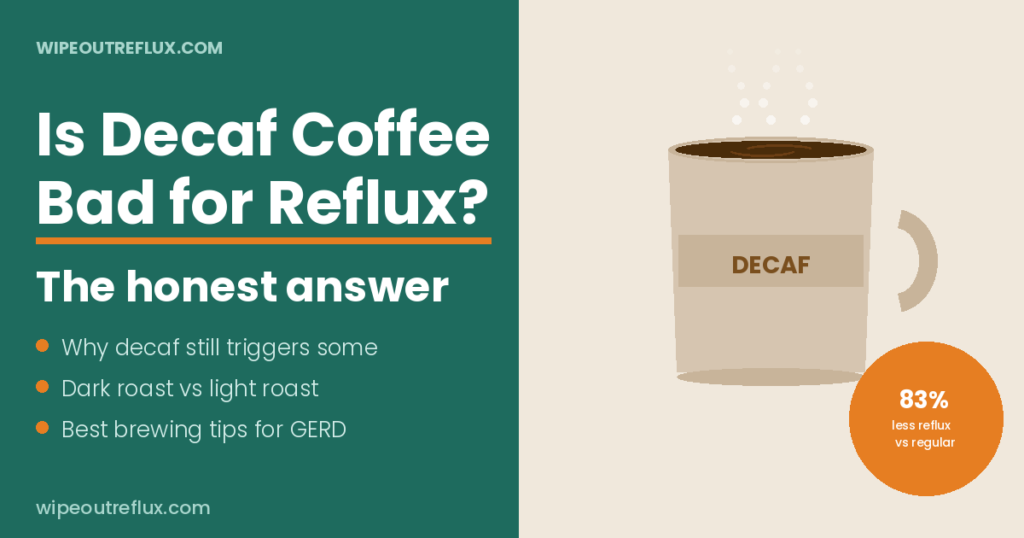
Switching to decaf is one of the first things people with acid reflux try — and in most cases it genuinely helps. But whether decaf coffee is actually safe, and how much it helps versus regular coffee, is more nuanced than most people realise. The mechanism behind coffee and reflux is not simply caffeine, which has important implications for how you choose and prepare your decaf.
Decaf coffee is significantly less likely to cause acid reflux than regular coffee, but it is not neutral. Research shows that switching to decaf can reduce esophageal acid exposure time by around 83% compared to regular coffee — a meaningful improvement. However, decaf still contains chlorogenic acids and other compounds that stimulate gastric acid secretion and can trigger symptoms in sensitive individuals, particularly on an empty stomach. For most people with mild to moderate reflux, decaf is a reasonable choice. For active GERD or LPR, it should still be approached with care.
Below I’ll explain the mechanisms clearly, cover what the research actually shows, and give you genuinely useful guidance on how to make the most reflux-friendly cup possible.
Key Takeaways
- Switching from regular to decaf coffee can reduce esophageal acid exposure time from around 17.9% to just 3.1% — roughly an 83% reduction — based on studies in GERD patients.
- Caffeine alone, when added to plain water, does not significantly trigger gastro-oesophageal reflux. The reflux problem in regular coffee comes primarily from other compounds — particularly chlorogenic acids — not caffeine by itself.
- Decaf retains these non-caffeine compounds. Chlorogenic acids remain largely intact after decaffeination and continue to stimulate gastric acid secretion.
- Dark roast coffee — including dark roast decaf — produces significantly less gastric acid stimulation than medium or light roast, due to higher levels of a compound called N-methylpyridinium (NMP) that actively suppresses acid secretion.
- Cold brew decaf has lower titratable acidity than hot brew decaf and may be easier on the stomach.
- Adding milk to decaf coffee is a reasonable harm-reduction measure — milk proteins buffer acidity and soften the stomach-lining irritation. It is cream (high fat) and large amounts of sugar that worsen reflux, not milk itself.
- For LPR (silent reflux), even decaf should be used cautiously — the residual acidity and gastric acid stimulation can contribute to pepsin activity in the throat.
- Swiss Water Process or CO₂-decaffeinated coffees are preferred over chemical solvent methods for those with gut sensitivity.
Why Regular Coffee Triggers Acid Reflux
To understand decaf properly, you need to understand why regular coffee causes reflux in the first place — and the answer is more complex than most articles acknowledge.
Regular coffee triggers reflux through two main pathways. First, certain compounds — particularly caffeine and chlorogenic acids — relax the lower esophageal sphincter (LES), the valve between the stomach and esophagus that keeps acid where it belongs. When the LES relaxes inappropriately, stomach contents can reflux upward.
Second, coffee stimulates the stomach to produce more gastric acid — meaning there is both more acid available to reflux and a weakened barrier keeping it down. This is a particularly bad combination.
Here is the crucial finding, though: a landmark study tested what happens when you add caffeine directly to water and give it to reflux patients. The result was that caffeine-only water had no significant effect on gastro-oesophageal reflux. The reflux-triggering compounds in coffee are primarily not caffeine itself, but the phenolic acids — particularly chlorogenic acids — present in the coffee bean. Decaffeination removes caffeine but leaves these compounds largely intact [__Wendl et al., Alimentary Pharmacology & Therapeutics, 1994__].
This reframes the entire decaf question: decaf removes one contributing factor (caffeine’s LES-relaxing effect) but does not address the non-caffeine mechanisms. Understanding this is what allows you to make genuinely smarter choices.
Does Decaffeination Actually Help?
Yes — significantly, but not completely. The clinical evidence is clear on this.
In the 1994 Wendl study above, decaffeination significantly reduced gastro-oesophageal reflux compared to regular coffee in healthy volunteers. A follow-up study specifically in patients with reflux disease confirmed this finding in a more clinically relevant population, measuring esophageal acid exposure time over three hours after drinking regular versus decaffeinated coffee with a standardised breakfast. Regular coffee produced a reflux time of 17.9%; decaffeinated coffee reduced this to just 3.1% — an 83% reduction [__Pehl et al., Alimentary Pharmacology & Therapeutics, 1997__].
That 83% reduction is clinically meaningful. For most people with reflux, switching from regular to decaf coffee represents a significant step down in risk. If you are currently drinking regular coffee and suffering symptoms, decaf is a sensible first switch to try.
The important caveat is that “significantly reduced” is not the same as “eliminated.” The residual 3.1% acid exposure time still exceeds that of water, and for people with already-inflamed esophageal or laryngeal tissue, even a reduced reflux burden can cause ongoing irritation.
Why Decaf Coffee Can Still Cause Reflux
If you have switched to decaf and are still getting symptoms, the most likely culprit is chlorogenic acids — and there is a counterintuitive wrinkle to be aware of.
Chlorogenic Acids Remain After Decaffeination
Chlorogenic acids are phenolic compounds naturally present in coffee beans. They stimulate gastric acid secretion and can affect LES tone independently of caffeine. Crucially, the decaffeination process — whether Swiss Water, CO₂, or solvent-based — does not remove chlorogenic acids. The bean’s acid profile is essentially unchanged by decaffeination.
Research has shown that chlorogenic acid and caffeic acid both stimulate gastric acid secretion and may weaken LES control independently of caffeine. These compounds remain fully present in your cup of decaf. In fact, some decaffeination processes may slightly concentrate non-caffeine compounds by selectively removing caffeine, meaning some decaf coffees can have marginally higher chlorogenic acid levels than their regular counterparts.
The pH of Decaf Is Nearly Identical to Regular Coffee
Decaf coffee typically has a pH of around 4.85 to 5.10 — essentially the same as regular coffee. Decaffeination does not meaningfully change acidity. If you were hoping that decaf would be significantly less acidic, that hope is mostly unfounded. Any advantage decaf has over regular coffee comes from reducing caffeine-related LES relaxation, not from lower acidity.
Drinking It on an Empty Stomach
Without food to buffer the stomach, the chlorogenic acids in decaf coffee have more direct access to the stomach lining, and gastric acid secretion is stimulated in a less-buffered environment. Drinking decaf coffee first thing in the morning before eating is a common pattern that produces more reflux risk than the same coffee would create after breakfast.
The Dark Roast Advantage: Why Roast Level Matters
This is one of the most practically useful pieces of research in the coffee and reflux field, and it is almost never mentioned in general reflux advice.
During the roasting process, a compound called N-methylpyridinium (NMP) forms in coffee beans. Research has shown that NMP actively suppresses gastric acid secretion at the cellular level — it increases expression of the anti-secretory somatostatin receptor and down-regulates pro-secretory receptors [__Bode et al., Molecular Nutrition & Food Research, 2012__]. Dark roasting produces significantly more NMP than medium or light roasting.
At the same time, dark roasting breaks down chlorogenic acids — the primary gastric acid stimulants — reducing their concentration significantly. A study directly comparing dark roast and medium roast coffees with identical caffeine content found that dark roast stimulated significantly less gastric acid secretion in healthy volunteers, attributing this to the higher NMP and lower chlorogenic acid content of the darker roast [__Rubach et al., Molecular Nutrition & Food Research, 2014__].
The practical implication is straightforward: if you are going to drink decaf coffee, choosing a dark roast decaf gives you the caffeine reduction of decaffeination combined with the lower chlorogenic acid and higher NMP profile of a darker roast. This is the most stomach-friendly version of coffee available.
What About LPR (Silent Reflux)?
If you have LPR (laryngopharyngeal reflux), I would be more cautious about decaf coffee than for straightforward GERD or heartburn.
LPR involves pepsin — the digestive enzyme — reaching the throat and airways. Pepsin becomes active and damaging when it encounters an acidic environment, which is why foods and drinks that lower the pH of the throat or stimulate gastric acid production are particularly problematic for LPR sufferers. At a pH of 4.85–5.10, decaf coffee sits in a range that can contribute to a mildly acidic throat environment, and its stimulation of gastric acid secretion creates more acidic material available to reflux upward.
This does not mean decaf coffee is absolutely off-limits for LPR, but it does mean I would treat it the same way I treat other borderline items: avoided during active flare phases, tested cautiously once symptoms have stabilised, and never consumed on an empty stomach or close to lying down. If you are in the early stages of managing LPR and still symptomatic, removing decaf coffee for 3–4 weeks is a worthwhile test to see whether it is contributing to your throat symptoms.
Practical Tips: How to Make Decaf Coffee Easier on Reflux
Choose Dark Roast Decaf
As covered above, dark roast decaf is the optimal combination for reflux management — lower chlorogenic acids, higher NMP, no caffeine. Look specifically for dark or extra-dark roast decaf options. Most supermarket decaf is medium roast; specialist coffee retailers are more likely to carry dark roast decaf.
Try Cold Brew Decaf
Cold brew involves steeping coffee grounds in cold water for 12–24 hours rather than hot water extraction. Research comparing cold brew and hot brew coffee found similar pH levels between the two, but cold brew has significantly lower titratable acidity — meaning less total acid content per cup, even at the same pH. Cold brew decaf extracts fewer chlorogenic acids and other irritating compounds, making it the gentlest preparation method. It is worth trying if hot decaf still causes you problems.
Drink It After Food, Not Before
Having decaf coffee after a meal rather than before gives the food you’ve eaten time to buffer the stomach and reduce the direct stimulation of gastric acid. This single timing change makes a meaningful difference for most people. The habit of having coffee as the first thing in the morning — on a completely empty stomach — is one of the most common patterns that converts a borderline-tolerable drink into a clear trigger.
Use Alkaline Water to Brew
Using alkaline water (pH 8.0 or above) to make your coffee raises the overall pH of the finished drink, making it less acidic in the cup. This is a straightforward hack that reduces the acidity burden without changing the coffee itself. Alkaline water with a pH of 8–9 is sufficient for this purpose.
Add Milk — But Skip the Cream
Adding a moderate amount of dairy milk to decaf coffee is a net positive for reflux management. Milk proteins — particularly casein — buffer the acidity and may reduce direct stomach-lining irritation. This is different from adding cream or large amounts of non-dairy creamers, which are high in fat and can worsen reflux by slowing gastric emptying. The tip to “minimise milk” in coffee is therefore a partial misconception — the issue is specifically cream and high-fat dairy additives, not milk itself. A reasonable splash of milk is fine and modestly helpful.
Choose Swiss Water Process or CO₂ Decaf
There are three main decaffeination methods: solvent-based (using methylene chloride or ethyl acetate), Swiss Water Process (water-only extraction), and CO₂ extraction. For people with gut sensitivity, Swiss Water or CO₂ decaf is the better choice — both are solvent-free and considered cleaner processes. Solvent-based decaf is safe at approved residue levels, but for anyone already managing a sensitive digestive system, the fewer chemical residues the better. Most quality specialty coffee brands will state their decaffeination method on the packaging.
Limit to One to Two Cups Per Day
Even decaf coffee is a cumulative acid load. One carefully prepared cup after breakfast is a very different situation to three cups throughout the day, including on an empty stomach. If you are finding that decaf is a borderline trigger, reducing frequency rather than switching brands is often the first lever to pull.
Frequently Asked Questions
Is decaf coffee bad for acid reflux?
It is significantly less problematic than regular coffee, but not neutral. Decaf can still trigger reflux in sensitive individuals because it retains chlorogenic acids that stimulate gastric acid secretion, and its pH is nearly identical to regular coffee. For most people with mild reflux, decaf is a reasonable choice when consumed thoughtfully. For active GERD or LPR, it should still be used cautiously.
Which coffee is best for acid reflux?
Dark roast decaf, prepared as cold brew or with alkaline water, after a meal, is the most reflux-friendly combination the research supports. Dark roast reduces chlorogenic acid content and increases NMP — a compound that actively suppresses gastric acid secretion. Decaf removes the caffeine-related LES relaxation. Cold brew further reduces the total acid extracted. Together, these changes address most of the mechanisms through which coffee triggers reflux.
Is decaf coffee less acidic than regular coffee?
Only minimally. The pH of decaf coffee (typically 4.85–5.10) is nearly the same as regular coffee. Decaffeination does not meaningfully change the acid profile of the bean. Any benefit decaf offers comes from reduced caffeine content, not reduced acidity.
Can I drink decaf coffee if I have GERD?
Many people with GERD tolerate decaf without significant problems, particularly when following the preparation tips above. The clinical research shows an 83% reduction in acid exposure time with decaf compared to regular coffee, which is meaningful. That said, individual responses vary. If decaf continues to cause symptoms despite optimising preparation, it may be worth taking a break and testing whether your symptoms improve.
Is instant coffee better or worse than ground decaf for reflux?
Instant coffee actually tends to have a slightly higher pH than filtered brewed coffee, making it marginally less acidic in the cup. However, instant decaf typically uses lower-quality beans, often medium-roasted, which means higher chlorogenic acid content and less NMP benefit. On balance, a quality dark roast ground decaf, prepared carefully, is the better option for reflux management despite not necessarily being lower in pH than instant.
Is cold brew decaf better for acid reflux than hot brew decaf?
Yes, in most cases. While the pH of cold brew and hot brew is similar, cold brew extracts fewer total acids from the grounds due to its low-temperature, long-duration brewing process. This results in lower titratable acidity — less total acid per cup — making it gentler on the stomach and esophagus.
Does decaf coffee affect LPR differently than regular acid reflux?
It can. LPR involves pepsin reaching the throat, where it is activated by acidity. Because decaf coffee is still mildly acidic and still stimulates gastric acid production, it can contribute to pepsin activation in the throat even without the caffeine component. People with LPR often need to be more conservative than those with standard GERD and may find even decaf triggers throat symptoms.
Conclusion
Decaf coffee is a genuine step in the right direction for anyone with acid reflux who cannot or does not want to give up coffee entirely. The research is clear: replacing regular coffee with decaf reduces esophageal acid exposure substantially — and for many people, this change alone is enough to make coffee a tolerable part of their diet.
But decaf is not a free pass. The non-caffeine compounds in coffee — particularly chlorogenic acids — survive the decaffeination process and continue to stimulate gastric acid secretion. The pH of the cup is virtually unchanged. And for people with LPR, where even small acid exposures can perpetuate throat symptoms, decaf should be used thoughtfully rather than freely.
The most practical takeaway from the research is this: if you are going to drink decaf, the choices that matter most are roast level (dark), preparation method (cold brew where possible), brewing water (alkaline), timing (after food), and frequency (one to two cups per day). Get those variables right and you are working with the science rather than against it.
If you are still struggling with symptoms despite switching to decaf and optimising your preparation, my Wipeout Diet Plan covers the broader dietary framework for reducing acid reflux at the source — including which beverages to keep, which to cut, and in what order to make changes. And for personalised guidance on your specific situation, you can book a private consultation here.
Related Articles
- Is Alkaline Water Good for Acid Reflux?
- The Complete Guide to LPR (Silent Reflux)
- The Ultimate Guide to Acid Reflux and GERD
- Earl Grey Tea and Acid Reflux: Is It Safe to Drink?
- Is Chamomile Tea Good for Acid Reflux?
- Understanding the Lower Esophageal Sphincter and Reflux
Research & References
- A three-hour ambulatory pH-metry study in 16 healthy volunteers found that decaffeination significantly reduced gastro-oesophageal reflux compared to regular coffee. Critically, caffeine-only water produced no significant reflux effect, demonstrating that non-caffeine compounds in coffee are the primary reflux drivers [__Wendl et al., Alimentary Pharmacology & Therapeutics, 1994__].
- In patients with confirmed reflux disease, switching from regular to decaffeinated coffee reduced esophageal acid exposure time from 17.9% to 3.1% over three hours — an 83% reduction — confirming that decaffeination is clinically meaningful for GERD management [__Pehl et al., Alimentary Pharmacology & Therapeutics, 1997__].
- N-methylpyridinium (NMP), a compound that forms during dark roasting, was shown to down-regulate gastric acid secretion mechanisms in human gastric cells, increasing anti-secretory receptor expression and reducing pro-secretory activity — providing a cellular basis for why darker roasts are easier on the stomach [__Bode et al., Molecular Nutrition & Food Research, 2012__].
- A direct comparison of dark roast and medium roast coffees with identical caffeine content found that dark roast produced significantly less gastric acid secretion in healthy volunteers, attributed to higher NMP levels (87 mg/L vs 29 mg/L) and substantially lower chlorogenic acid content (323 mg/L vs 1126 mg/L) [__Rubach et al., Molecular Nutrition & Food Research, 2014__].

David Gray
12 years living with LPR · Consultant & researcher
I've lived with LPR for twelve years — the misdiagnoses, the PPI courses that did nothing, the slow work of figuring out what actually helps. Wipeout Reflux is where I translate the research into plain terms for people stuck in the same place. Every claim here is sourced to peer-reviewed work, and I consult one-to-one with LPR sufferers.