
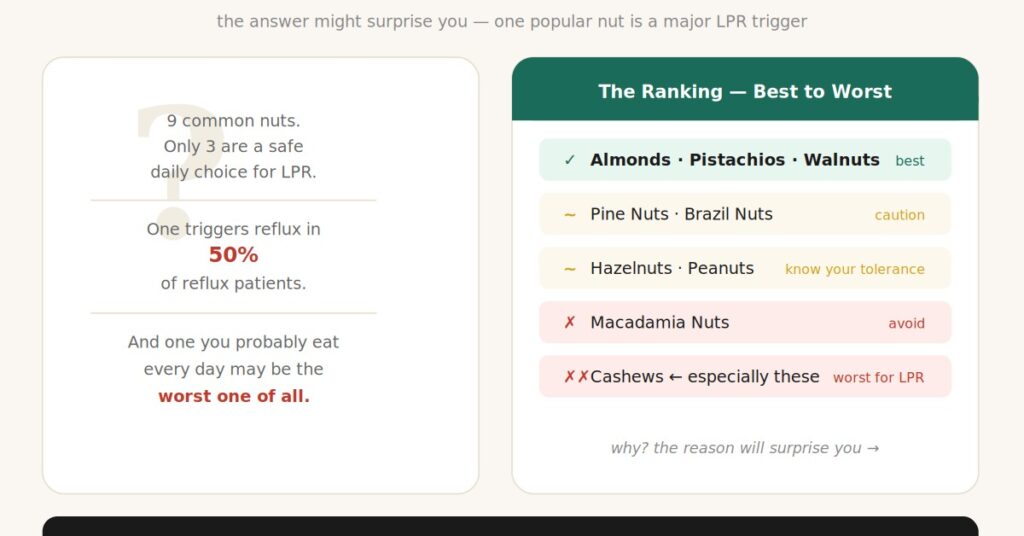
Nuts are one of the most common snack questions I get from people following the LPR diet. The good news is that most nuts are fine for acid reflux in moderation. But not all nuts are equal — a few are consistent reflux triggers, and one in particular is flagged specifically as a potent LPR trigger by leading reflux specialists.
This article gives you a clear ranked list, explains why fat content matters for reflux, covers what to look out for with nuts in general, and tells you which specific ones to eat freely, eat cautiously, and avoid. For a fuller pH and safety breakdown covering everything else on your plate, the Wipeout Reflux Food Reference Guide is a handy companion to keep alongside this list.
Key Takeaways:
- Almonds, pistachios and walnuts are the best nuts for acid reflux and LPR — lowest trigger risk, generally well tolerated
- Cashews and macadamia nuts are the worst — high fat, high trigger risk, avoid particularly during the early stages of the LPR diet
- Peanuts trigger reflux in approximately 50% of refluxers — more than most people expect given how commonly they’re eaten
- Brazilian cashews specifically are flagged in clinical LPR practice as a particularly potent trigger, likely due to processing chemicals used to remove the husk
- Fat content is the main mechanism — high-fat foods relax the lower oesophageal sphincter (LES) and slow gastric emptying, increasing reflux risk
- Portion size matters as much as nut type — a small handful is generally fine where a large portion may cause problems
- Always choose raw or dry-roasted, unsalted — flavoured, heavily salted or oil-roasted nuts add unnecessary irritants
Why Fat Content Is the Key Issue with Nuts and Reflux
Before getting into the ranked list it’s worth understanding why some nuts are more problematic than others for reflux — because it’s not about acidity, it’s about fat.
High-fat foods cause two problems for people with acid reflux and LPR. First, fat relaxes the lower oesophageal sphincter (LES) — the valve between the stomach and the oesophagus that prevents reflux. When the LES relaxes, acid and pepsin can travel upward more easily. Second, fatty foods slow gastric emptying — meaning food stays in the stomach longer, increasing the window during which reflux can occur.
This is why the nut ranking broadly follows fat content. The lower the fat, the safer the nut as a general rule. Almonds and pistachios contain primarily monounsaturated fats and are lower in total fat per serving than cashews and macadamias. Cashews and macadamias are the fattiest common nuts and consistently sit at the top of the trigger list.
Portion size matters too. Even the safer nuts can cause problems in large quantities — a small handful is very different to eating a 200g bag. Start with a handful (roughly 25g or a quarter cup) and see how you respond before increasing.
Nuts Ranked Best to Worst for Acid Reflux and LPR
1. Almonds — best choice
Almonds are the most consistently recommended nut for acid reflux and LPR — endorsed in leading reflux dietary guidance even during the strictest phase of the healing diet. They have a relatively high pH for a nut, are rich in monounsaturated fats rather than saturated fats, and contain magnesium which may help support LES function.
A handful of almonds (around 23 nuts) is a genuinely good snack option for people with LPR — filling enough to prevent overeating at the next meal, and tolerated well by the vast majority of refluxers. Raw or dry-roasted are both fine. Almond butter with no additives is also a good choice — it has a pH of around 6.0 to 6.5, only slightly acidic. See my dedicated almond butter and acid reflux article for more detail.
2. Pistachios — good choice
Pistachios are among the lowest-fat common nuts and are well tolerated by most people with reflux. Clinical LPR dietary guidance consistently ranks them alongside almonds and walnuts as the best options for refluxers. They’re also lower in calories per nut than most alternatives which makes portion control easier. Go for raw or dry-roasted, unsalted — heavily salted pistachios add unnecessary sodium which can irritate some people.
3. Walnuts — good choice
Walnuts are higher in fat than almonds and pistachios but they’re rich in omega-3 fatty acids — the anti-inflammatory type of fat — which may be beneficial for gut and oesophageal health generally. They are consistently listed as a low-trigger nut in LPR dietary guidance. Good in moderation — a small handful rather than a large portion.
4. Pine Nuts — generally fine
Pine nuts have a mild flavour and are generally well tolerated by people with acid reflux. They’re higher in fat than almonds but the fat profile is predominantly unsaturated. Use them as a topping or in small quantities rather than as a main snack.
5. Brazil Nuts — use cautiously
Brazil nuts are nutritionally excellent — one or two provides your entire daily selenium requirement — but they are quite high in fat. A couple of Brazil nuts as an occasional addition to your diet is fine. Eating them in large quantities is more likely to trigger reflux due to the high fat load.
6. Hazelnuts — use cautiously
Hazelnuts sit in the middle of the fat range and are a moderate trigger risk for some people. Fine in small amounts, particularly in their natural form. Avoid hazelnut products with added chocolate, sugar or oil which compound the reflux risk significantly.
7. Peanuts — use cautiously, know your tolerance
Peanuts are technically a legume rather than a tree nut but they’re commonly grouped with nuts. Clinical data from LPR specialists identifies peanuts as a reflux trigger in approximately 50% of reflux patients — a surprisingly high proportion given how commonly they’re eaten. If you’re going to eat peanuts, stick to raw or dry-roasted unsalted peanuts with no additives, and start with a small amount to gauge your tolerance. Peanut butter from 100% peanuts with nothing added is generally better tolerated than roasted, salted peanuts or peanut products with sugar and palm oil. More in my peanut butter and acid reflux guide.
8. Macadamia Nuts — avoid or limit significantly
Macadamia nuts are the highest-fat common nut — around 21g of fat per 28g serving. That fat load is enough to trigger significant LES relaxation in many people and they consistently sit near the bottom of reflux trigger rankings. If you enjoy them, treat them as an occasional small addition rather than a regular snack. During the initial strict phase of the LPR diet, avoid them entirely.
9. Cashews — avoid, especially for LPR
Cashews are the most problematic common nut for LPR specifically. They’re high in fat and, importantly, clinical LPR practice has flagged that Brazilian cashews — which are now the dominant commercial supply — are a particularly potent reflux trigger, believed to be related to the chemical processing used to remove the cashew husk during production. This isn’t a general high-fat nut issue — it’s a specific chemical irritant concern for the oesophagus and throat.
My recommendation: avoid cashews during the LPR diet, particularly during the initial healing phase. This is the one nut I’d specifically call out as worth cutting completely rather than just limiting.
Summary Table
| Nut | Rating for Reflux | Main reason |
|---|---|---|
| Almonds | ✅ Best choice | Lower fat, good pH, specialist endorsed |
| Pistachios | ✅ Good choice | Lowest fat, well tolerated |
| Walnuts | ✅ Good choice | Anti-inflammatory omega-3s, low trigger risk |
| Pine Nuts | 🟡 Generally fine | Moderate fat, fine in small amounts |
| Brazil Nuts | 🟡 Use cautiously | High fat — 1 to 2 only |
| Hazelnuts | 🟡 Use cautiously | Moderate trigger risk, fine in small amounts |
| Peanuts | 🟡 Know your tolerance | Trigger for ~50% of refluxers |
| Macadamia Nuts | 🔴 Avoid or limit | Highest fat of all common nuts |
| Cashews | 🔴 Avoid for LPR | High fat + specific chemical trigger concern |
Practical Tips for Eating Nuts with Acid Reflux
Always choose raw or dry-roasted, unsalted. Oil-roasted nuts add a layer of fat on top of the nut’s natural fat content. Flavoured nuts — sweet chilli, smoked, honey-roasted — often contain acidic ingredients, spices or large amounts of salt that can irritate the throat and trigger reflux independently of the nut itself. Plain is always better.
Keep portions to a small handful. Roughly 25g or a quarter cup is the portion to start with. This is enough to satisfy hunger and get the nutritional benefit without loading the stomach with fat. Even the best nuts can trigger reflux in large amounts.
Don’t eat nuts late at night. Like all higher-fat foods, nuts take longer to digest. Eating them within 2 to 3 hours of bed increases the chance of reflux during sleep. If you want a late-night snack, something light and alkaline is a much better choice.
Combine with alkaline foods. Pairing a small amount of almond butter with a banana or having almonds alongside some oatmeal balances the fat content with alkaline, easily digestible foods and reduces the overall reflux risk of the snack.
Chew thoroughly. Nuts require significant chewing to break down properly. Swallowing large pieces partially chewed means the stomach has to work harder to digest them, increasing the acid and pressure load. Chew until the nut is fully broken down before swallowing.
Test and track. Individual tolerance varies significantly. Some people with LPR eat almonds daily with no issues; others find even a small handful triggers symptoms. If you’re tracking your diet and symptoms — which I always recommend during the early stages — test nuts one type at a time so you can identify any specific triggers clearly.
What About Nut Butters?
Nut butters follow broadly the same ranking as whole nuts — almond butter is the best choice, peanut butter is generally fine in moderation with no additives, cashew butter and macadamia butter are the ones to avoid.
The key with nut butter is ingredients. The best nut butters for reflux contain only the nut — no added sugar, palm oil, salt or other ingredients. These additions make nut butters harder to digest, more acidic and more likely to trigger reflux. Always check the label and look for single-ingredient versions.
A thin spread of almond butter on wholegrain toast or oatcakes is a genuinely good snack option for people with LPR — filling, nutritious, and well tolerated by most.
Nuts and SIBO — an Important Caveat
If you have SIBO (small intestinal bacterial overgrowth) alongside your reflux — which is more common in LPR patients than most people realise — many nuts may cause problems due to their FODMAP content. High-FODMAP nuts include cashews and pistachios. If you find that nuts consistently cause bloating, gas or worsened reflux symptoms, SIBO is worth investigating. You can read more about the connection in my complete LPR guide.
Frequently Asked Questions
What is the best nut for acid reflux?
Almonds are the best nut for acid reflux and LPR. They have a relatively high pH for a nut, contain monounsaturated rather than saturated fats, and are consistently endorsed in leading reflux dietary guidance as safe even during the strictest phase of the LPR diet. Pistachios and walnuts are close behind. A small handful of raw or dry-roasted almonds is one of the better snack options available on an LPR diet.
Are cashews bad for acid reflux?
Yes — cashews are one of the worst nuts for acid reflux and particularly for LPR. They are high in fat which relaxes the LES and slows gastric emptying, and Brazilian cashews specifically have been flagged in clinical LPR practice as a potent trigger, likely due to chemical processing during production. Avoid cashews during the LPR diet, especially during the initial healing phase.
Can I eat peanuts if I have LPR?
Peanuts are a trigger food for approximately 50% of reflux patients according to clinical LPR data — more than most people expect. If you want to eat peanuts, choose raw or dry-roasted unsalted peanuts with no additives and start with a small amount to test your tolerance. If they consistently worsen your symptoms, cut them out. Some people tolerate them fine; others find them a consistent trigger.
Are walnuts good for acid reflux?
Yes — walnuts are a good choice for acid reflux. They are consistently listed as a low-trigger nut in LPR dietary guidance and are rich in anti-inflammatory omega-3 fatty acids. They are higher in fat than almonds so keep portions moderate — a small handful rather than a large amount.
Should I avoid all nuts during the LPR diet?
Not necessarily — it depends on how strict you need to be. During the initial detox or healing phase of the LPR diet, leading reflux specialists recommend avoiding nuts entirely as a precaution. Once you start to see improvement, almonds, pistachios and walnuts can generally be reintroduced in small amounts. Cashews and macadamia nuts are best avoided throughout.
Does nut butter cause acid reflux?
Nut butter can cause reflux if eaten in large amounts or if the product contains added oils, sugar or salt. Single-ingredient nut butters — particularly almond butter — are generally a good choice for reflux in moderation. Cashew butter and macadamia nut butter carry the same risks as the whole nuts and are best avoided for LPR.
Conclusion
Most nuts are fine for acid reflux and LPR in moderation — the key is knowing which ones to prioritise and which to avoid. Almonds, pistachios and walnuts are your best options. Pine nuts and Brazil nuts are fine in small amounts. Peanuts are worth testing carefully given the 50% trigger rate. Macadamia nuts should be limited. And cashews — particularly Brazilian cashews — are the one to cut out, especially if you have LPR.
As with everything on the LPR diet, start with small portions, test one type at a time and track how your body responds. Individual tolerance varies and what triggers someone else may be fine for you. For a complete structured diet plan for LPR see the Wipeout Diet Plan, and for personalised guidance consider a private consultation.
Related articles:
- LPR Diet — What to Eat and What to Avoid
- LPR Foods to Avoid — The Complete List
- Almond Butter and Acid Reflux — Good or Bad?
- Is Peanut Butter Good for Acid Reflux?
- The Complete Guide to LPR
- The Wipeout Diet Plan

David Gray
12 years living with LPR · Consultant & researcher
I've lived with LPR for twelve years — the misdiagnoses, the PPI courses that did nothing, the slow work of figuring out what actually helps. Wipeout Reflux is where I translate the research into plain terms for people stuck in the same place. Every claim here is sourced to peer-reviewed work, and I consult one-to-one with LPR sufferers.
David, you are a blessing. I have acid reflux. Been dealing with it for many years. It’s always good to know what’s good and what’s not so good for acid reflux. Knowledge and being responsible are the keys to managing this disease. Thank you. I look forward to reading more from your emails.
Most welcome I am very happy that I can help.
I have regular gerd and use omerzopole since using chopped unsalted walnuts I don’t need the drug
That’s great!
Roasted cashews ?
Roasted cashews are usually OK in small amounts, but they can trigger reflux for some people because they’re high fat.