
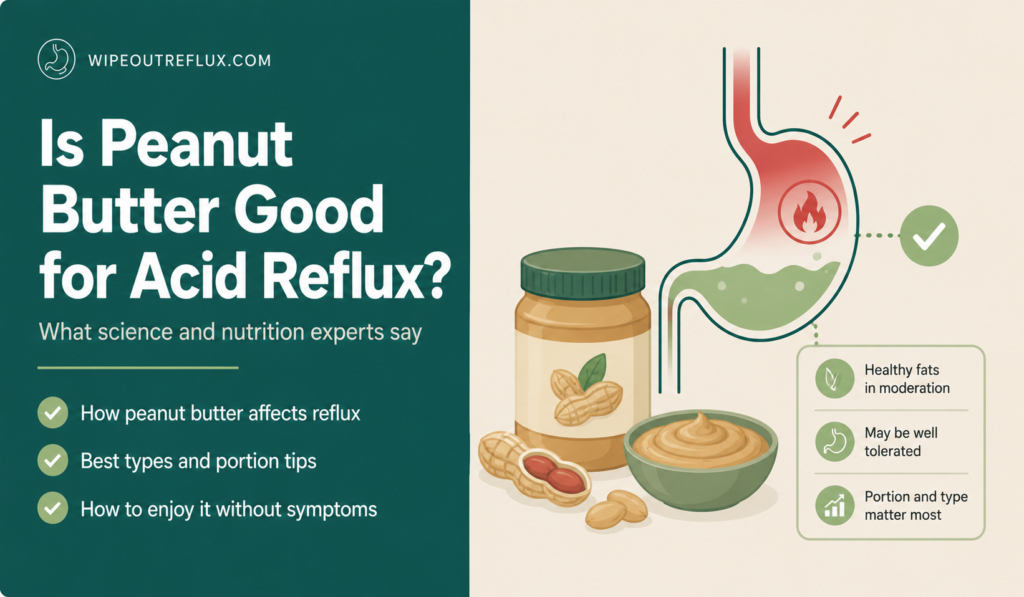
Peanut butter is not simply “good” or “bad” for acid reflux — it sits firmly in the middle, and whether it causes problems depends largely on which type you choose, how much you eat, and when you eat it.
The main concern is fat. Peanut butter contains around 16g of fat per two-tablespoon serving, and high-fat foods are among the more reliable GERD triggers because fat relaxes the lower esophageal sphincter (LES) and slows the rate at which your stomach empties. That said, peanut butter’s fat is predominantly monounsaturated and polyunsaturated — types that appear less problematic for the LES than saturated fat. This is an important distinction that tips the balance toward tolerable for many people, as long as portions are kept modest and the peanut butter is the natural, minimal-ingredient kind.
Commercial peanut butters — those with added palm oil, sugar, and stabilisers — introduce additional reflux risk factors that the plain oat base itself does not have. For people with LPR (silent reflux), more caution is warranted than for classic GERD.
Key Takeaways
- Peanut butter’s primary reflux risk is its fat content (~16g per 2-tbsp serving), which can trigger LES relaxation and slow gastric emptying.
- However, peanut butter’s fat is mostly monounsaturated and polyunsaturated — types that are considerably less problematic for the LES than saturated fat from sources like palm oil, cheese, or fried foods.
- Natural peanut butter (peanuts only, or peanuts and salt) is significantly better for reflux than commercial varieties that add palm oil, sugar, and stabilisers.
- Palm oil, found in many commercial peanut butters, is a saturated fat that is more likely to cause LES relaxation and delayed gastric emptying than the naturally occurring fats in peanuts.
- Added sugar in commercial peanut butter stimulates gastric acid production — a separate mechanism that can worsen reflux independently of the fat content.
- Portion size and timing are critical: a thin spread (1 tablespoon) eaten with a meal is very different from several tablespoons eaten as a late-night snack.
- LPR sufferers should be more cautious than GERD-only patients, as any LES-relaxing effect allows pepsin to reach the throat.
- Almond butter and sunflower seed butter are lower-fat alternatives worth considering for those who react to peanut butter.
The Real Issue: Fat Content and the LES
Peanut butter is roughly 50% fat by weight. In a standard two-tablespoon serving, you are consuming around 16g of fat — a meaningful amount in the context of reflux management. Fat influences reflux through two connected pathways.
First, fat triggers the release of cholecystokinin (CCK) from the small intestine. CCK is a hormone with several digestive functions, but one of its effects is causing transient relaxations of the LES — the valve that keeps stomach acid from escaping upward. Each time the LES relaxes when it should be closed, there is a window for acid to reflux into the esophagus. High-fat meals increase both the frequency and duration of these relaxation events.
Second, fat slows gastric emptying — the rate at which your stomach passes its contents into the small intestine. A slower-emptying stomach stays fuller for longer, keeping more acid-containing material in a position where it can reflux. This is why high-fat meals often cause reflux not just immediately after eating but for hours afterward.
A comprehensive systematic review published in Therapeutics and Clinical Risk Management, which analysed 72 studies on dietary and lifestyle factors in GERD, found that a high-fat diet was strongly positively associated with GERD (OR = 7.568) — one of the strongest dietary associations in the dataset [__Zhang et al., Therapeutics and Clinical Risk Management, 2021__].
Why Fat Type Matters — And Why Peanut Butter Gets Partial Credit
Not all fat behaves the same way in the digestive tract, and this is where peanut butter becomes more nuanced than most high-fat foods.
The fat in natural peanut butter is approximately 50% monounsaturated (primarily oleic acid) and 30% polyunsaturated (linoleic acid), with only around 20% saturated fat. Saturated fat — particularly long-chain saturated triglycerides found in butter, full-fat dairy, fried foods, and palm oil — appears to be the most problematic fat type for the LES. A detailed review in the Journal of Thoracic Disease noted that no study to date has directly compared saturated versus unsaturated fat on LES function in reflux patients, but the evidence points toward long-chain triglycerides as more aggressive CCK stimulators than unsaturated fats [__Newberry & Lynch, Journal of Thoracic Disease, 2019__].
The International Foundation for Gastrointestinal Disorders specifically includes peanuts and peanut butter — as sources of monounsaturated fat — among foods that people with GERD can generally include in their diet, in contrast to saturated fat sources which are more reliably problematic. This is a meaningful clinical endorsement that the original framing of peanut butter as simply risky because of its fat misses.
In practical terms: natural peanut butter in a sensible portion is a meaningfully different proposition from eating a high-fat meal built around fried food or cream-based sauces. The total fat load matters, the type of fat matters, and the context of the overall meal matters.
Natural vs Commercial Peanut Butter: Why It Makes a Significant Difference
This distinction is the single most important practical point for reflux sufferers choosing peanut butter. Natural peanut butter — made from 100% roasted peanuts, with perhaps a small amount of salt — contains only the naturally occurring fats of the peanut itself, which are predominantly unsaturated. Commercial peanut butters often modify this significantly:
- Palm oil: Added to prevent oil separation and create a smoother, more stable texture. Palm oil is high in saturated palmitic acid — the type of saturated fat most associated with LES relaxation and delayed gastric emptying. It introduces exactly the fat-type problem that natural peanut butter largely avoids.
- Added sugar: Many commercial peanut butters contain 2–5g of added sugar per serving. Simple sugars stimulate gastric acid production by triggering gastrin release — a separate mechanism that worsens reflux independently of fat. Sweetened varieties can push peanut butter from a tolerable food to a dual-mechanism trigger.
- Stabilisers and emulsifiers: These are generally low-concern additives, but can cause digestive sensitivity in some people and contribute to a less natural product overall.
The practical label-reading rule: look for peanut butter whose ingredients list reads only “peanuts” or “peanuts, salt.” If palm oil, hydrogenated vegetable oil, sugar, or glucose syrup appear anywhere in the ingredients, set it aside. No-stir natural peanut butters often have a thin layer of peanut oil on top — that separated oil is a sign you have the real thing. Stir it in before using.
Peanut Butter and LPR (Silent Reflux)
For people with LPR, the guidance on peanut butter needs to be more cautious than for GERD-only patients. In LPR, it is not just acid reaching the esophagus that causes damage — it is pepsin and acid reaching the throat, voice box, and upper airways. This requires refluxate to pass through both the LES and the upper esophageal sphincter (UES).
Any food that encourages transient LES relaxations — as high-fat foods do — increases the volume and frequency of upward reflux events that can potentially reach the throat. In the context of LPR, where throat and airway tissues are already sensitised by pepsin, even small amounts of refluxate that would not cause heartburn in classic GERD can trigger significant symptoms. If you have LPR, start with very small amounts of natural peanut butter — a teaspoon with a meal rather than a tablespoon as a snack — and monitor your symptoms carefully before making it a regular part of your diet.
How to Eat Peanut Butter With Reflux
If you tolerate peanut butter and want to include it in your diet, these practical principles significantly reduce the reflux risk:
- Keep portions small. One tablespoon, not three or four. The LES effect scales with fat load, so a thin spread on toast is very different from eating it by the spoonful.
- Eat it earlier in the day. Peanut butter before bed is one of the higher-risk ways to consume it. Fat slows gastric emptying, and lying down with a fatty meal still processing is a reliable reflux setup. Keep it to breakfast or midday.
- Pair it with reflux-friendly foods. Peanut butter on banana or with whole grain crackers is better than peanut butter with chocolate or on acidic bread. Bananas are alkaline-forming and mildly soothing; they are one of the best pairings for peanut butter if you have reflux.
- Don’t eat it on an empty stomach. Fat on an empty stomach can cause a more pronounced gastric response. Having it as part of a meal rather than alone gives your digestive system a more stable context.
- Choose natural over commercial. As discussed — the ingredient list is the most important factor.
Lower-Risk Nut Butter Alternatives
If you find peanut butter consistently worsens your symptoms even in small amounts of the natural variety, these alternatives are worth trying:
Almond Butter
Almond butter has a similar macronutrient profile to peanut butter but with a slightly higher monounsaturated fat proportion and a lower overall fat content per serving in many varieties. Almonds are also considered one of the more reflux-compatible nuts. Choose raw or dry-roasted almond butter with no added oils or sugar. For more detail on nuts and reflux see my article on nuts and acid reflux.
Sunflower Seed Butter
Sunflower seed butter (sunflower seed paste) is an underused alternative. Its fat is predominantly polyunsaturated, it contains no tree nuts or legumes (useful for people with peanut sensitivities), and it has a mild, pleasant flavour. Look for varieties with only sunflower seeds and salt.
Tahini
Tahini (sesame seed paste) is another option. It has a slightly bitter taste that takes some getting used to but is lower in fat per serving than peanut butter and has a predominantly unsaturated fat profile. It is widely used in Middle Eastern cooking and works well as a spread or sauce base.
Frequently Asked Questions
Is peanut butter good or bad for acid reflux?
It is conditional. Natural peanut butter (100% peanuts) eaten in small portions as part of a meal is generally tolerated by most people with mild to moderate acid reflux. Its fat is predominantly monounsaturated, which is less problematic for the LES than saturated fat. Commercial peanut butter with added palm oil and sugar introduces additional reflux risks and should be avoided if possible.
Does peanut butter cause acid reflux?
It can, particularly in larger amounts or when the commercial variety is consumed. The fat content is the main driver — fat triggers LES relaxation through cholecystokinin release and slows gastric emptying. Whether peanut butter actually triggers symptoms in any individual depends on portion size, the specific product, the time of day, what else has been eaten, and individual sensitivity.
Is natural peanut butter better than commercial for acid reflux?
Yes, significantly. Natural peanut butter avoids the palm oil (saturated fat) and added sugars that make commercial versions worse for reflux. Choosing a product with peanuts as the sole ingredient, or peanuts and salt, removes the two most problematic additions while keeping the monounsaturated fat profile that makes peanut butter relatively tolerable compared to other high-fat foods.
Is peanut butter acidic?
Peanut butter has a pH of around 6.0–6.3 — mildly acidic but not in a range that directly causes problems for most people with acid reflux. The acidity is not the primary concern; the fat content and its effects on LES function are what matter most in the reflux context.
Can I eat peanut butter if I have LPR?
With more caution than for classic GERD. LPR involves refluxate reaching the throat and airways, meaning any food that encourages LES relaxation carries more consequence. If you want to include peanut butter, use very small amounts (a teaspoon rather than a tablespoon), choose natural variety only, eat it earlier in the day, and observe whether it worsens throat symptoms.
What is the best time to eat peanut butter with acid reflux?
Earlier in the day — breakfast or a midday snack. Avoid it in the evenings or as a late-night snack. Fat slows gastric emptying, and lying down within two to three hours of eating a fat-containing food significantly increases reflux risk.
Is almond butter better than peanut butter for acid reflux?
Slightly, for most people. Almond butter has a comparable fat profile with a marginally lower saturated fat proportion and is considered one of the more reflux-friendly nut butters. It is not dramatically better than natural peanut butter, but for people who react to peanut butter specifically, almond butter is the most practical alternative.
Conclusion
Peanut butter occupies a nuanced position in the acid reflux food landscape. It is not a clear trigger in the way that fried food, chocolate, or citrus juice are — but it is also not the straightforwardly safe choice that simplified reflux advice often suggests. The fat content is real and does affect the LES, and for some people — particularly those with LPR or more severe GERD — even natural peanut butter in moderate amounts can cause problems.
For most people with mild to moderate reflux, a small serving of natural peanut butter (100% peanuts) eaten as part of a meal earlier in the day is a reasonable, tolerable choice. Avoid commercial varieties with palm oil and added sugar, keep portions to one tablespoon rather than several, and pair it with reflux-friendly foods. Start conservatively and see how your own digestive system responds.
If you want a complete guide to structuring your diet around your reflux — covering what to eat, portion guidance, and timing — the Wipeout Diet Plan is built specifically for GERD and LPR. For personalised guidance, you can book a private acid reflux consultation.
Related Articles
- Nuts and Acid Reflux: Which Are Safe and Which to Avoid?
- The Best Foods to Eat for LPR and Acid Reflux
- LPR Foods to Avoid: A Complete Guide
- Best Snacks for LPR and Acid Reflux
- The Ultimate Guide to Acid Reflux and GERD
- LPR (Silent Reflux): Causes, Symptoms and Treatment
- 2-Week Acid Reflux Diet Plan
Research and References
- __Zhang et al., Therapeutics and Clinical Risk Management, 2021__ — Systematic review of 72 studies examining dietary and lifestyle factors associated with GERD. Found that a high-fat diet was one of the strongest dietary predictors of GERD (OR = 7.568, 95% CI 4.557–8.908), alongside irregular eating habits. Confirms the mechanistic importance of dietary fat intake in reflux pathology, while also identifying vegetarian-leaning diets as protective.
- __Newberry & Lynch, Journal of Thoracic Disease, 2019__ — Comprehensive review of the role of diet in GERD development and management. Confirms that fat decreases LES pressure, increases the rate of transient LES relaxations, and delays gastric emptying. Importantly, identifies that fat type may be clinically relevant — long-chain triglycerides appear to produce greater CCK release and gastric volume changes than medium-chain triglycerides, supporting the distinction between saturated and unsaturated fat in GERD management.
- __Esmaillzadeh et al., PLOS ONE, 2013__ — Case-control study examining dietary intake and risk of reflux esophagitis. Found evidence of association between high dietary fat intake and GERD/esophagitis risk, alongside relationships with total caloric intake and BMI as confounders. Supports the broader evidence base linking dietary fat patterns to reflux disease in clinical populations.

David Gray
12 years living with LPR · Consultant & researcher
I've lived with LPR for twelve years — the misdiagnoses, the PPI courses that did nothing, the slow work of figuring out what actually helps. Wipeout Reflux is where I translate the research into plain terms for people stuck in the same place. Every claim here is sourced to peer-reviewed work, and I consult one-to-one with LPR sufferers.