
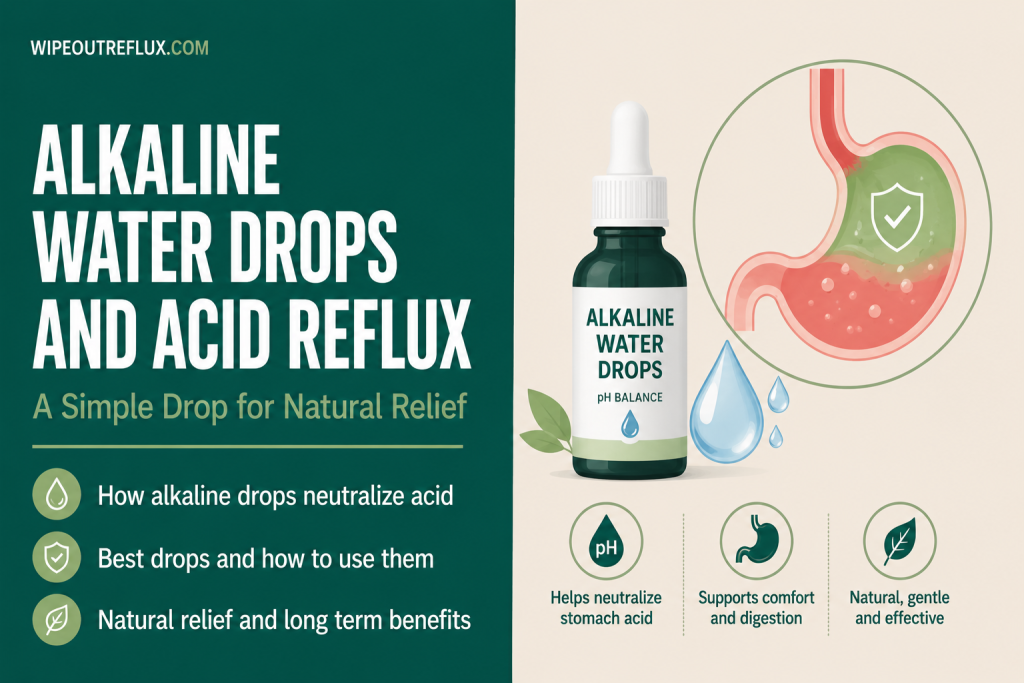
Alkaline water drops are one of those reflux remedies that sit in an interesting middle ground — they’re based on a real and well-researched mechanism, they’re used by people who have read Koufman’s work on pepsin and pH, and yet the clinical evidence specifically supporting drops (as distinct from naturally alkaline water) doesn’t exist yet. Understanding that gap is the difference between using them intelligently and expecting something they may not deliver.
The short honest verdict: if alkaline water drops raise your water’s pH to 8.8 or above, there is a plausible and mechanistically sound reason why this could help with LPR in particular — by inactivating pepsin at the throat level. That mechanism is backed by published in vitro research. But the drops themselves haven’t been studied in clinical trials, the studies on alkaline water used naturally bicarbonate-rich water rather than drops, and the broader alkaline water marketing ecosystem carries a lot of claims (about “body pH”, detoxification, and systemic alkalising) that have no credible scientific basis and shouldn’t be part of the conversation.
This article separates those things clearly: what the legitimate science actually says, what drops can and can’t do, how they differ from naturally alkaline water, and how to use them sensibly if you decide they’re worth trying.
Key Takeaways
- The science behind alkaline water for reflux is real — but specifically the finding that water at pH 8.8 or above instantly and irreversibly inactivates pepsin in vitro, and that bicarbonate-rich water reduces heartburn in clinical trials. Neither of these studies used alkaline water drops.
- Alkaline water drops work by adding concentrated alkaline minerals — typically potassium hydroxide, sodium hydroxide, potassium bicarbonate, or similar compounds — to raise water’s pH. If they achieve pH ≥8.8 in your glass, the pepsin-inactivating mechanism should theoretically apply.
- The relevant mechanism for reflux is entirely local and topical — alkaline water contacting the oesophagus and throat to buffer acid and inactivate pepsin. It does not and cannot change your body’s blood pH, which is tightly regulated at pH 7.4 regardless of what you drink.
- Drops formulated with bicarbonate-based minerals (potassium bicarbonate, potassium citrate) more closely mimic the naturally alkaline bicarbonate water studied by Koufman than drops using strong bases like KOH or NaOH alone.
- Alkaline water drops are most relevant for LPR (silent reflux), where pepsin reaching the throat is the primary damage mechanism. Inactivating pepsin at the throat level is more directly relevant to LPR than to standard GERD, where acid suppression via PPIs is generally more established.
- There is no clinical evidence yet comparing alkaline water drops specifically to naturally alkaline water, plain water, or standard treatment. Using drops is a mechanistically plausible adjunct — not a validated standalone treatment.
- Many alkaline water drop products make claims about “alkalising the body,” balancing systemic pH, or detoxification. These claims are not scientifically supported. The only credible reflux-relevant mechanism is local buffering and pepsin inactivation in the upper digestive tract.
What Are Alkaline Water Drops?
Alkaline water drops — also called pH drops or pH booster drops — are concentrated liquid supplements you add to regular drinking water to raise its pH. A typical product involves a few drops per glass of water, transforming neutral tap water (usually pH 6.5–7.5) into alkaline water at pH 8.5–10 depending on the product, the dose, and the starting pH of your water.
The ingredients vary by brand but generally fall into a few categories. Some products use strong alkalis — potassium hydroxide (KOH) and sodium hydroxide (NaOH) dissolved in water. At the concentrations in the drops, these are food-grade and safe when properly diluted, though they are caustic in concentrated form and must not be taken undiluted. Other products use mineral bicarbonate compounds — potassium bicarbonate, potassium citrate, tripotassium phosphate, magnesium chloride — which are gentler alkalising agents and more closely resemble the mineral profile of naturally alkaline spring water. Some combine both approaches.
The end result — water at a higher pH — is functionally similar regardless of the alkalising method used, at least in terms of pH measurement. Whether the source of alkalinity (strong base versus bicarbonate minerals) makes a difference to the biological effect in the throat and oesophagus is a genuinely open question, and one that hasn’t been directly studied.
The appeal for reflux sufferers is clear: naturally alkaline bottled water can be expensive, heavy, and inconsistently available. Drops offer a way to get high-pH water from any tap, anywhere, at a fraction of the cost. Whether that convenience comes with a trade-off in effectiveness is what the rest of this article works through.
The Science They’re Based On: Pepsin, pH, and Irreversible Inactivation
To understand why alkaline water has any relevance to acid reflux at all — and specifically to LPR — you need to understand how pepsin behaves at different pH levels.
Pepsin is the digestive enzyme at the centre of LPR damage. It’s produced in the stomach and activated by the low pH (acidic environment) there. When it reaches the throat via reflux, it causes direct inflammatory damage to laryngeal and pharyngeal tissue. What makes pepsin particularly problematic in LPR is that it doesn’t simply wash away — it’s taken up by mucosal cells and remains stable there even when the ambient pH rises back to neutral. It can be reactivated by any subsequent drop in pH: more reflux, acidic food or drink, even the natural morning acidity of the throat. This cycle of repeated reactivation is why LPR is so persistent and why acid suppression alone is often insufficient.
The key study here is the 2012 in vitro research by Koufman and Johnston, published in the Annals of Otology, Rhinology and Laryngology. They tested whether naturally alkaline artesian well water at pH 8.8 could inactivate human pepsin. The results were clear: pH 8.8 alkaline water instantly and irreversibly denatured pepsin — rendering it permanently inactive, not just temporarily suppressed. The same water also demonstrated significantly superior acid-buffering capacity compared to two common bottled waters at near-neutral pH.
The key word is irreversibly. Ordinary water at pH 6.7–7.4 does not inactivate pepsin — it just dilutes it. Alkaline water at pH ≥8.8 denatures the enzyme permanently. This is the threshold that matters: not just “alkaline” in a general sense, but specifically above 8.8.
It’s important to be precise about what this study was and wasn’t. It was an in vitro laboratory study — carried out in test tubes, not in patients. It tested naturally alkaline artesian well water with a specific mineral composition, not alkaline water drops or ionised water from an electric machine. It demonstrated a biological mechanism, not a clinical outcome. Those limitations matter and are worth keeping in mind throughout this discussion. The full pepsin mechanism and why it’s so central to LPR is covered in depth in the guide to neutralising pepsin in the throat.
Naturally Alkaline vs Artificially Alkalinised Water: Does the Source Matter?
This is the critical question for anyone evaluating alkaline water drops — and it’s one the research hasn’t directly answered.
The Koufman study specifically used naturally alkaline artesian well water. Natural alkalinity from bicarbonate minerals (calcium bicarbonate, magnesium bicarbonate) is chemically different from artificial alkalinity produced by adding concentrated potassium hydroxide or sodium hydroxide to neutral water, even if both methods produce water at the same pH reading.
Naturally alkaline water contains dissolved minerals — calcium, magnesium, bicarbonate — as part of a complex mineral matrix formed over geological time. The bicarbonate content in particular is what gives naturally alkaline water its acid-buffering capacity and is the same chemistry behind bicarbonate-rich mineral water’s clinical benefit for heartburn (covered further below). Bicarbonate is also the alkalising agent the body naturally produces to protect the oesophageal and gastric mucosa.
Products using KOH and NaOH to raise pH achieve the target pH number but deliver very little bicarbonate. The water becomes alkaline through hydroxide ions rather than through the bicarbonate buffering that characterises natural alkaline springs. Whether hydroxide-alkalised water has the same pepsin-inactivating effect as bicarbonate-alkalised water at the same pH has not been directly compared in published research.
In pure chemistry, pH is the key variable for pepsin denaturation — the enzyme unfolds when the surrounding environment is sufficiently alkaline, regardless of whether the alkalinity comes from hydroxide or bicarbonate. So the pepsin-inactivating effect should, in principle, be the same at equivalent pH. But the buffering capacity — how long the water maintains that alkalinity when it encounters the acid in your oesophagus and throat — may differ. Bicarbonate systems buffer more steadily across a range of pH; hydroxide-based alkalinity can shift more abruptly when it encounters acid.
The practical implication: if you’re choosing drops for reflux purposes, products with bicarbonate-based ingredients (potassium bicarbonate, potassium citrate, calcium carbonate) are likely a better choice than those using KOH and NaOH as the primary alkalising agent — not because there’s clinical evidence proving the difference, but because bicarbonate better mirrors the composition of the water that has actually been studied.
The Clinical Evidence: What We Know and What’s Still Missing
The clinical evidence base for high-pH water and reflux has two parts — and it’s worth being precise about what each part shows.
The in vitro evidence (laboratory)
Koufman and Johnston’s 2012 study established that pH 8.8 alkaline water inactivates pepsin in vitro. This is the foundation of the whole alkaline water / drops discussion for reflux. It establishes a mechanism, not a clinical outcome. No randomised controlled trial has tested naturally alkaline water against placebo for LPR or GERD symptoms in patients drinking it daily.
The clinical evidence for bicarbonate-rich mineral water
A phase-III randomised placebo-controlled trial (the STOMACH STILL trial) compared bicarbonate-rich mineral water against conventional mineral water in patients with heartburn over six weeks. Participants drinking approximately 1.5 litres per day of the bicarbonate-rich water experienced significantly greater reductions in heartburn frequency and severity, improved quality of life scores, and required less rescue medication than the control group. This is the strongest clinical evidence linking high-bicarbonate water to reflux symptom relief — and it used specifically bicarbonate-rich natural mineral water, not drops, at a high daily volume.
A separate clinical study of hydrogen carbonate-rich mineral water for heartburn found clinically meaningful symptom reductions across all measured dimensions, with effect sizes comparable to those reported in open-label PPI studies — a striking finding, though one requiring larger trials to confirm.
The gap: no trial has studied alkaline water drops specifically
There are no published clinical trials examining alkaline water drops as an intervention for GERD, LPR, or heartburn. The extrapolation from “naturally alkaline bicarbonate water reduces heartburn” to “adding drops to tap water should do the same” is mechanistically reasonable but is precisely that — an extrapolation.
This doesn’t mean drops don’t work. It means the evidence supports the principle (alkaline, bicarbonate-rich water may help reflux) without yet validating this specific delivery method. That’s a meaningful distinction for anyone trying to manage their expectations.
The Body pH Myth: Getting This Straight
This deserves a direct paragraph because a lot of alkaline water marketing conflates two completely different things.
Your blood and systemic pH is tightly regulated at 7.35–7.45 by your lungs and kidneys. Drinking any amount of alkaline water does not and cannot change your blood pH in a meaningful way. If it did, you would be in a medical emergency (alkalosis). This is settled physiology, not contested science.
The claims that alkaline water “alkalises your body,” corrects systemic acidity, or reverses the pH of tissues affected by lifestyle and diet are not supported by physiology. The body’s pH regulation systems are extraordinarily robust and immediately compensate for any alkaline load from food or drink.
The legitimate mechanism for alkaline water in reflux is entirely different — and entirely local. It’s about what the water does when it contacts the oesophageal and laryngeal mucosa directly: buffering acid on contact and, at pH ≥8.8, permanently inactivating pepsin. This is a topical effect, not a systemic one, and it’s the only credible basis on which alkaline water drops deserve consideration for reflux management. Any product making broader claims about systemic pH, detoxification, or body alkalisation should be viewed sceptically — those claims are adding noise to a legitimate but narrower mechanism.
Does the pH That Drops Actually Achieve Matter?
Yes — and this is one of the most practically important questions about drops, because not all products perform the same way.
The threshold established by Koufman’s research is pH 8.8. At this level, pepsin is irreversibly denatured. At lower pH values — including the 6.7–7.4 typical of most tap and bottled waters — pepsin is not inactivated, merely diluted. This means the pH your water actually reaches after adding drops is directly relevant to whether the primary reflux mechanism applies.
Most alkaline water drop products claim to raise water to pH 9–10. Whether they achieve this consistently depends on several variables: the starting pH of your water, the mineral content (hardness) of your local water supply, the dose used, and the temperature of the water. Hard water with high mineral content has greater natural buffering capacity and will resist pH change more than soft water — meaning the same number of drops may produce pH 9 in soft water but only pH 8.5 in hard water.
If you’re using drops specifically for reflux, testing the actual pH of your water with drops added is worthwhile. Inexpensive pH test strips (designed for water testing rather than pool testing, which typically have a different range) or a digital pH meter can give you a reliable reading. You’re aiming for ≥8.8, ideally 9.0–9.5. Going significantly higher (pH 10+) adds nothing therapeutically and some products at very high pH levels may affect taste or, in rare cases, cause minor irritation.
Who Might Benefit Most — and Where Caution Is Needed
The case for alkaline water (and by extension, well-formulated drops) is strongest in LPR rather than standard GERD, for several interconnected reasons.
In LPR, pepsin reaching the throat is the dominant damage mechanism. The throat and larynx have no acid-protective mechanisms comparable to the oesophageal lining — so any strategy that directly reduces pepsin activity at the throat level is addressing the primary injury process head-on. Alkaline water contacting the throat and laryngeal mucosa could, in principle, inactivate pepsin on contact. Drinking water is also one of the few non-pharmacological interventions that reaches these surfaces directly.
In standard GERD, by contrast, the primary issue is acid exposure in the oesophagus over time, and PPIs — which reduce acid production at the source — are well established and highly effective. The incremental benefit of alkaline water for oesophageal GERD on top of PPI therapy is much harder to make a case for, and the clinical trials on bicarbonate water for heartburn are most relevant for people not using PPIs or with mild-to-moderate symptoms.
LPR patients who are already managing diet carefully, using alginates, and not responding fully to PPIs represent the most reasonable candidate group for trying alkaline water drops — as an adjunct, with appropriate expectations, not as a primary treatment. The complete guide to LPR covers how all these strategies fit together.
Where caution applies:
- Products using NaOH as the primary alkalising agent add meaningful sodium. For those on sodium-restricted diets (hypertension, heart or kidney conditions), check the sodium content per serving and discuss with a doctor
- Never take drops undiluted — they are designed to be added to water, not taken directly. In concentrated form, potassium hydroxide and sodium hydroxide are caustic to mucous membranes
- Very high pH water (above pH 10) taken in large quantities can, in theory, interfere with gastric acid production over time, though at the doses used with drops diluted in a glass of water this is not a practical concern for most people
- If you have any condition affecting kidney function or electrolyte balance, the potassium content of some products is worth noting — discuss with your GP
How to Use Alkaline Water Drops for Reflux
If you decide to try alkaline water drops, the following approach makes the most sense based on the mechanism:
Prioritise timing around meals and reflux events. The most relevant moments to drink high-pH water for reflux are: between meals (not during, to avoid interfering with stomach acid during active digestion), after eating acidic or trigger foods, and before bed. These are the windows when pepsin may be most active in the throat and when alkaline water contact is most likely to be beneficial.
Aim for pH 8.8–9.5 in your glass. This is the range shown to inactivate pepsin. Test your water after adding drops, particularly if your tap water is hard or very soft, to confirm you’re hitting the target. There’s no benefit to much higher pH — you’re not trying to drink caustic solution, just water alkaline enough to denature pepsin on contact.
Use drops alongside other strategies, not instead of them. Alkaline water is a potential adjunct to diet management, alginate treatment, and lifestyle changes — not a replacement for any of them. The dietary foundation matters most: reducing the reflux events that deliver pepsin to the throat in the first place is always the priority. The existing article on alkaline water and LPR covers the underlying pepsin mechanism and the case for high-pH water in more detail.
Choose bicarbonate-based products where possible. As discussed above, products with potassium bicarbonate, potassium citrate, or similar mineral bicarbonates as their primary alkalising agents are chemically closer to the water studied in the research and may buffer more durably than those relying on KOH or NaOH alone.
Be consistent. The benefit of alkaline water for reflux is presumably cumulative — repeatedly bathing the throat in alkaline water to progressively inactivate pepsin, rather than a single dose having a dramatic immediate effect. Using drops with your water throughout the day rather than occasionally is more likely to matter.
Alkaline Water Drops vs Other Routes to High-pH Water
Drops are one of several ways to get alkaline water, each with trade-offs:
Naturally alkaline bottled water (from mineral springs — typically pH 7.5–9.0 depending on source) is the closest to what Koufman’s study actually used. It contains naturally occurring bicarbonate minerals and requires no modification. The downside is cost, packaging waste, and variable pH depending on brand. This is what the clinical trials used and therefore the gold standard by current evidence.
Electric water ionisers raise pH through electrolysis, splitting water into acidic and alkaline streams. These produce high-pH water (pH 9–12) and also generate dissolved molecular hydrogen, which has its own proposed antioxidant effects. They’re expensive (typically £500–£1,500+), require plumbing, and produce water whose primary alkalising ions are hydroxide rather than bicarbonate. No clinical trial has tested ionised alkaline water specifically for reflux.
Alkaline water filter pitchers raise pH through mineral filtration beds, typically adding calcium and magnesium minerals to produce water at pH 8.5–9.5. These produce water with a mineral profile closer to naturally alkaline spring water than ionisers do, at lower cost than both ionisers and ongoing bottled water purchases.
Alkaline water drops are the most cost-effective and convenient option — portable, no equipment needed, and one bottle typically makes many litres. The trade-off is the uncertainty about whether artificially alkalinised water performs identically to naturally alkaline water, the variation in mineral composition between products, and the lack of clinical trial evidence specific to drops.
For most LPR patients exploring alkaline water, drops represent a reasonable starting point — low cost, easy to trial, and mechanistically plausible. If they produce a subjective improvement in symptoms, that’s useful information. If not, the absence of significant downside means nothing has been lost except the cost of the product.
Frequently Asked Questions
Do alkaline water drops actually help acid reflux?
The mechanism is plausible — if drops raise your water’s pH to 8.8 or above, they should in theory inactivate pepsin on contact with the throat and oesophagus, and provide some acid-buffering benefit. But this specific question (drops for reflux) hasn’t been directly studied in clinical trials. The evidence supports naturally alkaline bicarbonate-rich water for heartburn, and laboratory evidence supports pH 8.8+ water for pepsin inactivation. Whether drops achieve equivalent results is a reasonable extrapolation that awaits direct confirmation.
What pH do alkaline water drops need to achieve to help with reflux?
The threshold established by Koufman and Johnston’s research is pH 8.8 — at this level, pepsin is irreversibly and instantly inactivated. Below this (including ordinary tap water at pH 6.7–7.4), pepsin is unaffected. Most drops claim to achieve pH 9–10, but this can vary depending on your starting water quality. Testing with pH strips is worthwhile if you’re using drops specifically for reflux management.
Are alkaline water drops better for LPR or for GERD?
The case is stronger for LPR. In LPR, pepsin reaching the throat is the primary damage mechanism, and directly inactivating pepsin at that site is a logical intervention. For standard GERD, acid suppression via PPIs is well established and the incremental benefit of alkaline water on top is less clear. Alkaline water (and drops) are best thought of as an LPR-specific adjunct rather than a GERD treatment.
Can alkaline water drops change my body’s pH?
No. Your blood pH is maintained at 7.35–7.45 by tightly regulated physiological systems. Drinking alkaline water — at any pH — does not and cannot meaningfully alter your body’s systemic pH. The legitimate mechanism is entirely local: alkaline water contacting the throat and oesophagus directly buffers acid and inactivates pepsin on those surfaces. Any product claiming to alkalise your body or correct systemic acidity is making an unsupported claim.
Which type of alkaline water drops are best for reflux?
Products using bicarbonate-based minerals — potassium bicarbonate, potassium citrate, calcium carbonate — are closer in composition to the naturally alkaline water used in the research and may offer more sustained buffering than drops using potassium hydroxide or sodium hydroxide alone. Check the ingredients list and look for bicarbonate-based formulations if possible. Also check the sodium content if you’re monitoring sodium intake.
Can I use alkaline water drops with Gaviscon Advance or PPIs?
Yes, there’s no known conflict between high-pH water and either PPIs or alginate-based products like Gaviscon Advance. A sensible approach is to use Gaviscon Advance after meals (as directed) and to drink alkaline water between meals — not simultaneously with Gaviscon, as both are acting on the throat and oesophageal environment and the timing is simply about optimising each independently.
How much alkaline water should I drink for reflux?
The clinical trial that showed benefit for heartburn used approximately 1.5 litres per day of bicarbonate-rich mineral water. There’s no established dose for alkaline water drops specifically. A reasonable approach is to make most or all of your daily drinking water alkaline during an active management phase, paying particular attention to timing around meals and before bed. This aligns with the principle of keeping the throat environment as unfavourable as possible for pepsin reactivation throughout the day.
Conclusion
Alkaline water drops for acid reflux occupy an honest and defensible position in the reflux management toolkit — but only when understood clearly. The mechanism is real: water at pH 8.8 irreversibly inactivates pepsin, and bicarbonate-rich water reduces heartburn in clinical trials. If drops achieve and maintain the required pH in your glass, the core mechanism should apply. What’s missing is direct clinical evidence for drops specifically, and the extrapolation from naturally alkaline water studies is reasonable but not yet proven.
For LPR sufferers in particular, where pepsin is the primary villain and where conventional treatments often fall short, exploring high-pH water — whether through drops, naturally alkaline bottled water, or an alkaline filter — is a low-risk and mechanistically sound addition to a broader management strategy. It’s not a standalone treatment, and it won’t replace the dietary changes and alginate approach that form the foundation. But as part of a thoughtful, multi-pronged approach, it’s worth more consideration than the mainstream reflux conversation typically gives it.
The most important thing is to get the rest of the picture right first. Diet and lifestyle changes reduce the frequency of reflux events — and therefore the amount of pepsin arriving at the throat in the first place. Alginates provide the physical barrier that stops pepsin getting there. Alkaline water then potentially addresses pepsin that has already reached throat tissue. Each layer reinforces the others. The LPR diet guide and the Wipeout Diet Plan cover the structured dietary foundation in full — alongside which alkaline water, used intelligently, becomes a useful supporting tool rather than a shortcut. For a clear reference on the pH values and reflux potential of everyday foods and drinks, the Wipeout Food Reference Guide is the companion to have — so you understand exactly what you’re combining alkaline water with, and why the pH of what you eat and drink all works together.
Research Sources
[__Koufman & Johnston, Annals of Otology, Rhinology and Laryngology, 2012__] — Foundational in vitro laboratory study: pH 8.8 naturally alkaline artesian well water instantly and irreversibly denatured human pepsin and demonstrated superior hydrochloric acid-buffering capacity compared to two common bottled waters at neutral pH; concluded alkaline water consumption may have therapeutic benefits as an adjunct in reflux disease — the study that established the pH 8.8 threshold and underpins the entire alkaline water discussion in reflux management.
[__Schröder et al. (STOMACH STILL trial), BMJ Open Gastroenterology, 2023__] — Phase-III randomised placebo-controlled trial comparing bicarbonate-rich mineral water (1.5L/day) vs conventional mineral water in patients with heartburn over six weeks; the bicarbonate-rich water group showed significantly greater reductions in heartburn frequency and severity, improved quality of life, and reduced rescue medication use; the most robust clinical trial evidence for high-bicarbonate water in heartburn management.
[__Vogt et al., United European Gastroenterology Journal, 2016__] — Clinical study of hydrogen carbonate-rich mineral water for heartburn; found clinically meaningful symptom reductions across all measured dimensions with effect sizes in a range comparable to open-label PPI studies; supported the bicarbonate mechanism for heartburn symptom relief and contributed to the clinical evidence base for bicarbonate-rich water in GERD management.
[__Johnston et al., The Laryngoscope, 2007__] — Key preclinical study establishing that human pepsin activity persists up to pH 6.5 (not just below pH 4 as previously believed); demonstrated that laryngeal biopsy samples from LPR patients contain tissue-bound pepsin that can be reactivated by any drop in pH; foundational to understanding why the 8.8 threshold matters and why even weakly acidic exposures continue to drive LPR damage despite acid suppression.
[__Schröder et al., Alimentary Pharmacology and Therapeutics, 2023__] — Supporting citation for the STOMACH STILL trial; published peer-reviewed account of the randomised controlled trial confirming that bicarbonate-rich water reduced heartburn symptom scores to a clinically relevant degree compared to regular mineral water, with the improvement sustained across the six-week trial period.

David Gray
12 years living with LPR · Consultant & researcher
I've lived with LPR for twelve years — the misdiagnoses, the PPI courses that did nothing, the slow work of figuring out what actually helps. Wipeout Reflux is where I translate the research into plain terms for people stuck in the same place. Every claim here is sourced to peer-reviewed work, and I consult one-to-one with LPR sufferers.
Where can you buy alkaline water drops?
Thanks for the question! Alkaline water drops (usually sold as “pH drops”) are easy to find online — Amazon has plenty of options, and most health food stores stock them too. Just check the pH they claim to achieve — for reflux purposes you want water at pH 8 or above to help deactivate pepsin. A cheaper alternative is bottled alkaline water or even a pinch of baking soda in water, but drops are handy for travel.