
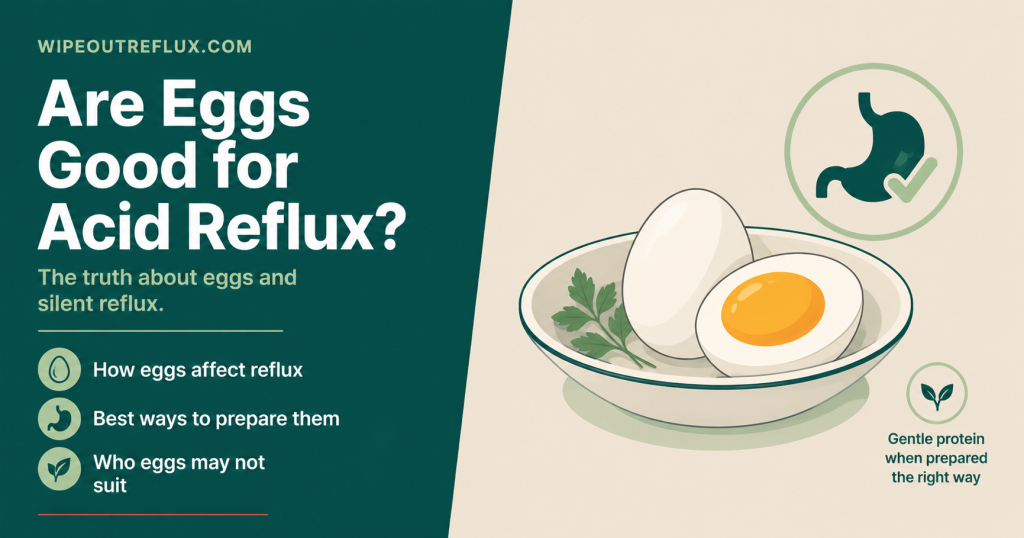
Yes — eggs are generally a good choice for acid reflux. The main reason is that they’re very low in acidity, sitting close to neutral on the pH scale, which makes them far gentler on your throat and oesophagus than common triggers like citrus, tomatoes, coffee, or vinegar. On top of that, eggs are a high-quality, easily digested protein, so for most reflux sufferers they’re a safe and genuinely useful food to build meals around.
The one thing to be aware of is fat. Egg whites are essentially fat-free and reflux-friendly for almost everyone. Egg yolks carry the fat, and frying adds more, so how you eat your eggs can fine-tune how well you tolerate them. But the headline is reassuring: eggs are a low-acid food, and that’s exactly what you want when managing reflux.
Having managed silent reflux for over eight years, eggs are one of the foods I recommend most often as a reliable protein — and one of the most misunderstood. Let me explain why they’re a good choice, and how the yolk-versus-white and cooking-method details let you get the most out of them.
Key Takeaways
- Eggs are a good choice for acid reflux — mainly because they’re very low in acidity (close to neutral pH).
- They’re a high-protein, easily digested food that doesn’t irritate the throat the way acidic triggers do.
- Egg whites are the safest part — fat-free, gentle, and reflux-friendly for almost everyone.
- Egg yolks carry the fat, which can trigger reflux in more sensitive people if eaten in large amounts.
- Cooking method fine-tunes tolerance: poached and boiled are best; fried is the one to limit.
- For most people, eggs can be a daily staple — just keep them low-fat and sensibly portioned.
Why Eggs Are a Good Low-Acid Food for Reflux
The biggest reason eggs work well for reflux is their acidity — or rather, their lack of it. Many of the worst reflux triggers are highly acidic: citrus fruits, tomatoes, sodas, coffee, and vinegar all sit low on the pH scale and can directly irritate an already inflamed throat, which matters enormously in silent reflux (LPR) where acidic food can reactivate pepsin sitting in the throat tissue.
Eggs are the opposite. They’re roughly neutral on the pH scale, so they don’t add to that acid load. For anyone building a low-acid diet — the single most effective dietary approach for reflux and LPR — eggs are a natural fit. They give you filling, high-quality protein without the acidity that makes so many other foods problematic. If you want the bigger picture on which foods help, my list of LPR foods to eat puts eggs alongside other gentle staples.
This low-acidity advantage is why eggs deserve a firmly positive verdict. The fat consideration below is real, but it’s a way to optimise how you eat eggs — not a reason to avoid them.
The One Thing to Watch: Fat (and Where It Hides)
Eggs aren’t acidic, so when they do cause symptoms for someone, the culprit is fat rather than pH. This is worth understanding because it’s what separates a reflux-friendly egg from a troublesome one.
Fatty foods affect reflux through well-documented mechanisms. Fat lowers the pressure of the lower esophageal sphincter (LES) — the valve that keeps stomach contents down — and slows stomach emptying. Classic research showed that fat decreases LES pressure, increases transient relaxations of that valve, and delays gastric emptying, all of which raise acid exposure in the oesophagus [Fox et al., Clinical Gastroenterology and Hepatology, 2007]. Population studies have also linked higher dietary fat intake with greater odds of GERD symptoms [Nasab et al., International Journal of Preventive Medicine, 2021].
The same rule sorts other proteins: chicken and turkey are lean enough to sit comfortably in a reflux diet, while red meat sits at the fattier end.
Here’s the key point for eggs: the white is almost pure protein with virtually no fat, while the yolk holds nearly all the egg’s fat — around 4–5 grams per large egg. So the fat consideration only really applies to yolks and to fatty cooking methods. The egg itself is low-acid and gentle; it’s the extras that need a little attention.
Egg Whites vs Egg Yolks for Reflux
Egg whites: reflux-friendly for almost everyone
Egg whites are one of the best protein options for reflux sufferers. They’re low-acid, fat-free, easy to digest, and don’t distend the stomach the way a heavy, fatty meal does. Egg-white omelettes or scrambled whites make an excellent reflux-friendly breakfast, and they pair well with other gentle foods like oats, wholegrain toast, or vegetables. If you’re particularly sensitive, whites are a safe place to start.
Egg yolks: still fine for most, just higher in fat
Yolks are nutritious and contain most of the egg’s vitamins, and plenty of people with reflux eat whole eggs with no trouble at all. Because the yolk carries the fat, though, it’s the part more likely to trigger symptoms if you’re sensitive or eating several at once. The practical approach isn’t to ditch yolks — it’s to keep them boiled or poached and to notice your own limit. Many people tolerate one or two whole eggs comfortably; symptoms tend to appear only with multiple yolks plus added fat and frying.
Cooking Method: How to Keep Eggs Reflux-Friendly
How you prepare your eggs is the easiest lever you have. Because the egg itself is low-acid, keeping the cooking low-fat lets you enjoy them freely. Here’s the rough ranking from most to least reflux-friendly:
- Poached or boiled (best): No added fat, low-acid, gentle on the stomach — the ideal way to eat a whole egg.
- Egg-white omelette: Low-fat, low-acid, and filling — a great reflux-friendly breakfast.
- Scrambled with minimal fat: Perfectly fine using a non-stick pan and little or no butter or oil.
- Fried eggs (limit these): Cooked in butter or oil, they add fat on top of the yolk, making them the version most likely to cause symptoms.
Frying is the only real problem, and it’s easily avoided. Fried and high-fat foods are among the most consistent reflux aggravators because of the LES-relaxing effect of fat. If you love a cooked breakfast, simply swapping fried eggs for poached is one of the easiest wins you can make — and you keep all the low-acid, high-protein benefit.
How to Get the Most From Eggs Without Triggering Reflux
Eggs are a keeper for most reflux sufferers. To make sure they stay that way:
- Poach or boil when you can, and go easy on added butter or oil.
- Favour whites if you’re especially sensitive, or stick to one or two whole eggs rather than a yolk-heavy dish.
- Watch what you pair them with. Eggs with bacon, sausage, fried bread, and lashings of butter turn a low-acid meal into a high-fat one — the eggs often take the blame when the whole plate is the issue.
- Keep portions moderate. A large, heavy meal distends the stomach and promotes reflux regardless of what’s in it.
- Don’t eat them late. Even a gentle food is better kept away from bedtime, when lying down lets reflux reach your throat.
Tolerance is individual, so if you’re unsure, test eggs one way at a time — try boiled whites first, then whole boiled eggs, and only then other methods. This one-variable-at-a-time approach is the best way to confirm how well you handle them. For more gentle meal ideas, my LPR foods to eat guide is a useful companion, and my LPR foods to avoid list shows the acidic triggers eggs can helpfully replace.
Frequently Asked Questions
Are eggs acidic?
No — eggs are roughly neutral on the pH scale, which is exactly why they’re a good choice for acid reflux. They don’t add to the acid load the way citrus, tomatoes, or coffee do. Any symptoms eggs occasionally cause come from fat content (mainly in the yolk) and cooking method, not from acidity.
Can I eat eggs every day with acid reflux?
For most people, yes. Because they’re low-acid and high in protein, eggs can be a daily staple — especially egg whites or a couple of boiled or poached whole eggs. Just keep the cooking low-fat and be mindful of what you serve alongside them. If you ever notice a pattern of symptoms, ease back on yolks or frequency.
Are scrambled eggs bad for acid reflux?
Not at all, as long as you cook them with little or no added fat. The eggs themselves are low-acid; problems only arise when they’re made with lots of butter, cream, or oil. Use a non-stick pan and go easy on the fat, and scrambled eggs sit comfortably in a reflux-friendly diet.
Why do fried eggs bother me but boiled eggs don’t?
Because frying adds fat — usually butter or oil — on top of the fat already in the yolk. That extra fat relaxes the valve between your stomach and oesophagus and slows digestion, both of which promote reflux. Boiled eggs have no added fat, so they keep all the low-acid benefit without the trigger. It’s a clear case of cooking method mattering more than the food itself.
Are eggs a good breakfast for silent reflux (LPR)?
They’re one of the better options. Poached eggs or an egg-white omelette give you low-acid, filling protein without the acidity of fruit juices or the fat of a fried breakfast — a genuinely reflux-friendly way to start the day.
Conclusion
So, are eggs good for acid reflux? For the large majority of people, yes — and confidently so. Their biggest advantage is that they’re very low in acidity, which makes them far gentler on the throat and oesophagus than the acidic foods that so often drive reflux. Add in that they’re a high-quality, easily digested protein, and eggs earn a firm place in a reflux-friendly diet. The only fine-tuning worth doing is around fat: favour whites if you’re sensitive, keep whole eggs to sensible portions, and poach or boil rather than fry. Do that, and eggs are a food you can enjoy freely.
The bigger lesson is that managing reflux is less about fearing individual foods and more about understanding why a food helps or hinders — and building a consistent pattern of low-acid, gentle choices. That’s exactly what the Wipeout Diet Plan is designed to do: take the guesswork out of eating for reflux and LPR with a structured, done-for-you plan, so you always know which foods and cooking methods keep you on track. It turns one-off food questions like this into a clear, reliable way of eating.
To check individual foods and drinks quickly, the Wipeout Food Reference Guide is an essential companion — it lists exactly which foods are safe for acid reflux and LPR along with their pH values, so you can look anything up at a glance. Use the Food Reference Guide as your everyday quick-check and the Wipeout Diet Plan as the deeper, more complete roadmap to getting better. Keep them low-acid and gently cooked, and eggs can be one of the most dependable foods in your reflux-friendly kitchen.
Research and References
- [Fox et al., Clinical Gastroenterology and Hepatology, 2007] — Demonstrated that dietary fat and calorie density affect oesophageal acid exposure, with fat decreasing LES pressure and increasing reflux events.
- [Nasab et al., International Journal of Preventive Medicine, 2021] — Cross-sectional study of 3,362 adults linking higher dietary fat intake with greater odds of GERD.
- [Iwakiri et al., Journal of Gastroenterology, 1999] — Controlled study evaluating how low- versus high-fat meals affect lower esophageal sphincter motility and reflux.

David Gray
12 years living with LPR · Consultant & researcher
I've lived with LPR for twelve years — the misdiagnoses, the PPI courses that did nothing, the slow work of figuring out what actually helps. Wipeout Reflux is where I translate the research into plain terms for people stuck in the same place. Every claim here is sourced to peer-reviewed work, and I consult one-to-one with LPR sufferers.