
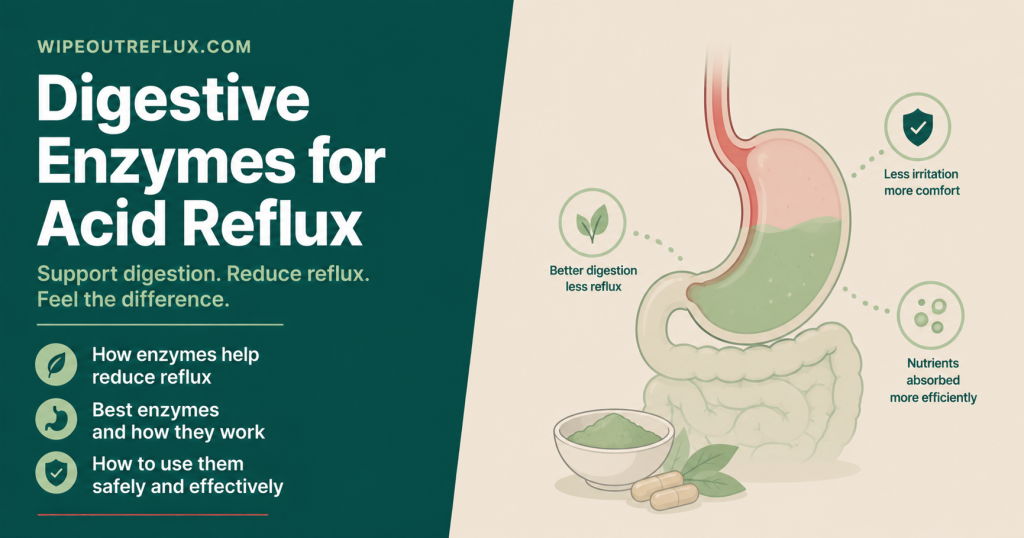
Digestive enzymes are not a proven treatment for acid reflux, and it’s important to be honest about that up front. There’s very little direct clinical evidence that enzyme supplements reduce reflux or heartburn specifically. What evidence does exist is for functional dyspepsia — a form of indigestion with bloating, fullness, and upper-tummy discomfort — which often overlaps with reflux but isn’t the same thing.
That said, there’s a reasonable mechanism for why they might help some people indirectly: by supporting more efficient digestion, enzymes may reduce the bloating and delayed stomach emptying that can worsen reflux. So they’re not useless — but they’re also not the targeted reflux fix that supplement marketing often implies.
After more than eight years managing silent reflux, I’ve tried and researched a lot of supplements, and digestive enzymes are one where the hype runs well ahead of the science. Let me walk through what they actually do, what the research really shows, and one important caution for anyone with LPR.
Key Takeaways
- Digestive enzymes have little direct evidence for treating acid reflux or GERD specifically.
- The real clinical evidence is for functional dyspepsia (indigestion), where several trials show symptom benefit.
- They may help reflux indirectly by improving digestion and reducing bloating and stomach distension.
- The “low stomach acid” theory behind enzyme use is popular online but weakly supported.
- LPR sufferers should be cautious with protease-containing enzymes, as pepsin is itself a protease that damages the throat.
- Enzymes are not a substitute for the diet and lifestyle changes that address reflux at its root.
What Are Digestive Enzymes?
Digestive enzymes are proteins that break food down into absorbable pieces. Your body makes them naturally — in your saliva, stomach, and especially your pancreas. The main ones are:
- Amylase — breaks down carbohydrates.
- Protease — breaks down proteins.
- Lipase — breaks down fats.
Supplement versions are usually derived from animal (porcine pancreatic), plant (bromelain from pineapple, papain from papaya), or microbial/fungal sources. They’re sold as general “digestion aids” and are frequently marketed for reflux, bloating, and indigestion — often bundled with claims that go far beyond the evidence.
There’s an important distinction here. For people with genuine pancreatic insufficiency (from cystic fibrosis or chronic pancreatitis, for example), prescription pancreatic enzyme replacement is essential and well-proven. But that’s a completely different situation from a person with reflux and an otherwise healthy pancreas taking over-the-counter enzymes. The evidence for one does not transfer to the other.
What the Research Actually Shows
Here’s where honesty matters. If you search for studies on digestive enzymes and reflux, you’ll find that direct trials on GERD or LPR are essentially absent. The research that exists is on functional dyspepsia.
In a randomised, double-blind, placebo-controlled trial, a multi-enzyme complex significantly reduced the severity of dyspeptic symptoms in patients with functional dyspepsia compared with placebo [Majeed et al., Journal of Medicinal Food, 2018]. A separate randomised controlled trial of a fungal-fermentation multi-enzyme blend also found improvements in dyspepsia-related quality of life over two months [Spagnuolo et al., Biomedicine & Pharmacotherapy, 2023].
These are legitimate findings — but notice what they’re measuring. The outcomes are dyspepsia symptoms like fullness, bloating, and upper abdominal discomfort, not heartburn, regurgitation, or the throat symptoms of LPR. Functional dyspepsia and reflux frequently coexist, so there may be some crossover benefit for people who have both. But it would be overreaching to call enzymes a reflux treatment based on dyspepsia trials. That gap between what’s marketed and what’s proven is exactly why I treat this topic cautiously.
The “Low Stomach Acid” Theory: Handle With Caution
Most online arguments for enzymes rest on a popular idea: that reflux is caused by too little stomach acid rather than too much. The theory goes that low acid leads to poor digestion, food sitting and fermenting, pressure building, and reflux pushing upward — with enzymes (and sometimes betaine HCl) offered as the fix.
It’s an appealing story, and low stomach acid is a real phenomenon in certain groups (older adults, long-term acid-suppression users, those with certain conditions). But as a general explanation for reflux, it’s weakly supported by evidence, and self-treating with acid or enzyme supplements can backfire — particularly if your throat or oesophagus is already inflamed. I’ve covered this in depth, including where the theory holds up and where it doesn’t, in my article on stomach acid and acid rebound. The short version: don’t assume low acid is your problem without good reason.
A Specific Warning for LPR Sufferers
This is the point I most want silent reflux sufferers to understand, because it’s rarely mentioned. Many digestive enzyme blends contain protease — an enzyme that breaks down protein. The problem is that pepsin, the enzyme responsible for most of the tissue damage in LPR, is itself a protease.
In LPR, pepsin travels up with reflux and lodges in the delicate tissue of your throat and voice box, where it can be reactivated by acidic food and continue to cause irritation. Adding more protease into the mix is, at best, unproven and, at worst, potentially counterproductive if any of it reaches already-inflamed throat tissue. Given how central pepsin is to silent reflux, I’d be cautious about protease-heavy supplements until there’s actual evidence they’re safe and helpful for LPR specifically. If you want to understand why pepsin matters so much, my guide on neutralising pepsin in the throat explains the mechanism.
Who Might Reasonably Try Digestive Enzymes?
None of this means enzymes are never worth considering. They may be a reasonable experiment if:
- Your dominant symptoms are bloating, fullness, and indigestion after meals rather than pure heartburn or throat symptoms.
- You’ve already addressed the foundations — a low-acid diet, meal timing, and portion size — and want to test an add-on.
- You suspect a specific intolerance, where a targeted enzyme (like lactase for dairy) may genuinely help.
- You approach it as a time-limited trial, one variable at a time, so you can actually tell whether it’s doing anything.
What enzymes should not be is your first move or your main strategy. Reflux and LPR respond most reliably to diet and lifestyle changes that reduce reflux events and protect the throat — the things with the strongest evidence behind them. An enzyme capsule can’t compensate for late, fatty, acidic meals.
Are Digestive Enzymes Safe?
For most healthy people, over-the-counter digestive enzymes are generally well-tolerated, with side effects usually limited to mild digestive upset. That said, a few sensible cautions apply: avoid them if you have active gastritis or an inflamed oesophagus without medical advice, be aware that plant enzymes like bromelain can interact with blood thinners, and always check with your doctor or pharmacist if you take other medications or have an ongoing condition. As with any supplement, “natural” doesn’t automatically mean risk-free.
Frequently Asked Questions
Can digestive enzymes cure acid reflux?
No. There’s no good evidence that digestive enzymes cure or even reliably treat acid reflux. The clinical evidence for enzymes is in functional dyspepsia (indigestion), not reflux. They may help some people indirectly by easing bloating and improving digestion, but they don’t address the root causes of reflux the way diet and lifestyle changes do.
Should I take digestive enzymes before or after meals?
If you’re trialling them, they’re typically taken with or just before meals so they’re present as food is being digested. But given the limited evidence for reflux specifically, I’d focus first on the changes that reliably help — and only test enzymes as a time-limited add-on once the basics are in place.
Do digestive enzymes help with bloating and indigestion?
This is where enzymes have their strongest support. Randomised trials have shown multi-enzyme supplements can reduce the severity of functional dyspepsia symptoms like bloating and fullness. If those are your main complaints — rather than heartburn or throat symptoms — enzymes may be more reasonable to try.
Are digestive enzymes safe for LPR or silent reflux?
Be cautious. Many blends contain protease, and pepsin — the enzyme that damages throat tissue in LPR — is itself a protease. There’s no evidence protease-containing supplements help LPR, and a theoretical reason they might not be ideal. I’d prioritise proven LPR strategies over enzymes until better evidence exists.
Is low stomach acid really the cause of my reflux?
It might be in specific cases — older adults and long-term acid-suppression users, for instance — but as a blanket explanation for reflux, the low-stomach-acid theory is weakly supported. Don’t self-treat with acid or enzyme supplements on that assumption without good reason, especially if your throat or oesophagus is inflamed.
What works better than digestive enzymes for reflux?
A low-acid diet, sensible meal timing (not eating close to bedtime), smaller portions, and — for many people — alginate therapy like Gaviscon Advance all have far stronger evidence for reflux and LPR than enzyme supplements. These address why reflux happens rather than just aiding digestion.
Conclusion
So, do digestive enzymes help acid reflux? The honest answer is: probably not directly, and certainly not as a standalone solution. Their real evidence lies in functional dyspepsia, they may offer some indirect benefit by easing bloating, and — for LPR sufferers especially — protease-containing blends warrant genuine caution. If your symptoms are indigestion-dominant and you’ve already got the foundations in place, a careful time-limited trial isn’t unreasonable. But enzymes are a possible minor add-on, not the answer to reflux.
The reason I keep coming back to the same message is that it’s true: reflux and silent reflux respond most reliably to what you eat and when you eat it. That’s the root of the problem, and it’s where your effort pays off most. The Wipeout Diet Plan exists precisely to make that part easy — a structured, done-for-you low-acid eating plan built specifically for reflux and LPR recovery, so instead of chasing supplements with thin evidence, you’re putting your energy into the change that actually moves the needle.
To make everyday food choices simpler, the Wipeout Food Reference Guide is an essential companion — it lists exactly which foods and drinks are safe for acid reflux and LPR along with their pH values, so you can check anything at a glance. Use the Food Reference Guide as your quick daily lookup and the Wipeout Diet Plan as the deeper, more complete roadmap to getting better. Put the proven foundations first, treat supplements as optional extras, and give your throat the consistent care it needs to heal.
Research and References
- [Majeed et al., Journal of Medicinal Food, 2018] — Randomised, double-blind, placebo-controlled trial showing a multi-enzyme complex reduced the severity of functional dyspepsia symptoms versus placebo.
- [Spagnuolo et al., Biomedicine & Pharmacotherapy, 2023] — Randomised, double-blind, placebo-controlled trial of a fungal-fermentation multi-enzyme blend improving dyspepsia-related quality of life over two months.

David Gray
12 years living with LPR · Consultant & researcher
I've lived with LPR for twelve years — the misdiagnoses, the PPI courses that did nothing, the slow work of figuring out what actually helps. Wipeout Reflux is where I translate the research into plain terms for people stuck in the same place. Every claim here is sourced to peer-reviewed work, and I consult one-to-one with LPR sufferers.