
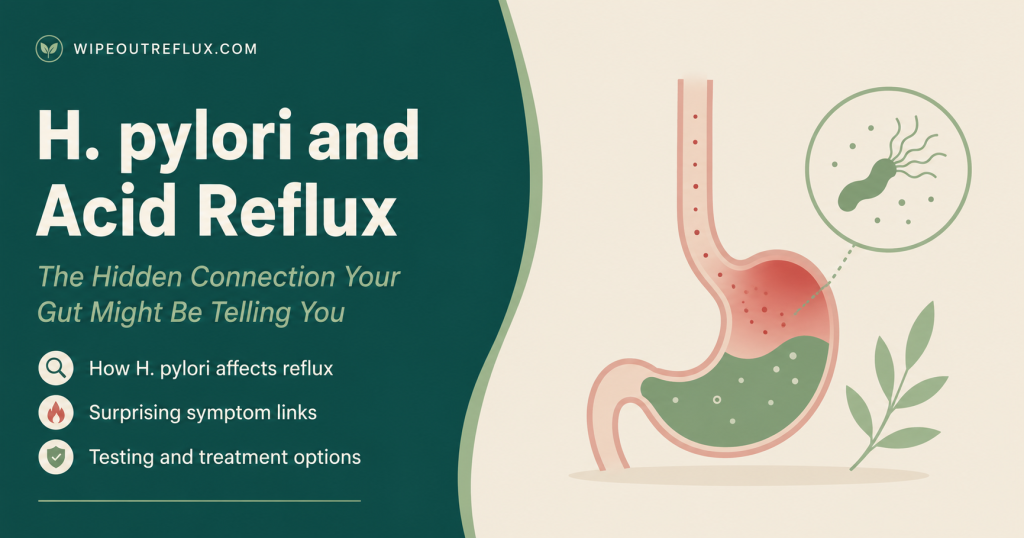
If you’ve been told you have Helicobacter pylori (H. pylori) and you also struggle with acid reflux, the relationship between the two is probably the opposite of what you’d expect. In most people, a long-standing H. pylori infection actually lowers stomach acid, which tends to protect against classic acid reflux and erosive damage in the oesophagus. Counterintuitively, it’s often eradicating the infection that unmasks or worsens reflux.
That’s the headline. But the full picture is more nuanced, and it depends heavily on where the bacteria colonise your stomach, and on whether you’re dealing with heartburn-type GERD or throat-based silent reflux (LPR). Having managed LPR myself for over eight years, this is one of the areas where I see people get bad, oversimplified advice, so let me walk through what the research actually shows and what it means for you.
Key Takeaways
- H. pylori and acid reflux usually have an inverse relationship — chronic infection often reduces stomach acid, which is why it’s linked to a lower risk of GERD and erosive oesophagitis.
- The effect depends on where the bacteria live: antrum-predominant infection can raise acid, while body (corpus) or whole-stomach infection reduces it.
- Eradicating H. pylori roughly doubles the risk of developing reflux oesophagitis in pooled studies, because acid production recovers once the infection clears.
- LPR (silent reflux) behaves differently. Some studies show H. pylori is more common in LPR patients, likely through a pepsin-related mechanism rather than acid alone.
- Low stomach acid from H. pylori can encourage bacterial overgrowth further down, which is its own source of reflux-type symptoms.
- Whether to treat H. pylori is a decision for your doctor — the cancer and ulcer risks of leaving it usually outweigh a possible reflux flare, but it’s worth knowing the trade-off exists.
What is H. pylori?
H. pylori is a spiral-shaped bacterium that colonises the lining of the stomach. It’s one of the most common chronic infections in the world, and most people who carry it have no symptoms at all. When it does cause problems, it’s usually chronic gastritis (inflammation of the stomach lining), stomach and duodenal ulcers, and — over decades in a small minority — an increased risk of stomach cancer.
What makes it relevant to reflux is that H. pylori doesn’t just sit there passively. It actively changes how much acid your stomach produces, and that change is the key to understanding its odd relationship with reflux.
Does H. pylori cause acid reflux?
This is the question most people arrive with, and the honest answer is: usually not — and often it’s protective. Population-level research has repeatedly found that people carrying H. pylori are less likely to have reflux disease, Barrett’s oesophagus, and oesophageal adenocarcinoma [Waldum & Fossmark, International Journal of Molecular Sciences, 2017].
A large 2025 meta-analysis pulling together cohort studies and randomised trials found an inverse association between H. pylori infection and GERD, and — more strikingly — that eradicating the infection roughly doubled the odds of developing reflux, with the effect strongest for endoscopy-confirmed reflux oesophagitis [Wang et al., Journal of Gastroenterology and Hepatology, 2025]. In other words, the bacterium is more often a brake on reflux than a cause of it.
The relationship is also strongly influenced by geography and body weight. In East Asian populations especially, the negative association between H. pylori and reflux oesophagitis is consistent, and one analysis found the protective effect was particularly pronounced in obese patients [Hong et al., Gut and Liver, 2011].
So if you have both H. pylori and reflux symptoms, it’s worth resisting the assumption that one is simply causing the other. Often they’re two separate things happening in the same stomach — and occasionally the infection is quietly holding your reflux in check.
The mechanism: how H. pylori changes your stomach acid
This is where it clicks into place, so stick with me — understanding the mechanism explains almost every apparent contradiction in the research.
H. pylori’s effect on acid depends on which part of the stomach it inflames:
- Antrum-predominant infection. The antrum is the lower part of the stomach. When inflammation concentrates here, it disrupts the cells that release somatostatin (the hormone that normally puts the brakes on acid). With that brake released, gastrin rises and acid output goes up. This is the pattern seen in people who develop duodenal ulcers, and it’s the version of H. pylori that could plausibly worsen reflux [Schubert, American Journal of Physiology-Gastrointestinal and Liver Physiology, 2012].
- Corpus (body) or whole-stomach infection. The corpus is where acid-producing parietal cells live. When inflammation settles here, or spreads across the whole stomach (pangastritis), acid production falls. Bacterial products and inflammatory signals directly suppress the acid pump, and over years this can progress to atrophy of the acid-producing tissue [Waldum & Fossmark, International Journal of Molecular Sciences, 2017].
Here’s the important part: most people with long-standing H. pylori end up with the whole-stomach, low-acid pattern. That’s why, on average, the infection is associated with less reflux, not more. Less stomach acid means that when reflux does happen, it’s less corrosive to the oesophagus.
It’s a genuinely elegant piece of biology, and it explains why blanket statements like “H. pylori causes reflux” or “H. pylori cures reflux” are both wrong. It depends entirely on your individual pattern of infection.
Why treating H. pylori can trigger reflux
If chronic infection often suppresses acid, then clearing the infection lets acid production recover — and that’s exactly what the data show. Once the bacteria are gone, the stomach lining calms down, the acid pumps switch back on, and some people experience heartburn or reflux for the first time.
A meta-analysis of nineteen randomised controlled trials found that reflux was significantly more common after eradication than in untreated controls [Xie et al., Turkish Journal of Gastroenterology, 2021]. The effect is most reliable for visible reflux oesophagitis on endoscopy, and it tends to show up more in certain groups — Asian populations, longer follow-up, and people who had peptic ulcers.
I want to be clear about how to read this, because it’s easily misused: this is not a reason to leave H. pylori untreated. The reasons doctors treat it — ulcer healing and meaningfully reducing stomach cancer risk — are serious, and a manageable reflux flare is a reasonable trade for that. But it does mean that if your reflux started shortly after a course of eradication antibiotics, you’re not imagining it, and it’s a recognised phenomenon worth raising with your doctor. If you find yourself in that situation, the same principles that help acid rebound after stopping PPIs and managing acid rebound generally apply.
H. pylori and LPR (silent reflux): a different story
Everything above concerns classic GERD — the heartburn-and-oesophagus picture. But LPR (silent reflux), where reflux reaches the throat and voice box rather than causing heartburn, doesn’t follow the same rules, and this is where it gets interesting for those of us dealing with throat symptoms.
Several studies actually find H. pylori is more common in people with LPR. A 2024 systematic review and meta-analysis reported that H. pylori infection was significantly associated with laryngopharyngeal reflux disease, with infected patients showing a higher prevalence of LPR than those without the bacteria [Wang et al., Journal of Voice, 2024]. An earlier meta-analysis put the prevalence of H. pylori among LPR patients at around 44% [Doi et al., Otolaryngology–Head and Neck Surgery, 2016].
Why the opposite direction to GERD? The likely answer is pepsin, and it’s the mechanism I keep coming back to when explaining why LPR is its own beast. LPR damage isn’t driven by acid alone — it’s driven by pepsin, the stomach’s protein-digesting enzyme, which gets carried up into the throat and reactivates whenever it meets acid. H. pylori appears to raise pepsin activity in this region. In one study of 477 patients, salivary pepsin was higher in the H. pylori-positive group, and both symptoms and salivary pepsin fell after eradication therapy — an improvement not seen in the infection-negative patients given PPIs alone [Zhang et al., European Archives of Oto-Rhino-Laryngology, 2022].
This fits the wider theme of LPR: it’s a pepsin problem as much as an acid problem, which is why understanding how to neutralise pepsin in the throat matters more for silent reflux than chasing acid levels alone. If your reflux is throat-based rather than heartburn-based, H. pylori is more likely to be a genuine contributor rather than a bystander.
The low-acid downside: bacterial overgrowth
There’s a second, less obvious way H. pylori can produce reflux-type symptoms — and it’s through low acid, not high. Stomach acid is a first line of defence against bacteria you swallow. When H. pylori drives acid down far enough, it can allow bacteria to survive and overgrow further along the gut.
This matters because bacterial overgrowth in the small intestine (SIBO) produces gas and pressure that can push contents back up, generating bloating, belching and reflux that feels acidic but isn’t primarily an acid problem. If you’ve got reflux alongside significant bloating and digestive upset, it’s worth understanding the connection between SIBO and acid reflux — because chasing acid alone won’t fix a problem that started with too little of it.
Should you get tested or treated?
To be upfront: I’m not a doctor, and whether to test for or treat H. pylori is a clinical decision that belongs with yours. But here’s the practical framing I’d want if it were me.
Testing is reasonable if you have persistent reflux or dyspepsia that isn’t responding as expected, ulcer symptoms, a family history of stomach cancer, or unexplained throat symptoms. It’s usually done with a breath test, stool antigen test, or biopsy during endoscopy. Note that acid-suppressing medication can cause false negatives, so testing is often best done off PPIs for a couple of weeks (under medical guidance).
Treatment — a course of antibiotics plus acid suppression — is standard when the infection is found, because the long-term benefits are well established. The reflux trade-off discussed above is real but usually secondary. If your symptoms are throat-based, the LPR/pepsin evidence tilts a little more in favour of treating, since eradication may actually help.
Where H. pylori isn’t the answer — and in the majority of reflux cases it won’t be — the fundamentals still do the heavy lifting: what you eat, when you eat, and how you protect the throat from pepsin. If your medication isn’t touching your symptoms, it’s worth reading why acid reflux medication sometimes doesn’t work before assuming an infection is to blame.
The bottom line
H. pylori and acid reflux have one of the more misunderstood relationships in digestive health. The instinctive assumption — that an infamous stomach bug must be fuelling your reflux — is usually backwards. For most people, chronic H. pylori quietly lowers stomach acid and is more of a brake on reflux than a cause, which is why clearing it can occasionally bring heartburn to the surface. The exception is silent reflux, where the pepsin connection makes the infection a more genuine player, and where treating it may actually help.
What this really underlines is that reflux is rarely about a single villain. Acid, pepsin, gut bacteria, and where inflammation sits in your stomach all interact, and pinning everything on one factor — whether that’s H. pylori, or acid itself — is how people end up stuck on treatments that never quite work. That’s exactly the thinking behind the Wipeout Diet Plan: a structured, pepsin-aware approach to calming reflux and giving your throat and oesophagus the conditions they need to heal, rather than chasing one mechanism in isolation. It’s the more in-depth, complete system I wish I’d had when I started.
If you want a practical starting point, the Wipeout Food Reference Guide is the essential companion — it lays out exactly which foods and drinks are safe for acid reflux and LPR along with their pH values, so you can make confident choices from day one. Between understanding the mechanisms and having the right tools, you’re in a far stronger position than most people who are handed a course of antibiotics and left to guess at the rest.
Frequently Asked Questions
Can H. pylori cause acid reflux?
Not usually. In most people, chronic H. pylori lowers stomach acid and is associated with a reduced risk of GERD and erosive oesophagitis. The exception is antrum-predominant infection, which can raise acid, and LPR (silent reflux), where H. pylori appears to play a more active, pepsin-related role.
Why did my reflux start after H. pylori treatment?
Because eradicating the infection allows acid production to recover. Pooled studies show reflux oesophagitis is roughly twice as common after eradication compared with untreated controls. It’s a recognised effect, not a sign the treatment was wrong — the ulcer and cancer-risk benefits of clearing the infection generally outweigh it.
Does H. pylori increase or decrease stomach acid?
It depends on location. Infection concentrated in the antrum (lower stomach) tends to increase acid; infection in the body of the stomach or across the whole stomach decreases it. Long-standing infections most often end up in the low-acid pattern, which is why the overall association with reflux is protective.
Is H. pylori linked to silent reflux (LPR)?
Yes, more so than to classic GERD. Several meta-analyses find H. pylori is more common in LPR patients, and treating it has been shown to lower salivary pepsin and improve throat symptoms in infected patients. If your reflux is throat-based, H. pylori is more likely to be relevant.
Should I get tested for H. pylori if I have reflux?
It can be worth it if your reflux is persistent, not responding to treatment, accompanied by ulcer-type or throat symptoms, or if you have a family history of stomach cancer. Discuss it with your doctor, and be aware that acid-suppressing medication can cause a false-negative result.
Can low stomach acid from H. pylori cause reflux symptoms?
Indirectly, yes. Low acid can allow bacterial overgrowth further down the gut, and the gas and pressure this creates can drive bloating and reflux that feels acidic but isn’t primarily an acid problem. This is one reason reflux with heavy bloating deserves a closer look than acid-suppression alone.
Does treating H. pylori help or hurt reflux?
It can go either way. For classic heartburn-type GERD, eradication can trigger or worsen reflux by restoring acid production. For LPR, eradication may actually improve throat symptoms by reducing pepsin. The right call depends on your symptom pattern and your doctor’s assessment of the broader risks.
References
- Wang et al., Journal of Gastroenterology and Hepatology, 2025 — Meta-analysis finding an inverse association between H. pylori and GERD, and roughly doubled odds of reflux (and reflux oesophagitis) after eradication.
- Waldum & Fossmark, International Journal of Molecular Sciences, 2017 — Review of how H. pylori alters acid secretion, noting most chronic infections cause pangastritis with reduced acid and apparent protection against GERD, Barrett’s oesophagus and oesophageal cancer.
- Hong et al., Gut and Liver, 2011 — Found H. pylori inversely related to reflux oesophagitis severity, with reflux increasing after successful eradication.
- Schubert, American Journal of Physiology-Gastrointestinal and Liver Physiology, 2012 — Details the mechanism by which infection site (antrum vs corpus) determines whether acid rises or falls.
- Xie et al., Turkish Journal of Gastroenterology, 2021 — Meta-analysis of 19 randomised trials showing reflux was significantly more common after H. pylori eradication than in controls.
- Wang et al., Journal of Voice, 2024 — Systematic review and meta-analysis showing a significant association between H. pylori infection and laryngopharyngeal reflux disease.
- Doi et al., Otolaryngology–Head and Neck Surgery, 2016 — Meta-analysis estimating H. pylori prevalence among LPR patients at around 44%.
- Zhang et al., European Archives of Oto-Rhino-Laryngology, 2022 — Found salivary pepsin and throat symptoms fell after H. pylori eradication in infected LPR patients, unlike PPI treatment in uninfected patients.

David Gray
12 years living with LPR · Consultant & researcher
I've lived with LPR for twelve years — the misdiagnoses, the PPI courses that did nothing, the slow work of figuring out what actually helps. Wipeout Reflux is where I translate the research into plain terms for people stuck in the same place. Every claim here is sourced to peer-reviewed work, and I consult one-to-one with LPR sufferers.