
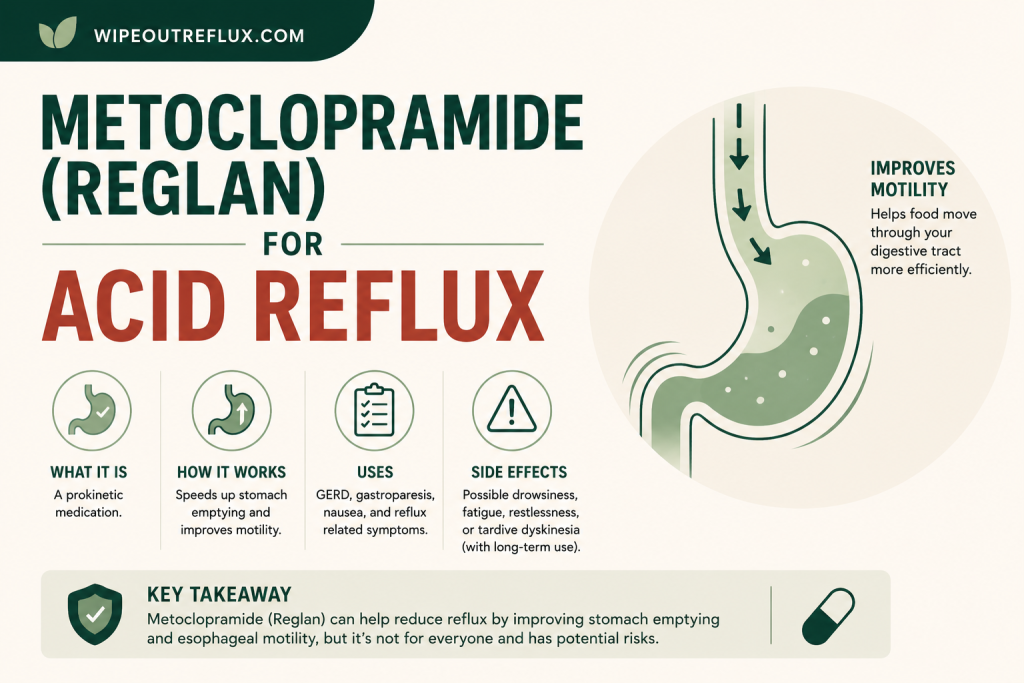
If you’ve researched prescription options for stubborn reflux, you may have come across metoclopramide — sold as Reglan in the US and Maxolon in the UK. It’s a prokinetic drug, meaning it speeds up the movement of your digestive tract, and on paper that sounds ideal for reflux. So does it actually work, and is it a good idea?
Here’s the honest headline: metoclopramide can act on several of the mechanisms behind reflux, but the evidence that it genuinely helps GERD is weak, and it carries a serious safety warning that has led major regulators to pull back sharply on its use. In the US it’s reserved for short-term use in severe, treatment-resistant cases, and in the UK and Europe it’s no longer approved for reflux at all. This is very much prescription-only, doctor-supervised territory.
I’m not a doctor, and none of this is medical advice. My aim is to explain the drug clearly so you can have an informed conversation with yours — not to encourage anyone to seek it out or self-medicate.
Key takeaways
- Metoclopramide (Reglan in the US, Maxolon in the UK) is a prokinetic and anti-sickness drug that speeds up stomach emptying.
- It can increase pressure at the lower oesophageal valve and improve stomach emptying — both relevant to reflux.
- Despite this, the evidence that it actually helps GERD is scant, and guidelines don’t recommend it for reflux alone.
- It carries a serious “black box” warning for tardive dyskinesia — a movement disorder that is often permanent.
- In the US, use is limited to a maximum of 12 weeks; in the UK and EU it’s restricted to about 5 days and is no longer used for reflux.
- Common side effects include drowsiness, fatigue and restlessness; it can also affect mood and hormone levels.
- It’s generally reserved for severe reflux with proven slow stomach emptying that hasn’t responded to standard treatment.
- For most people, safer measures — diet, lifestyle and alginates — do far more of the useful work.
What metoclopramide is and how it works
Metoclopramide is mainly a dopamine blocker, and it works on the digestive tract in a few connected ways. It increases pressure at the lower oesophageal sphincter (the valve between your stomach and oesophagus), it enhances the muscular contractions that move things along the oesophagus, and it speeds up how quickly the stomach empties [Katz et al., American Journal of Gastroenterology, 2022]. In theory, all three should reduce reflux — a tighter valve, faster clearance, and a stomach that spends less time full. You can read more about that valve in my guide to the stomach sphincter and LPR.
It’s also a centrally-acting anti-sickness drug, because it crosses into the brain and blocks dopamine there. That’s a double-edged feature: it’s why metoclopramide is useful for nausea, but it’s also the reason it can cause the neurological side effects that define its safety profile.
Does metoclopramide actually work for acid reflux?
This is where enthusiasm has to meet the evidence. While metoclopramide clearly acts on reflux-relevant mechanisms, the data showing it meaningfully helps GERD are thin. The American College of Gastroenterology’s guideline puts it plainly: data on its efficacy in GERD are scant, and given the significant adverse events, they do not recommend using metoclopramide solely for the treatment of GERD [Katz et al., American Journal of Gastroenterology, 2022].
European regulators went further. After reviewing the evidence, the European Medicines Agency concluded there was no consistent benefit in chronic conditions like reflux, and that the neurological risks of prolonged use outweighed the benefits — so metoclopramide should no longer be used to treat heartburn and acid reflux at all [European Medicines Agency, 2013]. So the picture is a drug that could help on paper, but whose weak evidence and real risks have pushed it to the margins. If your current treatment isn’t working, my guide on what to do when acid reflux medication isn’t working is a better place to start than reaching for this.
The black box warning: why metoclopramide is used so cautiously
This is the most important part of the article. In the US, metoclopramide carries the FDA’s strongest safety alert — a boxed warning — for a condition called tardive dyskinesia. This is a disorder of involuntary, repetitive movements, most often of the face and tongue but also the limbs, and it is frequently irreversible, with no reliable treatment even after the drug is stopped [US FDA Prescribing Information (Reglan)].
The risk rises the longer you take it and the higher the dose, and it’s greater in older adults, particularly older women. This single risk is why the FDA limits treatment to a maximum of 12 weeks, and why the EMA restricted metoclopramide to short-term use of around 5 days and removed reflux from its approved uses entirely. Beyond tardive dyskinesia, metoclopramide can cause other movement problems such as acute muscle spasms, restlessness and parkinsonism, and it’s not a drug to be taken casually or for long stretches.
Other side effects to know about
Even in short courses, side effects are common. Drowsiness, fatigue and restlessness each occur in around one in ten people. Less commonly, metoclopramide can cause low mood or depression, confusion, dizziness, headache and insomnia. Because it blocks dopamine, it can also raise the hormone prolactin, leading to breast tenderness or discharge and menstrual changes.
It interacts with a number of medications and isn’t suitable for everyone — people with Parkinson’s disease, certain gut obstructions, epilepsy and some other conditions generally shouldn’t take it. All of this is exactly why it needs a doctor’s assessment and monitoring rather than being something to source independently.
Metoclopramide and silent reflux (LPR)
Metoclopramide isn’t approved or established specifically for laryngopharyngeal reflux. The prokinetic rationale is theoretically appealing for LPR — faster emptying and a tighter valve should mean less reflux reaching the throat — but there’s little direct evidence for it in silent reflux, and the same serious safety concerns apply. If it’s ever considered for LPR, it tends to be off-label, short-term, and only when delayed stomach emptying is part of the picture. For most people with silent reflux, the pepsin-focused, source-level approach I describe in neutralising pepsin in the throat is far more relevant, and my GERD vs LPR comparison explains why LPR needs its own approach.
Where metoclopramide actually fits
For the vast majority of people with reflux, metoclopramide is not the answer, and it’s certainly not a starting point. Where it’s used for reflux at all — mainly in the US — it’s reserved for severe cases with documented slow stomach emptying that haven’t responded to standard treatment, given at the lowest effective dose for the shortest possible time, typically before meals and at bedtime, under close supervision. In the UK and Europe, it simply isn’t used for reflux any more.
For everyone else, the safer and more effective levers are the familiar ones. Reducing reflux at the source through diet, meal timing and weight management does the heavy lifting. An alginate such as Gaviscon Advance is a genuinely useful add-on with a far friendlier safety profile. And if you’re wrestling with PPIs, my guide on coming off PPIs and acid rebound is worth a read. If you and your doctor do consider metoclopramide, know the warning signs of movement problems and seek help immediately if they appear.
Conclusion
Metoclopramide is a case study in why a drug that looks perfect on paper isn’t always a good idea in practice. It genuinely acts on the mechanisms behind reflux — tightening the valve, improving clearance, speeding up the stomach — yet the evidence that it meaningfully helps reflux is weak, and its serious risk of a potentially permanent movement disorder has led regulators on both sides of the Atlantic to restrict it heavily. In the US it’s a short-term, last-resort option for severe cases; in the UK and Europe it’s no longer used for reflux at all. That tells you most of what you need to know about where it belongs.
If a doctor raises metoclopramide with you — most likely because slow stomach emptying is part of your picture — it’s worth understanding both the potential benefit and the boxed warning, and keeping any course short and closely monitored. But please treat this as background for that conversation, not as a prompt to seek the drug out yourself. For the overwhelming majority of people, the biggest and safest gains come from calming reflux at the source rather than from a risky medication.
That source-first approach is exactly what my Wipeout Diet Plan is built around — a structured, step-by-step programme for reducing reflux without reaching first for medication, going far deeper into the mechanisms and daily routine than any single article can. And to make everyday choices simple, the Wipeout Food Reference Guide is the essential companion, laying out the foods and drinks allowed on an acid reflux and LPR diet along with their pH values — so you can reduce reflux naturally before prescription drugs ever become the main event. Together they give you a foundation that works with your body rather than against it.
Frequently asked questions
What is metoclopramide (Reglan) and how does it work?
Metoclopramide is a prokinetic and anti-sickness drug, sold as Reglan in the US and Maxolon in the UK. It mainly blocks dopamine, which speeds up stomach emptying, increases pressure at the lower oesophageal valve, and improves oesophageal muscle contractions. Because it also acts in the brain, it treats nausea — but that same action is behind its neurological side effects.
Does metoclopramide work for acid reflux?
It acts on several reflux mechanisms, but the evidence that it meaningfully helps GERD is weak. Major gastroenterology guidelines do not recommend it for reflux alone, and European regulators found no consistent benefit in reflux and removed it as an approved use. Where it’s used for reflux at all, it’s reserved for severe, treatment-resistant cases, usually with slow stomach emptying.
Is metoclopramide safe, and what is the black box warning?
It carries the FDA’s strongest warning for tardive dyskinesia — a movement disorder causing involuntary, repetitive movements, often of the face and tongue, that is frequently irreversible with no reliable treatment. The risk increases with higher doses, longer use, and older age. This warning is the main reason its use is so tightly restricted.
How long can you take metoclopramide?
Not long. In the US, treatment should not exceed 12 weeks. In the UK and Europe, regulators restricted it to short-term use of around 5 days and removed reflux from its approved uses altogether, due to the risk of neurological side effects with prolonged treatment. It’s meant for the shortest effective duration at the lowest effective dose.
What are the side effects of metoclopramide?
The most serious is tardive dyskinesia. More common side effects include drowsiness, fatigue and restlessness, each in around one in ten people. It can also cause low mood or depression, confusion, dizziness and headache, and by raising prolactin it can cause breast tenderness or discharge and menstrual changes. It interacts with several drugs and isn’t suitable for everyone.
Is metoclopramide used for silent reflux (LPR)?
Not in any established or approved way. The prokinetic idea is theoretically appealing for LPR, since faster emptying could mean less reflux reaching the throat, but there’s little direct evidence and the same serious safety concerns apply. If used at all, it would be off-label and short-term, generally only when delayed stomach emptying is involved.
Can I get metoclopramide over the counter?
No. Metoclopramide is prescription-only because of its side-effect profile and requires a doctor’s assessment and monitoring. In the UK and Europe it isn’t licensed for reflux at all. Given the risk of a potentially permanent movement disorder, it’s genuinely not something to source online or self-medicate — any use should be doctor-supervised.
Research sources
- [Katz et al., American Journal of Gastroenterology, 2022] — The ACG GERD guideline notes that metoclopramide increases lower oesophageal sphincter pressure, enhances peristalsis and speeds gastric emptying, but that efficacy data in GERD are scant and, given significant adverse events, it is not recommended for treating GERD alone.
- [European Medicines Agency, 2013] — The EMA restricted metoclopramide to short-term use (about 5 days) with a lowered maximum dose, and concluded it should no longer be used for chronic conditions such as heartburn and acid reflux because the risks outweighed the benefits.
- [US FDA Prescribing Information (Reglan)] — The Reglan label carries a boxed warning that metoclopramide can cause tardive dyskinesia, a serious and often irreversible movement disorder whose risk rises with dose and duration, and states that therapy should not exceed 12 weeks.

David Gray
12 years living with LPR · Consultant & researcher
I've lived with LPR for twelve years — the misdiagnoses, the PPI courses that did nothing, the slow work of figuring out what actually helps. Wipeout Reflux is where I translate the research into plain terms for people stuck in the same place. Every claim here is sourced to peer-reviewed work, and I consult one-to-one with LPR sufferers.