
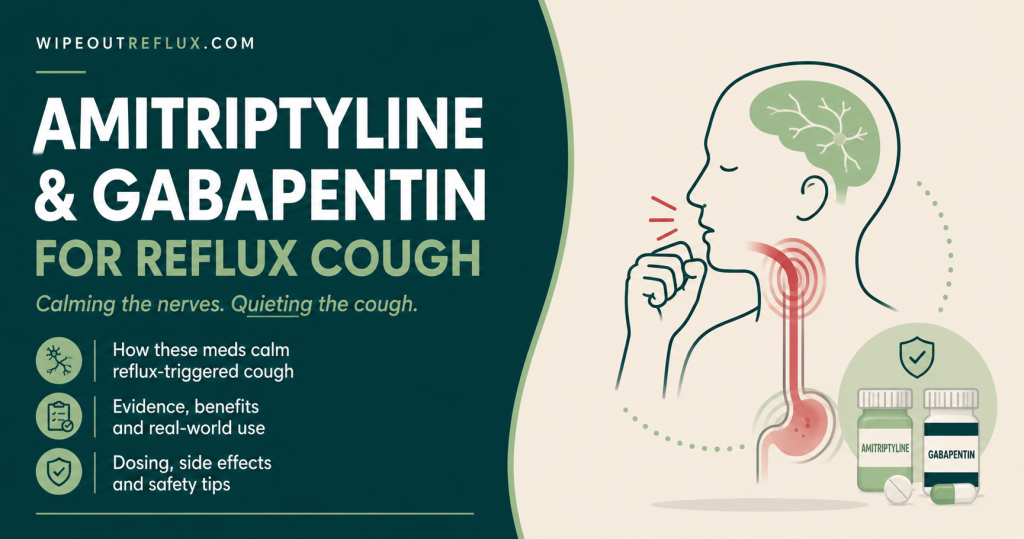
If you have a reflux cough that just will not quit — even after months on a PPI, a clean diet, and every lifestyle change going — there is an important possibility worth understanding: your cough may no longer be about acid at all.
A persistent cough that started with reflux can turn into something else over time — a hypersensitive cough reflex. The nerves involved become over-reactive, so you cough at tiny triggers that would not bother anyone else: a tickle in the throat, a change in air temperature, talking, laughing. At that point, adding more acid suppression often does nothing, because acid is no longer the driver.
This is exactly where amitriptyline and gabapentin come in. They are neuromodulators — drugs that calm down an oversensitive nervous system. They do not treat reflux; they turn down the volume on a cough reflex that has become stuck in the “on” position. I have managed my own LPR for over eight years, so let me explain how this works, what the evidence actually shows, and the trade-offs that come with these medicines.
Key Takeaways
- Persistent reflux cough is often a nerve problem, not an acid problem. The cough reflex becomes hypersensitive, so ordinary triggers set it off.
- Amitriptyline and gabapentin are neuromodulators. They calm the over-reactive cough reflex rather than treating reflux itself.
- Gabapentin has the strongest evidence. A randomised controlled trial showed it improved cough-related quality of life in refractory chronic cough.
- Amitriptyline also helps, especially in neuropathic-type cough, and it is convenient as a single bedtime dose.
- They are used off-label and are typically reserved for cough that persists after reflux and other causes have been addressed.
- Side effects are the trade-off. Drowsiness, dizziness, and (for amitriptyline) dry mouth are common, and both drugs need careful titration.
- They work best combined with speech therapy and with the reflux fundamentals still in place.
Why “Reflux Cough” Often Isn’t About Acid Anymore
This is the concept that changes everything, so it is worth slowing down on. Chronic cough specialists increasingly view stubborn cough as a cough hypersensitivity syndrome — and the parallel they draw is with neuropathic pain.
In neuropathic pain, nerves that were once responding to a real injury become sensitised and keep firing long after the original problem is gone, so that even a light touch hurts. The same thing can happen with the cough reflex. Reflux, or a viral infection, irritates the nerves in your throat and airway. In some people those nerves stay in a hyper-reactive state, and the cough reflex becomes triggered by trivial things — a tickle, dryness, cold air, speaking. Doctors call the throat version of this laryngeal sensory neuropathy, and the tell-tale sign is that persistent throat tickle or the constant urge to clear your throat.
Here is the practical consequence. If the cough is being driven by sensitised nerves rather than acid, acid-suppressing drugs will not fix it. That is not just theory — the CHEST expert panel found that esomeprazole was ineffective for unexplained chronic cough in people without features of acid reflux, while gabapentin was supported as a treatment recommendation [Gibson et al., Chest, 2016]. In other words, when the cough is a nerve problem, you need a nerve treatment. This is one of the most common reasons people find their acid reflux medication is not working for their cough.
How Amitriptyline and Gabapentin Work
Both drugs quieten an over-excited nervous system, but they come at it from different directions. Crucially, neither one does anything to your reflux. They work on the cough reflex, not the stomach.
Gabapentin
Gabapentin was originally developed for epilepsy and is now widely used for neuropathic pain. It dampens the excitability of over-active nerves. Applied to cough, the idea is that it reduces the central sensitisation of the cough reflex — the amplified nerve signalling that keeps the reflex on a hair trigger. When researchers found it worked, they concluded that central reflex sensitisation is a genuine mechanism in refractory chronic cough [Ryan et al., Lancet, 2012].
Amitriptyline
Amitriptyline is a tricyclic antidepressant, but that name is misleading here. At the low doses used for cough — often just 10 mg — it is not being used to treat mood; it is being used as a neuromodulator, the same way it is prescribed for nerve pain and migraine prevention. It modulates the neural signalling involved in the sensitised cough reflex, which is why it can settle a neuropathic cough that has not responded to anything else.
What the Evidence Says
Let me lay this out honestly, because the quality of evidence differs between the two.
Gabapentin
This is the better-studied option. In a randomised, double-blind, placebo-controlled trial of 62 patients with refractory chronic cough, gabapentin significantly improved cough-specific quality of life compared with placebo, with a number-needed-to-treat of about 3.6 — meaning roughly one in every three or four treated patients saw a meaningful benefit. Side effects (mainly nausea and fatigue) occurred in 31% [Ryan et al., Lancet, 2012]. That is a solid result for a condition that is notoriously hard to treat.
Amitriptyline
The amitriptyline evidence is smaller but striking, and it is directly relevant to reflux cough. In a randomised study of 28 patients with chronic cough from post-viral vagal neuropathy — all of whom had already failed PPI antireflux treatment — a majority of the amitriptyline group achieved a complete response on just 10 mg at bedtime, while none of the group given a codeine/guaifenesin cough suppressant did. Amitriptyline was a highly significant predictor of a greater than 50% improvement [Jeyakumar et al., The Laryngoscope, 2006]. The fact that these patients had a “reflux cough” that did not respond to reflux treatment, but did respond to a neuromodulator, tells you a lot about the real mechanism.
The bigger picture
Guidelines now reflect this. The CHEST panel specifically supported gabapentin for unexplained chronic cough while finding acid suppression ineffective when there were no acid-reflux features [Gibson et al., Chest, 2016]. A related gabapentinoid, pregabalin, has also shown benefit when combined with speech pathology therapy — a reminder that the best results often come from pairing a neuromodulator with cough-suppression techniques rather than relying on the drug alone.
The honest caveat across all of this: the trials are relatively small, the benefit is real but partial, and not everyone responds. These are useful tools, not guaranteed cures.
Amitriptyline vs Gabapentin: Which and When?
There is no universal “better” here — it comes down to the individual, and it is your doctor’s call. But a few practical differences are worth knowing.
Amitriptyline is often taken as a single dose at bedtime, which is simple and can help with sleep and the night-time throat tickle. Its sedating effect is sometimes an advantage at night, though a drawback by day.
Gabapentin is usually built up gradually to a higher total dose spread across the day, which means more doses and a slower titration, but it has the stronger trial evidence behind it.
In practice, clinicians often try one, and if it does not help or is not tolerated, switch to the other — response is genuinely individual. Both are started low and increased slowly to find the lowest dose that works.
The Side Effects
This is the trade-off that decides whether these drugs are worth it for a given person.
Amitriptyline commonly causes drowsiness, dry mouth, constipation, dizziness, and sometimes weight gain, all from its anticholinergic and sedating effects. In some cough studies a notable proportion of patients stopped it because of side effects, and it needs caution in people with certain heart-rhythm issues.
Gabapentin commonly causes dizziness, drowsiness, fatigue, and sometimes blurred vision or confusion. As in the trial above, side effects affect roughly a third of users, which is why the dose is titrated carefully.
Two rules apply to both: start low and increase slowly, and do not stop suddenly — gabapentin in particular should be tapered rather than stopped abruptly. These are prescription medicines that need proper medical supervision, not something to start or stop on your own.
Combine With Speech Therapy and the Fundamentals
The single most useful thing I can tell you is that neuromodulators work best as part of a package, not in isolation. Combining them with speech and language therapy — specific techniques to suppress the cough and reduce throat irritation — consistently produces better results than medication alone.
And you should not abandon the reflux fundamentals either. Even when the cough has become a nerve-driven problem, ongoing reflux can keep re-irritating those sensitised nerves and stop them settling. Reducing reflux frequency removes the fuel from the fire, which is exactly what my Wipeout Diet Plan is built to do. If your main symptom is the constant urge to clear your throat, my guide on how to stop constant throat clearing from reflux pairs well with this approach. It is also worth knowing that stress and anxiety can heighten this kind of hypersensitivity, which I cover in can LPR be caused by anxiety.
Conclusion
The most useful shift in thinking about a stubborn reflux cough is realising that, past a certain point, it may not be a reflux problem at all — it can become a hypersensitive cough reflex, a nerve problem that behaves much like neuropathic pain. That is why piling on more acid suppression so often fails, and why neuromodulators like amitriptyline and gabapentin can succeed where reflux drugs cannot.
Gabapentin has the stronger evidence, with a randomised trial showing real improvement in cough quality of life, while low-dose amitriptyline has impressed in neuropathic-type cough — notably in patients whose “reflux cough” had already failed PPIs. Neither is a cure, both come with side effects worth weighing, and both work best alongside speech therapy rather than on their own.
My honest view after years of living with this: these are valuable tools for the difficult cases, to be used under a doctor’s care when the fundamentals plus standard reflux treatment have not been enough — never as a shortcut around them. And the fundamentals still matter even here, because ongoing reflux keeps those over-sensitised nerves inflamed and stops them calming down. That is where lasting improvement really comes from, and it is what my Wipeout Diet Plan is designed to deliver, in the depth this condition needs. Pair it with the Wipeout Food Reference Guide — the essential companion that shows exactly which foods and drinks are reflux-friendly and their pH values — and you give your throat the low-irritation environment it needs to finally settle. Get the foundation right, and let any medication be the boost on top.
Frequently Asked Questions
Why does my reflux cough continue even though my reflux is treated?
Because a long-standing cough can become a hypersensitive reflex — the nerves in your throat and airway stay over-reactive and trigger coughing at minor stimuli, independent of acid. At that stage it behaves like a nerve problem rather than a reflux problem, which is why acid suppression stops helping.
Do amitriptyline and gabapentin treat acid reflux?
No. Neither drug affects reflux or acid. They are neuromodulators that calm an over-sensitive cough reflex. That is precisely why they can help a cough that persists after reflux itself has been managed.
Which is better for reflux cough, amitriptyline or gabapentin?
Gabapentin has the stronger trial evidence, but response is individual. Amitriptyline is convenient as a single bedtime dose and can help neuropathic-type cough. Doctors often try one and switch to the other if it does not help or is not tolerated.
How long do they take to work?
Both are usually started at a low dose and increased gradually, so it can take a few weeks of titration to reach an effective dose and judge the benefit. Improvement is gradual rather than immediate.
What are the main side effects?
Amitriptyline commonly causes drowsiness, dry mouth, constipation, and dizziness. Gabapentin commonly causes dizziness, drowsiness, and fatigue. Both affect a meaningful minority of users, which is why doses are titrated carefully.
Can I stop these medicines suddenly?
No. Both should be tapered rather than stopped abruptly, gabapentin especially. Always adjust or stop them under your doctor’s guidance.
Should I still follow a reflux diet if I am taking these?
Yes. Ongoing reflux keeps re-irritating the sensitised nerves and can stop them settling, so managing reflux through diet and lifestyle remains important even when the cough has become nerve-driven. Neuromodulators work best combined with those fundamentals and with speech therapy.
Research Sources
- [Ryan et al., Lancet, 2012] — A randomised, double-blind, placebo-controlled trial in 62 patients found gabapentin significantly improved cough-specific quality of life in refractory chronic cough, supporting central reflex sensitisation as a mechanism.
- [Jeyakumar et al., The Laryngoscope, 2006] — A randomised study of 28 patients with post-viral vagal neuropathic cough who had failed PPIs found low-dose amitriptyline was significantly more effective than a codeine/guaifenesin cough suppressant.
- [Gibson et al., Chest, 2016] — The CHEST guideline on unexplained chronic cough supported gabapentin as a treatment recommendation and found esomeprazole ineffective in patients without acid-reflux features.

David Gray
12 years living with LPR · Consultant & researcher
I've lived with LPR for twelve years — the misdiagnoses, the PPI courses that did nothing, the slow work of figuring out what actually helps. Wipeout Reflux is where I translate the research into plain terms for people stuck in the same place. Every claim here is sourced to peer-reviewed work, and I consult one-to-one with LPR sufferers.