
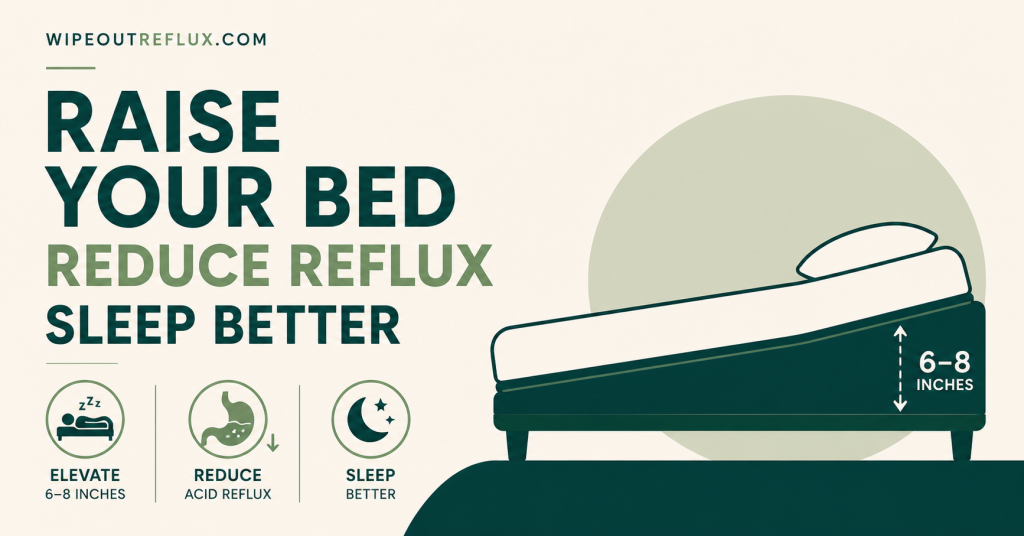
Raising the head of your bed is one of the simplest, cheapest, and best-evidenced things you can do for nighttime acid reflux and LPR. When you lie flat, gravity stops helping you — stomach contents can drift up your oesophagus and reach your throat all night. Tilt your upper body up even a little, and gravity goes back to work keeping everything where it belongs.
The quick version: raise the head end of the whole bed by 6 to 8 inches (about 15 to 20 cm) using sturdy blocks or bed risers under the head-end legs, or use a proper under-mattress wedge. What you should not do is simply pile up extra pillows — that bends your neck and folds your body at the waist, which can actually make reflux worse.
I have managed my own LPR for over eight years, and bed elevation is one of the few lifestyle changes I recommend to almost everyone with nighttime symptoms. Let me show you exactly how to do it properly, which method suits you, and how to avoid the common mistakes.
Key Takeaways
- Raise the head of the bed by 6 to 8 inches (15 to 20 cm) — the standard, evidence-based height.
- Lift the whole upper body on a straight incline, not just your head. Blocks under the bed legs or an under-mattress wedge do this best.
- Never just stack pillows. It bends the neck, raises abdominal pressure, and can worsen reflux.
- The evidence is solid. Studies show elevation reduces oesophageal acid exposure, speeds acid clearance, and eases nighttime symptoms.
- It helps throat symptoms too. Even 6 inches reduces the reflux that reaches the larynx in supine sleepers — key for LPR.
- Stop yourself sliding down with a footboard, bolster, or non-slip layer.
- Combine it with left-side sleeping and not eating late for the best results.
Why Raising the Head of Your Bed Helps
The logic is beautifully simple: gravity. When you are upright during the day, gravity naturally helps keep stomach contents down. The moment you lie flat, that help disappears, and refluxed material can pool in your oesophagus and creep up toward your throat. On top of that, at night you swallow less and produce less saliva, so anything that does reflux hangs around longer and takes more time to clear.
Tilting your upper body restores gravity’s assistance. It keeps stomach contents down, shortens how long any refluxed material sits in the oesophagus, and reduces how much reaches your throat and airway.
This is well supported by research. A study using pH monitoring found that elevating the head of the bed reduced oesophageal acid exposure and acid clearance time in nighttime refluxers, and eased heartburn and sleep disturbance [Khan et al., Journal of Gastroenterology and Hepatology, 2012]. A systematic review of controlled trials concluded that head-of-bed elevation has a beneficial effect on relieving reflux symptoms, and is a sensible non-drug option [Albarqouni et al., BMC Family Practice, 2021].
For silent reflux specifically, this matters even more. Research on supraesophageal reflux — reflux that travels all the way up to the throat and voice box — found it happens largely in the supine position, and that just 6 inches of head-of-bed elevation was effective at reducing it [Scott and Simon, The Journal of Allergy and Clinical Immunology: In Practice, 2015]. If your worst LPR symptoms hit overnight or on waking — hoarseness, throat clearing, a nighttime cough — this is one of the most direct fixes you have. It pairs naturally with the advice in my guides on acid reflux at night and the best sleeping position for silent reflux.
How Much to Raise It
The standard, well-established recommendation is 6 to 8 inches (15 to 20 cm) at the head end. That works out to a gentle incline of roughly 10 to 15 degrees. Systematic reviews have used blocks in the 20 to 28 cm range, and even 6 inches has been shown to reduce reflux reaching the throat.
You do not need to go extreme — a steeper angle is not necessarily better, and it can make sleeping uncomfortable or cause you to slide down. Aim for that 6 to 8 inch sweet spot, delivered as a smooth incline of your whole upper body.
The Best Methods, Ranked
There are several ways to achieve the elevation. Here they are, roughly best to most convenient.
1. Bed risers or blocks under the frame (the gold standard)
Placing sturdy blocks or purpose-made bed risers under the two legs at the head end of the bed lifts the entire frame into a gentle incline. This is my top recommendation because it tilts your whole body on a straight line — no bending at the neck or waist — which is exactly what the research is based on. Use solid wooden blocks, concrete blocks, or bed risers rated for your bed’s weight, and make sure the bed is completely stable afterwards.
2. Under-mattress wedge
A long foam wedge placed between your mattress and the base creates a gradual incline of the upper half of the bed. This is a great option if you cannot or do not want to lift the frame — for example with a storage bed or slatted base. Studies have found sleeping on a wedge significantly reduces oesophageal acid exposure. Choose one that starts around hip level and rises gradually, so you are inclined from the hips up rather than folded at the waist.
3. Wedge pillow (on top of the mattress)
A foam wedge pillow that you lie on top of is the most affordable and portable option. It is far better than stacking flat pillows, but it only lifts your upper torso, can be less stable, and you may slide off it. If you go this route, pick a long, gradual wedge that supports you from the hips up, not a short one that just props your head.
4. Adjustable bed base
A motorised adjustable base lets you raise the head section at the touch of a button — the most convenient and precise option, if the priciest. One tip: because these bend you at the waist, raising the knee section slightly too can stop your torso folding and keep pressure off your abdomen.
The Big Mistake: Don’t Just Use Pillows
This is the single most common error, so it is worth being blunt about. Stacking extra pillows under your head to prop yourself up does not work and can backfire. It bends your neck forward and folds your body at the waist, which increases pressure on your abdomen and can push more reflux upward — the opposite of what you want. You also tend to slide off the pillows during the night and end up flat anyway.
The goal is a straight, gentle incline of your whole upper body, achieved from underneath — not a bent neck propped up from a flat mattress.
Step-by-Step: Raising Your Bed With Blocks
Here is the simplest, most effective method, step by step:
- Choose your height. Aim for 6 to 8 inches (15 to 20 cm).
- Get sturdy risers. Use solid wooden or concrete blocks, or bed risers rated for the weight of your bed plus occupants.
- Lift and place. With help, gently lift the head end of the bed and slide a riser securely under each leg or caster at that end.
- Check stability. Make sure the bed sits solidly and does not rock or wobble before you use it.
- Add anti-slide measures (see below) so you do not gradually slip toward the foot of the bed.
- Give it one to two weeks. It takes a little getting used to, so stick with it before judging.
Stop Yourself Sliding Down
The most common complaint with an inclined bed is sliding toward the bottom during the night. A few easy fixes solve it:
- A footboard gives your feet something to rest against.
- A firm bolster or rolled towel placed under the fitted sheet at hip level acts as a gentle stop.
- A non-slip mattress pad or grippy underlay reduces the mattress and your body sliding.
Extra Tips for the Best Results
Elevation works even better when you stack it with a few other simple habits:
- Sleep on your left side. Combining elevation with left-side sleeping gives the best positional protection against reflux.
- Do not eat late. Leave around three hours between your last meal and lying down, so your stomach is emptier at bedtime.
- Consider your partner. Tilting the whole bed affects both of you; an under-mattress wedge on your side, or a single-sleeper wedge, can be a fairer compromise.
- Check with your doctor if relevant. If you are pregnant, have a neck or back condition, or have sleep apnoea, elevation often helps — but it is worth confirming your approach suits you. I look at the reflux–apnoea link in my guide to sleep apnoea and acid reflux.
Bed elevation is also one of the genuinely drug-free tools in the toolkit, which makes it especially useful if you are trying to reduce your reliance on medication — see my guide on getting off PPIs and acid rebound.
Conclusion
Raising the head of your bed is about as close as reflux gets to a free win. It costs little, it is backed by solid research, and it directly targets the nighttime reflux that causes so much trouble — the heartburn that wakes you, and the hoarseness, throat clearing, and cough that greet you in the morning. The formula is simple: lift the head end of the whole bed by 6 to 8 inches on a straight incline using blocks or an under-mattress wedge, stop yourself sliding down, and never rely on piled-up pillows.
Give it a couple of weeks to become second nature, and combine it with left-side sleeping and an earlier last meal for the biggest effect. For many people with nighttime reflux and LPR, this one change makes a noticeable difference on its own.
That said, positioning manages symptoms while you sleep — it does not fix what is driving the reflux in the first place. In my experience, lasting improvement comes from changing what you eat and how you eat, with bed elevation as the perfect overnight support on top. That is exactly what my Wipeout Diet Plan is built to deliver, in the depth this condition needs, and the Wipeout Food Reference Guide is the essential companion that shows exactly which foods and drinks are reflux-friendly and their pH values. Get the foundation right, raise your bed, and give your throat the calm, reflux-free nights it needs to heal.
Frequently Asked Questions
How high should I raise the head of my bed for acid reflux?
Aim for 6 to 8 inches (15 to 20 cm) at the head end — a gentle incline of about 10 to 15 degrees. This is the standard evidence-based height, and even 6 inches has been shown to reduce reflux reaching the throat. Going steeper is not necessarily better and can be uncomfortable.
Is it better to raise the bed or use a wedge pillow?
Raising the whole bed with blocks under the head-end legs is ideal, because it inclines your entire body on a straight line. An under-mattress wedge is a close second. A wedge pillow is more affordable and portable but only lifts your upper torso, so it is generally less effective — though still far better than flat pillows.
Why can’t I just use extra pillows?
Stacking pillows bends your neck and folds your body at the waist, which raises abdominal pressure and can actually worsen reflux. You also tend to slide off them and end up flat. The aim is a straight incline of your whole upper body from underneath, not a propped-up head.
Does raising the bed help LPR and throat symptoms?
Yes. Research shows reflux that reaches the throat and voice box happens largely when lying flat, and that even 6 inches of head-of-bed elevation reduces it. If your silent reflux symptoms are worst overnight or on waking, elevation is one of the most direct positional fixes.
How do I stop sliding down the bed?
Use a footboard for your feet to rest against, place a firm bolster or rolled towel under the fitted sheet at hip level, or add a non-slip mattress pad. These simple additions keep you in position through the night.
Will raising the bed affect my partner?
Tilting the whole bed inclines both sides, which not everyone wants. A fair compromise is an under-mattress wedge on your side of the bed, or a single-sleeper wedge pillow, so only your half is elevated.
How long until raising my bed helps?
Many people notice a difference within one to two weeks, once they have adjusted to the incline and sorted out any sliding. Give it a fair trial before deciding, and combine it with left-side sleeping and an earlier last meal for the best effect.
Research Sources
- [Khan et al., Journal of Gastroenterology and Hepatology, 2012] — Using pH monitoring, found that elevating the head of the bed with a 20 cm block reduced oesophageal acid exposure and acid clearance time in nighttime refluxers and eased heartburn and sleep disturbance.
- [Albarqouni et al., BMC Family Practice, 2021] — A systematic review of controlled trials concluded that head-of-bed elevation has a beneficial effect on relieving reflux symptoms and is a reasonable non-drug option, while noting the evidence base is small.
- [Scott and Simon, The Journal of Allergy and Clinical Immunology: In Practice, 2015] — Found that supraesophageal reflux (reflux reaching the throat) occurs largely in the supine position and that 6 inches of head-of-bed elevation was effective at reducing supine reflux.

David Gray
12 years living with LPR · Consultant & researcher
I've lived with LPR for twelve years — the misdiagnoses, the PPI courses that did nothing, the slow work of figuring out what actually helps. Wipeout Reflux is where I translate the research into plain terms for people stuck in the same place. Every claim here is sourced to peer-reviewed work, and I consult one-to-one with LPR sufferers.