
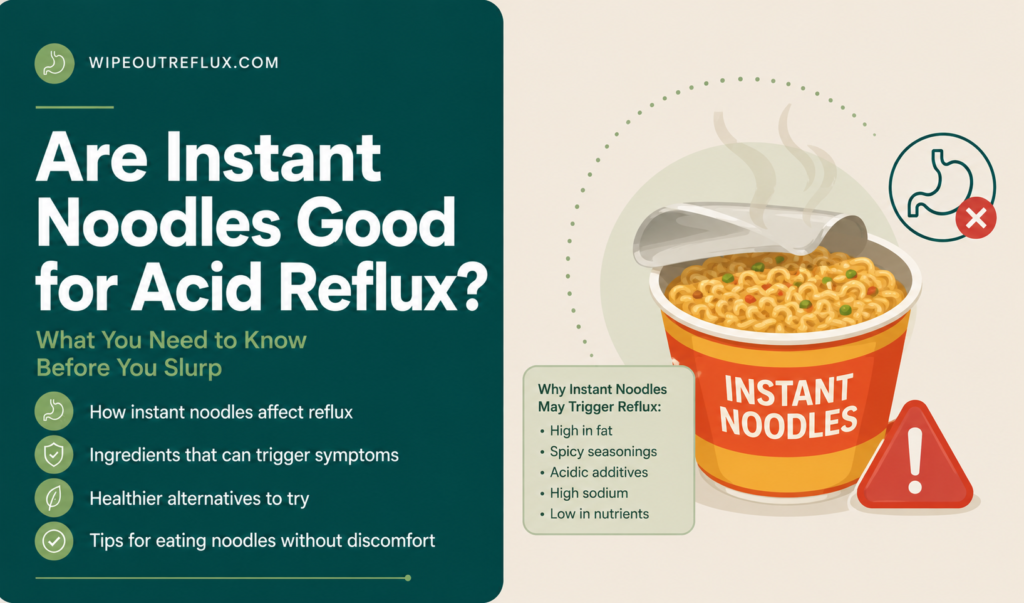
Are Instant Noodles Good for Acid Reflux?
Instant noodles are not a great choice for acid reflux — and while that’s probably not surprising, understanding exactly why helps you make smarter decisions if they’re a regular part of your diet. The problems aren’t just about spice. Most instant noodles carry a combination of high fat from pre-frying, extremely high sodium, capsaicin-containing flavour packets, garlic and onion compounds, and preservatives that slow gastric emptying. Each of these independently increases reflux risk. Together, they make a fairly reliable trigger food.
That said, the range within “instant noodles” is wide. A plain chicken-flavour ramen with half the seasoning packet is a different proposition from a full-strength spicy Korean buldak noodle. And restaurant ramen — made fresh with real broth — is different again from either. This article breaks down what’s actually causing the problem, and how to make the best choices if you want to eat noodles with acid reflux.
Key Takeaways
- Most instant noodles are pre-fried in palm oil, making them significantly higher in saturated fat than they appear — fat is one of the most reliable GERD triggers via LES relaxation.
- A single serving of instant noodles can contain 1,500–1,900mg of sodium — exceeding the daily recommended intake — and high sodium intake is associated with increased GERD risk.
- Spicy flavour variants contain capsaicin, which activates TRPV1 receptors in the esophagus, directly producing burning sensations and worsening reflux symptoms in GERD patients.
- Many flavour packets contain garlic and onion powder — both established LES-relaxing compounds and esophageal irritants.
- Preservatives in instant noodles significantly delay gastric emptying, meaning food sits in the stomach longer and has more opportunity to reflux.
- Air-dried noodles (non-fried) are meaningfully better for reflux than fried varieties — worth checking the label.
- Using half the flavour packet, or making your own broth, dramatically reduces the sodium and trigger load.
- Rice noodles are a more reflux-friendly noodle base than wheat-based instant noodles.
- Restaurant ramen made with a light broth (shio or clear shoyu) is generally better tolerated than instant ramen.
Why Instant Noodles Are Problematic for Acid Reflux: The Full Picture
Pre-Frying in Palm Oil — The Hidden Fat Problem
Most instant noodles on the market are pre-cooked by flash-frying before drying and packaging. This process means the noodles absorb a significant amount of palm oil — a saturated fat source — before they even reach you. A typical 85g serving of instant noodles contains around 7–14g of fat depending on the brand, much of it saturated.
Dietary fat is one of the most well-documented reflux triggers. It causes the release of cholecystokinin (CCK) in the small intestine, which relaxes the lower esophageal sphincter (LES) and slows gastric emptying — the two key mechanisms that allow acid to travel upward into the esophagus. High-fat diets carry an odds ratio of over 7 for GERD risk in systematic review evidence [__Eusebi et al., Therapeutic Advances in Gastroenterology, 2021__]. Air-dried noodle varieties, where the fat content can be as low as 1–3g per serving, are meaningfully better in this respect — look for “air dried” or “non-fried” on the packaging.
Sodium — A Significant but Overlooked Trigger
A single serving of instant noodles — and note that most packets contain more than one “serving” — typically contains 1,500–1,900mg of sodium, with some variants exceeding 2,000mg. The recommended daily intake for most adults is 1,500–2,300mg. In a single bowl of noodles, you may be hitting your entire daily sodium allowance before the rest of the day’s food is factored in.
High sodium intake has been identified as a risk factor for GERD. Research has found that high salt intake is associated with higher GERD incidence, alongside inadequate fruit and vegetable intake and excessive processed food consumption [__Kohansal et al., BMC Public Health, 2023__]. The relationship isn’t fully understood mechanistically — it may partly reflect the broader dietary pattern of high-sodium, low-fibre processed food — but reducing sodium is a consistent recommendation across GERD dietary guidance.
Capsaicin and Spicy Flavour Variants
Spicy instant noodles — chilli, curry, buldak, and similar variants — contain capsaicin, the compound that gives chillies their heat. Capsaicin directly activates TRPV1 receptors in the esophageal lining, which produces a burning sensation and sensitises the tissue to further irritation. A study of GERD patients found that 90% experienced esophageal symptoms following capsaicin exposure, compared to 35% of healthy controls — with the most severe responses in those with erosive disease [__Mujica-Coopman et al., Revista de Gastroenterología de México, 2010__].
For people with LPR, the situation is particularly problematic — capsaicin-induced sensitisation of the throat and larynx can trigger significant symptoms even when only a small amount reaches the upper airway. Spicy instant noodle variants should be avoided entirely if you have active reflux, and especially if you have LPR.
Garlic and Onion in Flavour Packets
Even in non-spicy flavour packets — chicken, beef, vegetable — garlic and onion powder are almost universally present as flavour base ingredients. These are among the most consistently reported dietary triggers for acid reflux, containing organosulfur compounds that relax the LES and directly irritate the esophageal mucosa. Garlic and onion powders, despite being dehydrated, still retain these compounds and can trigger symptoms in sensitive individuals.
Preservatives and Delayed Gastric Emptying
Instant noodles contain preservatives including TBHQ (tertiary butylhydroquinone) and BHA/BHT, which extend shelf life but are poorly handled by the digestive system. Research using pill cameras found that instant noodles remain largely intact in the stomach after two hours, while fresh noodles had largely broken down — indicating that the preservatives significantly slow digestion and gastric emptying. Delayed gastric emptying is a meaningful contributor to acid reflux, as food remaining in the stomach for longer creates more sustained pressure on the LES and more opportunity for acid to reflux upward.
Instant Noodles vs Restaurant Ramen for Acid Reflux
Restaurant ramen is a genuinely different food from instant ramen, and it’s worth separating them in the reflux context.
The main advantages of freshly made ramen: the noodles aren’t pre-fried, so the fat content is dramatically lower; there are no synthetic preservatives; the broth’s sodium level, while still significant, tends to be lower than flavour packets; and fresh ingredients like ginger, broth bones, and vegetables don’t carry the same preservative burden.
That said, not all restaurant ramen is equal from a reflux perspective:
- Tonkotsu (pork bone broth) — very high in fat from the long-simmered pork; the richest and most reflux-triggering broth style
- Miso ramen — fermented miso has probiotic properties but the broth is typically high in sodium and often includes garlic and chilli
- Shoyu (soy sauce broth) — lighter than tonkotsu; moderate sodium; generally better tolerated
- Shio (salt broth) — the lightest and clearest broth style; lowest fat; the most reflux-friendly option at a ramen restaurant
If you’re eating ramen at a restaurant, shio broth with plain toppings (chicken, egg, bamboo shoots, spring onion in moderation) is the most reflux-safe combination. Ask for the chilli on the side or omit it entirely.
Best Types of Noodles for Acid Reflux
If noodles are a regular part of your diet, the choice of noodle type matters for reflux independently of what you put on them.
- Rice noodles — the best choice for reflux. Made from rice flour, they’re naturally gluten-free, low in fat, easy to digest, and have no added preservatives when purchased plain and dry. Their pH is close to neutral and they don’t carry the same refined wheat profile as instant noodles.
- Air-dried wheat noodles — significantly better than fried instant noodles. Soba (buckwheat), udon, or plain wheat noodles cooked fresh from dry are good options with a controlled broth.
- Standard fried instant noodles — manageable in small amounts with limited flavouring, but not ideal
- Spicy instant noodles — avoid if you have GERD or LPR
For more on noodles in a reflux-friendly context, see our article on chicken noodle soup and acid reflux.
How to Make Instant Noodles More Reflux-Friendly
If instant noodles are a convenience food you rely on and don’t want to cut out entirely, these adjustments reduce the reflux risk significantly:
- Choose air-dried over fried — cut the fat content by 60–70% simply by choosing non-fried varieties. Most packaging will say “air dried” if it applies.
- Use half the flavour packet — this cuts sodium and trigger compounds (garlic, onion, MSG) in half while still providing flavour. The original article touched on this and it’s genuinely the most practical single change to make.
- Make your own broth — discard the packet entirely and use a homemade or low-sodium vegetable or chicken broth. Add your own reflux-safe seasoning: a small amount of turmeric, fresh ginger, or plain salt.
- Add safe vegetables — courgette, spinach, carrot, and cucumber all work well as additions and help buffer the acidity of the broth while adding fibre.
- Avoid cup noodles in Styrofoam — the combination of boiling water and polystyrene can leach BPA and other chemicals into the food, adding unnecessary digestive irritants.
- Keep portions small — a half-portion of noodles with a reflux-safe broth is far easier on the stomach than a full serving.
- Don’t eat them close to bedtime — the high sodium, fat, and preservative load make lying down soon after particularly risky.
Instant Noodles and LPR (Silent Reflux)
For LPR specifically, I’d be more cautious with instant noodles than I would with standard GERD. LPR is highly sensitive to acidic and irritating compounds reaching the throat, and the combination of capsaicin (in spicy varieties), garlic compounds, high sodium, and delayed gastric emptying creates a strong case for avoidance or very careful selection. If you do eat instant noodles with LPR, choose an air-dried plain flavour with your own broth, use a small portion, and eat them earlier in the day rather than in the evening.
Frequently Asked Questions
Are instant noodles bad for acid reflux?
As a regular food, yes — the combination of high fat (from pre-frying), very high sodium, spice and flavouring packet compounds, and preservatives that slow gastric emptying makes them a reliable reflux trigger in standard form. Occasional consumption of a plain, air-dried variety with reduced seasoning is manageable for most people, but they’re not a food to be eating frequently if reflux is a problem.
What kind of noodles are best for acid reflux?
Plain rice noodles are the best choice — low fat, easy to digest, close to neutral pH, and free of preservatives when purchased dry. Air-dried plain wheat noodles are a good second option. Both are far better than fried instant noodles from a reflux perspective. The key is what you cook them in — a light, low-sodium broth with no spice or garlic is the reflux-safe approach.
Can I eat ramen if I have acid reflux?
Restaurant ramen in moderation, yes — especially shio (salt broth) or plain shoyu-style. The fresh, non-fried noodles and real broth are significantly better than instant ramen. Avoid tonkotsu (high fat), spicy variants, and large portions. Instant ramen is more problematic due to the pre-frying, high sodium, and preservative content.
Does spicy instant noodle cause acid reflux?
Very reliably, yes. Capsaicin in spicy noodles activates TRPV1 receptors in the esophagus, directly producing burning sensations and sensitising the tissue to acid. Research found 90% of GERD patients experienced esophageal symptoms from capsaicin exposure. Spicy variants — chilli, curry, buldak — should be avoided if you have active reflux or LPR.
Are instant noodles good for an upset stomach?
Generally no. The preservatives slow gastric emptying, the sodium can worsen gastric irritation, and the spice compounds (even in mild flavours, garlic and onion are usually present) are irritants. A plain rice noodle soup with homemade broth is a far better choice when your stomach is unsettled. Plain boiled rice or plain toast are better still during a flare.
Is MSG in instant noodles bad for acid reflux?
MSG itself isn’t a well-established direct reflux trigger — the evidence linking MSG specifically to GERD is limited. The more significant issues in instant noodles are the fat, sodium, capsaicin, and garlic/onion compounds. That said, some people do report digestive sensitivity to MSG, and since it’s in most flavour packets alongside these other triggers, reducing the amount of seasoning packet you use addresses this incidentally.
Conclusion
Instant noodles are one of the more complex processed foods to assess for reflux, because the problems come from multiple directions simultaneously — fat, sodium, spice, garlic compounds, and preservatives all contribute independently. That complexity means there’s also meaningful variation within the category: a plain, air-dried chicken noodle with half the seasoning packet and a homemade broth is a genuinely different food from a full-packet spicy buldak noodle.
If instant noodles are a regular part of your diet, the practical steps are clear: switch to air-dried varieties, use half the flavour packet or make your own broth, skip spicy variants entirely, and treat them as an occasional convenience rather than a staple. Restaurant ramen on a light broth is a better option when you want noodles without the processed food downside. And if you’re building a meal specifically for reflux management, rice noodles in a homemade broth with safe vegetables are the most reliably well-tolerated version of a noodle dish.
For a comprehensive approach to eating well with acid reflux — including which carbohydrates, proteins, and meal types work best — my Wipeout Diet Plan provides practical guidance across all food categories. For tailored advice on your specific symptoms and diet, a Private Acid Reflux Consultation is also available.
Related Articles
- Is Chicken Noodle Soup Good for Acid Reflux?
- The Complete Guide to LPR (Silent Reflux)
- The Ultimate Guide to Acid Reflux and GERD
- Is Garlic Acidic or Alkaline? (Bad for Acid Reflux?)
- What Fish is Good for Acid Reflux?
- Best Salad Dressings for LPR
- Nuts and Acid Reflux: What You Need to Know
Research & References
- High-fat diets carry an odds ratio of over 7 for GERD risk in systematic review evidence, with dietary fat promoting LES relaxation and delayed gastric emptying — the two primary mechanisms driving acid reflux [__Eusebi et al., Therapeutic Advances in Gastroenterology, 2021__].
- High salt intake is associated with a higher incidence of GERD, alongside inadequate fibre intake and excessive consumption of processed foods [__Kohansal et al., BMC Public Health, 2023__].
- Capsaicin activates TRPV1 receptors in the esophageal lining, producing burning sensations and sensitising tissue to acid; 90% of GERD patients experienced esophageal symptoms following capsaicin exposure, compared to 35% of healthy controls [__Mujica-Coopman et al., Revista de Gastroenterología de México, 2010__].
- Spicy foods, fatty foods, and dietary patterns associated with processed food consumption are among the most consistently reported triggers for GERD symptoms in both clinical trials and population-based dietary studies [__Newberry & Lynch, Current Opinion in Gastroenterology, 2017__].

David Gray
12 years living with LPR · Consultant & researcher
I've lived with LPR for twelve years — the misdiagnoses, the PPI courses that did nothing, the slow work of figuring out what actually helps. Wipeout Reflux is where I translate the research into plain terms for people stuck in the same place. Every claim here is sourced to peer-reviewed work, and I consult one-to-one with LPR sufferers.