
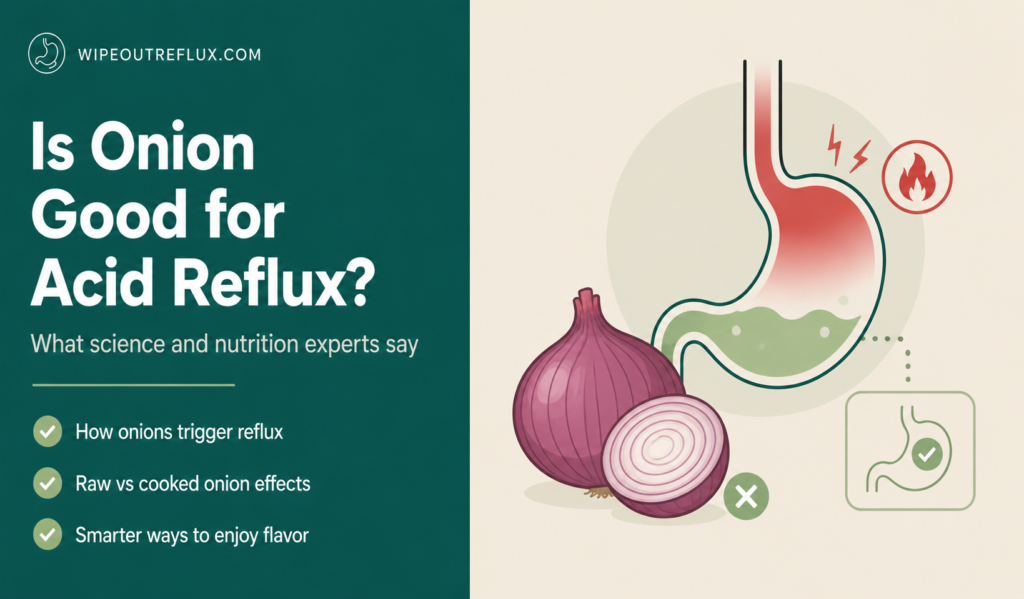
Onions are one of the more consistent dietary triggers for acid reflux, and the mechanism behind that is more interesting than most sources explain. The problem is not primarily acidity — at a pH of around 5.4–5.8, raw onions are mildly acidic but not acidic enough to be the main issue. The real culprits are fructans and volatile sulfur compounds: two separate properties of onions that cause problems through completely different pathways.
Cooking onions significantly reduces both of these effects, making cooked onions considerably easier to tolerate than raw.
Red and purple onions are generally milder than white. And for people who want the flavour of onion without the reflux risk, there are practical alternatives worth knowing about.
That said, onions are worth understanding in some depth — because they contain quercetin, a compound that has shown anti-inflammatory properties in the esophagus in research settings. There is a genuine paradox here: one part of the onion works against you, another theoretically works in your favour. I will cover both.
Key Takeaways
- Onions trigger acid reflux through two main mechanisms: fructans (fermentable fibres that increase gas and LES relaxation events) and volatile sulfur compounds (which irritate the esophageal lining).
- Clinical research confirms that fructooligosaccharides — the type of fermentable carbohydrate dominant in onions — directly increase the rate of transient LES relaxations and acid reflux episodes in GERD patients.
- Cooking onions breaks down fructans and deactivates volatile sulfur compounds significantly, making cooked onions considerably safer than raw for most reflux sufferers.
- Red and purple onions are milder in both sulfur content and pungency than white onions, making them the better choice if onions are to be included.
- Spring onions (scallions) and chives contain far less fructan than full onions and are often tolerated by people who react to regular onions.
- Onion powder is more problematic than fresh onion — it is more concentrated in fructans and sulphur compounds per gram of food.
- Onions also contain quercetin, which has shown anti-inflammatory and esophageal-protective effects in preclinical research — a real but currently limited silver lining.
Why Onions Trigger Acid Reflux: Two Distinct Mechanisms
Mechanism 1: Fructans and the LES Connection
Onions are one of the highest dietary sources of fructans — a type of fermentable carbohydrate that belongs to the FODMAP group (Fermentable Oligo-, Di-, Monosaccharides and Polyols). Fructans are not fully digested in the small intestine. Instead, they pass largely intact into the large intestine, where gut bacteria ferment them rapidly. This fermentation produces significant quantities of gas — hydrogen and methane — as a byproduct.
That gas production increases intra-abdominal pressure, which pushes against the stomach from below. When enough pressure builds, it overcomes the resistance of the lower esophageal sphincter (LES) and forces acid upward into the esophagus. In someone whose LES is already compromised — which is typical in both GERD and LPR (silent reflux) — this pressure effect is a reliable reflux trigger.
But the problem does not stop at gas pressure. Research has shown that the fermentation of fructooligosaccharides directly affects LES motor function itself — causing the sphincter to relax at times it should remain closed. A landmark controlled crossover study published in Gastroenterology administered fructooligosaccharides (FOS — the primary fructan in onions) to GERD patients over seven days and measured LES function, esophageal pH, and symptom scores. Compared to placebo, FOS ingestion produced a significant increase in transient LES relaxations, a marked increase in acid reflux episodes, greater esophageal acid exposure, and worsening of GERD symptom scores [__Piche et al., Gastroenterology, 2003__].
This is a particularly important finding: it means fructans do not just cause reflux through bloating and pressure — they appear to chemically signal the LES to open more frequently. A subsequent study confirmed this in healthy volunteers, finding that acute fructan ingestion increased the number of transient LES relaxations compared to placebo [__Geysen et al., Neurogastroenterology & Motility, 2020__].
Mechanism 2: Volatile Sulfur Compounds
When onions are cut, chopped, or crushed, enzymatic reactions produce a range of volatile sulfur compounds — most notably propanethial S-oxide (responsible for the eye-watering effect) and various thiosulfinates. These compounds are responsible for onion’s pungent flavour and sharp smell.
In the digestive tract, these sulfur compounds can directly irritate the esophageal lining and stomach mucosa, particularly in people who already have inflammation or sensitivity in those tissues from ongoing reflux. They also stimulate gastric acid production, increasing the amount of acid available to reflux upward. This is why raw onions tend to cause a more immediate and intense reflux response than many other trigger foods — the effect is fast and direct, rather than delayed by fermentation.
Heat breaks down these sulfur compounds substantially. Well-cooked onions have dramatically lower levels of the reactive volatiles responsible for mucosal irritation, which is why cooking transforms onions from a significant trigger to something many reflux sufferers can tolerate in moderation.
The Quercetin Paradox
Here is the nuance that most onion articles skip: onions are also one of the richest dietary sources of quercetin, a flavonoid compound with well-documented anti-inflammatory and antioxidant properties. Red and purple onions in particular have high quercetin concentrations.
In preclinical research, quercetin has shown meaningful protective effects on the esophagus in reflux models. A study published in the Journal of Digestive Diseases found that quercetin reduced esophageal mucosal injury in rats with reflux esophagitis by suppressing NF-κB and interleukin-8 inflammatory pathways — mechanisms directly relevant to the tissue damage that ongoing reflux causes [__Wu et al., Journal of Digestive Diseases, 2015__]. A more recent 2025 study confirmed that quercetin inhibits reflux-induced esophageal inflammation in rat models by downregulating several inflammatory mediators including NF-κB and IL-6 [__Chen et al., PLOS ONE, 2025__].
The honest caveat is that these are animal studies, and the quercetin dose tested is considerably higher than what you would get from eating onions as food. In practical terms, the fructan and sulfur problems outweigh any quercetin benefit for most reflux sufferers. But the research is interesting and suggests that quercetin — taken as a supplement rather than through food — could potentially have a future role in esophageal protection. For now, it does not change the practical guidance on onions.
Does Cooking Onions Make Them Safer for Acid Reflux?
Yes, substantially. Cooking onions makes them significantly better tolerated by most reflux sufferers for two reasons:
First, heat degrades fructans. The enzymatic processes that produce fructan chains are disrupted by heat, and prolonged cooking at high temperatures causes fructan breakdown — reducing the fermentable fibre load that reaches the gut. This means less gas production and fewer TLESR events triggered by fermentation.
Second, the volatile sulfur compounds that irritate the esophageal lining are converted by heat into different, less reactive compounds. Well-cooked onions develop their sweetness precisely because the sharp sulfurous volatiles have broken down into sweeter disulphides and other compounds that are far less irritating to the digestive tract.
This does not mean cooked onions are completely safe for everyone. Larger quantities of cooked onion still deliver enough fructan to cause problems in sensitive individuals. And for those with SIBO or very reactive gut function, even cooked onions may be a trigger. But as a general principle: if you want to include onions, cook them thoroughly rather than eating them raw, keep portions modest, and observe your own response.
Are Some Onion Varieties Better Than Others?
Red and Purple Onions
Red and purple onions have a milder, sweeter flavour profile than white onions because they tend to contain less of the aggressive sulfur volatiles responsible for pungency and mucosal irritation. They are also higher in quercetin (concentrated in their purple pigment). For reflux sufferers who want to include onions, red or purple is the better starting point — particularly when cooked.
White and Yellow Onions
Standard white and yellow onions are higher in the pungent sulfur compounds and generally more likely to cause immediate irritation when eaten raw. Cooked, the difference between varieties narrows considerably, but white onions remain the more triggering option overall.
Spring Onions and Scallions
Spring onions (scallions) are worth singling out because their fructan content is considerably lower than full onions. The green tops of spring onions are low-FODMAP and tolerated by most people with fructan sensitivity. The white bulb ends have more fructan and should be treated with more caution. For reflux sufferers who want a mild onion flavour without the full fructan load, the green tops of spring onions are one of the more practical options.
Chives
Chives are another useful option. They have a mild onion flavour, low fructan content, and are generally well tolerated even by people who react to regular onions. Used as a garnish or flavouring, they add onion character to a dish without the fermentable carbohydrate load of a full onion.
Onion Powder and Processed Onion Products
Onion powder is typically worse than fresh onion for reflux, not better. Dehydration concentrates the fructans per gram — a small amount of onion powder delivers more fermentable carbohydrate than the equivalent flavour contribution from fresh onion. The sulfur compounds are preserved in dried form as well.
Many pre-made sauces, gravies, marinades, seasonings, and ready meals use onion powder as a base ingredient precisely because of its concentrated flavour. If you are reading labels carefully as part of managing your reflux — which is worth doing — onion powder in ingredients lists is worth treating as a trigger regardless of its position in the list.
Practical Alternatives for Onion Flavour Without the Trigger
The flavour role that onions play in cooking — savoury depth, sweetness when cooked, aromatic base — can be replicated through lower-FODMAP options:
- Garlic-infused oil: Fructans are not soluble in fat. Heating garlic (or onion) in oil and then removing the solids transfers the flavour without the FODMAPs. This is one of the most effective low-FODMAP cooking hacks for people who react to onion and garlic.
- Green tops of spring onions: As noted above, the green parts are low in fructans and work well as a garnish or cooked ingredient for mild onion flavour.
- Chives: Fresh or dried, a straightforward substitute in cooked dishes and salads.
- Asafoetida (hing): A spice commonly used in Indian cooking that provides a savoury, onion-like depth when used in very small amounts in cooking oil. It is FODMAP-free and increasingly available in mainstream grocery stores. Use sparingly — a small pinch goes a long way.
- Leeks (green part only): The green tops of leeks are low in fructans compared to the white portion, and provide a mild, sweet onion flavour when cooked.
Frequently Asked Questions
Are onions bad for acid reflux?
Yes, for most reflux sufferers. Onions contain fructans that trigger LES relaxation and produce gas through gut fermentation, and volatile sulfur compounds that irritate the esophageal lining and stimulate acid production. Raw onions are more problematic than cooked. For people with GERD or LPR, onions — especially raw — are consistently among the more reliable trigger foods.
Why do raw onions cause more reflux than cooked?
Because both the fructan and sulfur problems are reduced by cooking. Heat degrades fructans, reducing the fermentable carbohydrate load that reaches the gut. It also converts the reactive volatile sulfur compounds responsible for mucosal irritation into less aggressive forms. Cooked onions still contain fructans but at lower levels, and without the sharp sulfur irritation of raw onions.
Is onion powder worse than fresh onion for acid reflux?
Generally yes. Dehydration concentrates both fructans and sulfur compounds, meaning a smaller amount of onion powder can deliver a larger trigger dose than the equivalent fresh onion. It is worth checking ingredient labels on pre-made sauces and seasonings where onion powder is commonly used.
Are red onions better for acid reflux than white?
Somewhat. Red and purple onions are milder in sulfur pungency and contain more quercetin, making them easier on the esophageal lining. The fructan content is broadly similar across varieties, so the main advantage of red onions is reduced direct mucosal irritation rather than a lower fermentation effect. Both are better eaten cooked.
Can I eat spring onions with acid reflux?
The green tops of spring onions are one of the better options for reflux sufferers who want onion flavour. They are low in fructans compared to full onions, making them less likely to trigger the fermentation-LES pathway. Stick to the green parts rather than the white bulb ends, which have a higher fructan content.
Does garlic have the same effect as onion on acid reflux?
Yes — garlic shares the same two mechanisms. It is high in fructans and releases aggressive allicin-based sulfur compounds when crushed or chopped. Many people who react to onions also react to garlic. Garlic-infused oil (where garlic is cooked in oil and then removed) is the most practical way to get garlic flavour without fructan exposure, since fructans do not dissolve into fat.
What can I use instead of onion in cooking to avoid reflux?
The green tops of spring onions, chives, garlic-infused oil, the green parts of leeks, and asafoetida (used very sparingly) are all practical low-FODMAP alternatives that provide onion-adjacent flavour without the fermentable carbohydrate load. For a broader guide to what to eat and avoid, see the full LPR foods to avoid guide.
Conclusion
Onions are a well-established reflux trigger with a clear, research-backed mechanism: fructans increase LES relaxation events and gas pressure, while volatile sulfur compounds irritate the esophageal lining directly. Clinical studies confirm that fructooligosaccharides — the dominant fructan in onions — measurably worsen both LES function and acid exposure in GERD patients. This puts onions in the category of foods where the guidance is fairly unambiguous: limit them, particularly raw, and observe whether they consistently worsen your symptoms.
Cooking helps substantially. Red onions are a milder starting point than white. Spring onion greens and chives give you onion flavour with far less fructan load. And garlic-infused oil is one of the more underrated tools in the reflux kitchen.
If you are trying to build a coherent eating approach around your reflux rather than avoiding foods one at a time through trial and error, the Wipeout Diet Plan brings all of this together into a structured framework designed specifically for GERD and LPR. For one-to-one guidance on your specific situation, you can book a private acid reflux consultation.
Related Articles
- LPR Foods to Avoid: A Complete Guide
- The Best Foods to Eat for LPR and Acid Reflux
- The Ultimate Guide to Acid Reflux and GERD
- LPR (Silent Reflux): Causes, Symptoms and Treatment
- GERD vs LPR: What’s the Difference and Which One Do You Have?
- Best Snacks for LPR and Acid Reflux
- 2-Week Acid Reflux Diet Plan
Research and References
- __Piche et al., Gastroenterology, 2003__ — Controlled double-blind crossover study administering fructooligosaccharides (FOS) to 9 GERD patients over seven days. FOS ingestion significantly increased the rate of transient LES relaxations, the number of acid reflux episodes, esophageal acid exposure time, and GERD symptom scores compared to placebo. Identified GLP-1 excess release as a likely mediating mechanism. This study provides direct clinical evidence that fructans — the dominant fermentable carbohydrate in onions — mechanically worsen LES function and reflux in GERD patients.
- __Geysen et al., Neurogastroenterology & Motility, 2020__ — High-resolution impedance manometry study in 20 healthy volunteers investigating the effect of acute fructan ingestion on TLESRs, reflux events, and symptom perception. Found that fructan administration increased postprandial TLESR frequency compared to placebo, providing evidence that fructans affect LES motor function even in people without established reflux disease.
- __Wu et al., Journal of Digestive Diseases, 2015__ — Rat model study of quercetin’s protective effects on reflux esophagitis. Found that quercetin (at 100–200 mg/kg doses) reduced esophageal mucosal injury and downregulated NF-κB p65 and interleukin-8 inflammatory pathways, producing outcomes comparable to omeprazole treatment. Supports the mechanistic rationale for quercetin as an anti-inflammatory agent in reflux-related esophageal damage, though human clinical data are still limited.
- __Chen et al., PLOS ONE, 2025__ — Transcriptomic and metabolomic analysis of quercetin’s mechanism in a rat model of reflux esophagitis. Confirmed that quercetin inhibits esophageal inflammation by suppressing NF-κB and IL-6 signalling pathways and reducing cytokine-driven mucosal injury. Provides more detailed mechanistic understanding of quercetin’s protective potential in GERD-related esophageal inflammation.
- __Plaidum et al., Nutrients, 2022__ — Randomised crossover study in GERD-IBS patients comparing high-FODMAP (wheat noodle) vs low-FODMAP (rice noodle) meals on TLESR frequency, intestinal gas production, and GERD symptom scores. High-FODMAP meals produced significantly more TLESRs, higher H₂ and CH₄ gas levels, and greater regurgitation, bloating, and belching compared to low-FODMAP meals. Supports the clinical relevance of reducing FODMAP-rich foods — including onions — in managing GERD symptoms.

David Gray
12 years living with LPR · Consultant & researcher
I've lived with LPR for twelve years — the misdiagnoses, the PPI courses that did nothing, the slow work of figuring out what actually helps. Wipeout Reflux is where I translate the research into plain terms for people stuck in the same place. Every claim here is sourced to peer-reviewed work, and I consult one-to-one with LPR sufferers.