
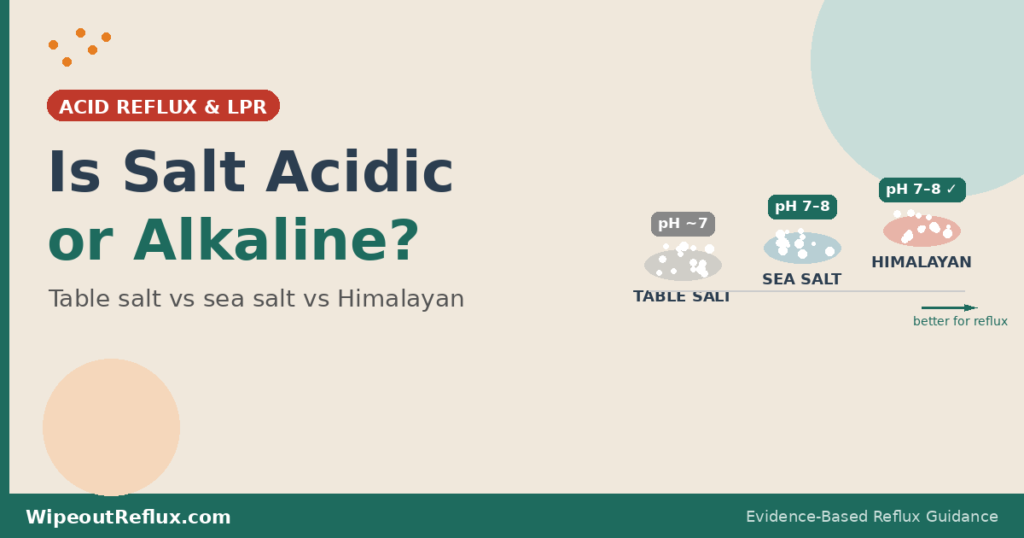
Salt itself is neither acidic nor alkaline — standard table salt (sodium chloride) dissolves to a neutral pH of around 7. But not all salts behave identically, and more importantly, the amount of salt you consume has a well-documented relationship with acid reflux and GERD risk that goes beyond simple pH.
The key distinction is between the chemistry of salt itself and the effects of high-sodium eating patterns on the digestive system. The former is largely neutral; the latter is a genuine reflux risk factor — one backed by large-scale research.
Key Takeaways
- Table salt (sodium chloride) has a neutral pH of around 7 — it is neither acidic nor alkaline in the traditional sense.
- Sea salt and pink Himalayan salt tend to be slightly more alkaline due to their natural mineral content and less processing.
- The pH of the salt itself is less important for reflux than how much salt you consume — high-sodium diets have been linked to increased GERD risk in research.
- A large Norwegian population study found that people who habitually add salt to food at the table were 70% more likely to develop GERD symptoms than those who did not.
- Highly salted and processed foods are a more significant concern than small amounts of natural salt used in cooking — the sodium load, not the salt grains themselves, is what drives the risk.
- For most people with GERD or LPR (silent reflux), a moderate amount of natural salt used in home cooking is fine — it’s the extra added salt at the table and the sodium in processed foods that warrants more caution.
- Pink Himalayan salt and Celtic sea salt are better choices than standard table salt for reflux sufferers due to fewer additives and a more natural mineral profile.
Is Salt Acidic or Alkaline?
From a pure chemistry standpoint, sodium chloride — table salt — dissolves in water to form a solution with a pH of approximately 7, which is neutral. This makes it neither acidic nor alkaline. It doesn’t contribute hydrogen ions (which would make it acidic) or hydroxide ions (which would make it alkaline) in any meaningful way when consumed in normal food quantities.
That said, different types of salt have slightly different compositions and pH profiles:
- Table salt — pH approximately 7 (neutral). Highly refined, often contains anti-caking additives such as sodium hexacyanoferrate or calcium silicate, which can push the pH slightly toward the acidic end.
- Sea salt — pH typically 7–8 (slightly alkaline). Less refined than table salt, retains more of its natural trace minerals, and tends to dissolve more cleanly without additives.
- Pink Himalayan salt — pH approximately 7–8 (slightly alkaline). Contains over 80 naturally occurring trace minerals including potassium, magnesium, and iron. The most naturally alkaline of the common salts and the one least likely to cause any irritation.
- Celtic sea salt — similar to pink Himalayan, slightly alkaline, harvested with minimal processing.
The practical difference in pH between these salts is small in the context of a full meal. The more meaningful distinction for acid reflux is not which type you use but how much total sodium you’re consuming — particularly through processed and heavily salted foods.
The Real Concern: Salt Quantity and GERD Risk
This is the part most articles on salt and acid reflux miss. The pH of salt is largely a non-issue. What the research actually focuses on is the relationship between habitual high-salt intake and the risk of developing GERD symptoms — and the findings are significant.
A large population-based study published in Gut involving over 43,000 participants found that people who habitually added salt to their food at the table were 70% more likely to develop GERD symptoms than those who never added extra salt. The same study found that eating salted fish or meat more than twice a month increased GERD risk by 50% [Nilsson et al., Gut, 2004].
A separate case-control study found that high dietary intake of salt was independently associated with an increased risk of reflux esophagitis — the more severe form of GERD where acid causes physical damage to the esophageal lining [Wu et al., Gastroenterology Research and Practice, 2013].
The mechanisms behind this link aren’t fully established, but several are plausible. High sodium intake may stimulate increased gastric acid secretion, potentially delay gastric emptying (which increases reflux pressure), and contribute to weight gain — a well-known independent risk factor for GERD. The type of food that tends to be heavily salted is also relevant: processed meats, crisps, fast food, and ready meals tend to be high in fat and sodium simultaneously, compounding the reflux risk.
It’s worth noting that one Dutch randomised controlled trial found no significant increase in gastroesophageal reflux in healthy volunteers given high dietary sodium, though it did note a decrease in LES pressure. This suggests the effect may be more pronounced in people who already have reflux rather than those without it — which is exactly the population most readers here fall into.
Is Salt Bad for Acid Reflux?
The honest answer is: salt in moderate amounts, used reasonably in home cooking, is unlikely to be a meaningful driver of your reflux symptoms. A pinch of sea salt on vegetables or a small amount in a homemade soup is very different from the sodium load in a ready meal or takeaway.
Where salt becomes more relevant for reflux sufferers is in habitual patterns:
- Adding extra salt at the table — this is the specific behaviour linked to 70% higher GERD risk in the Nilsson study. If you have GERD or LPR and routinely salt your food before eating, it’s worth reducing or stopping this habit.
- Eating heavily processed or pre-packaged foods — these are by far the largest source of sodium in most diets, and they also tend to contain multiple other reflux triggers (fat, preservatives, acidic additives). Reducing processed food intake addresses both the salt problem and several other reflux drivers at once.
- Salted or preserved meats and fish — these were specifically implicated in the Nilsson research. Processed deli meats, smoked fish, and salted preserved foods warrant particular caution for those with ongoing reflux.
For people with LPR (silent reflux), the mechanism is slightly different from GERD but the dietary principles overlap. The LPR dietary approach focuses heavily on reducing acid load and irritants — and high-sodium processed foods, which often also contain acidic preservatives and additives, fit squarely into the category of foods to reduce.
Which Type of Salt is Best for Acid Reflux?
If you’re going to use salt — and most people will, in reasonable amounts — here’s how the different types compare from a reflux standpoint:
Pink Himalayan Salt
My top recommendation for reflux sufferers. It’s completely unprocessed, contains no anti-caking additives, and its natural trace mineral content gives it a slightly alkaline profile. The coarser texture also tends to encourage using less of it, since a small amount goes a longer way in terms of flavour. It has a clean, slightly mineral taste that works well in both cooking and as a finishing salt.
Celtic Sea Salt
An excellent alternative to Himalayan salt. Harvested from coastal salt pans with minimal processing, it retains a full mineral profile and tends to be slightly moist and grey in colour due to its clay content. Like Himalayan salt, it contains no additives and dissolves cleanly. A strong second choice for anyone with acid reflux.
Sea Salt (General)
A significant step up from standard table salt. Most sea salts are less processed and contain fewer additives than iodised table salt, though quality varies by brand. Fine sea salt without anti-caking agents is a good everyday cooking choice for reflux sufferers.
Standard Table Salt
The least desirable option for those with sensitive reflux. It’s the most refined, most often contains anti-caking additives, and is the salt type specifically associated with increased GERD risk in the research mentioned above. If you currently use standard table salt, switching to sea salt or pink Himalayan salt is a simple, low-effort improvement worth making.
Whatever salt you use, opting for coarser grinds rather than fine-milled versions is slightly better — coarse salt retains more natural minerals, and the larger crystals make it easier to use sparingly without losing flavour.
Salt and LPR: What to Watch For
LPR (laryngopharyngeal reflux) involves reflux reaching the throat and larynx, which are more sensitive to irritation than the esophagus. While the pH of salt itself isn’t a direct concern for LPR the way that citrus or vinegar is, the broader dietary patterns associated with high salt intake are relevant.
Heavily processed and salted foods often contain acidic preservatives (citric acid, acetic acid) that directly lower the pH of food significantly. These combinations are more dangerous for LPR than the sodium itself. The safest approach is cooking from whole ingredients at home using a quality natural salt in moderate amounts — this gives you full control over both the sodium content and any additional acidic ingredients.
For a complete breakdown of which foods to prioritise and which to avoid with LPR, see my LPR foods to avoid guide and the foods to eat with LPR.
Final Thoughts
Salt itself — especially natural varieties like pink Himalayan or Celtic sea salt — is not a significant direct trigger for acid reflux when used in moderate amounts in home cooking. The chemistry is neutral, and a sensible pinch of quality salt on your food is not going to cause a reflux flare.
The problem is habitual over-salting and the sodium that comes packaged with processed foods, preserved meats, and restaurant meals. That combination — high sodium, high fat, often acidic additives — is where the real reflux risk lies, as the research confirms. If you’re serious about managing your reflux through diet, reducing processed food intake will almost automatically bring your sodium down to a healthier level, alongside the many other benefits it delivers.
If you want a practical, structured guide to eating well with GERD or LPR — covering which ingredients to cook with, how to season food without triggering symptoms, and what a full reflux-friendly diet looks like — the Wipeout Diet Plan covers all of this in depth. It’s designed specifically for people dealing with ongoing reflux who want a complete framework rather than isolated food tips. And if you’d like personalised advice on your specific situation, you can book a one-to-one consultation with me directly.
Frequently Asked Questions
What is the pH of salt?
Standard table salt (sodium chloride) dissolved in water produces a solution of approximately pH 7 — neutral. Sea salt and pink Himalayan salt tend to sit slightly above 7 (mildly alkaline) due to their trace mineral content. None of the common cooking salts are meaningfully acidic.
Is salt bad for GERD?
In moderate amounts used in home cooking, natural salt is unlikely to significantly worsen GERD. The concern is with high-sodium patterns — habitually adding extra salt at the table or regularly eating processed, heavily salted foods. A large study found people who add extra salt at the table are 70% more likely to develop GERD symptoms. The sodium load and its associated dietary patterns matter more than any individual pinch of salt.
Which salt is best for acid reflux?
Pink Himalayan salt and Celtic sea salt are the best choices — both are unprocessed, contain no additives, and have a slightly alkaline mineral profile. Standard table salt is the least desirable option due to its processing and anti-caking additives. Sea salt without additives is a solid middle-ground choice.
Are salts considered acid?
No — most cooking salts are neutral or very mildly alkaline, not acidic. The word “salt” in chemistry refers to any compound formed by the reaction of an acid and a base, and depending on the specific compounds involved, salts can be acidic, basic, or neutral. Sodium chloride (table salt) specifically is neutral.
Does pink Himalayan salt help acid reflux?
It’s not a treatment for acid reflux, but of the common salts it’s the best choice for reflux sufferers — it’s free from additives, naturally mineral-rich, and slightly alkaline. Switching from table salt to Himalayan salt as part of a broader dietary improvement is a reasonable and low-effort step, though it won’t override other major dietary triggers on its own.
Is sea salt better than table salt for acid reflux?
Yes, for a couple of reasons. Sea salt is less refined, usually contains no anti-caking additives, and tends to sit at a slightly more alkaline pH than table salt. It also tends to have a more pronounced flavour, which often means people use slightly less of it to achieve the same effect. Look for sea salt without added anti-caking agents on the label.
Related Articles
- The Complete Guide to LPR (Silent Reflux)
- LPR Foods to Avoid: What’s Making Your Silent Reflux Worse
- Foods to Eat With LPR and Acid Reflux
- The Ultimate Guide to Acid Reflux
- Best Salad Dressings for Acid Reflux & GERD
- Are Olives Acidic or Alkaline?
- The Stomach Sphincter and LPR: Why the Valve Matters
Research Sources
A large population-based study of over 43,000 participants found that habitually adding salt to food at the table was associated with 70% higher odds of GERD symptoms, and eating salted fish or meat more than twice monthly increased risk by 50% [Nilsson et al., Gut, 2004]. A case-control study of 537 participants found high dietary salt intake independently associated with an increased risk of reflux esophagitis after adjustment for confounding variables [Wu et al., Gastroenterology Research and Practice, 2013].

David Gray
12 years living with LPR · Consultant & researcher
I've lived with LPR for twelve years — the misdiagnoses, the PPI courses that did nothing, the slow work of figuring out what actually helps. Wipeout Reflux is where I translate the research into plain terms for people stuck in the same place. Every claim here is sourced to peer-reviewed work, and I consult one-to-one with LPR sufferers.