
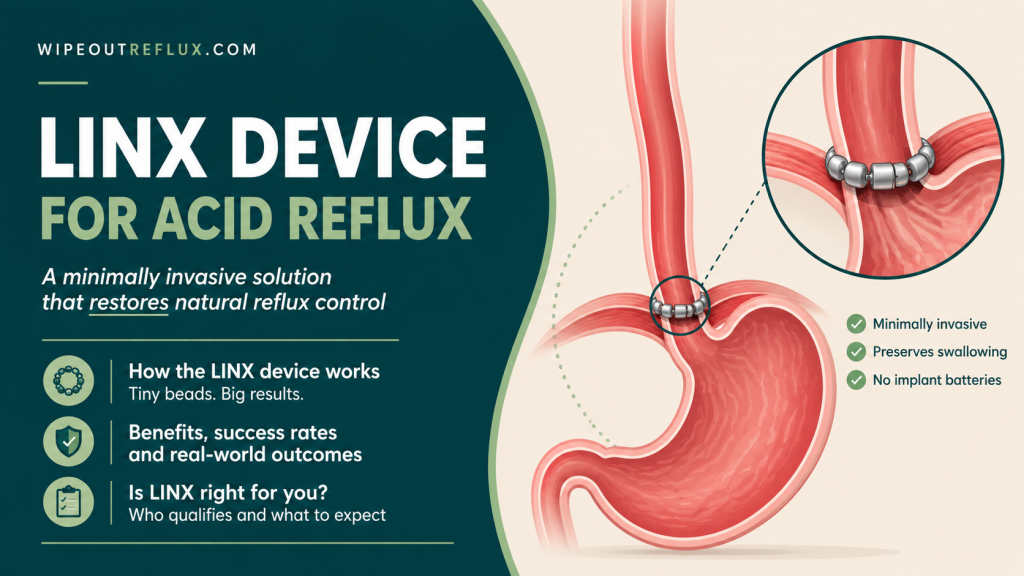
If you have proven acid reflux that will not settle on medication — or you simply do not want to be on a PPI for the rest of your life — the LINX device is one of the alternatives you will come across. It is a clever little implant: a ring of magnetic beads placed around the valve at the bottom of your oesophagus, designed to keep reflux in while still letting you swallow, belch, and vomit normally.
LINX is a genuine, FDA-approved procedure with solid long-term data behind it, and for the right person it can be excellent — strong reflux control, often freedom from daily pills, and fewer of the side effects that come with the older fundoplication operation. But the two words that matter most are “right person.” LINX suits a specific type of patient, and there are clear situations where it is the wrong choice.
I have managed my own LPR for over eight years, so let me walk through exactly how the device works, what the evidence shows, and — most importantly — who it suits and who should think twice.
Key Takeaways
- LINX is a magnetic ring placed laparoscopically around the lower oesophageal sphincter to strengthen a weak valve and stop reflux.
- It preserves normal function. The magnets separate when you swallow, belch, or vomit, then re-close — a key advantage over fundoplication.
- The evidence is strong for typical GERD. Long-term studies show durable reflux control and that most patients come off PPIs.
- It shines for regurgitation. In a randomised trial, LINX controlled regurgitation far better than doubling up on PPIs.
- It suits proven, mechanical reflux — abnormal acid testing, partial PPI response, good oesophageal motility, and no or a small hiatal hernia.
- It is not for everyone. Metal allergy, poor oesophageal motility, and the need for high-strength MRI scans are important reasons to avoid it.
- The main trade-off is dysphagia — difficulty swallowing that is common early on and usually settles, but occasionally persists.
What Is the LINX Device?
The LINX Reflux Management System is a small, flexible ring made of titanium beads, each containing a magnetic core, strung together on titanium wires — it looks a bit like a bracelet. A surgeon implants it laparoscopically (keyhole surgery) around the lower oesophageal sphincter, the muscular valve where your oesophagus meets your stomach. It received FDA approval in 2012 and has been implanted in tens of thousands of patients since.
The whole point of the device is to fix a mechanical problem. In many people with reflux, that lower valve is weak and opens when it should stay shut. LINX reinforces it. If you want the background on why this valve fails in the first place, I cover it in my guide to the stomach sphincter and reflux.
How the LINX Device Works
The mechanism is elegant, and understanding it explains both the benefits and the side effects.
At rest: the magnets keep the valve closed
When you are not eating, the magnetic attraction between the beads gently holds the ring closed, adding strength to your own weak sphincter. Crucially, at rest the beads only just touch each other, so they support the valve without squeezing the oesophagus shut.
When you swallow: the ring opens
When you swallow, the pressure of food and the muscular wave pushing it down is strong enough to overcome the magnetic bond. The beads slide apart along their wires, the ring expands, and the food passes through. Once the bolus is gone, the magnets pull the beads back together and the valve re-seals. For reflux to happen, stomach pressure now has to overcome both your natural sphincter and the magnetic force — a much higher bar.
You can still belch and vomit
This is one of LINX’s biggest selling points. Because the ring is a pressure-relief system rather than a fixed wrap, it opens to let you belch or vomit when needed. That matters, because the older fundoplication operation often takes those abilities away and leaves people with trapped gas and bloating.
What the Evidence Says
LINX is unusually well studied for a device, so let me lay out the key findings.
The pivotal trial
The original FDA trial followed 100 patients with GERD who had only partially responded to PPIs. The device reduced oesophageal acid exposure and reflux symptoms, and a 50% or greater reduction in daily PPI use was achieved in the large majority [Ganz et al., New England Journal of Medicine, 2013].
Durable, long-term results
At five years, the same cohort showed sustained benefit: median GERD quality-of-life scores fell from 27 to 4, PPI use dropped from 100% of patients to about 15%, and moderate-to-severe regurgitation fell from 57% to just 1.2%. No device erosions, migrations, or malfunctions occurred, and all patients retained the ability to belch and vomit [Ganz et al., Clinical Gastroenterology and Hepatology, 2016]. Even longer-term data — out to 6 to 12 years — has confirmed that the benefits hold up, with the large majority of patients staying off PPIs and normalising their acid exposure [Ferrari et al., Scientific Reports, 2020].
Better than doubling your PPI for regurgitation
This is a standout finding for anyone whose main problem is stuff coming back up. In a randomised trial of patients with troublesome regurgitation despite a daily PPI, LINX controlled regurgitation in 96% of patients, compared with just 19% of those switched to a twice-daily PPI [Bell et al., Clinical Gastroenterology and Hepatology, 2020]. Since regurgitation is exactly the kind of reflux that reaches the throat, this is a mechanistically important result.
Compared with fundoplication
Head-to-head studies have found LINX delivers reflux control that rivals traditional Nissen fundoplication, but with fewer side effects — notably less gas-bloat and better preservation of belching and vomiting [Reynolds et al., Journal of the American College of Surgeons, 2015]. That trade-off is a big part of LINX’s appeal.
Who the LINX Device Suits
Here is the honest “good candidate” picture, drawn from the trial criteria and how it is used in practice. LINX tends to suit someone who has:
- Objectively proven reflux — abnormal acid exposure confirmed on pH or impedance testing, not just symptoms. This is the single most important box to tick, which is why proper testing (like Restech or a Peptest as part of the workup) matters so much before any surgery.
- A partial response to PPIs, or a wish to get off them — whether because of side-effect concerns or simply not wanting lifelong medication.
- Predominant regurgitation, given how well LINX controls it.
- Normal or near-normal oesophageal motility, because the oesophagus needs to generate enough pressure to open the ring when swallowing.
- No hiatal hernia, or a small one. Larger hernias can still be repaired at the same time in experienced centres, but they add complexity.
If your reflux medication is only partly working, it is worth understanding why before jumping to surgery — I cover the common reasons acid reflux medication does not work, because some of them are fixable without an operation.
Who Should Think Twice
Just as important is knowing when LINX is the wrong choice. Be cautious, or look elsewhere, if you have:
- A metal allergy. The device contains titanium, nickel, stainless steel, and ferrous materials, so it is contraindicated in anyone allergic to these.
- A likely need for high-strength MRI scans. This is a big and often-overlooked one. The device is MRI-conditional only up to 1.5 Tesla (older models to 0.7 Tesla). If you have a condition that may need frequent or high-resolution 3-Tesla MRI — some neurological or cancer situations — LINX may not be suitable, since a stronger scan could require the device to be removed.
- Significant oesophageal dysmotility or a swallowing disorder like achalasia, where the oesophagus cannot reliably push food through the ring.
- Barrett’s oesophagus. LINX can be used to manage GERD symptoms, but the labelling now makes clear it is not proven to treat Barrett’s itself, and surveillance must continue.
- Symptoms that are not actually caused by reflux. If testing does not confirm reflux, a device that stops reflux will not help — which is exactly why objective testing comes first.
LINX and LPR / Silent Reflux
I want to be straight about this, because a lot of my readers have silent reflux rather than classic heartburn. LINX is fundamentally a GERD device — it was designed, tested, and approved for typical reflux, measured by acid exposure and symptoms like heartburn and regurgitation.
Its relevance to LPR is more indirect. Because LINX dramatically reduces total reflux events and is especially good at stopping regurgitation — the volume reflux that carries stomach contents up toward your throat — it is mechanistically plausible that it could help some people with reflux-driven laryngeal symptoms. But the dedicated, high-quality evidence for LINX in LPR specifically is limited. So if you are considering it for throat symptoms, the crucial step is confirming that reflux is genuinely driving them, which means proper testing rather than assumption. My guide on GERD vs LPR explains why that distinction matters so much here.
The Downsides and Risks
No procedure is free of trade-offs, and LINX has a few worth knowing.
Dysphagia (difficulty swallowing) is the most common issue. It is very common in the early weeks as your body adjusts to the device, and it usually settles over a few weeks to months — eating normally soon after surgery actually helps prevent the device scarring in place. In a minority it persists and becomes bothersome, and some of these patients need an endoscopic stretch (dilation) or, occasionally, removal of the device.
Device removal is uncommon but possible, most often for persistent dysphagia. The flip side is a genuine advantage: LINX is removable and reversible. It can be taken out laparoscopically and, if needed, converted to a fundoplication — an option you do not have once a fundoplication is done.
Rare risks include device erosion into the oesophagus or migration, but long-term studies have found these to be very uncommon.
LINX vs Fundoplication vs PPIs
To put it simply: PPIs reduce the acidity of what refluxes but do nothing to the faulty valve, which is why they can leave regurgitation and non-acid reflux untouched. Fundoplication rebuilds the barrier by wrapping the stomach around the oesophagus — very effective, but more anatomy-altering and more prone to gas-bloat and trouble belching. LINX sits in between: a standardised, minimally invasive, reversible way to reinforce the valve that preserves normal function, for people with proven reflux who want a durable fix.
It is not the only device-based option, either. If you are researching procedures, it is worth comparing LINX with the Stretta procedure and the broader range of reflux surgery options, since the best choice depends heavily on your anatomy and reflux pattern. And if your main goal is escaping PPIs, read about getting off PPIs and acid rebound first.
Conclusion
The LINX device is one of the most elegant solutions we have for mechanical acid reflux. It reinforces the weak valve at the heart of the problem, controls reflux and regurgitation impressively well, frees most suitable patients from daily PPIs, and — unlike the older fundoplication — lets you keep belching and vomiting normally. The long-term data is genuinely reassuring, and for the right candidate it can be life-changing.
But “the right candidate” is the whole story. LINX suits people with objectively proven, mechanical reflux, decent oesophageal motility, and no barriers like metal allergy or a need for high-strength MRI. It is not a fix for symptoms that testing cannot tie to reflux, and it is a surgical commitment with a real, if usually temporary, dysphagia trade-off. That is why the workup — proper reflux testing and an honest conversation with a specialist — matters more than the device itself.
One last thing from my own experience: surgery addresses the valve, but it does not change what you eat or how you eat, and those triggers still shape how you feel day to day. Plenty of people manage to get their reflux under control — and avoid an operation altogether — by getting the fundamentals right first. That is exactly what my Wipeout Diet Plan is built to do, in the depth this condition needs, and the Wipeout Food Reference Guide is the essential companion that shows exactly which foods and drinks are reflux-friendly and their pH values. Whether you ultimately choose a device or not, getting the foundation right is never wasted — and for many people, it is enough.
Frequently Asked Questions
How does the LINX device stop acid reflux?
It is a ring of magnetic beads placed around the lower oesophageal sphincter. The magnetic attraction reinforces the weak valve to keep it closed against reflux, but separates when you swallow so food can pass, then re-closes. It strengthens the barrier without stopping normal swallowing.
Is the LINX procedure reversible?
Yes. Unlike fundoplication, the LINX device can be removed laparoscopically if needed, and a fundoplication can be performed afterwards. That reversibility is one of its advantages.
Can you still burp and vomit with LINX?
Yes. Because the device works as a pressure-relief system, it opens to allow belching and vomiting, then re-closes. This is a key difference from fundoplication, which often removes those abilities and causes gas-bloat.
What is the main side effect of LINX?
Difficulty swallowing (dysphagia) is the most common, especially in the first weeks as the body adjusts. It usually settles over a few weeks to months. In a minority it persists and may need an endoscopic stretch or, rarely, device removal.
Can I have an MRI with a LINX device?
Only up to certain strengths. The device is MRI-conditional to 1.5 Tesla (older models to 0.7 Tesla), so a stronger 3-Tesla scan is not compatible. If you are likely to need high-strength or frequent MRIs, discuss this carefully with your surgeon before choosing LINX.
Does LINX help with LPR or silent reflux?
LINX is a GERD device, tested for typical reflux. Its strong control of regurgitation makes it mechanistically plausible for reflux-driven throat symptoms, but dedicated LPR evidence is limited. The key is confirming reflux is actually causing your symptoms through proper testing before considering it.
Who is not a good candidate for LINX?
People with a metal allergy, significant oesophageal motility disorders, a likely need for high-strength MRI, or symptoms not confirmed to be caused by reflux. A large hiatal hernia adds complexity, and Barrett’s oesophagus requires ongoing surveillance regardless.
Research Sources
- [Ganz et al., New England Journal of Medicine, 2013] — The pivotal FDA trial in 100 GERD patients found magnetic sphincter augmentation reduced oesophageal acid exposure and reflux symptoms, with most patients achieving at least a 50% reduction in PPI use.
- [Ganz et al., Clinical Gastroenterology and Hepatology, 2016] — Five-year outcomes showed sustained symptom control, a fall in PPI use from 100% to about 15% of patients, regurgitation dropping from 57% to 1.2%, and no device erosions, migrations, or malfunctions.
- [Ferrari et al., Scientific Reports, 2020] — Six-to-12-year outcomes confirmed durable improvement, with the majority of patients discontinuing PPIs and normalising oesophageal acid exposure.
- [Bell et al., Clinical Gastroenterology and Hepatology, 2020] — In a randomised trial, magnetic sphincter augmentation controlled regurgitation in 96% of patients versus 19% with twice-daily PPIs, with most patients discontinuing PPIs.
- [Reynolds et al., Journal of the American College of Surgeons, 2015] — A matched-pair analysis found magnetic sphincter augmentation achieved reflux control comparable to laparoscopic Nissen fundoplication, but with fewer side effects such as gas-bloat and better preservation of belching and vomiting.

David Gray
12 years living with LPR · Consultant & researcher
I've lived with LPR for twelve years — the misdiagnoses, the PPI courses that did nothing, the slow work of figuring out what actually helps. Wipeout Reflux is where I translate the research into plain terms for people stuck in the same place. Every claim here is sourced to peer-reviewed work, and I consult one-to-one with LPR sufferers.