
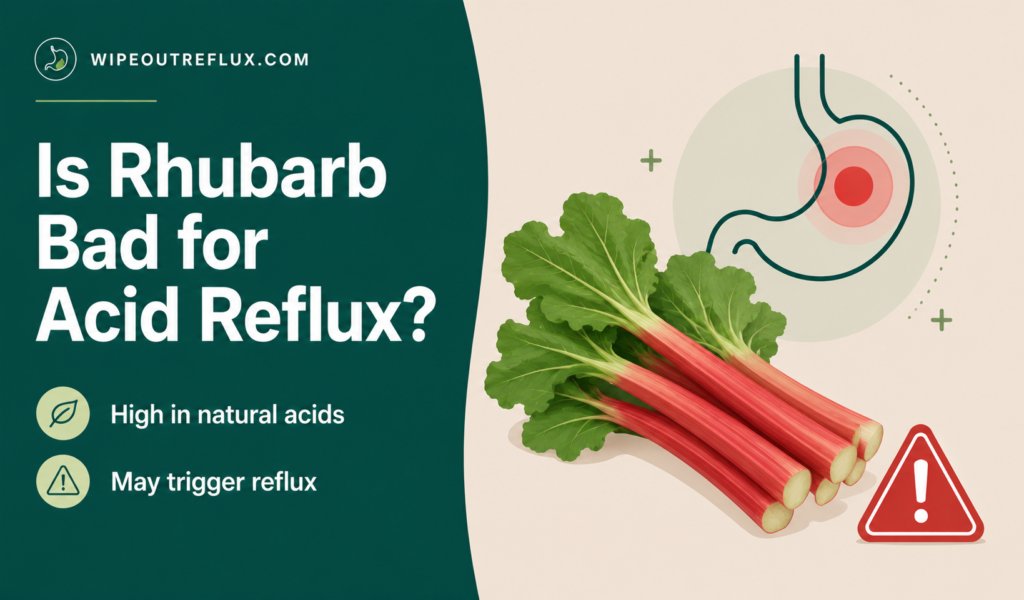
Rhubarb is one of the most acidic plant foods commonly eaten, and for anyone managing acid reflux or LPR, that acidity matters significantly. The answer to whether rhubarb is bad for acid reflux is fairly clear: yes, it is. Rhubarb’s pH sits between 3.1 and 3.5, placing it in the same highly acidic bracket as tomato juice and most soft drinks. That level of acidity is enough to directly irritate the esophageal lining, and — particularly for people with LPR — to reactivate pepsin deposited in the throat.
That said, rhubarb is almost never eaten plain. It’s typically cooked into pies, crumbles, jams, and compotes — and the sugar added to make it palatable introduces a second reflux concern on top of the acidity. Understanding both problems, and the mechanism behind each, helps you make a genuinely informed decision about whether rhubarb has any place in your diet during an active reflux phase.
There’s also a nuanced side to rhubarb worth exploring. Its anthraquinone compounds have documented gastrointestinal effects — including prokinetic properties that support intestinal motility — and its polyphenol content is high. These properties don’t cancel out the acidity problem for reflux sufferers, but they do add context to a more complicated picture than the original “just avoid it” advice suggests.
Key Takeaways
- Rhubarb has a pH of approximately 3.1–3.5, making it highly acidic — comparable to tomato juice and well within the range that directly irritates the esophageal lining
- The primary acid in rhubarb stalks is malic acid, which accounts for 89–92% of total acidity; oxalic acid makes up around 10% in the stalks (much higher in the leaves, which are toxic and should never be eaten)
- Acidic foods at pH below 4 cause measurable drops in esophageal pH that can mimic or trigger genuine reflux events
- For LPR sufferers, rhubarb’s pH of 3.1–3.5 falls well within the range that reactivates pepsin deposited in throat tissue — making it a particularly high-risk food during an active flare
- The way rhubarb is almost always consumed — with significant added sugar in pies, crumbles, and jams — compounds the reflux risk further
- Rhubarb contains anthraquinones with prokinetic effects on the gut, and is rich in polyphenols, but these properties don’t offset the acidity problem for reflux
- If you have GERD (without LPR), small amounts of cooked rhubarb in a well-controlled diet may occasionally be tolerable — individual response varies
- If you have LPR, rhubarb should be avoided during active symptom phases because of the direct pepsin reactivation risk
How Acidic Is Rhubarb?
Rhubarb stalks have a measured pH of approximately 3.1 to 3.5, making them one of the most acidic vegetables commonly consumed. To put that in context: tomato juice sits around pH 4.0–4.5, orange juice around 3.5–4.0, and lemon juice around 2.0–2.7. Rhubarb occupies the same territory as orange juice and is significantly more acidic than most fruits typically flagged as reflux triggers.
The acidity in rhubarb stalks comes primarily from organic acids, with malic acid being the dominant one — accounting for 89–92% of the total acid content, at concentrations of around 679mg per 100g fresh weight. Oxalic acid makes up approximately 10% of the acidity in the stalks, with smaller amounts of citric and tartaric acid also present [Stoleru et al., Plants, 2021].
It’s worth clarifying that the oxalic acid distribution in rhubarb is not uniform across the plant. The leaves contain dangerously high levels of oxalic acid and should never be eaten — they are toxic. The stalks are safe to eat, with oxalic acid at levels similar to spinach or beetroot, and the concern for reflux is the overall acidity of the stalks, not the oxalic acid specifically.
The original article on this page noted rhubarb as “quite acidic” at pH 3–3.5. This is accurate. Where the article fell short was in explaining why that level of acidity creates a concrete problem for reflux sufferers, and in separating the GERD and LPR experiences — which are meaningfully different here.
Why Rhubarb Is Problematic for Acid Reflux
Direct Esophageal Irritation
When you eat something with a pH below 4, the contents of your mouth and esophagus briefly drop below the threshold at which esophageal tissue experiences acid stress. Research examining how acidic foods affect esophageal pH found that all tested acidic foods and drinks produced abrupt drops to pH below 4, in 80% of cases lasting over 30 seconds — a drop comparable in its tissue-level effects to a genuine acid reflux event [Farre et al., The American Journal of Gastroenterology, 2006].
Rhubarb, with its pH of 3.1–3.5, comfortably clears this threshold. Every mouthful briefly lowers the pH of the esophagus into the irritant range, regardless of whether you’re also experiencing reflux from the stomach. For someone with an already-sensitive or inflamed esophageal lining — which is common in people with active GERD — this direct acid contact is enough to provoke heartburn, burning, or regurgitation-like sensations.
This is worth understanding clearly: the acidity of rhubarb doesn’t only matter because it might trigger a reflux event from the stomach. It matters because it directly irritates tissue it comes into contact with on the way down — before any stomach involvement.
Pepsin Reactivation in LPR
For people with laryngopharyngeal reflux (LPR), the problem with rhubarb goes deeper than esophageal irritation. LPR involves pepsin — a digestive enzyme produced in the stomach — reaching the throat and larynx during reflux events and depositing itself on the sensitive tissue there. Pepsin remains stable in this tissue even at neutral pH, but it can be reactivated when exposed to anything acidic.
Pepsin’s activity peaks at a pH of around 2.0 and becomes inactive at pH 6.5, but it remains stable and capable of reactivation when the pH drops again [Frontiers in Medicine, 2025]. Rhubarb, at pH 3.1–3.5, is firmly within the range that reactivates deposited pepsin. This means that eating rhubarb — even a small amount, even without triggering a new reflux event from the stomach — can reactivate dormant pepsin already sitting in your throat and cause or worsen LPR symptoms: hoarseness, throat clearing, mucus, globus sensation, or a burning feeling in the throat.
This is why LPR management guidelines typically target a higher pH threshold than GERD alone. While GERD management focuses primarily on preventing acid from reaching the esophagus, LPR management requires avoiding anything acidic enough to reactivate pepsin in the throat — generally anything below pH 5.0 to 6.0. Rhubarb, at pH 3.1–3.5, is well below that threshold. For a full explanation of why this matters and what to eat instead, my LPR diet guide covers the pepsin reactivation mechanism and dietary strategy in detail.
What Makes Rhubarb Even Riskier in Practice: Sugar and Fat
Rhubarb is almost never eaten unsweetened. Its natural tartness — a result of that malic acid content — makes it essentially unpalatable to most people without significant sweetening. The result is that rhubarb in the real world arrives as rhubarb pie, rhubarb crumble, rhubarb jam, or rhubarb fool — all with substantial added sugar and often cream, butter, or pastry as well.
This matters for reflux because each of these additions introduces a separate problem. Added sugar increases fermentation in the upper GI tract, which can raise intragastric pressure and promote the transient LES relaxations that allow acid to escape the stomach. Fat from cream, butter, or pastry crust lowers LES pressure through cholecystokinin (CCK) release and slows gastric emptying, extending the window during which reflux can occur.
So a slice of rhubarb pie isn’t just a problem because of rhubarb’s acidity — it’s a combination of highly acidic filling, significant fat from the pastry, and sugar that compounds the GI pressure issue. The original article on this page suggested adding sweeteners to rhubarb as a way to manage its acidity for reflux sufferers. In practice, adding sugar to an already-acidic food doesn’t reduce the acidity meaningfully, and it introduces an additional reflux mechanism. That’s a recommendation I’d caution against.
Similarly, the suggestion to combine rhubarb with milk or yogurt to neutralise its acidity is well-intentioned but flawed. Full-fat dairy products contribute fat that relaxes the LES, and the neutralising effect of a small amount of dairy on a highly acidic serving of rhubarb is minimal in practical terms. If you’re pairing rhubarb with dairy specifically to manage reflux, you’re trading one problem for another.
Is There Anything Good About Rhubarb for Digestion?
Rhubarb isn’t without its positive properties, and it’s worth acknowledging them — even if they don’t change the calculus for reflux management.
Rhubarb stalks are genuinely high in polyphenols, including anthocyanins (which give the stalks their red colour) and proanthocyanidins. These compounds have antioxidant and anti-inflammatory properties that contribute to gut health over the long term. Rhubarb has also been shown in some studies to have higher polyphenol content than kale and other leafy greens.
More specifically relevant to digestion: rhubarb contains anthraquinone compounds — particularly emodin and rhein — that have well-documented prokinetic and laxative effects on the gastrointestinal tract. Anthraquinone derivatives stimulate the intestinal submucosal plexus, promoting peristalsis, which theoretically speeds gastric emptying and reduces the window during which reflux can occur [Yang et al., BioMed Research International, 2018]. In traditional Chinese medicine, rhubarb root preparations have been used for centuries specifically to address gastrointestinal stagnation and constipation.
The important caveat here is that the anthraquinone content of culinary rhubarb stalks — the amount you’d eat in a dessert or a compote — is far lower than the therapeutic doses used in traditional medicine and research contexts. The prokinetic benefit of eating a serving of stewed rhubarb is likely minimal compared to the direct acidity impact on the esophageal lining and throat. The polyphenol content is genuinely valuable as part of an overall diet, but there are many other high-polyphenol foods — including berries, dark leafy greens, and certain herbal teas — that don’t carry the same acidity burden.
Does Cooking Change Rhubarb’s Impact on Reflux?
This is one of the more common questions I receive about rhubarb, and the answer is: not significantly, at least for the acidity problem.
Cooking rhubarb softens the stalks and alters some of the texture, but it does not meaningfully change its pH or organic acid content. Malic acid is heat-stable — the predominant acid in rhubarb stalks doesn’t break down during typical cooking temperatures. Stewed rhubarb, rhubarb compote, and rhubarb in a pie filling all retain essentially the same acidity as raw rhubarb. Adding bicarbonate of soda during cooking can raise the pH slightly, but the quantities needed to move the pH above 5 would significantly change the flavour and texture of the dish.
Raw rhubarb eaten without cooking is, if anything, slightly more likely to cause immediate esophageal irritation simply because the acid hits the lining directly without dilution. But cooked rhubarb remains highly acidic, and the reflux risk is not meaningfully reduced by the cooking process.
Should You Avoid Rhubarb Entirely With Acid Reflux?
The answer depends on whether you have GERD, LPR, or both — and on the current state of your symptoms.
If you have LPR (silent reflux), particularly during an active flare, I would avoid rhubarb entirely. Its pH places it well within the pepsin reactivation range, and any amount of rhubarb — cooked or raw, in a dessert or on its own — is likely to perpetuate the throat inflammation that characterises LPR. There are better options for satisfying a sweet craving that don’t come with this trade-off. For guidance on which fruits are safer for LPR, my article on LPR foods to avoid covers this in full.
If you have GERD without LPR, the position is more nuanced. Individual tolerance to acidic foods varies, and some people with well-managed GERD can handle small amounts of acidic food without symptoms — particularly if they’re careful with timing, portion, and what else they’re eating. A small serving of rhubarb compote, without heavy pastry or cream, eaten well before lying down, may be tolerable if your symptoms are currently stable. If it triggers heartburn or regurgitation, that’s a clear signal to avoid it.
The framing of the original article — that rhubarb is “not generally a good choice” but may be attempted cautiously — is broadly reasonable, though the specific tips given (adding sugar, pairing with yogurt) are themselves reflux risks and should be reconsidered.
Frequently Asked Questions
Is rhubarb bad for acid reflux?
Yes, for most people with active acid reflux or LPR. Rhubarb’s pH of 3.1–3.5 means it directly irritates the esophageal lining on consumption, and it falls well within the range that reactivates pepsin in the throat. How problematic it is in practice also depends on how it’s eaten — a rhubarb pie with pastry and cream introduces fat and sugar on top of the acidity, compounding the problem significantly.
Is rhubarb acidic?
Yes, rhubarb is highly acidic. Its pH typically ranges from 3.1 to 3.5, making it more acidic than tomatoes (pH 4.0–4.5) and comparable to orange juice (pH 3.5–4.0). The primary acid is malic acid, which accounts for around 89–92% of the total acidity, with oxalic acid contributing around 10% in the stalks. Note that the leaves contain dangerously high oxalic acid and should never be consumed.
What does rhubarb do to your stomach?
In the stomach, rhubarb’s anthraquinone compounds (particularly emodin) have a stimulating effect on intestinal smooth muscle, promoting peristalsis. This prokinetic effect is better documented in medicinal contexts than in culinary consumption, but it means rhubarb doesn’t slow gastric emptying the way fatty foods do. The main concern for reflux isn’t the stomach effect per se — it’s the acidity of rhubarb passing through the esophagus and throat on the way down.
Can you eat rhubarb if you have LPR?
I’d strongly recommend avoiding it during any active LPR flare. Rhubarb’s pH of 3.1–3.5 is well within the range that reactivates pepsin in the throat, which is the primary driver of LPR inflammation. Even a small amount of rhubarb in a compote or dessert can sustain throat symptoms. When symptoms have settled, some people can cautiously trial a very small amount, but the risk-reward balance is generally poor when there are so many other foods available that don’t carry this risk.
Does cooking rhubarb make it less acidic?
Not meaningfully. Malic acid — the dominant organic acid in rhubarb — is heat-stable and remains in the stalks after cooking. Stewed rhubarb and rhubarb pie filling retain essentially the same pH as raw stalks. Adding bicarbonate of soda can raise the pH, but the amounts needed to move it above 5 significantly affect taste and texture. Cooking does not solve the reflux problem with rhubarb.
How do you make rhubarb less problematic for reflux?
The options are limited. Adding bicarbonate of soda before cooking can partially neutralise the malic acid and raise the pH, though it alters the flavour. Eating very small amounts (a tablespoon of compote rather than a full serving) reduces the acid load. Avoiding it alongside other reflux triggers — particularly fat and alcohol — limits the compounding effect. But there is no preparation method that converts rhubarb into a low-acid food compatible with an active reflux flare.
What fruits are better than rhubarb for acid reflux?
Bananas, melons (cantaloupe, honeydew), pears, and papaya are among the lowest-acid fruits and are generally well-tolerated with reflux. They sit comfortably above pH 5 and don’t carry the pepsin reactivation risk for LPR that rhubarb does. Berries are mildly acidic and tolerated by many GERD sufferers in moderate amounts, but are borderline for LPR. See my article on what to drink and eat on a reflux-friendly diet for more context.
Conclusion
Rhubarb is genuinely acidic — its pH of 3.1 to 3.5 places it firmly in the category of foods that directly irritate the esophageal lining and, for LPR sufferers, reactivate pepsin in the throat. The way it’s almost universally eaten — sweetened with large amounts of sugar and combined with fatty pastry or cream — adds further reflux triggers on top of the core acidity issue. This isn’t a food that sits in a grey zone.
If you have GERD and your symptoms are well controlled, a very small amount of rhubarb eaten carefully — not in a fat-heavy dessert, not close to bedtime — may be tolerable, and that’s worth testing with awareness. If you have LPR, I would avoid it entirely during any active phase. The pH is too low to avoid pepsin reactivation, and there are plenty of other, safer ways to get the nutritional value rhubarb offers (polyphenols, fibre, vitamin K) from foods that don’t carry the same acidity burden.
The broader principle applies here as it does across reflux management: understanding the mechanism behind a food’s impact gives you better tools to make real decisions, rather than relying on blanket avoidance lists alone. If you want a structured, evidence-based framework for navigating exactly these kinds of food decisions, the Wipeout Diet Plan covers the full dietary approach for both GERD and LPR. And if you’d prefer personalised guidance for your specific situation, my one-to-one consultation is available to work through this with you directly.
Related Articles
- LPR Diet: What to Eat and Foods to Avoid with Silent Reflux
- LPR Foods to Avoid: A Complete Guide for Silent Reflux
- Is Lemon Acid or Alkaline? The Truth About Lemon and Acid Reflux
- Are Bananas Acidic or Alkaline? What Reflux Sufferers Should Know
- Best Snacks for LPR and Acid Reflux (And What to Avoid)
- The Complete GERD and Acid Reflux Guide
Research & References
- Stoleru et al., Plants (MDPI), 2021 — A study examining the yield and nutritional composition of rhubarb juice across cultivars found that malic acid is the dominant organic acid in rhubarb petioles, accounting for 89–92% of total acidity at concentrations of approximately 679mg per 100g fresh weight, with oxalic acid comprising around 10% of stalk acidity and the remainder made up of citric and tartaric acids. [Stoleru et al., Plants, 2021]
- Farre et al., The American Journal of Gastroenterology, 2006 — A study in 10 normal volunteers using combined impedance-pH testing found that ingestion of acidic foods and drinks caused abrupt drops in intraesophageal pH below 4 in 80% of cases, lasting over 30 seconds — effects that can directly mimic or constitute genuine acid reflux events and have implications for esophageal mucosal irritation. [Farre et al., The American Journal of Gastroenterology, 2006]
- Frontiers in Medicine, 2025 — A review of pepsin-induced GERD pathogenesis confirmed that pepsin — derived from pepsinogen in acidic environments — exhibits peak activity at pH 2.0, becomes inactive at pH 6.5, but remains stable and is capable of reactivation when the pH drops again, with this reactivation mechanism representing a key driver of tissue damage in LPR. [Frontiers in Medicine, 2025]
- Zhang et al., Therapeutics and Clinical Risk Management, 2021 — A systematic review of 72 studies across 19 countries found that acidic foods and drinks are positively associated with GERD symptoms and onset risk, with acidic foods specifically identified as contributors to increased esophageal acid exposure in susceptible individuals. [Zhang et al., Therapeutics and Clinical Risk Management, 2021]
- Yang et al., BioMed Research International, 2018 — A retrospective study in critically ill patients found that rhubarb anthraquinone derivatives stimulate the intestinal submucosal plexus to promote peristalsis, improve feeding tolerance, and protect the intestinal mucosal barrier — demonstrating measurable gastrointestinal motility effects attributable to rhubarb’s anthraquinone compounds. [Yang et al., BioMed Research International, 2018]

David Gray
12 years living with LPR · Consultant & researcher
I've lived with LPR for twelve years — the misdiagnoses, the PPI courses that did nothing, the slow work of figuring out what actually helps. Wipeout Reflux is where I translate the research into plain terms for people stuck in the same place. Every claim here is sourced to peer-reviewed work, and I consult one-to-one with LPR sufferers.