
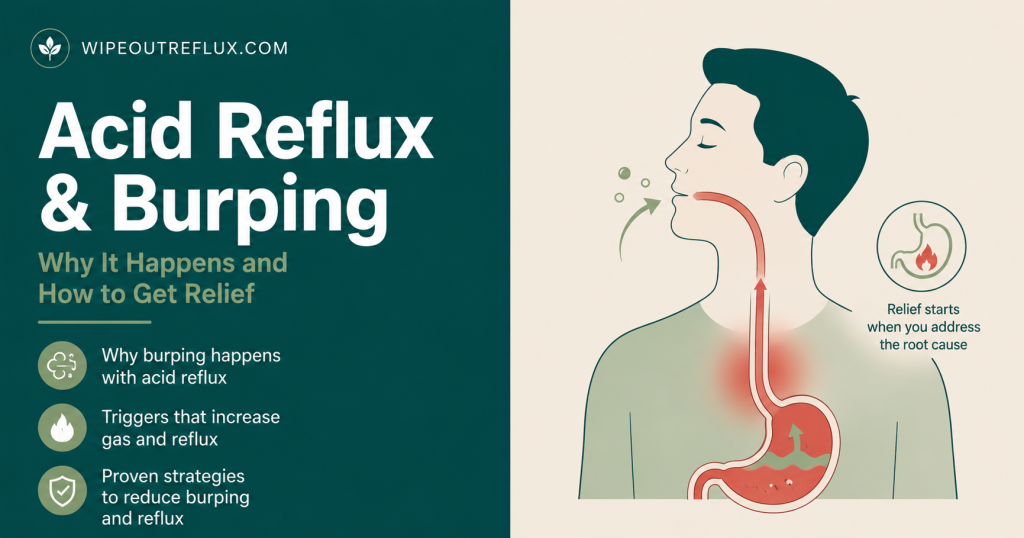
Burping and acid reflux are more closely linked than most people realise — and the relationship goes both ways. Yes, acid reflux causes burping. But burping can also trigger more acid reflux. For a significant number of people with GERD, the two are caught in a self-reinforcing cycle that standard treatments like PPIs often fail to break.
If you’re dealing with constant or excessive burping alongside reflux, or if your medication isn’t working as well as it should, there’s a good chance that a specific belching pattern — called supragastric belching — is making things significantly worse. Understanding what this is, and why it behaves differently from ordinary burping, changes how you approach management.
This article explains the mechanics behind acid reflux and burping, covers the bloating and gas angle, and gives you practical tools to reduce both — including what the research actually supports.
Key Takeaways
- Burping is one of the most common complaints in GERD, with research showing almost half of GERD patients list excessive belching as their main troublesome symptom
- There are two distinct types of belch — the gastric belch (physiological, releases trapped stomach gas) and the supragastric belch (a learned reflex where air enters and immediately exits the oesophagus without ever reaching the stomach)
- Supragastric belching (SGB) can directly trigger reflux episodes — it’s not just a symptom, it’s a driver
- SGB is a key reason many people with GERD don’t respond fully to PPIs — it’s a mechanical problem that acid suppression alone can’t fix
- Gas and bloating increase pressure on the stomach, triggering more transient LES relaxations and more reflux
- Carbonated drinks, eating too fast, large meals, and swallowing air all drive the burping-reflux cycle
- Diaphragmatic breathing has clinical evidence behind it for reducing SGB and improving PPI-refractory GERD symptoms
- Persistent excessive burping that doesn’t improve with lifestyle changes warrants investigation — it can point to SGB, a hiatal hernia, or an underlying motility issue
Does Burping Cause Acid Reflux?
Yes — in certain cases, it does. This is one of the more counter-intuitive findings to come out of reflux research in recent years, and it’s something that most generic health articles still get wrong by treating burping purely as a symptom of reflux rather than a potential cause.
Studies using 24-hour pH-impedance monitoring — the gold-standard method for tracking both reflux episodes and belches in real time — have confirmed that in a meaningful proportion of cases, a supragastric belch occurs immediately before a reflux episode, not after. In other words, the belch creates the conditions for acid to escape upward, rather than the other way around [Keeratichananont S. et al., Journal of Neurogastroenterology and Motility, 2023].
This has real clinical implications. If your burping is triggering reflux events rather than simply accompanying them, then treating the acid alone — with a PPI or antacid — won’t fully address the problem. You need to address the belching mechanism itself. And that starts with understanding which type of burp you’re dealing with.
Why Acid Reflux Causes Burping
Under normal circumstances, the lower oesophageal sphincter (LES) stays closed between meals. But when the stomach becomes distended — from food, swallowed air, carbonated drinks, or gas produced by fermentation — the pressure triggers what’s called a transient lower oesophageal sphincter relaxation (TLESR). This is the body’s way of venting gas from the stomach, and it results in a gastric belch [Bredenoord A.J. and Smout A.J.P.M., Clinical Gastroenterology and Hepatology, 2007].
The problem is that every TLESR also creates a window during which stomach acid — and pepsin — can escape upward into the oesophagus. This is the same mechanism that underlies most GERD episodes. So the more TLESRs you have, the more reflux events you’re likely to experience. And anything that increases gastric distension — large meals, fizzy drinks, eating quickly — increases the frequency of both belching and reflux simultaneously.
Research into the stomach sphincter and how it affects LPR covers this valve mechanism in more detail. It’s worth understanding because the same TLESR dynamic that drives burping in GERD is also what allows acid and pepsin to reach the throat in silent reflux (LPR).
Supragastric Belching: The Pattern That Makes Reflux Worse
Not all burps work the same way. The gastric belch described above is physiological — it’s venting actual gas from your stomach. The supragastric belch (SGB) is different, and it’s the type that causes the most problems for people with reflux.
During an SGB, air is sucked or injected from the throat into the oesophagus and then immediately expelled — before it ever reaches the stomach. It’s a rapid, repetitive action that often happens dozens of times a day, and it typically begins as a response to reflux discomfort: the brain learns that swallowing air and quickly releasing it provides momentary relief from the sensation of acid rising. Over time, this becomes a habitual reflex that the person may not even be aware of [Kessing B.F. et al., American Journal of Gastroenterology, 2014].
The mechanism matters because SGB is not just ineffective relief — it actively makes reflux worse. The rapid movement of air into and out of the oesophagus during an SGB can directly induce reflux episodes, with evidence showing that belch-triggered reflux events extend further up the oesophagus and maintain longer acid contact time than reflux episodes that occur without a preceding belch [Keeratichananont S. et al., Journal of Neurogastroenterology and Motility, 2023].
This is also a major reason why some people with GERD don’t respond well to acid suppression. PPIs reduce the acidity of what refluxes — but they don’t stop the belching reflex that’s driving the reflux in the first place. Research suggests that SGB can be present in up to 40% of patients with PPI-refractory GERD symptoms — making it one of the most common reasons standard treatment falls short. If your reflux medication isn’t working as well as it should, this is one of the first things worth investigating. My article on acid reflux medication not working covers other contributors to treatment failure too.
What Helps With Supragastric Belching
Because SGB is a learned behavioural pattern rather than a purely mechanical one, the most effective treatments are behavioural rather than pharmaceutical. A prospective clinical study found that a standardised diaphragmatic breathing protocol significantly reduced both belching scores and GERD symptom severity in patients with PPI-refractory reflux and excessive SGB — with improvements maintained at four-month follow-up [Ong A.M. et al., Clinical Gastroenterology and Hepatology, 2018].
Cognitive behavioural therapy (CBT) and speech therapy have also shown benefit. The underlying goal in all three approaches is the same: interrupting the unconscious habit loop that drives SGB and replacing it with a more controlled breathing pattern.
Acid Reflux, Bloating, and Gas: The Full Picture
Bloating and gas are closely connected to both reflux and burping, and the relationship tends to compound over time. Excess gas in the stomach or upper gut increases gastric pressure, triggers more TLESRs, and creates more opportunities for acid to escape — which then leads to more discomfort, more air-swallowing behaviour, and more gas. It’s a self-reinforcing cycle that can be genuinely difficult to break without addressing each part of it.
Several common dietary patterns drive this:
- Carbonated drinks introduce gas directly into the stomach, dramatically increasing gastric distension and TLESR frequency
- Eating quickly means swallowing larger volumes of air with every bite
- Large meals take longer to empty from the stomach, maintaining higher gastric pressure for longer
- High-FODMAP foods ferment in the gut and produce significant gas, which then needs to vent upward
- Foods that relax the LES — fatty foods, peppermint, alcohol, chocolate — compound the problem by making the valve easier to open
SIBO (small intestinal bacterial overgrowth) is another driver worth considering if your bloating and gas are persistent and severe. The bacterial overgrowth produces significant gas from fermentation of carbohydrates, which then puts sustained pressure on the LES from below. My article on SIBO and acid reflux covers this overlap in detail.
Getting your gas and bloating under control is one of the most effective things you can do for your reflux, precisely because it reduces the TLESR frequency that drives both burping and acid escape. It’s often more impactful than additional medication, particularly for people whose reflux is already partially managed but not fully resolved.
Acid Reflux and Constant or Excessive Burping
Occasional burping after meals is entirely normal. What isn’t normal — and what warrants attention — is burping that is constant, repetitive throughout the day, or that seems to be happening in cycles regardless of when you last ate.
This pattern is a hallmark of SGB. The repetitive, sometimes rapid nature of it often surprises people when they first learn what’s happening mechanically: air is being drawn into the oesophagus and expelled immediately, dozens or even hundreds of times a day, in a loop that feels impossible to stop. Many people with SGB describe feeling like they need to burp constantly but never finding real relief — because unlike a genuine gastric belch, the SGB isn’t clearing anything from the stomach.
Excessive burping can also indicate a hiatal hernia, where part of the stomach pushes through the diaphragm and disrupts normal LES function. This makes TLESRs more frequent and reflux more severe. It’s a structural issue that changes the management picture and is worth ruling out with an endoscopy or barium swallow if your symptoms are severe or long-standing.
There’s also a throat-symptom overlap worth flagging here: some people with LPR (silent reflux) describe what feels like a need to constantly clear their throat — a sensation that can be closely related to the same upper oesophageal/throat dynamics that drive SGB. The two conditions frequently coexist. If your “burping” feels more throat-based than stomach-based, it may actually be throat-clearing driven by pepsin irritation higher up in the airway. My guide on stopping constant throat clearing from reflux goes into this in more detail.
Burping isn’t the only reflex reflux can set off, either — if yours comes alongside repeated hiccupping or sudden mouthfuls of sour fluid and saliva, see can acid reflux cause hiccups and water brash and regurgitation.
How to Manage Burping from Acid Reflux
Managing the burping side of reflux means targeting both the gastric distension that triggers TLESRs and, where relevant, the SGB pattern that drives things further. The approaches below work on both fronts.
Eat Slowly and Chew Thoroughly
Eating quickly is one of the most common drivers of air swallowing. Slowing down reduces the volume of air ingested with each bite, which directly reduces gastric distension, TLESR frequency, and the discomfort that triggers SGB as a coping response. Chewing each mouthful fully also aids gastric emptying, keeping pressure lower for longer after meals.
Cut Carbonated Drinks Completely
Fizzy drinks — including sparkling water, diet fizzy drinks, and mixers — introduce significant volumes of gas directly into the stomach with every sip. For people with GERD and excessive burping, this is one of the single most impactful dietary changes. Plain water, herbal teas, and alkaline water are far better alternatives.
Keep Meals Smaller and Less Frequent in Volume
Large meals drive the TLESR mechanism more than almost anything else. Eating smaller portions more frequently, rather than two or three large meals, keeps gastric pressure lower throughout the day and significantly reduces both burping and reflux frequency.
Avoid Lying Down Within Three Hours of Eating
Gravity plays a major role in keeping stomach contents where they belong. Lying down after a meal removes that gravitational advantage and allows gas and acid to move upward more easily. Timing your last meal at least three hours before bed makes a meaningful difference. For night-time reflux, my guide to the best sleeping position for silent reflux covers head elevation and left-side sleeping in detail.
Work on Diaphragmatic Breathing
If SGB is part of your picture, diaphragmatic breathing is the most evidence-supported intervention available. It retrains the breathing pattern that underpins the SGB reflex, and the clinical data shows real reductions in both belching and reflux symptoms. Search for “diaphragmatic breathing for reflux” to find guided exercises — or ask your GP for a referral to a speech therapist or gastroenterologist who specialises in this.
Use Alginate-Based Treatments
Alginates like Gaviscon Advance form a physical raft on top of stomach contents that helps prevent both acid and pepsin from escaping during TLESRs. Unlike antacids, which only neutralise acid after it has risen, alginates work by blocking the reflux event at the source. For people with both burping and reflux, particularly LPR, this can be significantly more effective than standard antacid approaches. My Gaviscon Advance guide covers dosing and timing in full.
Address Your Diet Systematically
The foods most likely to drive the burping-reflux cycle are carbonated drinks, fatty foods, high-FODMAP items (garlic, onion, legumes, wheat), peppermint, and alcohol. The Wipeout Diet Plan provides a structured approach to identifying and eliminating your personal triggers without unnecessary dietary restriction.
Frequently Asked Questions
Is it normal to burp a lot with acid reflux?
Yes — excessive belching is one of the most commonly reported symptoms in GERD. Research shows that almost half of GERD patients identify burping as their main troublesome symptom. However, if burping is constant and seems to happen regardless of meals or food, it may indicate a specific pattern called supragastric belching that needs targeted management.
Why do I burp constantly even when I haven’t eaten?
Constant burping that isn’t obviously related to meals is a common feature of supragastric belching (SGB). In SGB, air is drawn into the oesophagus and expelled immediately — it never reaches the stomach — so there’s no real gastric gas being vented. The trigger is typically a habitual response to oesophageal discomfort, often reflux-related. Diaphragmatic breathing and behavioural therapy are the most effective approaches.
Does burping help acid reflux or make it worse?
A genuine gastric belch — the kind that vents gas from the stomach — can provide brief relief from bloating pressure. But supragastric belching makes reflux measurably worse by directly inducing more reflux events. So the answer depends entirely on which type of burping is happening. If you find that burping feels compulsive, provides no real relief, or makes your reflux symptoms worse immediately afterward, SGB is the likely culprit.
Can acid reflux cause bloating and gas?
Yes. Reflux and gas often share the same underlying driver — excess gastric pressure triggering transient LES relaxations. Slow gastric emptying (which is common in GERD), along with dietary factors, can cause significant gas and bloating that then worsens the reflux. The two conditions are frequently seen together and benefit from being addressed together.
Why does my burping get worse at night?
Nocturnal burping and reflux worsen because lying flat removes the gravitational barrier that keeps stomach contents down during the day. Gas that would ordinarily vent upward while sitting or standing becomes more disruptive at night, and any existing SGB habit can continue during sleep in some cases. Elevating the head of the bed by 15–20cm and avoiding food within three hours of sleep are the most effective interventions.
Should I worry about excessive burping with acid reflux?
Excessive burping alongside reflux is very common and in most cases is explained by SGB or gas-driven TLESR patterns. However, if your burping is accompanied by difficulty swallowing, unintentional weight loss, vomiting, or blood in the stool, you should seek a GP review promptly — these symptoms warrant investigation regardless of the suspected cause.
Can burping be a sign of LPR (silent reflux)?
There is overlap between the SGB mechanism and the upper throat symptoms seen in LPR. Some people with LPR describe what they perceive as a need to constantly clear their throat or make throat noises — which can feel similar to the urge to burp. The two conditions share related physiology and frequently coexist. If throat symptoms are predominant alongside your burping, it’s worth reading up on LPR symptoms to see whether that picture fits.
Conclusion
Burping and acid reflux aren’t just two symptoms that happen to occur together — they’re mechanically connected in ways that matter for how you manage them. Understanding the difference between a physiological gastric belch (your body venting gas) and a supragastric belch (a learned reflex that triggers more reflux) is probably the most useful shift in perspective for anyone stuck in the burping-reflux cycle.
The practical upshot is this: if you’re still dealing with significant burping despite using PPIs or antacids, the medication isn’t failing — it’s just not targeting the right part of the problem. Supragastric belching is a behavioural and mechanical issue that responds to diaphragmatic breathing, dietary changes, and where necessary, behavioural therapy. Addressing gas and bloating through diet is equally important, because reducing gastric pressure reduces the TLESR frequency that drives both the burping and the acid escape simultaneously.
For a full dietary framework built around reducing reflux triggers — including the eating patterns that drive gas, bloating, and LES relaxation — the Wipeout Diet Plan is the most structured starting point I’d recommend. And for a quick, practical reference on which specific foods and drinks are reflux-safe and their pH values, the Wipeout Reflux Food Reference Guide is designed to sit alongside it as an everyday decision-making tool.
If you’re managing both burping and LPR throat symptoms, there’s a lot more in the complete guide to LPR that covers the throat side of things in depth.
Research & References
Bredenoord A.J. and Smout A.J.P.M. (2007). Physiologic and pathologic belching. This review describes the two mechanisms of belching — the vagally-mediated gastric belch and the supragastric belch — and their association with GERD and functional dyspepsia. [Bredenoord A.J. and Smout A.J.P.M., Clinical Gastroenterology and Hepatology, 2007]
Kessing B.F., Bredenoord A.J., Smout A.J.P.M. (2014). The pathophysiology, diagnosis and treatment of excessive belching symptoms. A comprehensive review examining both gastric and supragastric belching, their relationship to GERD and functional dyspepsia, and available treatment approaches including behavioural therapy and acid suppression. [Kessing B.F. et al., American Journal of Gastroenterology, 2014]
Ong A.M., Chua L.T., Khor C.J. et al. (2018). Diaphragmatic breathing reduces belching and proton pump inhibitor refractory gastroesophageal reflux symptoms. A prospective study of 36 patients with PPI-refractory GERD and excessive SGB found that a standardised diaphragmatic breathing protocol significantly reduced belching scores and GERD symptom severity, with sustained improvement at four-month follow-up. [Ong A.M. et al., Clinical Gastroenterology and Hepatology, 2018]
Keeratichananont S. et al. (2023). Gastroesophageal reflux characteristics in supragastric belching patients with positive versus negative pH monitoring. This study confirmed that in GERD patients with SGB, the number of SGBs positively correlates with reflux episodes preceded by SGBs, and that SGB-associated reflux events extend further proximally with longer acid contact time than lone reflux episodes. [Keeratichananont S. et al., Journal of Neurogastroenterology and Motility, 2023]

David Gray
12 years living with LPR · Consultant & researcher
I've lived with LPR for twelve years — the misdiagnoses, the PPI courses that did nothing, the slow work of figuring out what actually helps. Wipeout Reflux is where I translate the research into plain terms for people stuck in the same place. Every claim here is sourced to peer-reviewed work, and I consult one-to-one with LPR sufferers.