
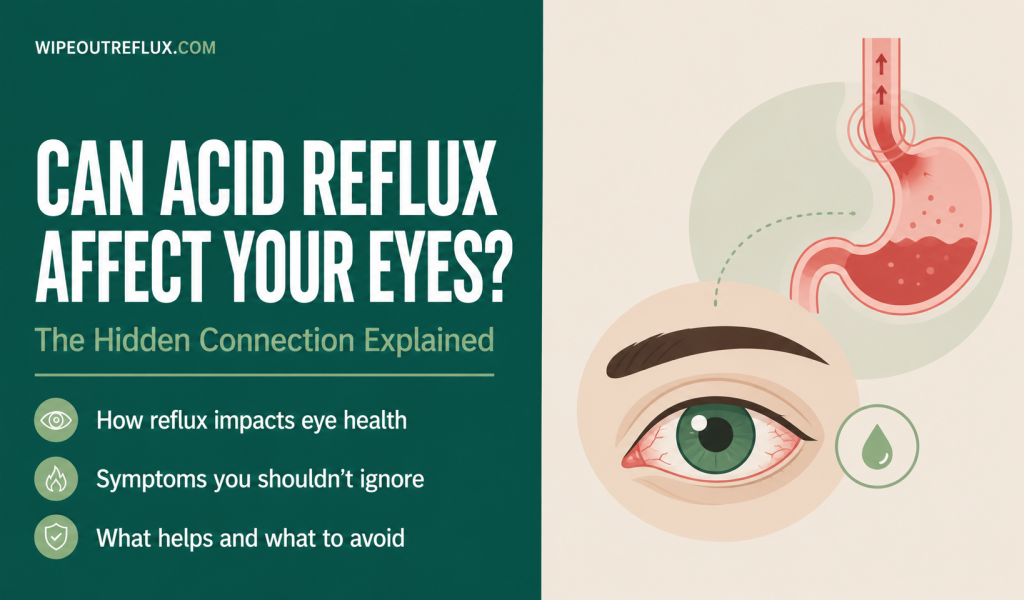
Acid reflux is well known for causing heartburn, a sore throat, and the throat and larynx symptoms of LPR. What most people — and many doctors — don’t realise is that reflux can also affect the eyes. Not as a vague secondary complaint, but through a direct and now well-documented mechanism: the same pepsin enzyme that damages the throat in silent reflux has been detected in the tears of LPR patients, and the research connecting GERD to dry eye disease, blocked tear ducts, and ocular surface inflammation is growing rapidly.
The short answer to whether acid reflux can affect your eyes is yes — particularly if you have LPR (silent reflux). Studies have found pepsin in the tears of over half of LPR patients tested, with higher pepsin concentrations associated with worse eye symptoms and more severe ocular surface damage. A large 2025 population study found that GERD patients were nearly 2.5 times more likely to develop a blocked tear duct than people without reflux.
If you’ve been dealing with dry, irritated, or watery eyes alongside your reflux symptoms and assumed the two were unrelated, this article is worth reading carefully. The connection is real, the mechanism is increasingly understood, and there are practical implications for how both conditions are managed.
Key Takeaways
- Pepsin — the digestive enzyme central to LPR damage — has been detected in the tears of over 50–64% of LPR patients in clinical studies, and in none of the healthy controls tested.
- The proposed route is anatomical: pepsin can travel from the nasopharynx through the nasal cavity and nasolacrimal duct in a retrograde direction, reaching the tear film and ocular surface.
- A 2025 global population study of over 876,000 patients found that GERD patients had a 2.49-fold higher risk of developing primary acquired nasolacrimal duct obstruction (PANDO) — a blocked tear duct — than matched controls without GERD.
- LPR patients show significantly higher scores on the Ocular Surface Disease Index (a validated measure of eye discomfort), reduced tear film break-up time, and increased meibomian gland dysfunction compared to healthy controls.
- The inflammatory response in the eye from pepsin appears to involve both direct proteolytic tissue damage and the upregulation of neuroinflammatory markers in conjunctival tissue.
- The most common eye symptoms reported by LPR patients in these studies include redness (56%), foreign body sensation (40%), and itching (38%) — symptoms that closely resemble dry eye disease.
- Researchers have proposed the term PROD Syndrome (Pepsin-Related Ocular surface Damage and Dry eye) for this presentation, recognising it as a distinct extraesophageal manifestation of LPR.
- Treating the underlying reflux — including with alginate-based therapy — has been shown to improve ocular surface parameters in LPR patients alongside conventional eye treatment.
Can Acid Reflux Really Reach the Eyes?
When most people think of where reflux goes, they think upward: from the stomach, through the lower oesophageal sphincter, up the oesophagus, and — in LPR — into the throat, larynx, and sometimes the sinuses. The eye seems far removed from this pathway. But the anatomy tells a different story.
Reflux research has progressively expanded its understanding of where pepsin can travel. It has been detected in the middle ear (explaining the connection between LPR and ear problems), in the paranasal sinuses, in the nasopharynx, and — more recently — in the tear film. Each of these findings follows the same logic: pepsin is a biomarker produced exclusively in the stomach, so when it’s found in a distant tissue, reflux is the only plausible origin.
The discovery that pepsin reaches the eyes followed logically from earlier work identifying it in the sinuses and nasopharynx. Once pepsin is in the nasal cavity — which happens regularly in people with LPR, where gaseous reflux events bring stomach contents into the upper airway — the nasolacrimal duct provides a direct anatomical highway to the tear film. This duct is the drainage tube that normally carries tears from the eye into the nose. In reflux, the direction reverses.
This is not a theoretical pathway. Pepsin has now been demonstrated in tears in multiple independent studies. The relationship with LPR severity is dose-dependent: higher pepsin concentrations in tears correlate with worse ocular surface damage and more severe reflux. This isn’t coincidence — it’s a mechanism.
If you’re curious about how far pepsin can travel from the oesophagus, the complete guide to LPR covers pepsin’s reach in detail — including the ear, sinuses, and throat damage that most people associate with silent reflux.
The Nasolacrimal Duct: The Route Pepsin Takes to the Eye
Understanding the route requires a brief look at anatomy. The nasolacrimal duct is a small tubular passage that runs from the corner of the eye (via the lacrimal sac) down into the nasal cavity, specifically into the inferior meatus — the lower part of the nasal passage. Its normal function is drainage: tears flow from the eye surface through this duct and into the nose, which is why your nose runs when you cry.
The valve system in this duct — the valve of Hasner at its nasal end — is designed primarily to prevent flow in the retrograde direction. But it is not perfectly competent. High-resolution CT imaging has shown that air can be found inside the nasolacrimal sac and duct in roughly 29% of healthy individuals, demonstrating that retrograde passage of nasal contents is anatomically possible even in people without any reflux disease.
In LPR, where gaseous and liquid reflux events regularly carry pepsin into the nasopharynx and nasal passages, the conditions for retrograde nasolacrimal transit are far more favourable. Pepsin reaching the inferior meatus — right at the nasolacrimal duct opening — has a direct path upward toward the tear film. Researchers have proposed that this is how pepsin found in tears got there: it travels from the nasopharynx through the nasal cavity, through the inferior meatus, and up the nasolacrimal duct in retrograde fashion, reaching the lacrimal sac and ultimately the ocular surface.
The same mechanism that allows pepsin to reach the middle ear via the Eustachian tube — a pathway now well established in LPR otitis media research — applies here. The body’s anatomical connections between the upper digestive tract, nasal cavity, and sensory organs create multiple routes for reflux-derived material to cause remote damage. The eye is one of them.
Pepsin in Tears: What the Studies Found
The most striking finding in the reflux-eye research is not the association data — it’s the direct detection of pepsin in the tears of LPR patients. This is where the mechanistic case becomes hard to dismiss.
A study of 50 LPR patients (confirmed by endoscopic signs and validated reflux symptom scores) found measurable tear pepsin in 32 out of 50 (64%) of LPR patients, compared to none of the 20 healthy controls. The average pepsin concentration in tear samples was 55.4 ng/mL. Importantly, tear pepsin levels were significantly correlated with the severity of LPR disease — the worse the reflux, the higher the pepsin in the tears. And the presence of pepsin in tears was associated with more severe ocular symptoms, including foreign body sensation and conjunctival redness.
A separate study of 77 LPR patients found pepsin detectable in 51% of tear samples, again with no detectable pepsin in any of the 25 healthy controls. Patients with LPR had significantly worse Ocular Surface Disease Index scores and significantly shorter tear break-up times than controls — both standard measures of dry eye and ocular surface health. The study also found increased inflammatory markers in conjunctival tissue from LPR patients, including HLA-DR immunoreactivity and elevated mRNA expression of interleukin-8 and other neuroinflammatory mediators.
A review of seven published studies on the topic concluded that eye pepsin concentrations above 2.5 ng/mL appear capable of damaging the ocular surface through two mechanisms: direct proteolytic activity (pepsin breaking down surface proteins and tissue), and the upregulation of local pro-inflammatory cytokines — the same two-pronged mechanism by which pepsin damages laryngeal tissue in standard LPR.
This last point matters. Pepsin doesn’t just sit in the tear film inertly. At the right pH and in sufficient concentration, it actively digests tissue. The conjunctiva and corneal surface are no more designed to withstand pepsin than the vocal cords are.
Dry Eye Syndrome and LPR: A Two-Way Problem
The most common ocular presentation in LPR patients is dry eye — or more precisely, something that resembles dry eye but may have a different driving mechanism than classic dry eye disease.
Across the clinical studies, LPR patients consistently show reduced tear film break-up time (a key measure of tear quality — how quickly the tear film destabilises before being refreshed by a blink), higher levels of ocular surface discomfort on standardised questionnaires, and evidence of epithelial damage on the conjunctiva and cornea. In the 50-patient PROD study, 48% of LPR patients showed epithelial damage and 72% showed lacrimal function impairment — dramatic figures in a group not primarily presenting with eye complaints.
There are likely multiple mechanisms at play in this LPR-dry eye connection. The direct proteolytic damage from pepsin is one. But researchers have also identified a neurogenic component: LPR is associated with neuroinflammatory changes (elevated VIP and NPY — vasoactive intestinal peptide and neuropeptide Y) both in the laryngeal tissue and, it now appears, in the conjunctival tissue of the eye. This suggests a systemic inflammatory and neurological signalling component to the LPR-eye connection, not just a simple local pepsin delivery problem.
A second mechanism is autonomic dysfunction. The vagal nerve — already implicated in LPR and anxiety-driven reflux patterns — also regulates tear secretion through both parasympathetic and sympathetic pathways. Autonomic dysregulation in LPR, mediated through altered vagal signalling, may reduce the quality and quantity of lacrimal and meibomian gland secretions independently of pepsin reaching the eye directly.
This dual-mechanism picture — direct pepsin damage plus systemic neurogenic-autonomic involvement — explains why LPR patients who seem to have mild reflux in terms of throat symptoms can still have significant eye involvement, and why treating only the eye symptoms without addressing the underlying reflux doesn’t provide lasting resolution.
Meibomian Gland Dysfunction: The Reflux-Eye Connection Gets Specific
One of the more specific findings from the LPR-eye research is the significantly higher rate of meibomian gland dysfunction (MGD) in LPR patients compared to controls.
The meibomian glands are small oil-secreting glands that run along the inner edge of the eyelids. Their job is to produce the lipid (oily) layer of the tear film — the outermost layer that slows tear evaporation and keeps the eye surface stable between blinks. When the meibomian glands are dysfunctional, the tear film evaporates too quickly, leaving the eye surface exposed and irritated. This is what produces the gritty, burning, foreign body sensation and the transient blurry vision that clears after blinking.
In the Di Zazzo et al. study of 53 LPR patients, increased meibomian gland dysfunction was observed compared to healthy controls, alongside reduced tear break-up time — consistent with a tear film that lacks adequate lipid protection. The mechanisms proposed include both direct pepsin damage to meibomian gland tissue and the neurogenic inflammatory changes that disrupt the regulation of these glands.
Meibomian gland dysfunction symptoms — burning eyes, redness, foreign body sensation, transient blur that clears with blinking, crusting at the lid margins — overlap substantially with what LPR patients in these studies were reporting. If you have LPR and have been attributing these symptoms to screen time, allergens, or just general fatigue, reflux-driven MGD may be a factor worth considering.
Blocked Tear Ducts and GERD: The Strongest Population-Level Evidence
While the dry eye and pepsin-in-tears research is compelling, the strongest population-level evidence for the reflux-eye connection comes from the link between GERD and primary acquired nasolacrimal duct obstruction (PANDO) — a blocked tear duct in adults.
PANDO is a condition where the nasolacrimal duct becomes progressively inflamed, fibrotic, and ultimately obstructed. Its cause is often listed as idiopathic (unknown), but the anatomy — right where refluxed material in the nasal cavity would first make contact — has long suggested reflux as a possible contributor.
A landmark 2025 global population study published in Eye (Nature Publishing Group) examined this directly, using data from over 157 million patients across 18 countries. After propensity score matching — a technique to balance the GERD and control groups for potential confounders — the analysis included 876,330 patients in each group. The result was striking: GERD was associated with a 2.49-fold higher risk of developing PANDO (hazard ratio 2.49; 95% CI 2.18–2.85; P < 0.001).
This isn’t a small or ambiguous finding. A 2.49-fold risk increase in a study of this scale is a strong signal. The proposed mechanisms are the same as those discussed above: direct noxious effect of refluxate (including pepsin and acid) on the nasal mucosa surrounding the nasolacrimal duct opening, with ascending inflammation causing mucosal oedema, progressive fibrosis, and eventual obstruction. GERD may also contribute through autonomic nervous system hyperactivity, causing venous plexus engorgement around the duct that produces mucosal swelling and dacryostenosis.
PANDO presents as watery eyes (epiphora), sometimes with mucoid discharge and recurrent eye infections, because tears can no longer drain normally and pool in the inner corner of the eye. People with PANDO who also have GERD or LPR — and those symptoms are often treated as entirely separate problems by different specialists — may have a single underlying cause driving both.
What Eye Symptoms Should Reflux Patients Watch For?
Based on the research, the ocular symptoms most commonly associated with GERD and LPR include:
- Red or bloodshot eyes — reported in 56% of LPR patients in the PROD study, associated with conjunctival inflammation
- Foreign body sensation — the feeling of grit or something in the eye, reported in 40% of LPR patients studied
- Itching eyes — reported in 38% of LPR patients, related to both surface irritation and neurogenic inflammation
- Dry, irritated, or burning eyes — the hallmark of dry eye disease and meibomian gland dysfunction
- Watery or excessively tearing eyes — counterintuitively, a sign of tear drainage obstruction (PANDO) or reflex tearing in response to ocular surface irritation
- Transient blurry vision that clears with blinking — a characteristic feature of insufficient or unstable tear film
- Crusty or sticky eyelid margins, particularly in the morning — often associated with meibomian gland dysfunction
- Recurrent styes or eyelid infections — can occur when meibomian gland function is chronically disrupted
None of these symptoms are specific to reflux-related eye disease in isolation — they overlap with allergic conjunctivitis, digital eye strain, and many other conditions. The relevant pattern to watch for is these symptoms occurring alongside known reflux or LPR symptoms, particularly the silent reflux presentation of throat clearing, hoarseness, and globus sensation.
If you’ve had dry eye investigated and treated without sustained improvement, and you have concurrent LPR, the reflux-eye connection may be the missing piece. It’s worth mentioning to your optometrist or ophthalmologist, and equally worth mentioning your eye symptoms to whoever is managing your reflux.
What Should You Do If You Have Reflux and Eye Symptoms?
The research suggests a clear practical implication: treating the underlying reflux improves ocular surface outcomes in LPR patients, beyond what conventional eye drops achieve alone.
In the Ciprandi et al. combined treatment study, patients with dry eye and LPR who received alginate-based therapy for their reflux alongside alginate-containing eye drops showed significant improvements in OSDI scores, Schirmer test results (measuring tear production volume), and tear break-up time — outcomes not achieved by standard hyaluronic acid eye drops alone. The alginate appears to work on both sides: orally, forming the familiar raft to reduce reflux events; and topically in the eye, scavenging pepsin in the tear film and inhibiting its proteolytic activity.
For anyone with both conditions, the priority order is clear:
- Take reflux seriously, particularly if you have LPR — the silent reflux treatment options are broader than most people realise and diet is central to reducing the reflux events that drive pepsin into the tear film
- Mention your eye symptoms to your reflux clinician and your eye symptoms’ reflux context to your ophthalmologist — cross-specialty awareness of this link is still limited
- Don’t rely solely on lubricating eye drops if your dry eye isn’t responding — if LPR is contributing, the underlying pepsin delivery problem needs addressing
- Dietary management that reduces reflux events will reduce pepsin reaching all the extraoesophageal sites — throat, sinuses, ears, and eyes alike
The guide to neutralising pepsin in the throat is directly applicable here — the same principles that protect the larynx from pepsin apply to reducing its availability to travel further, including to the nasolacrimal system.
Frequently Asked Questions
Can acid reflux cause dry eyes?
Yes — research now shows a clear association between LPR and dry eye disease. Studies have found pepsin in the tears of more than half of LPR patients tested, alongside significantly worse dry eye scores, reduced tear film quality, and higher rates of meibomian gland dysfunction compared to controls. The mechanism involves both direct pepsin delivery to the ocular surface via the nasolacrimal duct and neurogenic-autonomic inflammation linked to LPR.
Can GERD cause blurry vision?
GERD or LPR-related eye involvement can contribute to the transient blurry vision characteristic of dry eye disease and meibomian gland dysfunction — a blur that typically clears after blinking, because the tear film temporarily stabilises. This isn’t the same as structural vision loss. If you experience sudden, persistent, or unexplained vision changes, these always need urgent ophthalmological evaluation regardless of whether you have reflux.
How does pepsin get into the eyes from acid reflux?
The proposed route is the nasolacrimal duct — the small tube that normally drains tears from the eye into the nasal cavity. In LPR, gaseous and liquid reflux events carry pepsin into the nasopharynx and nasal passages. From there, pepsin can travel retrograde through the nasolacrimal duct — entering at the inferior meatus in the nasal cavity and ascending toward the lacrimal sac and tear film. This is the same logic as pepsin reaching the middle ear via the Eustachian tube.
Can acid reflux cause watery eyes?
Watery or persistently tearing eyes (epiphora) can be a sign of nasolacrimal duct obstruction — a condition where the tear drainage tube becomes blocked and tears overflow rather than draining normally. A major 2025 study found that GERD patients were 2.49 times more likely to develop this condition than matched controls, suggesting reflux-driven inflammation of the duct as a significant contributing cause.
What is PROD syndrome?
PROD stands for Pepsin-Related Ocular surface Damage and Dry eye — a term proposed by researchers to describe the specific pattern of dry eye and ocular surface disease that develops in LPR patients as a result of pepsin reaching the tear film. It distinguishes this reflux-driven presentation from other causes of dry eye, and highlights that treating only the eye without addressing the underlying reflux will leave the root cause unresolved.
Can treating acid reflux improve dry eye symptoms?
Evidence suggests yes. Studies comparing alginate-based reflux treatment alongside eye drops versus eye drops alone found that the combined approach produced significant improvements in tear production, tear film stability, and ocular surface discomfort scores — improvements not seen with eye drops alone. This supports the idea that reducing reflux events — and therefore reducing pepsin reaching the tear film — improves the eye condition as well.
Should I tell my eye doctor about my LPR or acid reflux?
Absolutely. Most ophthalmologists and optometrists are not yet routinely screening for reflux in dry eye patients, and most gastroenterologists are not asking about eye symptoms. Raising the connection gives your eye doctor the context to consider reflux as a contributing factor if your dry eye isn’t responding as expected to conventional treatment, and may influence how both conditions are managed going forward.
Conclusion
The idea that acid reflux — particularly LPR — can affect the eyes is one that most people, and many clinicians, haven’t encountered before. But the research is now substantial enough that this connection deserves to be taken seriously. Pepsin has been found in the tears of LPR patients at rates that can’t be explained by chance. The ocular surface changes in LPR patients — worse dry eye scores, reduced tear film stability, meibomian gland dysfunction — are consistent and reproducible across independent studies. And the 2.49-fold increased risk of blocked tear ducts in GERD patients in a global study of nearly a million people is a striking population-level signal.
What makes this clinically important for reflux sufferers is the implication: if your dry eye symptoms or eye discomfort aren’t resolving with standard treatment, and you have concurrent LPR or GERD, the eye may be a remote site of reflux damage rather than an independent problem. Addressing the reflux — reducing the events that carry pepsin into the nasal cavity and from there into the tear film — may be as important as any eye-specific treatment.
For LPR specifically, reducing the frequency and reach of reflux events through diet and lifestyle is the foundation. The LPR diet guide and the Wipeout Diet Plan cover the structured dietary approach in depth — and the fewer reflux events you have, the less pepsin is available to travel into your throat, sinuses, ears, and now eyes. For an essential reference on pH values and reflux potential of individual foods and drinks, the Wipeout Food Reference Guide is the companion to have alongside — covering what’s suitable for acid reflux and LPR with the data to back it up.
Research Sources
[__Pla et al., Life, 2020__] — Landmark study of 50 LPR patients; tear pepsin detectable in 64% of patients (55.4 ng/mL mean) and in none of 20 healthy controls; 48% of LPR patients had epithelial damage, 72% had lacrimal function impairment; named the condition PROD Syndrome (Pepsin-Related Ocular surface Damage and Dry eye) and identified a significant correlation between lacrimal pepsin concentration and ocular surface severity.
[__Di Zazzo et al., Cornea, 2023__] — Study of 77 LPR patients vs 25 controls; pepsin detectable in 51% of LPR patient tears with zero detection in controls; patients showed significantly worse OSDI scores and shorter TBUT; conjunctival imprints demonstrated increased HLA-DR immunoreactivity and elevated mRNA for IL-8, NADPH oxidase, and VIP — consistent with neurogenic ocular surface inflammation.
[__Di Zazzo et al., Cornea, 2023__] — Randomised controlled study of 53 LPR patients vs 25 controls; documented increased OSDI scores, reduced TBUT, and increased meibomian gland dysfunction in LPR patients; 15 naive LPR patients treated with magnesium alginate eye drops and oral therapy showed significant improvement in ocular surface parameters; identified VIP and NPY transcripts as evidence for neurogenic inflammation.
[__Ali et al., Eye (Nature Publishing Group), 2025__] — Major global population study using TriNetX data from 157 million patients across 18 countries; 876,330 matched GERD patients vs controls showed a 2.49-fold higher risk of primary acquired nasolacrimal duct obstruction (PANDO) in the GERD group (HR 2.49; 95% CI 2.18–2.85; P < 0.001); the largest study to date establishing GERD as a risk factor for blocked tear ducts.
[__Lechien et al., Journal of Voice, 2021__] — State-of-the-art review of seven eligible studies on LPR and ocular disease; concluded that pepsin concentrations above 2.5 ng/mL in the tear film may cause ocular surface damage through direct proteolytic activity and pro-inflammatory cytokine expression; proposed that pepsin reaches the lacrimal duct through hypopharyngeal-nasal gaseous reflux events.
[__Mazzacane et al., International Journal of Ophthalmology, 2018__] — First study to frame LPR as an ocular extraoesophageal manifestation and to correlate Ocular Surface Disease Index score directly with Reflux Symptom Index score in patients; identified the nasolacrimal duct route (nasopharynx → inferior meatus → retrograde duct transit) as the likely anatomical pathway for pepsin reaching the tear film.
[__Magliulo et al., European Archives of Oto-Rhino-Laryngology, 2013__] — Proposed the mechanism by which GERD contributes to PANDO: direct noxious effect of refluxate on nasal mucosa at the inferior meatus, ascending inflammation to the nasolacrimal duct causing mucosal oedema and fibrosis; demonstrated pepsin in tears as the mechanistic link and used CT imaging evidence showing retrograde nasolacrimal air transit in 29% of healthy subjects to support anatomical plausibility.
[__Owji & Abtahi, Orbit, 2009__] — Early study proposing GERD as a contributor to acquired nasolacrimal duct obstruction through both direct refluxate damage to nasal mucosa and autonomic nervous system hyperactivity causing venous plexus engorgement and secondary mucosal oedema of the duct; highlighted the anatomical proximity of the nasolacrimal duct opening to nasal refluxate exposure.
[__Ciprandi et al., International Journal of Ophthalmology, 2023__] — Real-life retrospective study of combined treatment using alginate-based eye drops and oral alginate tablets in LPR patients with dry eye syndrome; demonstrated significant improvements across OSDI, tear break-up time, and Schirmer test, with outcomes superior to standard hyaluronic acid eye drops alone; mechanistically, alginate scavenges pepsin in the tear film and inhibits its proteolytic activity.
[__Lechien et al., Frontiers in Medicine, 2025__] — Comprehensive review of shared mechanisms between LPR and dry eye syndrome, covering the nasolacrimal duct pepsin pathway, neurogenic inflammation via VIP and NPY signalling, and autonomic dysregulation through altered vagal nerve function affecting both oesophageal sphincter competence and meibomian/lacrimal gland secretion regulation.

David Gray
12 years living with LPR · Consultant & researcher
I've lived with LPR for twelve years — the misdiagnoses, the PPI courses that did nothing, the slow work of figuring out what actually helps. Wipeout Reflux is where I translate the research into plain terms for people stuck in the same place. Every claim here is sourced to peer-reviewed work, and I consult one-to-one with LPR sufferers.