
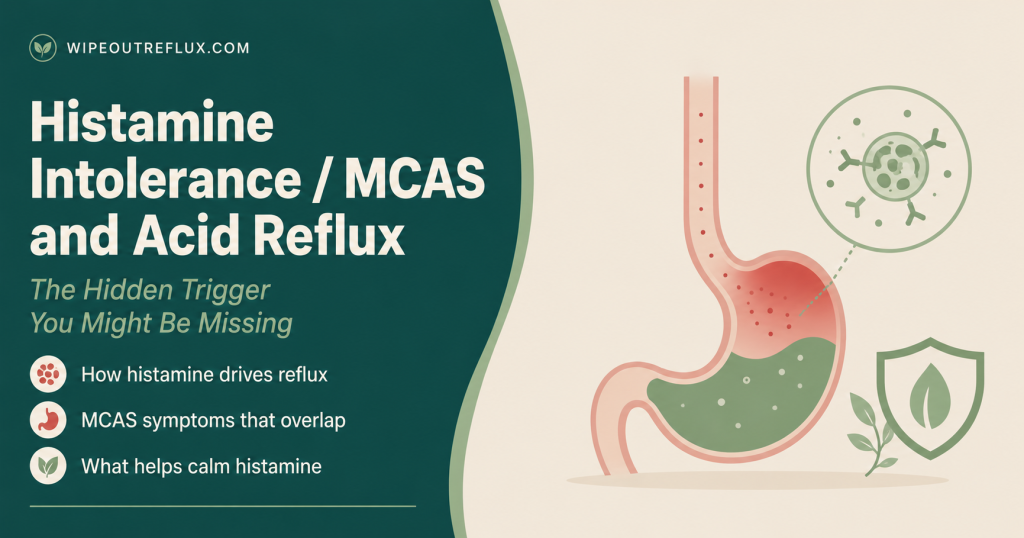
If your reflux comes with flushing, headaches, hives, itching, a racing heart, or reactions to foods like wine, aged cheese and leftovers, ordinary acid reflux might not be the whole story. Histamine intolerance and mast cell activation syndrome (MCAS) can both drive reflux-type symptoms, and there’s a solid mechanistic reason why: histamine is one of the three main signals that tells your stomach to make acid. When your body carries too much histamine, or releases it inappropriately, more acid production is a logical downstream effect.
That said, this is an area where it’s easy to over-diagnose yourself, because histamine-related symptoms overlap with plenty of other conditions and the science is still catching up. Having managed LPR myself for over eight years, I’ve watched histamine intolerance go from fringe idea to popular explanation for almost everything, so let me walk through what’s genuinely well-established, what’s still emerging, and how to think about it sensibly if you have reflux.
Key Takeaways
- Histamine directly stimulates stomach acid by binding H2 receptors on the acid-producing cells — the same receptors that H2 blockers like famotidine (Pepcid) block.
- Histamine intolerance is thought to stem from low activity of DAO, the enzyme that breaks down dietary histamine, leading to a build-up that can cause reflux, bloating and other non-allergic gut symptoms.
- MCAS involves mast cells releasing histamine and other mediators inappropriately, and GERD is one of its commonly reported gastrointestinal features.
- Both conditions are genuinely difficult to diagnose and their symptoms overlap heavily with IBS, ordinary GERD, and food sensitivities.
- A time-limited low-histamine diet, sometimes with DAO support, is the main dietary strategy — but the evidence is still limited, and long-term over-restriction is a real risk to avoid.
- If antihistamines or a low-histamine approach clearly help your reflux, that’s a meaningful clue worth exploring with a doctor rather than self-managing indefinitely.
What are histamine intolerance and MCAS?
These two get lumped together, but they’re not the same thing, and it’s worth separating them.
Histamine intolerance (HIT) is a mismatch between how much histamine you take in or produce and how much your body can break down. The main enzyme responsible for clearing histamine from food in the gut is diamine oxidase (DAO). When DAO activity is low — through genetics, gut damage, or certain medications — histamine isn’t degraded properly and accumulates, producing a range of variable, non-allergic complaints across the gut, skin, airways and head [Schnedl & Enko, Nutrients, 2021].
MCAS (mast cell activation syndrome) is different. Here the problem isn’t a clearance enzyme but the source: mast cells — immune cells embedded throughout your tissues, including the gut lining — release histamine and other inflammatory mediators inappropriately and repeatedly. The formal definition requires recurrent symptoms affecting at least two organ systems, evidence of mast cell mediator release, and a response to drugs that block or stabilise mast cells [Valent et al., International Journal of Molecular Sciences, 2020].
The overlap is that both flood the system with histamine. And that matters for reflux because of where histamine sits in your stomach’s plumbing.
The direct link: histamine controls your stomach acid
This is the mechanism that makes the whole topic click, and it’s genuinely well-established, so it’s worth understanding properly.
Your stomach’s acid-producing parietal cells respond to three main stimulants: gastrin (a hormone), acetylcholine (a nerve signal), and histamine. When histamine binds to the H2 receptor on a parietal cell, it switches on an enzyme cascade — adenylate cyclase, then cAMP — that activates the proton pump and drives acid secretion [Engevik, Kaji & Goldenring, Physiological Reviews, 2020].
Here’s the neat part that proves the point: this is exactly why H2 blockers like famotidine reduce acid. They work by blocking that same histamine H2 receptor. In other words, medicine has been deliberately targeting the histamine-acid connection for decades. If a drug that blocks histamine’s effect lowers acid, then a body carrying excess histamine plausibly runs in the opposite direction — toward more acid, and more reflux.
So the link between histamine and acid reflux isn’t hand-waving. It’s built into the basic physiology of how the stomach decides to make acid.
Histamine intolerance and reflux
Given that mechanism, it’s not surprising that gastrointestinal complaints — including heartburn and reflux-type symptoms — are among the recognised features of histamine intolerance, alongside bloating, abdominal pain and altered bowel habits [Schnedl & Enko, Nutrients, 2021].
There are a few ways histamine intolerance can feed reflux:
- More acid. Excess histamine stimulating H2 receptors nudges acid production upward, which can worsen reflux in a susceptible oesophagus or throat.
- Gut inflammation and motility changes. Histamine affects how the gut moves and how permeable its lining is, and sluggish or disordered motility is a classic route to reflux.
- A vicious cycle with gut damage. Because DAO is produced in the gut lining, anything that inflames that lining can lower DAO further, allowing more histamine through — which is why histamine issues often travel with other gut conditions.
That last point connects to something I write about often. An imbalanced gut can include bacteria that actually produce histamine, adding to the load from the bottom up. If your reflux comes with heavy bloating and you’ve had gut issues, it’s worth understanding the wider picture around gut bacterial overgrowth and acid reflux, because histamine intolerance rarely exists in isolation.
MCAS and reflux
MCAS approaches reflux from a different direction. Mast cells live right in the lining of your gut and oesophagus, and when they degranulate they release a cocktail of mediators — histamine among them — that inflames local tissue and disrupts normal function. Gastrointestinal symptoms, including GERD, are among the most common and burdensome features people with MCAS report [Valent et al., International Journal of Molecular Sciences, 2020].
So with MCAS you get a double hit: the same histamine-driven acid stimulation as above, plus direct inflammation of the oesophageal and throat tissue from mast cell mediators. That combination can produce reflux and throat symptoms that don’t behave like textbook GERD and don’t respond fully to acid suppression alone — which is often the clue that something beyond simple acid is going on.
One important caveat: true MCAS, by the formal diagnostic criteria, is not common, and the label gets applied far more often than it’s actually confirmed. Multi-system symptoms that respond to mast-cell-targeting treatment are suggestive, but diagnosis genuinely belongs with a specialist. I mention this because the internet has a habit of turning every unexplained symptom into MCAS, and that’s not doing anyone any favours.
The silent reflux (LPR) angle
This is where it gets particularly relevant for those of us dealing with throat-based symptoms rather than classic heartburn. LPR (silent reflux) involves reflux reaching the sensitive tissues of the throat and voice box, and those tissues are populated with mast cells just like the rest of the gut.
The theory — and I’d stress it’s still emerging rather than settled — is that histamine and mast cell activity may amplify LPR in two ways. First, by driving more acid, which reactivates pepsin (the stomach enzyme that does much of the actual damage in silent reflux) higher up the throat. Second, by inflaming laryngeal tissue directly, lowering the threshold at which reflux causes symptoms. This fits the broader reality of LPR, which is as much a pepsin and tissue-sensitivity problem as an acid one, and it’s why understanding how to neutralise pepsin in the throat matters more than chasing acid alone.
If your silent reflux flares alongside classic histamine signs — flushing after wine, reactions to aged or fermented foods, itching, headaches — a histamine component is at least worth investigating. If it doesn’t, histamine is probably a distraction from more fundamental triggers.
Why this is so easy to miss (and misattribute)
Histamine intolerance is a slippery diagnosis. Its symptoms are variable and non-specific, it doesn’t show up cleanly on a single test, and serum DAO levels don’t reliably reflect what’s happening in the gut. Diagnosis leans heavily on a careful symptom history rather than one definitive result [Schnedl & Enko, Nutrients, 2021].
On top of that, histamine intolerance itself remains incompletely defined, and researchers are open that more evidence is needed to pin down how to diagnose and manage it well [Comas-Basté et al., Biomolecules, 2020]. That’s not a reason to dismiss it — the mechanism is real — but it is a reason to hold the label loosely and test it against your own response rather than assuming it explains everything.
What to actually do about it
I’m not a doctor, so treat this as a framework to discuss with yours rather than a protocol. But here’s how I’d approach it practically.
Notice the pattern first. Histamine-related reflux usually travels with non-gut clues — flushing, headaches, hives, nasal symptoms, a fast heartbeat — especially after high-histamine foods like aged cheese, cured meats, wine, fermented foods and leftovers. Reflux on its own, with none of those, is far more likely to be ordinary reflux.
Try a time-limited low-histamine trial, not a permanent one. A short low-histamine diet, sometimes paired with DAO enzyme supplements, is the main dietary strategy, and some people get real relief [Comas-Basté et al., Biomolecules, 2020]. But these diets are restrictive, and staying on one indefinitely can cause more problems than it solves — nutritionally and psychologically. The goal is a short, structured trial of a few weeks to see whether symptoms shift, then reintroduction to find your actual tolerance. If you’re going to try it, doing so with a dietitian is far better than white-knuckling an ever-shrinking food list alone.
Mind the medication angle. Some medications can reduce DAO activity, which is a genuinely interesting wrinkle worth raising with your doctor if you suspect histamine issues [Schnedl & Enko, Nutrients, 2021]. It’s also why an H2 blocker such as famotidine sometimes helps histamine-driven reflux more than expected — it’s blocking the exact receptor at issue. If you’re weighing acid-reducing options, it’s worth reading how famotidine (Pepcid) compares to Gaviscon.
Don’t skip the fundamentals. Even where histamine is a real contributor, the core reflux mechanics still apply: meal timing, portion size, and protecting the throat from pepsin. If your medication isn’t touching your symptoms, that’s often a sign to widen the lens rather than escalate the dose — it’s worth understanding why reflux medication sometimes doesn’t work.
The bottom line
The connection between histamine and acid reflux is one of the few in this space that rests on genuinely solid physiology: histamine is a direct trigger of stomach acid, which is precisely why blocking its H2 receptor has been a mainstay reflux treatment for decades. So histamine intolerance and MCAS can absolutely feed reflux, both by driving acid and, in the case of MCAS, by inflaming the tissues of the gut and throat directly.
Where I’d urge caution is in assuming histamine is your answer. It’s a slippery, hard-to-diagnose area that overlaps with ordinary reflux, IBS and food sensitivities, and the label gets over-applied. The honest approach is to look for the wider histamine pattern, test it with a short, sensible trial rather than a permanent restrictive diet, and keep working with a doctor rather than self-managing forever. Reflux, as ever, is rarely about a single villain — acid, pepsin, gut bacteria, motility and histamine all interact, and lasting relief comes from addressing the whole system rather than fixating on one piece. That’s the thinking behind the Wipeout Diet Plan, which gives you a structured, pepsin-aware way to calm reflux and let your throat and oesophagus heal — the complete, in-depth system I wish I’d had at the start.
If you want a practical foundation to build on, the Wipeout Food Reference Guide is the essential companion — it sets out exactly which foods and drinks are safe for acid reflux and LPR along with their pH values, so you can make confident choices without second-guessing every meal. Combine that clarity with an understanding of how histamine fits in, and you’re far better placed than someone chasing one trendy explanation in isolation.
Frequently Asked Questions
Can histamine intolerance cause acid reflux?
It can contribute. Histamine directly stimulates stomach acid production through H2 receptors, so a build-up of histamine from low DAO activity can nudge acid upward and worsen reflux. Reflux and heartburn are recognised gastrointestinal features of histamine intolerance, though they usually appear alongside non-gut symptoms like flushing and headaches.
What’s the difference between histamine intolerance and MCAS?
Histamine intolerance is mainly a clearance problem — too little DAO enzyme to break down dietary histamine. MCAS is a release problem — mast cells inappropriately dumping histamine and other mediators. Both raise histamine levels, but MCAS is a defined immunological condition affecting multiple organ systems, while histamine intolerance is more of a dietary sensitivity.
Why does histamine increase stomach acid?
Because histamine is one of the three main triggers of acid secretion. It binds H2 receptors on the stomach’s parietal cells, activating the proton pump that produces acid. This is the exact pathway that H2-blocker medications like famotidine target in reverse to reduce acid.
Do antihistamines help acid reflux?
H2 blockers (such as famotidine) are technically antihistamines that act on the stomach’s H2 receptors, and they do reduce acid. Standard allergy antihistamines act on H1 receptors and aren’t reflux treatments, though some people with genuine histamine issues notice broader relief. If antihistamines clearly ease your reflux, mention it to your doctor — it’s a useful clue.
Is silent reflux (LPR) linked to histamine?
Possibly, though the evidence is still emerging. The throat tissues involved in LPR contain mast cells, and histamine may worsen silent reflux both by driving more acid (which reactivates pepsin) and by inflaming laryngeal tissue directly. It’s most worth considering when LPR flares alongside classic histamine symptoms.
Should I try a low-histamine diet for my reflux?
A short, time-limited trial can be worthwhile if you have histamine-type symptoms beyond reflux, ideally guided by a dietitian. The key is to keep it brief and then reintroduce foods to find your real tolerance. Staying on a heavily restricted low-histamine diet long-term carries nutritional and psychological risks and usually isn’t necessary.
How is histamine intolerance diagnosed?
There’s no single reliable test. Serum DAO levels don’t consistently reflect gut activity, so diagnosis rests largely on a careful symptom history and, often, response to a low-histamine trial. Because the symptoms overlap with many other conditions, it’s best assessed by a clinician rather than self-diagnosed from a symptom list online.
References
- Schnedl & Enko, Nutrients, 2021 — Review explaining that histamine intolerance originates in the gut through low DAO activity, producing variable non-allergic gastrointestinal and extra-intestinal symptoms, with diagnosis resting largely on symptom history.
- Engevik, Kaji & Goldenring, Physiological Reviews, 2020 — Detailed account of parietal cell physiology, including how histamine binding the H2 receptor activates the proton pump to secrete gastric acid.
- Valent et al., International Journal of Molecular Sciences, 2020 — Consensus paper on the diagnosis, classification and management of MCAS, including its multi-system symptom profile and the role of mast cell mediators.
- Comas-Basté et al., Biomolecules, 2020 — Review of the current state of histamine intolerance, covering diagnostic uncertainty and the low-histamine diet with DAO supplementation as the main management strategy.

David Gray
12 years living with LPR · Consultant & researcher
I've lived with LPR for twelve years — the misdiagnoses, the PPI courses that did nothing, the slow work of figuring out what actually helps. Wipeout Reflux is where I translate the research into plain terms for people stuck in the same place. Every claim here is sourced to peer-reviewed work, and I consult one-to-one with LPR sufferers.