
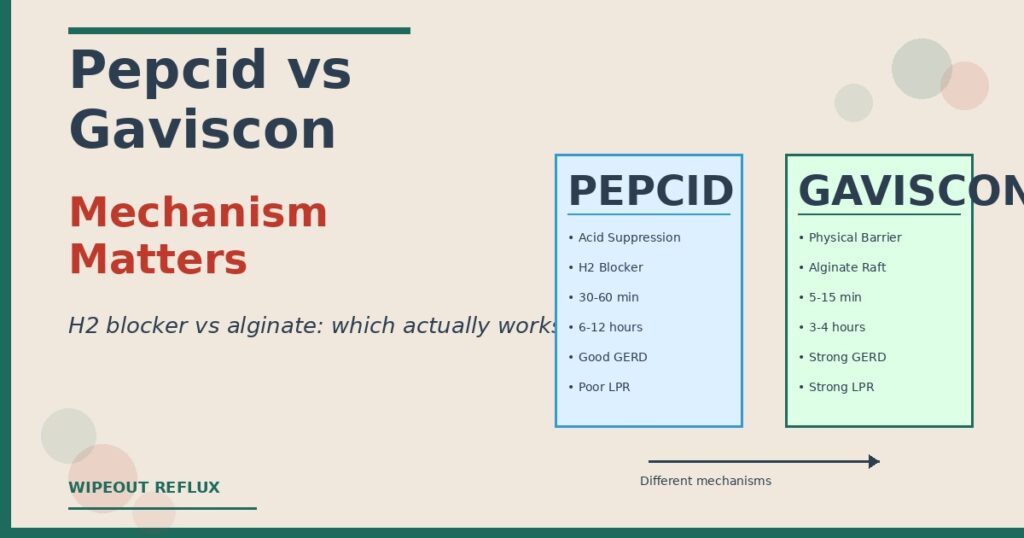
Pepcid (famotidine) suppresses stomach acid production but doesn’t prevent reflux and loses effectiveness over time. Gaviscon forms a protective raft that physically blocks reflux from happening. For occasional heartburn after meals, Gaviscon works faster and better. For persistent GERD, Pepcid provides longer-lasting relief but is less potent than PPIs.
For LPR, Gaviscon is superior because it prevents pepsin escape—something no acid suppressant can do. The best choice depends on your reflux type, frequency, and symptom pattern. Many people benefit from using both together strategically.
How Pepcid Works: Suppressing Acid, Not Preventing Reflux
Pepcid (famotidine) is an H2-receptor antagonist—a class of drugs that reduce stomach acid production by blocking histamine receptors on stomach cells. It works by decreasing the amount of acid your stomach makes, not by preventing reflux itself.
Speed: Pepcid works within 30-60 minutes after taking it. You’ll feel relief relatively quickly if your symptoms are acid-related.
Duration: Effects last 6-12 hours, making it suitable for both daytime and bedtime dosing.
Effectiveness for GERD: Pepcid works moderately well for mild-to-moderate GERD symptoms. It reduces the volume and acidity of gastric contents, which decreases the damaging potential of reflux. However, clinical research shows it’s significantly less powerful than proton pump inhibitors (PPIs). One randomized controlled trial found that omeprazole (a PPI) was substantially more effective than famotidine in both symptom relief and healing esophageal damage.
The tachyphylaxis problem: With continuous daily use, your body adapts and Pepcid becomes progressively less effective—a phenomenon called tolerance or tachyphylaxis. After 2-4 weeks of daily use, many people notice their symptoms returning or worsening despite the same dose. This is why Pepcid is generally not recommended for long-term daily management; it’s better suited for occasional use.
Effectiveness for LPR: Pepcid is particularly problematic for LPR (laryngopharyngeal reflux). LPR isn’t primarily an acid problem—it’s a pepsin problem. Pepcid suppresses acid, but pepsin already deposited in laryngeal tissue remains active. Additionally, when you consume acidic foods, they reactivate dormant pepsin without requiring a new reflux event. Pepcid can’t prevent this pepsin reactivation because it’s a dietary acid exposure, not a stomach acid suppression issue. Many LPR patients on Pepcid experience minimal symptom improvement.
How Gaviscon Works: Creating a Physical Barrier
Gaviscon (alginate-based formulation) works through a completely different mechanism than Pepcid. When sodium alginate (derived from seaweed) contacts stomach acid, it undergoes a chemical reaction with ions in your stomach and forms a gel-like “raft” that floats on top of your stomach contents. This raft creates a physical barrier—preventing acid, pepsin, and other gastric contents from refluxing into your esophagus.
Speed: Gaviscon works within 5-15 minutes of swallowing—much faster than Pepcid. This makes it ideal for acute symptom relief after meals or before bed.
Duration: The protective raft remains intact for 3-4 hours, making postprandial (after-meal) protection and nighttime use very effective.
Effectiveness for GERD: Gaviscon is highly effective for GERD, particularly postprandial reflux. Research shows that Gaviscon eliminates the “acid pocket”—the pool of highly acidic fluid that forms on top of your meal after eating—in the majority of GERD patients. This is a mechanism that PPIs don’t address because they work systemically, not locally at the reflux source. A randomized clinical trial comparing Gaviscon to omeprazole found them non-inferior for short-term symptom relief, with Gaviscon working faster (within days vs. Omeprazole’s gradual buildup over days).
Effectiveness for LPR: Gaviscon is superior to Pepcid for LPR because it physically prevents pepsin from escaping the stomach in the first place. By creating a mechanical barrier, Gaviscon doesn’t just suppress the acid that would activate pepsin—it blocks pepsin itself from reaching your throat. This is why LPR specialists recommend alginates as a core part of treatment, often more strongly than any acid-suppressing medication.
Direct Comparison: Pepcid vs Gaviscon
Mechanism
Pepcid: Acid suppression (blocks acid production at source)
Gaviscon: Physical barrier (prevents reflux mechanically)
Winner: Depends on problem type. For acid-driven GERD, Pepcid. For any reflux (especially LPR), Gaviscon.
Speed of Action
Pepcid: 30-60 minutes
Gaviscon: 5-15 minutes
Winner: Gaviscon (faster relief when you need it)
Duration of Effect
Pepcid: 6-12 hours
Gaviscon: 3-4 hours
Winner: Pepcid (longer-lasting, fewer doses needed)
GERD Effectiveness
Pepcid: Moderate; loses effectiveness over time with daily use
Gaviscon: Strong; maintains effectiveness long-term
Winner: Gaviscon for consistent, lasting relief. Pepcid for occasional use.
LPR Effectiveness
Pepcid: Poor; doesn’t address pepsin reactivation or escape
Gaviscon: Strong; mechanically prevents pepsin escape
Winner: Gaviscon (significantly superior)
Long-Term Viability
Pepcid: Limited; tachyphylaxis develops, side effects with chronic use
Gaviscon: Excellent; no systemic absorption, safe for indefinite use
Winner: Gaviscon
Cost
Pepcid: ~$10-15 for 30-day supply (generic famotidine very cheap)
Gaviscon: ~$8-12 for 4-week supply depending on formulation
Winner: Roughly equivalent; Pepcid slightly cheaper for daily use
Ease of Use
Pepcid: Tablet/capsule once or twice daily
Gaviscon: Liquid (10 mL) or tablets, taken after meals/at bedtime (more frequent dosing)
Winner: Pepcid (simpler daily routine; Gaviscon requires more frequent dosing)
Side Effects
Pepcid: Generally well-tolerated; rare side effects; safe for most people
Gaviscon: No systemic absorption; virtually no side effects; safe in pregnancy
Winner: Gaviscon (truly no side effects; Pepcid has rare but documented issues)
Which Should You Choose? A Decision Framework
Choose Pepcid if: You have occasional heartburn (a few times per week) triggered by specific meals or late eating. You want once or twice-daily dosing. You don’t have LPR. You’re on a tight budget and OK with tolerance developing over weeks.
Choose Gaviscon if: You have postprandial reflux (reflux after meals). You have LPR or throat symptoms. You want fast relief (within minutes). You’re using it long-term and don’t want tolerance to develop. You prefer no systemic medication.
Use both together if: You have moderate-to-severe GERD. You take Pepcid once daily for baseline suppression + Gaviscon after meals for postprandial protection. This combination addresses both sustained acid suppression and acute reflux episodes. Many reflux specialists recommend this approach.
Use neither alone if: You have frequent, persistent reflux (daily symptoms). You need something stronger than H2 blockers. Consider a PPI (omeprazole, lansoprazole, esomeprazole). Or better yet, address dietary triggers systematically—the Wipeout Diet Plan is specifically designed to eliminate reflux through pH-based food selection rather than relying on medication alone.
The Pepsin Problem: Why Gaviscon Wins for LPR
This is the critical distinction many people miss.
When you have LPR, pepsin (an enzyme from your stomach) escapes into your throat and deposits in laryngeal tissue. Pepcid suppresses the acid that would activate pepsin, but it doesn’t prevent pepsin from being there in the first place. Additionally, pepsin is stable (inactive but present) at neutral pH; it can be reactivated hours later by dietary acids (citrus, coffee, wine, vinegar, tomato). When you consume these acidic foods, they reactivate dormant pepsin directly in your throat tissue—and Pepcid can’t prevent this because it’s not a stomach acid suppression issue, it’s a dietary acid exposure issue.
Gaviscon, by contrast, physically prevents pepsin from escaping the stomach. The raft floats on top of stomach contents and acts as a mechanical barrier—pepsin never reaches your throat in the first place. This is why Gaviscon is the superior choice for LPR, even though Pepcid is often prescribed first (mainly because doctors are more familiar with acid suppressants).
Research confirms this: a randomized controlled trial comparing alginates (Gastrotuss) to omeprazole (a PPI, which is stronger than Pepcid) for LPR found them non-inferior—meaning the alginate worked as well as the PPI, despite the PPI being a more powerful acid suppressant. This wouldn’t make sense unless the mechanism of action mattered more than acid suppression alone.
Real-World Dosing Recommendations
For Occasional Heartburn (1-2 times per week)
Strategy: Gaviscon as needed after meals or at bedtime. No daily Pepcid needed.
Dosing: 10 mL Gaviscon after meals and/or at bedtime. Effects expected within minutes.
For Frequent GERD (3-5 days per week)
Strategy: Pepcid once or twice daily (baseline suppression) + Gaviscon after meals (acute protection).
Dosing: Pepcid 20 mg twice daily OR 40 mg at bedtime + Gaviscon 10 mL after meals as needed. Duration on this regimen: 2-4 weeks before assessing if Pepcid tolerance is developing.
For LPR (Throat symptoms)
Strategy: Gaviscon as primary medication (mechanical prevention of pepsin escape) + strict dietary adherence (the Wipeout Diet) + elevation/timing changes. Pepcid is secondary/optional.
Dosing: Gaviscon 10 mL after meals and especially at bedtime (LPR is often nocturnal). Add Pepcid 20 mg at bedtime only if Gaviscon + diet aren’t sufficient. Don’t expect Pepcid to solve LPR alone; it won’t.
For Persistent Reflux Despite Both
Next step: Don’t just increase doses. You likely need a mechanistic shift. Consider a PPI (omeprazole, lansoprazole, esomeprazole) for stronger acid suppression, but pair it with Gaviscon + dietary changes. Or focus entirely on dietary modification—many people find this more effective than any medication.
When to Add Other Treatments
If Pepcid + Gaviscon aren’t enough: The problem likely isn’t medication choice but root causes. Address these in order:
1. Dietary triggers: Eliminate acidic foods (citrus, tomato, coffee, wine, vinegar, chocolate). This is non-negotiable for LPR recovery. The Wipeout Diet Plan is mechanism-based dietary management—it’s not generic calorie-counting, it’s pH-optimization for reflux. The Wipeout Reflux Food Reference Guide is a good guide for checking individual foods against that pH threshold.
2. Lifestyle factors: Sleep elevation (head 30-45 degrees), meal timing (3+ hours before bed), portion sizes (smaller meals reduce pressure).
3. Upgrade medication: If still symptomatic, add a PPI rather than increasing Pepcid dose. A PPI will be more effective for sustained suppression.
4. Professional evaluation: If reflux persists despite medication + diet + lifestyle changes, professional assessment is important. Persistent reflux can indicate structural issues (hiatal hernia, valve dysfunction) that medications can’t fix.
Combining Pepcid & Gaviscon: The Synergistic Approach
Pepcid and Gaviscon work through different mechanisms, so combining them makes pharmacologic sense:
Pepcid suppresses baseline stomach acid. This means your stomach produces less acid overall, which reduces the acid load available to reflux.
Gaviscon prevents reflux mechanically. Even if reflux happens, the raft blocks it from reaching your esophagus and throat.
Together, they address both the problem source (too much acid production) and the mechanism (reflux itself). This is why many reflux specialists recommend this combination for moderate GERD, especially when symptoms are persistent.
Example regimen: Pepcid 20 mg at breakfast and 40 mg at bedtime + Gaviscon 10 mL after lunch, dinner, and at bedtime. This combination provides all-day acid suppression plus targeted mechanical protection around meals and sleep.
Frequently Asked Questions
Does Gaviscon Work as Well as Pepcid?
For different things. Gaviscon works faster and lasts longer mechanically. Pepcid works longer systemically (6-12 hours vs. 3-4 hours). For postprandial reflux, Gaviscon is superior. For sustained baseline suppression, Pepcid is better (but develops tolerance). For LPR, Gaviscon is clearly better.
Can I Take Pepcid and Gaviscon Together?
Yes, absolutely. They work through different mechanisms and complement each other. Many people benefit from this combination. No significant interactions.
Why Does Pepcid Stop Working After a Few Weeks?
Tachyphylaxis—your stomach adapts to the medication and becomes less responsive. After 2-4 weeks of daily use, many people notice symptoms returning. This is why Pepcid is better for occasional use, not daily long-term management.
Is Gaviscon Safe to Use Every Day?
Yes, completely. Gaviscon is not absorbed into your bloodstream; it works locally in your stomach. It’s safe for long-term daily use, during pregnancy, and in children. No systemic side effects.
Which Is Better for LPR: Pepcid or Gaviscon?
Gaviscon is significantly better for LPR. Pepcid suppresses acid but doesn’t prevent pepsin escape. Gaviscon mechanically prevents pepsin from reaching your throat. Combined with strict dietary adherence (avoid acidic triggers), Gaviscon addresses LPR from both directions.
Should I Use Pepcid at Night or During the Day?
Pepcid is often taken at bedtime because that’s when many people experience reflux—lying down increases reflux risk. If you have daytime symptoms, take it at breakfast and bedtime (40 mg total: 20 mg each time). If symptoms are purely nocturnal, bedtime dosing only is sufficient.
Can I Switch Between Pepcid and Gaviscon Daily?
Not ideal. Pick a strategy and stick with it for 2-4 weeks before assessing effectiveness. Switching constantly makes it hard to know what’s actually working. If you need variety, combine them (Pepcid daily + Gaviscon as-needed) rather than switching between them.
Conclusion: They’re Different Tools for Different Problems
Pepcid and Gaviscon are not competitors—they’re complementary tools with different mechanisms. Pepcid suppresses acid production; Gaviscon prevents reflux mechanically. For occasional heartburn, Gaviscon alone is better. For frequent GERD, combining them makes sense. For LPR, Gaviscon is superior and should be central to treatment.
The most effective reflux management strategy combines the right medication (or medication combination) with dietary modification through the Wipeout Diet Plan and lifestyle changes (elevation, timing, stress management). Medication alone, regardless of which you choose, addresses symptoms but not root causes.
If you’re struggling to find the right approach for your reflux type, professional guidance can help you build a targeted strategy that combines medication wisely with behavioral change for lasting recovery.
Research & References
Over-the-Counter Acid Reflux Medications: Which Ones Work? — Expert clinical guidance from Dr. Jamie Koufman, a leading reflux specialist, recommending famotidine (Pepcid) as the safest H2 blocker option and alginates (Gaviscon Advance, Reflux Raft) for nighttime protection and LPR management, with specific dosing recommendations for combining them.
Efficacy and Tolerability of Omeprazole Compared with Famotidine for Treatment of Gastroesophageal Reflux Disease — Randomized controlled trial demonstrating that omeprazole (a PPI) was significantly more effective than famotidine (Pepcid) in healing erosive esophagitis and controlling reflux symptoms, establishing the superiority of PPIs over H2 blockers for GERD.
Gaviscon vs. Omeprazole in Symptomatic Treatment of Moderate Gastroesophageal Reflux: A Direct Comparative Randomised Trial — Double-blind trial comparing Gaviscon (alginate 4×10 mL/day) directly to omeprazole (a PPI), finding them non-inferior for short-term symptom relief, with Gaviscon working faster and alginates offering a mechanical prevention mechanism PPIs cannot achieve.
Gaviscon Double Action Liquid Is More Effective Than Antacid in Controlling Postprandial Esophageal Acid Exposure in GERD Patients — Published study showing that Gaviscon eliminates the “acid pocket” and provides sustained postprandial protection through mechanical raft formation, a mechanism that acid-suppressing drugs like Pepcid cannot replicate.
Magnesium Alginate vs. Proton Pump Inhibitors for Treatment of Laryngopharyngeal Reflux: A Non-Inferiority Randomized Controlled Trial — Clinical trial demonstrating that alginates are non-inferior to PPIs (omeprazole) for LPR symptom and sign reduction, providing evidence that alginate mechanical prevention is as effective as PPI acid suppression for LPR—suggesting pepsin prevention may matter more than acid suppression for this condition.
An Update on Current Treatment Strategies for Laryngopharyngeal Reflux Symptoms — Peer-reviewed review documenting that H2 blockers like famotidine are considered second-line therapy for LPR due to their lower potency and shorter duration, while alginates are increasingly recognized as a superior first-line option for mechanical pepsin prevention in LPR.
A Doctor’s Guide to Treatment of Silent Reflux, Respiratory Reflux, and LPR — Specialist clinical guidance recommending famotidine (Pepcid) and alginates as more effective for respiratory reflux (LPR) than PPIs, with emphasis on mechanical prevention through alginate therapy rather than acid suppression alone.

David Gray
12 years living with LPR · Consultant & researcher
I've lived with LPR for twelve years — the misdiagnoses, the PPI courses that did nothing, the slow work of figuring out what actually helps. Wipeout Reflux is where I translate the research into plain terms for people stuck in the same place. Every claim here is sourced to peer-reviewed work, and I consult one-to-one with LPR sufferers.