
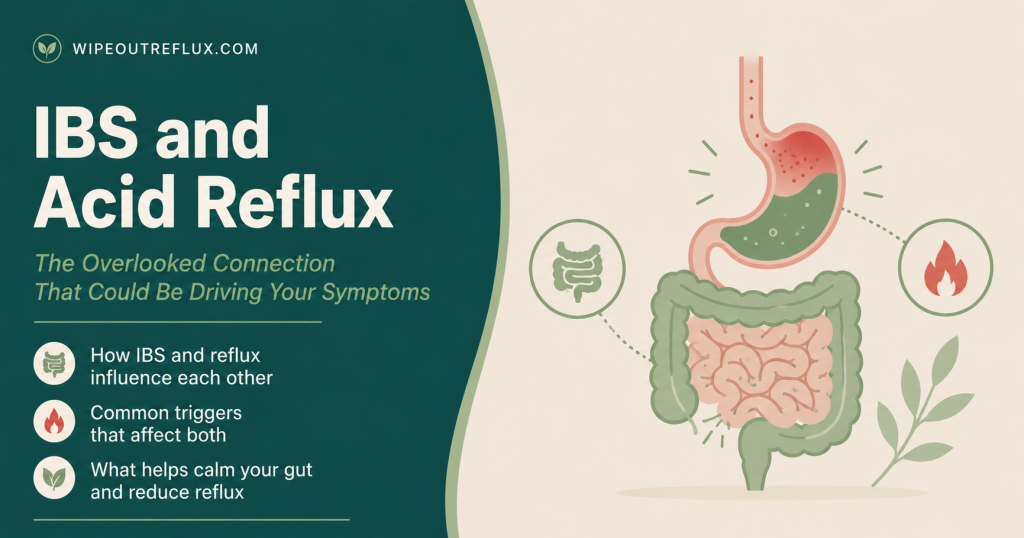
If you have irritable bowel syndrome (IBS) and acid reflux, you’re not dealing with two unlucky coincidences — the two cluster together far more than chance would predict. Reflux-type symptoms are roughly four times more common in people with IBS than in those without it. The reason is that both conditions are increasingly understood as disorders of gut-brain interaction: they share the same underlying wiring problems — oversensitive gut nerves and disordered motility — just showing up at different ends of the digestive tract.
That shared root matters enormously for treatment, because it explains a frustration I hear constantly: acid-suppressing medication only goes so far when the real driver isn’t excess acid but an oversensitive, poorly-coordinated gut. Having managed LPR myself for over eight years, I’ve come to see this overlap as one of the most useful things a reflux sufferer can understand, so let me walk through what the evidence actually shows and what it means for you.
Key Takeaways
- The overlap is large. Reflux-type symptoms are around four times more common in people with IBS than in those without.
- They share mechanisms. Both involve visceral hypersensitivity (oversensitive gut nerves), altered motility, and gut-brain axis dysregulation — not just acid.
- It’s usually non-erosive reflux. IBS tracks with functional, symptom-based reflux rather than the erosive acid damage seen on endoscopy — a crucial clue about what’s really going on.
- Gas and pressure play a role. Fermentation of certain carbohydrates produces gas that raises abdominal pressure and can push reflux upward.
- A low-FODMAP diet helps IBS strongly and may ease reflux when the two overlap — but it’s a structured, time-limited tool, not a permanent restriction.
- If acid suppression alone isn’t controlling your reflux, the gut-brain angle is worth exploring rather than simply increasing the dose.
Just how common is the overlap?
Very. A community meta-analysis found that reflux-type symptoms were present in around 42% of people with IBS, and that having IBS raised the odds of reflux symptoms roughly four-fold compared with people without IBS [Lovell & Ford, American Journal of Gastroenterology, 2012]. That’s a striking degree of clustering — far more than you’d expect if the two conditions were unrelated.
The relationship also runs both ways in daily life: people who come in for reflux frequently turn out to have IBS symptoms too, and vice versa. When they coincide, symptoms tend to be more stubborn and quality of life takes a bigger hit than with either condition alone. So if you have both, you’re firmly in the majority pattern, not an unusual case.
Why do IBS and reflux overlap?
This is the part that ties everything together. The modern understanding is that IBS and reflux frequently share the same underlying mechanisms, and in people who have both, visceral hypersensitivity and disordered gut motility appear to be coexisting drivers [Huang et al., World Journal of Gastroenterology, 2023].
Two shared features do most of the work:
- Visceral hypersensitivity. This is the big one. In both IBS and much of what we call reflux, the nerves lining the gut are turned up too high — they register normal sensations (a bit of gas, a little acid, ordinary stretching) as pain or discomfort. The same oversensitivity that makes the bowel painful in IBS can make the oesophagus and throat register minor reflux as major symptoms.
- Disordered motility. Both conditions involve the gut’s muscular coordination going awry. In the upper gut, that can mean a weaker valve at the top of the stomach and slower clearance, both of which promote reflux.
Underpinning both is the gut-brain axis — the constant two-way signalling between your digestive system and your nervous system. When that signalling is dysregulated, the whole tract becomes more reactive. This is also why stress and anxiety genuinely worsen both conditions: it’s not “in your head” in a dismissive sense, it’s a real neurological loop between brain and gut. I’ve written more about the way anxiety and reflux feed each other, and the same principle applies across IBS.
The key clue: it’s usually non-erosive reflux
Here’s a detail that reframes the whole picture, and that most articles miss. When researchers looked closely, IBS was associated with non-erosive reflux — reflux symptoms without visible acid damage on endoscopy — but not with erosive oesophagitis, the structural acid injury. Notably, IBS and non-erosive reflux shared risk factors including somatization and anxiety, whereas erosive damage did not [Nam et al., Journal of Neurogastroenterology and Motility, 2013].
Why does this matter so much? Because it tells you that in the IBS-plus-reflux picture, the problem is often sensitivity and signalling, not corrosive acid. That’s a completely different target. If your oesophagus isn’t being burned but your nerves are firing off symptoms anyway, pouring more and more acid suppression at the problem is aiming at the wrong thing — which is exactly why some people find their reflux medication never quite works. It’s one of the more common reasons reflux medication fails to control symptoms, and recognising it opens up much more effective approaches.
The gas-and-pressure connection
There’s also a mechanical bridge between the two conditions, and it’s where diet comes in. Certain carbohydrates — known as FODMAPs — aren’t fully absorbed in the small intestine, so they travel on to the colon where gut bacteria ferment them, producing gas. That gas raises pressure inside the abdomen, and increased pressure can promote reflux by encouraging the valve at the top of the stomach to relax and by pushing contents upward.
This is the same fermentation-and-gas process that drives the bloating and pain of IBS, which is why a single dietary lever can sometimes ease both. It’s also closely tied to what happens when gut bacteria overgrow in the wrong place — if your reflux comes with heavy bloating, it’s worth understanding the connection between bacterial overgrowth and acid reflux, because the gas-pressure mechanism sits at the heart of both.
Does a low-FODMAP diet help?
This is where people get most interested, so let me be straight about what the evidence supports and what it doesn’t.
For IBS itself, a low-FODMAP diet is one of the better-evidenced dietary approaches, reliably reducing abdominal pain and bloating in many people [Kuźmin et al., Nutrients, 2025]. For reflux specifically, the evidence is thinner. In a randomised trial in people with reflux that hadn’t responded to acid suppression, a low-FODMAP diet and standard dietary advice both produced modest, similar improvements, with no clear winner [Rivière et al., Neurogastroenterology & Motility, 2021].
The sensible reading is this: a low-FODMAP approach is most likely to help reflux when it overlaps with IBS — where the gas-and-pressure mechanism is in play — rather than as a standalone reflux cure. And a crucial caveat: this is a structured, three-phase tool (a short elimination period, then systematic reintroduction, then personalisation), not a permanent diet. The restriction phase shouldn’t drag on, because long-term over-restriction risks nutritional gaps and unhelpful changes to the gut microbiome [Kuźmin et al., Nutrients, 2025]. If you try it, doing so with a dietitian is far safer and more effective than an indefinite, ever-shrinking food list.
The silent reflux angle
For those of us dealing with throat-based symptoms, the gut-brain overlap is especially relevant. LPR (silent reflux) is heavily driven by tissue sensitivity in the throat and voice box, and visceral hypersensitivity — the same nerve oversensitivity central to IBS — plausibly lowers the threshold at which reflux triggers throat symptoms like globus, throat clearing and cough.
What this means practically is that if you have IBS and silent reflux, calming the whole gut-brain system tends to help more than chasing acid alone. LPR is also as much a pepsin problem as an acid one, which is why understanding how to neutralise pepsin in the throat matters alongside the broader gut-brain work. The two approaches complement each other.
What to actually do about it
I’m not a doctor, so take this as a framework to discuss with yours rather than a protocol.
Treat them as connected, not separate. If you have both, managing them together — through diet, stress and the gut-brain system — usually beats treating each in isolation. Improvements in one often bring improvements in the other.
Don’t just escalate acid suppression. Given how often the reflux here is non-erosive and sensitivity-driven, keep in mind that more acid suppression targets a mechanism that may not be the main problem. If standard treatment isn’t working, that’s a signal to widen the approach rather than push the same lever harder.
Consider a structured, time-limited diet trial. A low-FODMAP trial can be worthwhile if you have clear IBS symptoms alongside reflux, ideally guided by a dietitian, and always with reintroduction built in from the start.
Take the gut-brain axis seriously. Because stress genuinely amplifies both conditions through real neurological pathways, approaches that calm that system — and, for some people, gut-brain-directed therapies — can make a meaningful difference. This isn’t a substitute for proper diagnosis, so persistent or changing symptoms should always be assessed by a doctor to rule out other causes.
Keep the fundamentals. Meal timing, portion size and protecting the throat from pepsin still do a lot of the day-to-day work, whatever else is going on underneath.
The bottom line
IBS and acid reflux overlap so heavily because they’re two sides of the same coin: a hypersensitive, poorly-coordinated gut wired to an overactive gut-brain axis. Reflux symptoms are roughly four times more common in people with IBS, and crucially, that reflux is often the non-erosive, sensitivity-driven kind rather than corrosive acid damage. Understanding that changes everything, because it explains why endlessly escalating acid suppression so often falls short and points toward approaches that actually address the shared root.
As always with reflux, the real lesson is that it’s rarely about a single villain. Acid, pepsin, gut bacteria, motility and the gut-brain connection all interact, and lasting relief comes from calming the whole system rather than fixating on one piece. That’s the thinking behind the Wipeout Diet Plan: a structured, pepsin-aware approach that settles reflux and gives your gut, throat and oesophagus the conditions they need to calm down, working alongside proper IBS care rather than instead of it. It’s the complete, in-depth system I wish I’d had when I started.
For a practical starting point, the Wipeout Food Reference Guide is the essential companion — it lays out exactly which foods and drinks are safe for acid reflux and LPR along with their pH values, so you can make confident choices without second-guessing every meal. Pair that clarity with an understanding of the gut-brain overlap, and you’re addressing the real problem rather than treating one symptom while missing its cause.
Frequently Asked Questions
Can IBS cause acid reflux?
They’re strongly linked, and reflux symptoms are about four times more common in people with IBS. Rather than one directly causing the other, both share underlying mechanisms — oversensitive gut nerves, disordered motility, and gut-brain signalling problems — which is why they so often occur together.
Why do I have both IBS and reflux?
Because they’re increasingly understood as two expressions of the same underlying issue: a hypersensitive, poorly-coordinated gut governed by a dysregulated gut-brain axis. The oversensitivity that causes bowel symptoms in IBS can also make the oesophagus and throat react strongly to minor reflux.
Is the reflux in IBS caused by too much acid?
Often not. Research links IBS with non-erosive, symptom-based reflux rather than the erosive acid damage seen on endoscopy. This suggests the problem is frequently nerve oversensitivity rather than excess corrosive acid — which is why acid suppression alone sometimes disappoints.
Does a low-FODMAP diet help reflux?
It helps IBS well, and may ease reflux when the two overlap, largely by reducing the gas and abdominal pressure that promote reflux. As a standalone reflux treatment the evidence is limited. It’s best used as a structured, time-limited trial with reintroduction, ideally with dietitian support, rather than a permanent restriction.
Can stress make both IBS and reflux worse?
Yes, through genuine physiology rather than imagination. The gut-brain axis is a two-way signalling system, and stress can heighten gut sensitivity and disrupt motility, worsening both conditions. This is why approaches that calm the nervous system can help symptoms in both.
Should acid reflux and IBS be treated together?
Usually, yes. Because they share mechanisms, addressing the whole gut-brain system — diet, stress, and sensitivity — tends to work better than treating each condition in isolation. Improvements in one frequently carry over to the other.
Can IBS affect silent reflux (LPR)?
It can. The visceral hypersensitivity central to IBS may lower the threshold at which reflux triggers throat symptoms like globus and throat clearing. If you have both, calming the overall gut-brain system alongside protecting the throat from pepsin tends to help more than targeting acid alone.
References
- Lovell & Ford, American Journal of Gastroenterology, 2012 — Community meta-analysis finding reflux-type symptoms in around 42% of people with IBS and roughly four-fold higher odds of reflux symptoms compared with those without IBS.
- Huang et al., World Journal of Gastroenterology, 2023 — Review of IBS noting that visceral hypersensitivity and gut motility disorders may be coexisting mechanisms in overlapping GERD and IBS, with the gut-brain axis central to pathophysiology.
- Nam et al., Journal of Neurogastroenterology and Motility, 2013 — Study of 2,769 people finding IBS associated with non-erosive reflux (sharing risk factors such as somatization and anxiety) but not with erosive oesophagitis.
- Rivière et al., Neurogastroenterology & Motility, 2021 — Randomised trial in PPI-refractory reflux showing a low-FODMAP diet and standard dietary advice produced similar, limited symptom improvement.
- Kuźmin et al., Nutrients, 2025 — Systematic review showing the low-FODMAP diet reduces IBS symptoms but has very limited evidence in GERD, while cautioning about its restrictive nature and the need for dietitian supervision.

David Gray
12 years living with LPR · Consultant & researcher
I've lived with LPR for twelve years — the misdiagnoses, the PPI courses that did nothing, the slow work of figuring out what actually helps. Wipeout Reflux is where I translate the research into plain terms for people stuck in the same place. Every claim here is sourced to peer-reviewed work, and I consult one-to-one with LPR sufferers.