
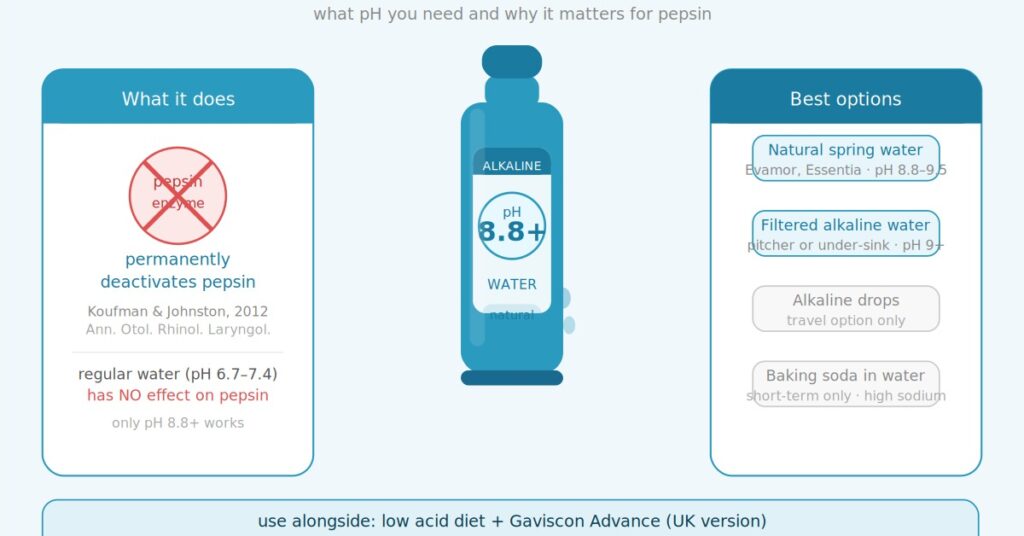
If you have LPR (silent reflux), alkaline water is one of the most useful things you can add to your daily routine — not because it treats the root cause, but because of something very specific it does to pepsin. Once you understand that, the case for drinking it is pretty clear.
This article covers why it matters for LPR specifically, what the research actually shows, how to use it properly and what to look for when choosing one.
Key Takeaways:
- Alkaline water with a pH of 8.8 or above permanently deactivates pepsin — the enzyme responsible for most LPR throat damage
- This is confirmed by a peer-reviewed study by Dr. Jamie Koufman and Dr. Nikki Johnston (2012) published in the Annals of Otology, Rhinology and Laryngology
- Regular tap and bottled water (typically pH 6.7 to 7.4) does not deactivate pepsin — only water at pH 8.8 or above has this effect
- Alkaline water is most effective when used alongside a low acid diet and Gaviscon Advance — not as a standalone treatment
- The best options are naturally alkaline spring water or filtered alkaline water — ideally pH 9 or above
- Stop drinking alkaline water 48 hours before a Peptest — it will deactivate pepsin in saliva and affect your results
Why Alkaline Water Matters for LPR — The Pepsin Connection
To understand why alkaline water is useful for LPR you need to understand what’s actually causing the symptoms — because it’s not just the acid.
When you reflux with LPR, stomach acid carries a digestive enzyme called pepsin up into the throat and voice box. Pepsin is normally there to break down protein in the stomach — when it gets into the throat it starts doing the same thing to your throat cells, causing inflammation and damage. This is what produces most of the symptoms people with LPR experience — the chronic cough, the hoarseness, the globus sensation, the throat clearing.
Here’s the crucial part: pepsin can sit dormant in your throat cells for up to 24 to 48 hours after a reflux episode. It doesn’t disappear. It waits. And if anything acidic comes into contact with your throat during that time — food, drink, even another reflux event — the pepsin gets reactivated and causes more damage all over again. This is why LPR can feel relentless even when you’re being careful.
Alkaline water breaks this cycle. Water at pH 8.8 or above doesn’t just neutralise acid — it permanently deactivates pepsin, stopping it from causing any further damage. This is different from what regular water does. Tap water and most bottled water sit between pH 6.7 and 7.4, which is not alkaline enough to affect pepsin at all.
You can read more about how pepsin works and why it matters in my complete guide to LPR.
What the Research Shows
The key study here is one by Dr. Jamie Koufman and Dr. Nikki Johnston (2012), published in the Annals of Otology, Rhinology and Laryngology. This was a laboratory study that specifically tested whether alkaline water at pH 8.8 could inactivate human pepsin.
The findings were clear: pH 8.8 alkaline water instantly and irreversibly denatured human pepsin, rendering it permanently inactive. The same water also showed far superior acid-buffering capacity compared to conventional bottled waters at neutral pH. The researchers concluded that alkaline water consumption may have genuine therapeutic benefits for people with reflux disease.
Notably this research was co-authored by Dr. Nikki Johnston — the same researcher now developing fosamprenavir as the world’s first pepsin inhibitor for LPR. Both approaches are targeting the same thing from different angles — and alkaline water is the dietary version of the same principle.
The Zalvan et al. JAMA study (2017) comparing a plant-based Mediterranean diet and alkaline water against PPI therapy found that the dietary approach — which included alkaline water as the primary beverage — produced comparable symptom improvement to PPIs in LPR patients. That’s a significant finding. It suggests alkaline water as part of a broader dietary approach can match pharmacological acid suppression for LPR.
More recently, clinical writing from Koufman’s team has emphasised that pH 9.5 or above is the optimal target — the higher the pH the more effectively pepsin is deactivated. pH 8.8 is the confirmed threshold, but aiming higher gives you more margin.
How to Use Alkaline Water for LPR
The most effective way to use alkaline water for LPR is to make it your default drink throughout the day, use it after anything acidic, and drink it first thing in the morning before anything else. Here’s why each of these matters.
Make it your main water throughout the day. The goal is to keep the throat environment consistently alkaline — not just drink it occasionally. Every time you reach for regular water at pH 6 to 7 when you could be drinking alkaline water, you’re missing a chance to neutralise dormant pepsin. I switched to alkaline water as my only water and noticed the difference within a couple of weeks.
Use it after anything acidic. If you eat or drink something slightly acidic — even something within the LPR-safe range — following it immediately with alkaline water helps neutralise residual acidity in contact with the throat. Think of it as a rinse that resets the environment each time. If you’re unsure where a particular food sits, my food reference guide gives the pH for most of them.
First thing in the morning is particularly valuable. After 7 to 8 hours lying down there’s a reasonable chance some reflux has occurred during sleep. Making alkaline water the first thing that touches your throat in the morning helps deal with any pepsin that’s settled there overnight. This is one of those habits that genuinely makes a difference.
Stop it 48 hours before a Peptest. Alkaline water deactivates pepsin so effectively that it will skew your Peptest results if you drink it before the sampling window. Switch to regular water at least 48 hours before collecting samples. More on this in my Peptest review.
What pH Do You Need?
For alkaline water to deactivate pepsin and help LPR, it needs to be at least pH 8.8 — and ideally pH 9 or above. This is the threshold confirmed by the Koufman and Johnston study. Below pH 8.8, including all standard tap water and most bottled water, there is no meaningful effect on pepsin.
In practice, aim for pH 9 or above. This gives you a comfortable margin above the 8.8 threshold and means even if the pH drops slightly after opening (which it can), you’re still in the effective range.
pH 10 or above is generally the upper end you’d want to drink regularly. Very high pH water over extended periods isn’t something that’s been studied long-term, and there’s no established benefit to going far beyond what’s needed to deactivate pepsin.
Your Options for Getting Alkaline Water
There are four main ways to get alkaline water for LPR, ranked here from best to least ideal. The short version: naturally alkaline spring water is the gold standard, quality filtered alkaline water is a more affordable daily option, drops are fine for travel, and baking soda works as a short-term fix only.
1. Naturally alkaline bottled spring water — the best option
Naturally alkaline water — where the pH comes from minerals occurring naturally in the water source rather than from anything added — is the best choice. This is what the Koufman study actually used: Evamor, a naturally alkaline artesian water at pH 8.8. Natural bicarbonate in the source water is what creates the alkalinity.
Look for the pH stated on the label. If it doesn’t state a pH it’s unlikely to be meaningfully alkaline. Common options in the UK and US with confirmed higher pH include:
- Evamor — naturally alkaline artesian water, pH 8.8 (the specific water used in Koufman’s study)
- Essentia — ionised water, typically pH 9.5
- Flow — naturally alkaline spring water, typically pH 8.1
- Icelandic Glacial — naturally alkaline, pH around 8.4
One important caveat: the pH stated on the label is the pH at source. Once bottled and transported, pH can drop somewhat. The only way to know the actual pH of what’s in the bottle is to test it yourself with a pH meter or pH strips. I’d recommend testing before committing to a brand — it’s a small investment that pays off if you’re buying regularly.
2. Filtered alkaline water — a cost-effective alternative
Alkaline water filter pitchers and under-sink systems raise the pH of regular tap water through a mineral filtration process. They’re significantly cheaper long-term than buying bottled water daily and the quality ones consistently produce water at pH 9 to 9.5.
Look for filters that use a multi-stage process including mineralisation — this is what raises the pH naturally rather than just through electrolysis. Brands like Santevia and AlkaViva are generally well-regarded.
3. Alkaline water drops — a portable option
You add a few drops to regular water to raise the pH. The quality varies significantly between brands and the pH increase is less consistent than filtration or naturally alkaline water. Worth using when travelling or when you don’t have access to your usual option, but not my first choice for daily use.
4. Baking soda in water — works but not ideal long-term
Half a teaspoon of baking soda in water raises the pH significantly and does work to neutralise acid and pepsin. The problem with using it regularly is the sodium content — it’s high in salt which is a concern if you’re drinking it multiple times a day. Fine as an occasional option but not something I’d use as your primary source of alkaline water long-term.
Should You Test the pH Yourself?
Yes — and it’s worth doing. A basic digital pH meter costs around £10 to £20 / $15 to $25 and takes the guesswork out of it entirely. The pH on the label is the pH at source — once bottled and transported it can drop, sometimes significantly. The only way to know what’s actually in the bottle is to test it.
I’d recommend testing any water you’re planning to drink regularly for LPR. If it comes back at pH 7 or below, it’s not doing what you need. Calibrate the meter before use with the calibration solution that comes with it and test at room temperature for the most accurate reading.
Is Alkaline Water Enough on Its Own?
No — alkaline water on its own is not enough to treat LPR. It deactivates pepsin already in the throat but does nothing to stop more pepsin from refluxing up. If the diet and Gaviscon Advance aren’t in place alongside it, you’ll be chasing your tail.
I’ve seen people drink alkaline water religiously and still struggle because they haven’t addressed the root cause. The water is doing its job — but new pepsin keeps arriving faster than it can be neutralised. That’s why the combination matters.
The combination that actually works is:
- The low acid diet — stops pepsin from being reactivated by acidic food and drink
- Gaviscon Advance (UK version) — creates a physical barrier that prevents reflux reaching the throat
- Alkaline water — deactivates any pepsin that does reach the throat, and keeps the throat environment alkaline
Used together, these three things address the problem from three different angles. Alkaline water is a meaningful piece of that — it’s just not the whole picture on its own. For the complete treatment approach check my silent reflux treatment guide.
If you want a fully structured plan that tells you exactly what to eat, what to drink and how to combine these approaches, check the Wipeout Diet Plan. And if you want personalised guidance for your specific situation consider a private consultation.
Frequently Asked Questions
What pH does alkaline water need to be for LPR?
The research-confirmed threshold is pH 8.8 — this is where alkaline water permanently deactivates human pepsin, as demonstrated in Koufman and Johnston’s 2012 study. In practice, aim for pH 9 or above to give yourself a comfortable margin. Most tap and standard bottled water sits between pH 6.7 and 7.4 — not alkaline enough to affect pepsin.
Does alkaline water help GERD as well as LPR?
Yes — the Koufman study confirmed benefits for reflux disease generally, not just LPR. For GERD the acid-buffering capacity of alkaline water is the main benefit — it helps neutralise acid in the oesophagus. For LPR the pepsin deactivation is the more critical mechanism. Both benefit.
Can I drink too much alkaline water?
There’s no established harm from drinking alkaline water regularly at the levels needed for LPR management. The concern sometimes raised about disrupting stomach acid applies mainly to very high pH water consumed in very large quantities — normal drinking levels are not a concern. Your stomach produces its own acid regardless of what you drink and self-regulates effectively.
Is naturally alkaline water better than ionised or filtered alkaline water?
Naturally alkaline water — where the pH comes from naturally occurring minerals like bicarbonate in the source — is generally considered the better option. The Koufman study specifically used naturally alkaline artesian water. Ionised and filtered options can be effective but the quality varies more between brands. If using a filter, look for one that uses mineralisation rather than just electrolysis.
Will alkaline water interfere with my digestion?
Drinking alkaline water between meals and away from meals is unlikely to interfere with digestion. Drinking a lot of anything immediately before or during a meal can dilute stomach acid temporarily but this applies to any water. The practical advice is to drink alkaline water consistently throughout the day rather than in large amounts right before eating.
How does alkaline water fit with the low acid diet?
They work together. The low acid diet prevents dietary acids from reactivating dormant pepsin in the throat. Alkaline water actively deactivates that pepsin. Together they’re more effective than either alone — the diet stops reactivation, the water neutralises what’s there. You can read more about the dietary approach in my LPR diet guide.
Conclusion
Alkaline water at pH 8.8 or above permanently deactivates pepsin and is one of the most practical additions you can make to an LPR treatment plan. The science is solid, the mechanism is clear, and it’s something you can implement today without a prescription or a specialist referral. The key points: minimum pH 8.8, ideally 9 or above, naturally alkaline or quality filtered, used as your default drink throughout the day.
Used on its own it won’t resolve LPR. As part of the right combination — low acid diet, Gaviscon Advance and alkaline water — it genuinely moves the needle.
Related articles:
- The Complete Guide to LPR — Causes, Symptoms and Treatment
- LPR Diet — What to Eat, What to Avoid and What to Drink
- LPR Foods to Avoid — The Complete List
- Gaviscon Advance for LPR
- Silent Reflux Treatment — What Actually Works
- How I Cured My Silent Reflux
- Peptest Review — Is It Worth Doing?
- What Can You Drink with Acid Reflux?
References
- Koufman JA, Johnston N. (2012) “Potential benefits of pH 8.8 alkaline drinking water as an adjunct in the treatment of reflux disease.” Annals of Otology, Rhinology and Laryngology, 121(7):431-434. PubMed
- Zalvan CH et al. (2017) “A Comparison of Alkaline Water and Mediterranean Diet vs Proton Pump Inhibition for Treatment of Laryngopharyngeal Reflux.” JAMA Otolaryngology-Head and Neck Surgery, 143(10):1023-1029. PMC
- Johnston N, Dettmar PW, Bishwokarma B, Lively MO, Koufman JA. (2007) “Activity/stability of human pepsin: implications for reflux attributed laryngeal disease.” The Laryngoscope, 117(6):1036-9. PubMed

David Gray
12 years living with LPR · Consultant & researcher
I've lived with LPR for twelve years — the misdiagnoses, the PPI courses that did nothing, the slow work of figuring out what actually helps. Wipeout Reflux is where I translate the research into plain terms for people stuck in the same place. Every claim here is sourced to peer-reviewed work, and I consult one-to-one with LPR sufferers.
Hi David
Ive read your article about LPR and many other such articles online. Thanks, yours is quite comprehensive n helpful.
I have a few questions to ask before i sign up for the Wipeout Diet as i have already bought many things suggested by articles i’ve read n would not want them to go to waste.
I’ve stopped taking PPI -Dexilant 60mg. Cold turkey method. It came back with vengeance but i persevered without it. I realised i’ve got LPR n not gerd or acid.
reflux.
Currently I am fasting during the month of Ramadhan. It helps a bit but towards the end of the day of fasting from 6am to 7pm i noticed the mucus got more until i broke the fast at 7pm. But the mucus is always there 24/7 except when i am lying down sleeping.
Questions
DRINKS
1) is it better to sip small amts of alkaline water thru out the day?
Ive also been drinking tumeric/ ginger tea which helps a bit n eating ginger crystals snack.
I also hav a box of slippery elm organic throat coat tea to finish. Wld this b ok instead of chamomile tea ?
I also have apple cider vinegar tabs.
I also need to drink low fat milk every morning for breakfast as daily calcium intake. But does it cause more mucus?
Problem is difficult to tell which food is the one that causes the LPR as i take a variety of food.
Also i dont want to waste all these things ive bought to try out.
2) Do i need Gaviscon Adv as i dont have heart burns?
3) Wedge pillow
I find them uncomfortable as i am a side sleeper. I tried a 12 inch Tempur wedge back rest as a pillow. Do u have to put your head on highest part of wedge n shoulders on middle part of wedge?
I find it more comforfortable with my neck below the wedge! I also have no problem with LPR when i am sleeping except a bit of sore throat when i get up in the morning.
4) I also have bought daily essential enzymes tabs n betaine HCi which i started on 2 weeks ago. Not much effect yet.
5) As chamomile tea is for sleep too, wldnt the double effect of taking melatonin knock me out!
6)24/7 mucus in throat. I spit it out always and it comes back immediately for me to spit it out again. I can only do this when i am at home not when i am out at work. Is it better not to clear it as it actually protects the throat but they are really sticky n uncomfortable.
Thanks
Would really appreciate it if u can answer these questions as i am getting fed up with wrong diagnosis by gastro/ ENT doctors n consuming PPI for years with no effect. Have u considered writing a book?
Hi Rue, thanks for the detailed message — and yes, from what you’ve described this sounds far more like **LPR** than classic GERD. A lot of people get stuck on PPIs for years because doctors assume “reflux = acid”, when LPR is often more about **pepsin + weakly acidic reflux**, which is why PPIs often don’t fully fix it. Also, stopping Dexilant cold turkey can cause major rebound acid, so that flare-up makes sense.
### 1) Drinks / supplements
**Alkaline water** in small sips through the day can help, especially for throat irritation, but don’t overdo it. **Ginger** is generally good if you tolerate it. **Turmeric** can help some people but irritate others. **Slippery elm throat coat tea** is fine and can be soothing (doesn’t have to be chamomile). I would personally **avoid apple cider vinegar tablets** with LPR — too risky for throat irritation.
**Milk/dairy** can worsen mucus/throat coating for some people, so it’s worth trialing a break from it for a couple of weeks if mucus is severe.
### 2) Gaviscon Advance
Yes, it can still help even without heartburn. LPR often causes reflux into the throat without classic burning. Gaviscon Advance is more of a **physical barrier** than an acid reducer.
### 3) Wedge pillow
The goal is elevating the **upper body**, not bending the neck. If your neck is lower than the wedge, it’s not ideal. But if symptoms aren’t bad during sleep, the wedge may not be your main priority anyway.
### 4) Enzymes + betaine HCl
Digestive enzymes are usually okay. **Betaine HCl is risky for LPR**, and can worsen irritation in many people. If it’s not clearly helping, I wouldn’t push it.
### 5) Chamomile + melatonin
Chamomile is mild. Melatonin is stronger. You don’t necessarily need both, but they can be used together if tolerated.
### 6) Constant mucus + throat clearing
This is extremely common in LPR. The problem is that constant clearing creates a vicious cycle (irritation → mucus → clearing → more irritation). Try to reduce it by swallowing, sipping water, or gentle “silent clearing” instead.
### Ramadan fasting
Fasting can help some people, but late-day symptoms can happen because the stomach is empty/acidic, and then breaking the fast with a larger meal can trigger reflux. Breaking the fast gently and avoiding heavy/fatty foods helps a lot.
Overall, your biggest issue might be trying **too many things at once**. LPR improves slowly, but simplifying your routine usually gives you clearer progress.
Hi David.
I’ve recently started using alkaline water and making dietary changes because I believe I have LPR. I’ve heard that if you drink too much Alkaline water, it could cause kidney issues. Is this a possibility. Thanks.
Hey Jason, no there is nothing to be concerned about when it comes to alkaline water.
Also, is all the water you drink during the day alkaline? Or just at certain times. Thanks!
You don’t have to but it may help symptoms more so if you do.
Could you clarify the best time to take the water? In the beginning you said 15 to 30 minutes before meals and then above say best to take after meals. thank you for the clarification
Generally you should be drinking it regularly throughout the day. I would just suggest not to drink a lot when eating as it may bloat the stomach more so. Also it’s a good idea to not drink a lot soon before bed.
I heard on Doctor Radio using alkaline water as a throat spray will help break down pepsin in the throat and help with throat clearing. Any comments on how or when to use? Would using before bedtime harm my teeth?
That should help yes. The times it makes most sense to take if after meals and at bedtime. It shouldn’t harm your teeth is should actually help protect them from the acid.
Hi which water should I buy for acid reflux , just alkaline or alkaline ionised . Also I’ve heard that aloe Vera juice is good for acid reflux what do you think ,
I would personally opt for just alkaline not ionized because it’s natural mainly. I think Aloe vera can help but you need to make sure to only drink one with no additives. It can also cause some people to use the bathroom more so it’s a good idea to just take in small amounts at least when starting.
Hi why is gaviscon Advance better than Gaviscon double action .also can I ever stop getting acid reflux burning my Oesophagus , i have a hiatus hernia , have changed diet not over weight, ,cannot take medication to many side effects .
It’s to do with the sodium alginate I believe there is more alginate in the Gaviscon advance. And thats the most important ingredient.
Hi David,
I am following your wipeout diet.
Once you ve eaten, how long after is it ok to start to drink water?
Thanks
It’s a good idea not to drink too much liquid or water when eating because it may expand the stomach more. Ideally I would suggest not to drink for 1 hour after eating. What I do, is when I finish eating I may have a little sip of water and then I don’t drink for a while after as suggested.