
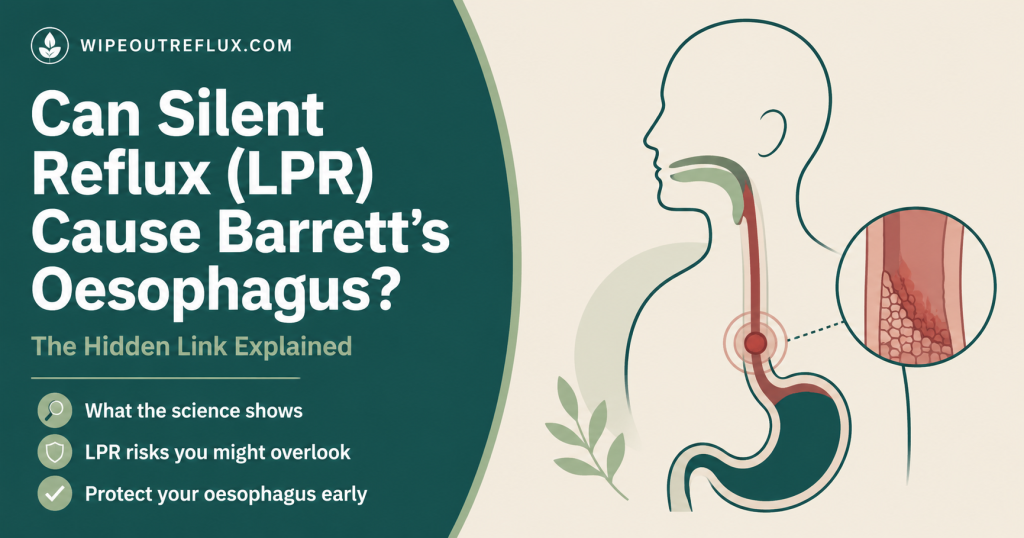
If you’ve been diagnosed with silent reflux, or you suspect you have it, there’s a fear that tends to creep in late at night: could this quietly be turning into something dangerous? Barrett’s oesophagus — and the small cancer risk attached to it — is usually the specific worry. I’ve had that worry myself, and after years of researching reflux, I think the honest answer is more reassuring than most people expect, but it does come with some important nuance you deserve to understand properly.
Let’s walk through it carefully — what Barrett’s actually is, whether silent reflux can cause it, and what the real risks and options are.
Can silent reflux (LPR) cause Barrett’s oesophagus? A direct answer
Silent reflux (laryngopharyngeal reflux, or LPR) is not a typical or direct cause of Barrett’s oesophagus on its own. Barrett’s is fundamentally a complication of acid damage to the lower oesophagus, whereas LPR is defined by refluxate reaching the throat and voice box. The vast majority of people with LPR never develop Barrett’s.
However — and this is the part that matters — LPR is a sign that reflux is happening, and in some people that same reflux is also affecting the oesophagus, sometimes without obvious heartburn. Long-standing laryngeal symptoms, especially alongside classic reflux symptoms or a hiatal hernia, are associated with a higher chance of finding Barrett’s on endoscopy. So LPR doesn’t directly cause Barrett’s, but in certain people it can be a clue worth investigating.
Key Takeaways
- Barrett’s oesophagus is a complication of GERD, caused by acid damaging the lower oesophagus — not by reflux reaching the throat.
- LPR alone rarely produces Barrett’s. In one study of suspected-LPR patients, fewer than 1% had Barrett’s.
- But LPR can coexist with significant oesophageal reflux. Long-duration laryngeal symptoms (over 5 years) significantly raised the odds of finding Barrett’s.
- The cancer risk from Barrett’s is real but small. Non-dysplastic Barrett’s carries roughly a 0.1–0.3% annual risk of progressing to oesophageal cancer.
- Barrett’s progresses in stages, from intestinal metaplasia to low-grade dysplasia, high-grade dysplasia, then cancer — usually over many years, leaving time to intervene.
- Barrett’s doesn’t reverse on its own, but dysplastic Barrett’s can be eradicated with radiofrequency ablation in over 80–90% of cases.
- High-dose PPIs (and possibly aspirin) can reduce progression, based on a large UK trial.
- Diet and lifestyle support oesophageal protection, though no food reverses Barrett’s once established.
What Barrett’s oesophagus actually is
To understand whether silent reflux can cause Barrett’s, you first need to understand what Barrett’s is — because the mechanism tells you most of the answer.
The normal lining of your oesophagus is made of flat, squamous cells. They’re not built to withstand repeated acid exposure. When the lower oesophagus is bathed in refluxed stomach contents over years, those cells can adapt by transforming into a more acid-resistant, intestinal-type lining — a process called intestinal metaplasia. That changed, salmon-coloured lining extending up from the stomach junction is Barrett’s oesophagus.
It’s essentially the oesophagus defending itself. The problem is that this new lining carries a small risk of further abnormal changes over time, which is why it’s classed as a premalignant condition. Barrett’s is found in roughly 5–15% of people with GERD.
The crucial point for our question: this is a distal oesophageal phenomenon, driven by acid sitting in the lower oesophagus. That’s a different location from where LPR does its damage.
Why LPR is different from GERD — and why that matters here
This distinction is the heart of the whole question, and it’s where a lot of online fear-mongering goes wrong.
In classic GERD, acid pools in the lower oesophagus, causing heartburn and, over time, potentially Barrett’s. In LPR, the refluxate travels higher — past the upper oesophageal sphincter and into the throat, voice box, and airway. It often does this in smaller amounts, sometimes as a fine mist, and frequently without the prolonged acid pooling in the lower oesophagus that drives Barrett’s.
That’s why people with pure LPR typically don’t have much to show on a standard oesophageal endoscopy. In one analysis of suspected-LPR patients, only about 18% had reflux oesophagitis and well under 1% had Barrett’s, even though most had genuine reflux confirmed by pH monitoring. The throat is far more sensitive to even brief reflux because, unlike the oesophagus, it lacks the protective defences of saliva, peristalsis, and bicarbonate — so it takes much less reflux to cause LPR symptoms than to cause Barrett’s.
If you want the fuller breakdown of how these two conditions differ, I’ve covered it in depth in my guide to GERD vs LPR.
So where does the real link come from?
Here’s the honest nuance. While LPR doesn’t directly carve Barrett’s into your lower oesophagus, having LPR symptoms tells you reflux is occurring — and in some people, the same underlying reflux affects both the throat and the lower oesophagus.
A cross-sectional study of ear, nose, and throat patients with laryngeal symptoms found an overall Barrett’s prevalence of around 11.8% when they were actually scoped. Notably, of those who had Barrett’s, about 30% reported only LPR-type symptoms with no typical heartburn. The strongest predictor wasn’t how severe the throat symptoms were, but how long they’d been present: laryngeal symptoms lasting more than five years raised the odds of Barrett’s more than fivefold [[Nason et al., Journal of Clinical Gastroenterology, 2013]].
The takeaway isn’t that LPR causes Barrett’s. It’s that chronic, long-standing reflux of any kind — including the silent kind — is worth taking seriously, and that throat symptoms can occasionally be the only outward sign of reflux that’s also reaching the oesophagus. The presence of a hiatal hernia and a longer segment of altered lining were other significant risk factors in that group.
How worried should you actually be? The cancer numbers
This is where I want to bring the temperature down, because the fear around Barrett’s is often wildly out of proportion to the actual statistics.
Even if you do have Barrett’s oesophagus, the annual risk of it progressing to oesophageal cancer is low. A large Danish population cohort found the absolute annual risk of adenocarcinoma in Barrett’s without dysplasia was around 0.12% — far lower than the 0.5% figure that older guidelines assumed [[Hvid-Jensen et al., New England Journal of Medicine, 2011]]. Put another way, fewer than 5% of people with Barrett’s will ever develop oesophageal cancer.
The risk does rise as Barrett’s progresses through its stages, which is exactly why monitoring exists — to catch any change early, while it’s still highly treatable.
The stages of Barrett’s, explained simply
Barrett’s doesn’t leap to cancer. It moves through a recognised sequence, usually over many years, and each stage has very different risk:
- Non-dysplastic (intestinal metaplasia): The changed lining with no precancerous changes. Annual cancer risk roughly 0.1–0.3%.
- Low-grade dysplasia (LGD): Early abnormal cellular changes. Risk is higher and quite variable, which is why confirmed LGD is taken seriously.
- High-grade dysplasia (HGD): More advanced precancerous changes, carrying a substantially higher annual risk — commonly cited around 7% per year, though estimates vary widely.
- Oesophageal adenocarcinoma: Cancer itself.
Two things are worth holding onto here. First, this is a slow, stepwise process for most people — there’s usually a long window for detection. Second, the diagnosis of dysplasia is notoriously variable between pathologists, which is why a confirmed low-grade dysplasia diagnosis ideally gets a second expert opinion before any drastic action.
Can Barrett’s oesophagus be reversed or cured?
This is one of the most common questions, and the answer has two parts.
On its own, established Barrett’s does not reliably reverse — not with diet, and not even with acid-suppressing medication. PPIs like omeprazole control acid and protect against further damage, but they don’t make the changed lining revert to normal. The metaplastic cells are there to stay unless they’re actively removed.
Where modern medicine has made real progress is in eradicating Barrett’s when there’s dysplasia. Radiofrequency ablation (RFA) uses controlled heat energy delivered through an endoscope to destroy the Barrett’s lining, allowing healthy squamous tissue to regrow in its place. In the landmark trial, complete eradication of low-grade dysplasia occurred in about 90% of treated patients, and high-grade dysplasia in around 81%, with significantly less progression to cancer compared to surveillance alone [[Shaheen et al., New England Journal of Medicine, 2009 (via Medscape)]].
Importantly, RFA is generally reserved for Barrett’s with dysplasia, not flat non-dysplastic Barrett’s, which is usually just monitored. And even after successful ablation, you still need ongoing acid control, because the underlying reflux that caused Barrett’s in the first place is still there.
Monitoring and surveillance: how it usually works
If Barrett’s is found, the standard approach is surveillance endoscopy — periodic scoping with biopsies to check for any progression. For non-dysplastic Barrett’s, guidelines typically suggest a repeat endoscopy every 3 to 5 years, with more frequent checks if dysplasia is found.
The whole logic of surveillance rests on the slow, stepwise nature of progression: catch any change at the dysplasia stage, and it can usually be treated endoscopically before it ever becomes cancer. This is genuinely good news, and it’s the reason a Barrett’s diagnosis is a reason for routine vigilance rather than panic. Your gastroenterologist will set intervals based on your specific findings.
Do PPIs prevent Barrett’s from progressing?
This is an area with some of the strongest evidence, and it’s reassuring.
The large UK AspECT trial followed over 2,500 Barrett’s patients for nearly nine years. It found that high-dose esomeprazole (a PPI) significantly prolonged the time to a composite of death, high-grade dysplasia, and oesophageal cancer compared with low-dose PPI. Adding aspirin appeared to provide additional benefit, and the two together had the strongest effect, with serious side effects being rare [[Jankowski et al., The Lancet, 2018]].
So while PPIs don’t reverse Barrett’s, there’s good trial evidence that adequate acid suppression helps slow progression. This is one context where, if you have Barrett’s, the calculus around long-term PPI use looks quite different from the general reflux population. (If you’re weighing up PPIs more broadly, I’ve written about coming off PPIs and acid rebound — but Barrett’s is a situation where stopping should only ever be a medical decision, not a DIY one.) Any aspirin use should always be discussed with your doctor given bleeding risks.
Diet and lifestyle with Barrett’s (and to protect your oesophagus generally)
Let me be straight about what diet can and can’t do. No food, supplement, or eating pattern reverses established Barrett’s oesophagus. The evidence linking specific foods to Barrett’s risk is genuinely mixed, though higher vegetable intake has been associated with lower risk while the data on fruit, fat, and red or processed meat remains inconclusive.
What diet and lifestyle can do is reduce the reflux that drives oesophageal damage in the first place. For practical purposes, the recommended approach is essentially the same as for GERD and LPR:
- Reduce acidic, fatty, and fried foods that worsen reflux — my list of foods to avoid with reflux is a good starting point.
- Lean on lower-acid, reflux-friendly options — see my guide to foods to eat.
- Avoid eating within about 3 hours of lying down, and elevate the head of your bed.
- Lose weight if you’re carrying excess around the middle, as central obesity is a known risk factor.
- Stop smoking and moderate alcohol — both are associated with Barrett’s and oesophageal cancer risk.
The goal isn’t to undo Barrett’s through diet — it’s to calm the reflux engine so you’re not adding fuel to the fire.
What about pepsin? The LPR-specific angle
Since you’re likely here because of silent reflux specifically, there’s one more piece worth understanding. In LPR, the agent doing damage to your throat isn’t just acid — it’s pepsin, a digestive enzyme that hitches a ride up with refluxate and can reactivate in your throat tissue whenever the local environment turns acidic. This is the mechanism that makes LPR so persistent, and it’s why managing LPR is as much about controlling pepsin and reflux frequency as it is about acid alone. I’ve explained this in detail in my complete guide to LPR and how to neutralise pepsin in the throat.
The reassuring connection is this: the same strategies that reduce reflux frequency and keep refluxate out of your oesophagus — diet, timing, weight, positioning, appropriate medication — are exactly the ones that protect against oesophageal damage too. Managing your LPR well is, in effect, also protecting your oesophagus.
When you should get checked
Most people with silent reflux do not need to worry about Barrett’s. But it’s sensible to talk to your doctor about a screening endoscopy if you have several of the recognised risk factors stacked together: chronic reflux symptoms for many years (including long-standing LPR), being male, over 50, white, a smoker, carrying central obesity, or having a family history of Barrett’s or oesophageal cancer. Any alarm symptoms — difficulty swallowing, food sticking, unintentional weight loss, or vomiting blood — warrant prompt medical attention rather than watchful waiting.
A one-off endoscopy can settle the question for most people, and for the large majority it brings genuine peace of mind.
Frequently Asked Questions
Does silent reflux always lead to Barrett’s oesophagus over time?
No. The large majority of people with LPR never develop Barrett’s, because LPR usually doesn’t involve the prolonged lower-oesophageal acid pooling that drives Barrett’s. It’s long-standing reflux in general — not the throat symptoms specifically — that’s the relevant factor, and even then most people don’t progress.
I have LPR but no heartburn. Could I still have Barrett’s?
It’s possible but uncommon. In one ENT-patient study, a minority of those found to have Barrett’s reported only LPR-type symptoms without classic heartburn. If your laryngeal symptoms have persisted for years and you have other risk factors, it’s reasonable to ask your doctor whether a screening endoscopy makes sense.
Can Barrett’s oesophagus turn back to normal on its own?
Not reliably. Established Barrett’s doesn’t reverse with diet or even with PPIs alone. Dysplastic Barrett’s can be removed with radiofrequency ablation, which allows normal lining to regrow, but flat non-dysplastic Barrett’s is usually just monitored rather than treated.
What is the life expectancy with Barrett’s oesophagus?
For most people with non-dysplastic Barrett’s, life expectancy is essentially normal, because the annual cancer risk is very low and surveillance catches changes early. The condition is best thought of as a reason for routine monitoring, not a sentence.
Does taking omeprazole prevent Barrett’s from becoming cancer?
Adequate acid suppression appears to help. A large trial found high-dose PPI therapy slowed progression to high-grade dysplasia and cancer compared with low-dose, with added benefit from aspirin. PPIs don’t reverse Barrett’s, but in this specific situation they play a protective role. Any medication decisions here should be made with your doctor.
How often will I need an endoscopy if I have Barrett’s?
For non-dysplastic Barrett’s, surveillance is commonly every 3 to 5 years, with shorter intervals if dysplasia is found. Your gastroenterologist will tailor the schedule to your specific findings and risk factors.
Conclusion
So, can silent reflux cause Barrett’s oesophagus? The honest, evidence-based answer is: not directly, and for most people with LPR, Barrett’s simply isn’t on the cards. Barrett’s is a complication of acid damage to the lower oesophagus, while LPR is about refluxate reaching the throat — a different location, and one that usually involves far less of the sustained oesophageal acid exposure that Barrett’s requires. The vast majority of people with silent reflux never develop it.
The nuance worth holding is that long-standing reflux of any kind deserves to be taken seriously, because LPR can occasionally be the only visible sign of reflux that’s also reaching the oesophagus. If you’ve had symptoms for years and carry other risk factors, a single screening endoscopy is a sensible, reassuring step. And even where Barrett’s is found, the cancer risk is small, the progression is slow, surveillance works, and dysplastic changes can be eradicated. This is a manageable situation, not a frightening one.
The most empowering thing you can do is reduce the reflux that drives oesophageal damage in the first place — and that’s exactly what the Wipeout Diet Plan is built around: a mechanism-first, step-by-step approach to calming reflux and LPR at the root, rather than just suppressing symptoms. Because so much of protecting your oesophagus comes down to keeping acidic, reflux-triggering foods off your plate, it pairs naturally with the Wipeout Food Reference Guide — an essential, at-a-glance reference of which foods and drinks are safe for acid reflux and LPR, along with their pH values. Think of the Food Reference Guide as your everyday lookup tool and the Wipeout Diet Plan as the deeper, complete roadmap.
Take the reflux seriously, get checked if your risk factors warrant it, and then get on with calming the root cause. That’s the approach that actually protects you.
Research Sources
- [Nason et al., Journal of Clinical Gastroenterology, 2013] — Cross-sectional study of ENT patients with laryngeal symptoms, finding an 11.8% Barrett’s prevalence and that laryngeal symptoms lasting over five years raised the odds of Barrett’s more than fivefold, with hiatal hernia as a significant risk factor.
- [Hvid-Jensen et al., New England Journal of Medicine, 2011] — Large Danish population cohort establishing that the absolute annual risk of oesophageal adenocarcinoma in non-dysplastic Barrett’s is approximately 0.12%, much lower than previously assumed.
- [Jankowski et al., The Lancet, 2018] — The AspECT randomised trial in over 2,500 Barrett’s patients, showing high-dose PPI (with additional benefit from aspirin) prolonged time to death, high-grade dysplasia, and oesophageal cancer.
- [Shaheen et al. RFA data, summarised via Medscape] — Landmark radiofrequency ablation trial data showing complete eradication of low-grade dysplasia in ~90% and high-grade dysplasia in ~81% of treated patients, with reduced progression to cancer versus surveillance.
- [Wang et al., Journal of Clinical Medicine, 2023] — Review noting that among suspected-LPR patients, reflux oesophagitis and Barrett’s are uncommon (under 1% Barrett’s in one cohort) despite most having pathological reflux, underscoring that LPR differs from erosive GERD.

David Gray
12 years living with LPR · Consultant & researcher
I've lived with LPR for twelve years — the misdiagnoses, the PPI courses that did nothing, the slow work of figuring out what actually helps. Wipeout Reflux is where I translate the research into plain terms for people stuck in the same place. Every claim here is sourced to peer-reviewed work, and I consult one-to-one with LPR sufferers.