
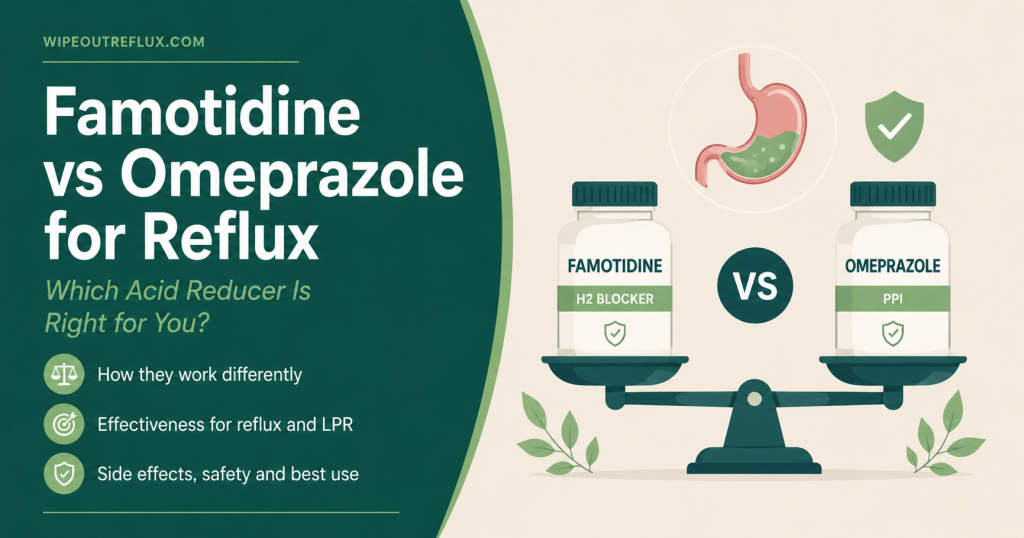
Short answer: for frequent or more severe acid reflux, omeprazole (a PPI) is the stronger, more effective choice, and it’s what guidelines recommend first. For occasional heartburn or fast, on-demand relief, famotidine (an H2 blocker) often does the job with a gentler long-term safety profile.
They’re not really the same tool. Omeprazole is more powerful and better at healing an inflamed esophagus, but it’s slower to kick in and carries more long-term questions. Famotidine works faster and is easier to use now and then, but it’s weaker and, importantly, your body builds tolerance to it with daily use.
I’ve spent more than eight years managing my own silent reflux, so I’ve lived with both. Let me walk you through how they compare, when each one makes sense, and the catches that most comparisons skip.
Key Takeaways
- Omeprazole is more potent and heals erosive esophagitis far better than famotidine, which is why guidelines make PPIs first-line for frequent GERD.
- Famotidine works faster (within 30–60 minutes), making it useful for occasional or on-demand relief.
- Omeprazole takes 1–4 days to reach full effect and works best taken 30–60 minutes before a meal.
- Famotidine develops tolerance (tachyphylaxis) within a couple of weeks of regular use, which limits it for long-term daily control.
- They can be combined: a PPI by day plus a bedtime H2 blocker on an as-needed basis for nocturnal breakthrough.
- Neither drug removes pepsin or fixes non-acid reflux, so neither is a complete answer for LPR.
- Both can cause rebound acid if stopped abruptly, so taper rather than quit cold.
Famotidine vs Omeprazole at a Glance
Here’s the quick version before we get into the detail.
Drug class: Famotidine (brand name Pepcid) is an H2 blocker. Omeprazole (Prilosec, Losec) is a proton pump inhibitor, or PPI.
Strength: Omeprazole suppresses stomach acid more completely and for longer. Famotidine reduces acid, but less powerfully.
Speed: Famotidine is the fast one, often working within an hour. Omeprazole is the slow burner, needing a few days to reach full effect.
Best for: Omeprazole suits frequent heartburn (two or more days a week) and diagnosed or erosive GERD. Famotidine suits occasional heartburn, predictable trigger meals, and on-demand use.
Long-term use: Omeprazole is designed for it (with some safety caveats). Famotidine loses effectiveness over time due to tolerance.
How They Work (Mechanism Before Advice)
Understanding the mechanism explains everything else, so bear with me for a moment.
Your stomach makes acid partly in response to histamine, which docks onto H2 receptors on acid-producing cells. Famotidine is an H2 blocker: it sits on those receptors and blocks the histamine signal, dialling acid production down. It’s like turning down one of the main dials that tells the stomach to make acid.
Omeprazole works further downstream. It’s a proton pump inhibitor, and it shuts off the proton pump itself, the final common step that actually pumps acid into the stomach. Because it blocks the last stage rather than one upstream signal, it produces deeper, more complete acid suppression. The trade-off is that PPIs only shut down pumps that are actively working, so they need to be taken before a meal and take a few days of dosing to reach their full effect.
So in plain terms: famotidine turns down a dial quickly but only partway, while omeprazole closes the main valve more fully but takes longer to get there.
Which Works Better for Acid Reflux?
On raw effectiveness, the evidence is clear, and it favours omeprazole.
Across randomised trials, PPIs consistently outperform H2 blockers for both healing an inflamed esophagus and relieving symptoms. Healing rates for erosive esophagitis are far higher with PPIs, commonly in the region of 80–90%, versus roughly half with H2 blockers [Khan et al., Cochrane Database of Systematic Reviews, 2007]. That’s a big gap, and it’s why the American College of Gastroenterology recommends an 8-week trial of a once-daily PPI, taken before a meal, as the first-line medical treatment for classic reflux [Katz et al., American Journal of Gastroenterology, 2022].
One practical point hides inside that guidance: PPIs must be taken 30–60 minutes before a meal, not at bedtime and not with food. Taking omeprazole at the wrong time is one of the most common reasons it seems not to work. If your PPI feels useless, timing is the first thing to check, and I go deeper into that in my article on what to do when your acid reflux medication isn’t working.
Where famotidine wins is speed. It can bring relief within 30–60 minutes, whereas omeprazole can take one to four days to reach full strength. So for effectiveness over weeks, omeprazole leads comfortably. For quick relief in the moment, famotidine has the edge.
When Famotidine Might Be the Better Choice
“Weaker” doesn’t mean “worse for everyone.” Famotidine has real advantages in the right situations.
It shines for occasional or predictable heartburn, say before a meal you know tends to trigger you, because you can take it on demand and feel the benefit fairly quickly. It’s also a reasonable option for people with mild, infrequent symptoms who don’t need or want the deeper, ongoing suppression of a PPI. And for those specifically trying to avoid or reduce long-term PPI use, famotidine can be a useful part of the plan, though as you’ll see below, it has its own limitation. If you’re weighing up options in the H2-blocker space, I’ve written a fuller rundown in alternatives to famotidine.
It’s also worth knowing that famotidine has effectively become the default H2 blocker. Ranitidine (Zantac) was withdrawn in 2020 over a contamination concern, which left famotidine as the go-to option in this class. So when people talk about H2 blockers for reflux today, famotidine is usually what they mean.
The Tolerance Problem With Famotidine
This is the catch that most comparisons gloss over, and it genuinely matters.
When you take famotidine (or any H2 blocker) every day, your body adapts, and the acid-suppressing effect fades. This is called tachyphylaxis, or tolerance, and it can set in within about one to two weeks of continuous use [H2 Blockers, StatPearls, NIH]. A well-known study found that adding a bedtime H2 blocker to control overnight acid worked well on the first night, but after a month of daily use the benefit had essentially vanished [Fackler et al., Gastroenterology, 2002].
PPIs like omeprazole don’t have this problem in the same way, which is a big reason they’re preferred for anyone who needs steady, day-in day-out control. The practical upshot is that famotidine tends to work best when used intermittently, on the days you actually need it, rather than as a permanent daily medication. Used that way, tolerance is much less of an issue.
What About LPR and Silent Reflux?
Here’s where I have to zoom out, because LPR changes the calculation.
For throat reflux, PPIs are still the usual first-line medical option, but the honest truth is that acid suppression alone is often disappointing for LPR. A big part of the reason is pepsin, an enzyme that rides up with reflux and lodges in your throat tissue, where it can be reactivated by acid. Neither omeprazole nor famotidine removes pepsin, and neither does anything about non-acid or weakly-acidic reflux, which drives a meaningful share of LPR. That’s exactly why so many people with silent reflux get only partial relief from acid blockers. I explain the pepsin piece in detail in how to neutralise pepsin in the throat.
Where famotidine can earn its place in LPR is at night. A lot of throat damage happens overnight while you’re lying down, and a bedtime H2 blocker, used as needed rather than every single night to sidestep tolerance, can help mop up nocturnal acid that a daytime PPI doesn’t fully cover [Katz et al., American Journal of Gastroenterology, 2022]. If nights are your problem, my guide to acid reflux at night is worth a read alongside this. But medication is only ever part of the LPR picture, which I lay out fully in my complete guide to LPR.
Can You Take Famotidine and Omeprazole Together?
Yes, and this combination is a recognised strategy rather than a mistake. The classic approach is a PPI during the day, taken before meals, plus a bedtime H2 blocker to control nocturnal acid breakthrough, the overnight return of acid that PPIs alone don’t always suppress.
The one rule that makes this work is to use the bedtime famotidine on an as-needed basis rather than every night, precisely because of the tolerance issue we just covered. Used intermittently for the nights you need it, it stays useful. Used relentlessly every night, it fades. As always, run any combination past your doctor or pharmacist, especially if you take other medications.
Side Effects and Safety
Both drugs are generally well tolerated, but their safety profiles differ in ways worth knowing.
Famotidine is considered to have a gentle long-term safety profile and is usually very well tolerated. The main caveats are the tolerance problem, the need to reduce the dose if you have significant kidney impairment, and occasional side effects like headache or constipation. It’s the reassuring, low-drama option in the short term.
Omeprazole is highly effective but has drawn more scrutiny over long-term use. Extended high-dose use has been linked in some studies to lower vitamin B12 and magnesium, effects on bone density, kidney issues, and it can interact with certain drugs. These associations don’t mean PPIs are dangerous for everyone, and for many people the benefits clearly outweigh the risks, but they’re a reason not to stay on a high dose indefinitely without review.
One thing both share: rebound acid. Stop either abruptly after regular use and your stomach can temporarily overproduce acid, making symptoms flare. This catches a lot of people out when they try to quit, and it’s why tapering matters. I walk through the whole process in getting off PPIs and acid rebound.
How to Choose
If I boil it down, the decision usually looks like this. Frequent heartburn, two or more days a week, or a diagnosis of GERD or erosive esophagitis? Omeprazole is the stronger, guideline-backed choice, taken correctly before a meal. Occasional heartburn, a known trigger meal, or a need for fast relief now and then? Famotidine is a sensible, gentler option used on demand. Troublesome nights despite a daytime PPI? A bedtime famotidine used as needed can complement it.
Whatever you choose, two principles hold: take a PPI before meals to actually get its benefit, and don’t stop either drug abruptly. And remember that medication is a tool for managing symptoms, not a substitute for addressing what’s driving your reflux in the first place.
Frequently Asked Questions
Is omeprazole stronger than famotidine?
Yes. Omeprazole suppresses stomach acid more completely and for longer, and it heals erosive esophagitis far more effectively than famotidine. Famotidine’s advantage is speed, not strength.
Which works faster, famotidine or omeprazole?
Famotidine. It typically brings relief within 30–60 minutes, whereas omeprazole can take one to four days to reach full effect. That’s why famotidine suits on-demand use and omeprazole suits steady daily control.
Does famotidine stop working over time?
With daily use, it can. Your body builds tolerance (tachyphylaxis) within a couple of weeks, and the acid-suppressing effect fades. Using it intermittently, only on the days you need it, largely avoids this.
Can I switch from omeprazole to famotidine?
Some people do, particularly to reduce long-term PPI use, but do it with medical guidance and expect that famotidine is weaker and prone to tolerance. Stopping omeprazole suddenly can also trigger rebound acid, so a gradual approach is usually better.
Which is safer for long-term use?
Famotidine has fewer long-term safety concerns, but tolerance limits how well it works day after day. Omeprazole is more effective long-term but has drawn more scrutiny over extended high-dose use. It’s a genuine trade-off worth discussing with your doctor.
The Bottom Line
Famotidine and omeprazole both reduce stomach acid, but they’re built for different jobs. Omeprazole is the more powerful, guideline-preferred option for frequent or erosive reflux, healing the esophagus in a way famotidine simply can’t match, as long as you take it properly before meals. Famotidine is the faster, gentler option for occasional heartburn and on-demand relief, with the important catch that it loses its punch when used every day.
For most people the smart approach isn’t loyalty to one drug, it’s matching the tool to the situation: a PPI for steady control, famotidine for quick or occasional relief, and sometimes both together, with the bedtime H2 blocker used as needed. But whichever you land on, keep the bigger truth in mind. These medications manage acid; they don’t remove pepsin, they don’t stop non-acid reflux, and they don’t fix the habits and foods driving your symptoms. That’s why so many people stay stuck on medication for years without ever feeling truly better.
If you want to actually calm reflux at the source rather than just suppress it, that’s what the Wipeout Diet is built for. It’s my in-depth, step-by-step plan for settling acid reflux and LPR, and it goes far deeper into the whole approach than any tablet can. For a quick, practical starting point, grab the Wipeout Food Reference Guide, an essential reference covering the foods and drinks that are safe for acid reflux and LPR along with their pH values. Get the medication right with your doctor, get the food right with the guide, and you give yourself a genuine chance to heal rather than just cope.
Research and References
- Khan et al., Cochrane Database of Systematic Reviews, 2007 — A systematic review of short-term reflux esophagitis treatment showing proton pump inhibitors are more effective than H2 blockers for both healing and symptom relief.
- Katz et al., American Journal of Gastroenterology, 2022 — The ACG clinical guideline for GERD, recommending an 8-week trial of a once-daily PPI taken before meals as first-line therapy, with a bedtime H2 blocker used as needed for nocturnal symptoms.
- Fackler et al., Gastroenterology, 2002 — A study showing that the benefit of a bedtime H2 blocker for nocturnal acid control was lost after about a month of daily use, demonstrating H2-blocker tolerance (tachyphylaxis).
- H2 Blockers, StatPearls, NIH — An overview noting that regular H2-blocker use can produce tolerance within 7–14 days, limiting their role as long-term maintenance therapy for GERD.

David Gray
12 years living with LPR · Consultant & researcher
I've lived with LPR for twelve years — the misdiagnoses, the PPI courses that did nothing, the slow work of figuring out what actually helps. Wipeout Reflux is where I translate the research into plain terms for people stuck in the same place. Every claim here is sourced to peer-reviewed work, and I consult one-to-one with LPR sufferers.