
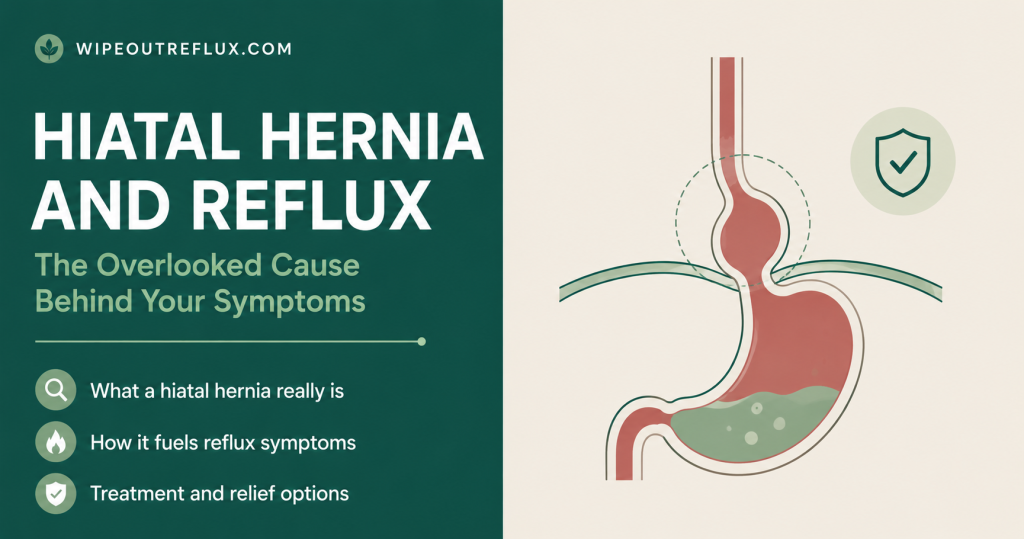
If you’ve been told you have a hiatal hernia, chances are it came up in the context of your reflux symptoms — and for good reason. A hiatal hernia is one of the most common underlying structural causes of both acid reflux and LPR (laryngopharyngeal reflux), and understanding exactly how it contributes to your symptoms can make a real difference in how effectively you manage them.
The short answer is this: a hiatal hernia weakens the physical barrier that keeps stomach contents from moving upward. When that barrier is compromised, acid, enzymes, and even bile have an easier pathway into the oesophagus and, in some cases, all the way up into the throat. The hernia doesn’t cause reflux by itself in every case, but in many people it significantly worsens existing reflux or makes it far harder to control.
In this article I’ll walk through what a hiatal hernia actually is, the specific mechanisms through which it drives reflux, how it relates to LPR, what your treatment options look like, and a non-surgical device specifically designed to target the hernia itself — something most people with hiatal hernias have never heard of.
Key Takeaways
- A hiatal hernia occurs when part of the stomach pushes up through the diaphragm opening into the chest cavity, disrupting the normal anti-reflux barrier.
- Between 50% and 94% of people with GERD have a sliding hiatal hernia — it is one of the most significant structural contributors to reflux disease.
- The hernia weakens the lower oesophageal sphincter and removes the additional support the diaphragm normally provides, creating a double failure of the anti-reflux barrier.
- A hiatal hernia can also act as an acid reservoir — trapping stomach acid above the diaphragm where it can re-enter the oesophagus even after it has initially cleared.
- LPR (silent reflux) and hiatal hernia are closely linked — the hernia makes reflux more likely to travel upward into the throat and larynx.
- Most small hiatal hernias are managed with the same diet and lifestyle approach used for standard reflux treatment.
- iQoro is a neuromuscular training device designed specifically to strengthen the muscles around the hiatus — the only non-surgical approach targeting the structural cause of hiatal hernia-related reflux.
- Surgery is reserved for large hernias causing significant complications, or reflux that fails all other treatments.
What Is a Hiatal Hernia?
Your diaphragm is the large dome-shaped muscle that separates your chest cavity from your abdomen. It has a natural opening — called the hiatus — through which your oesophagus passes on its way down to the stomach. Normally, the stomach sits comfortably below the diaphragm, and the hiatus is snug enough to provide external support to the lower oesophageal sphincter (LES).
A hiatal hernia happens when the opening in the diaphragm becomes enlarged or weakened, allowing part of the stomach to push upward into the chest. The stomach doesn’t belong there. When it herniates through the hiatus, it disrupts the mechanics of the gastroesophageal junction — the critical gateway between your oesophagus and stomach — in ways that directly promote reflux.
Hiatal hernias become more common with age and are strongly associated with obesity, pregnancy, chronic coughing, heavy lifting, and years of raised intra-abdominal pressure. They develop gradually over time and may be present for years before any symptoms appear.
The Four Types of Hiatal Hernia
Not all hiatal hernias are the same. Clinicians classify them into four types based on how and where the stomach protrudes:
- Type I (sliding): The most common type, accounting for around 95% of all cases. The gastroesophageal junction slides up through the hiatus intermittently. This type has the strongest association with GERD and LPR.
- Type II (pure paraesophageal): The GEJ stays in place but a portion of the gastric fundus herniates alongside the oesophagus. Less common and less associated with reflux, but can cause mechanical symptoms.
- Type III (mixed): Both the GEJ and part of the stomach herniate through the hiatus. Features of both types I and II.
- Type IV: A large defect that allows other abdominal organs (colon, spleen, small intestine) to also enter the chest. Rare and usually symptomatic.
When most people talk about a hiatal hernia causing their reflux, they’re dealing with a Type I sliding hernia. The rest of this article focuses primarily on that type.
How a Hiatal Hernia Causes Reflux — The Mechanism
This is the part that most generic articles gloss over, but it matters because it directly shapes how you treat it. A hiatal hernia doesn’t cause reflux in one single way — it disrupts the anti-reflux barrier through at least three distinct mechanisms simultaneously.
The Two-Sphincter Problem
Under normal circumstances, the lower oesophageal sphincter isn’t the only thing protecting you from reflux. The crural diaphragm — the ring of muscle surrounding the hiatus — acts as a second external sphincter, squeezing the oesophagus from the outside and adding an extra layer of protection, particularly during physical strain or deep breathing.
When a hiatal hernia develops, the stomach slides upward and the LES becomes separated from the crural diaphragm. These two structures that normally work together as a team are now physically apart. The LES loses its external muscular backup, its resting pressure drops, and the entire gastroesophageal junction becomes mechanically compromised. Research has confirmed that this loss of the diaphragmatic “second sphincter” is one of the primary reasons hiatal hernias are so closely tied to reflux disease Hyun & Bak, Gut and Liver, 2011.
If you’ve been trying to understand why the sphincters involved in reflux work the way they do, my article on stomach sphincters and LPR covers this in more detail.
The Acid Reservoir Effect
There’s a second mechanism that’s less well known but arguably just as important: the acid reservoir. In someone with a sliding hiatal hernia, the portion of the stomach that has herniated above the diaphragm can trap a pocket of acid between the LES and the crural diaphragm. This pocket doesn’t clear properly when the stomach contracts — instead, it sits there, ready to re-enter the oesophagus the next time the LES opens or relaxes.
This is part of why people with hiatal hernias often experience worse reflux after meals and overnight. The acid reservoir fills up during eating, and then re-enters the oesophagus in repeated surges rather than a single reflux episode. It’s also one of the reasons standard acid suppression often under-delivers for people with larger hernias — you can reduce the acid production, but the reservoir mechanism continues.
Impaired Oesophageal Clearance
A third mechanism is reduced oesophageal clearance. When reflux does occur, peristalsis — the muscular wave action of the oesophagus — is responsible for pushing the acid back down into the stomach. In people with hiatal hernias, the disrupted anatomy can impair this clearance function, meaning acid spends longer in contact with the oesophageal lining before being cleared. Longer contact time means greater tissue damage.
Hiatal Hernia, GERD, and LPR — Understanding the Overlap
The relationship between hiatal hernia and standard GERD is well established. What’s less commonly discussed is the link between hiatal hernia and LPR — the form of reflux that travels all the way up into the throat and voice box without necessarily causing heartburn.
Because a hiatal hernia makes reflux episodes more frequent and often more forceful, there’s a greater chance that refluxate reaches the upper oesophagus and beyond. For some people, particularly those with any degree of upper oesophageal sphincter (UES) weakness, this translates directly into throat symptoms — chronic throat clearing, hoarseness, a lump-in-throat sensation, or a persistent dry cough — with little or no heartburn present at all.
This is a key reason why some people with a confirmed hiatal hernia continue to have troublesome LPR symptoms even when their heartburn is well controlled by medication. The heartburn might be managed, but the upward movement of reflux into the throat is a different problem, driven partly by the structural changes the hernia creates. You can read more about the distinction between these two conditions in my guide on GERD vs LPR and the full breakdown of LPR symptoms.
Symptoms of Hiatal Hernia-Related Reflux
The symptoms of a hiatal hernia causing reflux are broadly similar to those of GERD and LPR in general, but there are a few patterns that tend to be more pronounced when a hernia is involved:
- Heartburn and regurgitation that are notably worse after meals or when bending forward
- Reflux that is difficult to control with standard doses of PPIs
- Symptoms that flare significantly when lying down, particularly overnight
- Difficulty swallowing or a feeling of food getting stuck in the mid-chest
- Chest pain or pressure (always rule out cardiac causes with your GP)
- Chronic cough, hoarseness, or throat clearing — especially when the hernia is associated with LPR
- A feeling of fullness after eating relatively small amounts
A small hiatal hernia may produce no symptoms at all and be discovered incidentally during an endoscopy or imaging for something else entirely. The severity of symptoms generally correlates with hernia size, though not perfectly — some people with larger hernias experience surprisingly mild symptoms and vice versa.
How Is a Hiatal Hernia Diagnosed?
Hiatal hernias are usually identified through one of three investigations:
- Endoscopy: A camera passed into the oesophagus and stomach. Good for larger hernias but can miss smaller ones.
- Barium swallow: An X-ray taken while swallowing a barium contrast agent. Provides dynamic images of the oesophagus and upper stomach, and is effective at detecting sliding hernias.
- High-resolution manometry: Measures pressure profiles along the oesophagus and can identify the separation of the LES and crural diaphragm that characterises a hiatal hernia, even when smaller than 2cm.
It’s worth noting that small hernias — particularly those under 2cm — are frequently missed on endoscopy. If your doctor has told you your endoscopy was clear but you continue to have significant reflux, it doesn’t necessarily mean a small hernia isn’t present.
Treating Hiatal Hernia-Related Reflux
The approach to treatment depends on the size of the hernia, the severity of symptoms, and whether complications have developed. For the vast majority of people with a Type I sliding hernia, the initial treatment path is the same as for standard reflux — with a few important additions.
Diet and Lifestyle Changes
Diet is non-negotiable and arguably more important when a hiatal hernia is involved, precisely because the hernia creates structural conditions that make reflux easier to trigger. The same principles apply: avoid foods that relax the LES (fatty foods, alcohol, chocolate, peppermint), cut back on acidic triggers (coffee, citrus, carbonated drinks), eat smaller meals, and never lie down within three hours of eating.
One adjustment that’s especially important with a hiatal hernia is meal size. A full stomach pushes upward against the hernia and makes the acid reservoir mechanism significantly worse. Smaller, more frequent meals reduce this pressure. My full guide on LPR foods to avoid covers the dietary side in detail, and for a structured diet approach, the Wipeout Diet Plan is the most comprehensive resource I’ve put together for managing reflux through food.
Elevating the head of the bed (not just using extra pillows) by 6–8 inches is particularly effective for hernia-related nocturnal reflux — gravity works directly against the acid reservoir mechanism. Weight loss, where relevant, is one of the most impactful structural interventions available, as reduced intra-abdominal pressure directly lessens the upward force on the herniated stomach. See my article on acid reflux at night for more on managing overnight symptoms.
Medications
PPIs (proton pump inhibitors) are the standard first-line medication, and they can be effective for symptom control by reducing the acidity of the refluxate. However — and this is important — PPIs do not address the structural problem the hernia creates. They reduce acid production, but the hernia and its associated mechanical dysfunction remain. This is why reflux from a hiatal hernia is sometimes harder to control with medication alone, particularly when the hernia is larger.
Gaviscon Advance (the UK alginate formulation) is particularly useful alongside PPIs in hiatal hernia patients, because it creates a physical raft on top of stomach contents that can help block the acid reservoir from re-entering the oesophagus. I’d always recommend taking it after meals and before bed in this context. My full review is in the Gaviscon Advance guide.
iQoro — Targeting the Structural Cause
One of the most interesting and genuinely underutilised approaches to hiatal hernia-related reflux is the iQoro device — and it’s the only non-surgical option that actually targets the hernia itself rather than just managing the symptoms it causes.
iQoro is a small, suction-based neuromuscular training device. You hold it between your lips and pull outward against resistance for 10 seconds, three times a day. The resistance engages a chain of muscles running from the face down through the oropharynx, oesophagus, and diaphragm — including the muscles around the hiatal opening. The theory is that consistent daily training strengthens and tones this muscle chain, improving hiatal competence and reducing the degree to which the stomach herniates upward.
Clinical research has backed this up. A study published in the World Journal of Gastroenterology found that iQoro training significantly improved oesophageal dysphagia and reflux symptoms in patients with hiatal hernia, with 98% of participants showing improvement in dysphagia after 6–8 months of daily use. Reflux symptoms improved in 86% of those who had them at the start of the study, with the improvement attributed to improved hiatal competence Hägg et al., World Journal of Gastroenterology, 2015. A separate study focused specifically on hiatal hernia patients found that iQoro training improved hoarseness, cough, oesophageal retention, and globus (lump-in-throat) symptoms — all common LPR complaints — with results attributed to improved hiatal function Hägg et al., Acta Otolaryngologica, 2015.
It’s worth being clear-eyed about the evidence: these are uncontrolled studies with relatively small sample sizes, and all studies to date have been co-authored by researchers involved in iQoro’s development. That doesn’t invalidate the findings, but it does mean the results should be interpreted with appropriate caution. What’s notable is that iQoro has received a Medtech Innovation Briefing from NICE (the UK’s National Institute for Health and Care Excellence) as a treatment option for hiatal hernia — which reflects a genuine acknowledgment of its clinical plausibility in an NHS context.
It’s not a quick fix — results appear to build over months of consistent daily use. But for people who want to do something about the structural cause of their hernia without going down the surgical route, it’s the most legitimate option currently available. I’ve covered it in much more depth in my full iQoro review, including how to use it correctly and what to realistically expect.
Surgery
Surgical repair of a hiatal hernia is usually considered when the hernia is large (typically over 5cm), when it’s causing complications like severe oesophagitis, Barrett’s oesophagus, or recurrent bleeding, or when reflux symptoms are completely refractory to all other treatment. The standard procedure is laparoscopic fundoplication — where the top of the stomach is wrapped around the lower oesophagus to reinforce the LES — performed alongside hernia repair. It’s effective in the right candidates but carries its own risks and recurrence rates, and should only be considered once conservative options have been properly exhausted.
Frequently Asked Questions
Does everyone with a hiatal hernia get acid reflux?
No. Many small hiatal hernias — particularly those under 2cm — cause no symptoms at all. The hernia itself is a structural abnormality, but reflux only develops when that structure compromises the anti-reflux barrier to a significant degree. That said, if you have a hiatal hernia and you do have reflux symptoms, the hernia is likely contributing to them.
Can a hiatal hernia cause LPR without heartburn?
Yes — and this is more common than most people realise. Because a hiatal hernia makes reflux episodes more frequent and often more forceful, there’s a greater chance that refluxate travels upward into the throat. LPR can present with throat clearing, hoarseness, a globus sensation, or cough, with little or no heartburn. This can make the reflux origin very easy to miss.
How large does a hiatal hernia need to be before it causes problems?
There’s no fixed threshold. Smaller hernias may cause significant symptoms in some people and nothing at all in others, depending on individual factors like LES baseline tone, diet, weight, and lifestyle. Larger hernias generally correlate with more severe reflux and are more likely to require intervention.
Can a hiatal hernia heal on its own?
Hiatal hernias don’t spontaneously resolve. The anatomical change — a widened hiatal opening and displaced stomach — is structural and doesn’t reverse without intervention. However, symptoms can be managed effectively with diet, lifestyle changes, medication, and devices like iQoro. Surgery provides the most definitive structural fix, but it’s only appropriate for selected cases.
Why isn’t my reflux improving on PPIs if I have a hiatal hernia?
PPIs reduce acid production but don’t address the structural problem the hernia creates. The acid reservoir mechanism, impaired oesophageal clearance, and weakened anti-reflux barrier all continue regardless of how little acid the stomach is producing. This is why a combined approach — diet, alginate agents like Gaviscon Advance, and where appropriate iQoro — often produces better results than PPIs alone in hernia patients.
Is the iQoro device worth trying for a hiatal hernia?
It’s a reasonable option for people who want to address the structural cause of their hernia without surgery. The evidence base, while limited by study size and design, shows consistent improvement in reflux and dysphagia symptoms in hernia patients, with the mechanism (improved hiatal competence through neuromuscular training) being physiologically sound. Commitment to daily use for several months is essential — it’s not something that produces quick results. My iQoro review covers what to expect in detail.
Can diet really make a difference when there’s a structural problem like a hernia?
Absolutely. The hernia creates conditions that make reflux easier to trigger, but diet determines how much reflux actually occurs within those conditions. A person with a small hiatal hernia who eats large, fatty, late-evening meals with coffee and alcohol is going to experience far more reflux than someone with the same hernia who follows a structured, reflux-conscious diet. The structural problem is real, but dietary management can still dramatically reduce the frequency and severity of symptoms.
Conclusion
A hiatal hernia isn’t just an incidental finding — for most people who have one alongside reflux symptoms, it’s a significant structural contributor to what they’re experiencing. Understanding the specific ways it undermines the anti-reflux barrier helps explain why reflux can be so persistent in this group, and why a single approach rarely gets the job done.
The most important thing to take away is that treatment has to address both the symptoms and, where possible, the structural driver. That means combining a clean diet with appropriate medication, giving serious consideration to iQoro if you want a non-surgical option that targets the hernia itself, and leaning on the lifestyle adjustments — particularly meal size, timing, and head elevation at night — that directly counteract the mechanical problems the hernia creates.
For a comprehensive, structured approach to the dietary side of reflux management, the Wipeout Diet Plan covers everything from food selection to meal timing and portion principles, specifically designed for people managing LPR and GERD. The Wipeout Food Reference Guide is a useful companion resource that lists the pH values of common foods and drinks to help you make faster, better-informed decisions day to day.
The hernia may be structural, but your response to it doesn’t have to be passive.
Research & References
Hyun & Bak, Gut and Liver, 2011 — A comprehensive review of the clinical significance of hiatal hernia in the context of GERD. Covers the two-sphincter hypothesis, the role of the crural diaphragm in anti-reflux function, and the relationship between hernia size and reflux severity. Concludes that both the LES and the diaphragm are independently important in the pathogenesis of reflux disease.
Hägg et al., World Journal of Gastroenterology, 2015 — A prospective cohort study of 43 patients with oesophageal dysphagia and reflux symptoms, including 21 with confirmed hiatal hernia, who underwent 6–8 months of daily iQoro training. Found 98% improvement in dysphagia and significant improvement in reflux symptoms. High-resolution manometry showed measurable improvement in hiatal canal pressure with iQoro traction, supporting a mechanism of improved hiatal competence.
Hägg et al., Acta Otolaryngologica, 2015 — A study of 28 hiatal hernia patients with misdirected swallowing and oesophageal retention symptoms. Daily iQoro training was associated with significant improvement in hoarseness, cough, oesophageal retention, and globus symptoms — all symptoms commonly seen in LPR — with improvements attributed to improved hiatal function and oropharyngeal motor strength.

David Gray
Content Researcher & Author
David Gray founded Wipeout Reflux to address a critical gap in reflux management. His research synthesizes over 100 peer-reviewed studies on laryngopharyngeal reflux (LPR), pepsin biology, and GERD pathophysiology. For LPR specifically—a condition most physicians misdiagnose—his work focuses on pepsin reactivation and why standard PPI therapy fails most patients. He develops evidence-based protocols targeting root causes of both LPR and GERD, integrating emerging research on sphincter dysfunction, dietary interventions, and newer clinical approaches. Wipeout Reflux represents practical application of clinical science for patients seeking real solutions.