
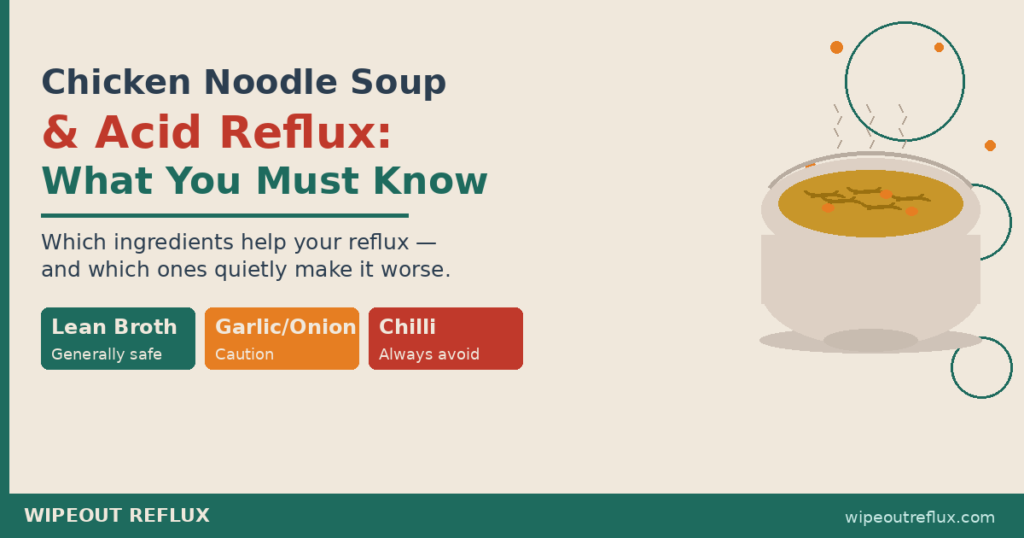
When your stomach is playing up and reflux symptoms are flaring, most people naturally reach for something light and comforting. Chicken noodle soup tends to sit at the top of that list — and for good reason. But is it actually a smart choice if you have acid reflux, GERD, or LPR?
The short answer is yes, chicken noodle soup is generally one of the better meal choices you can make when you have acid reflux. The broth-based format, lean protein, and simple carbohydrates make it far easier on your digestive system than most alternatives.
That said, the ingredients you use — or the version you order — can completely change that picture. There are a handful of common additions to chicken noodle soup that can actively worsen reflux, and if you have LPR specifically, you need to know what to watch for.
Key Takeaways
- Chicken noodle soup is generally a reflux-friendly meal thanks to its broth-based, low-fat composition
- Chicken breast is the safest cut — lower in fat and easier to digest than thighs or legs
- Garlic and onions are the most common problem ingredients in chicken noodle soup for acid reflux sufferers
- Ginger, when included, can actively benefit reflux by accelerating gastric emptying
- Rice noodles are a marginally better choice than wheat noodles for people with more severe reflux
- Chili or any significant spice should be left out entirely
- Eating the soup at a moderate temperature matters — very hot liquids can irritate an already-sensitive oesophagus
- Homemade versions give you full control over ingredients; canned or restaurant versions are often high in sodium and may include hidden triggers
Why Chicken Noodle Soup Is Generally Good for Acid Reflux
The core reason chicken noodle soup tends to work well for reflux sufferers comes down to its macronutrient profile. It’s predominantly water-based, low in fat, and built around lean protein — and each of those factors matters mechanically for reflux.
Research has consistently shown that high-fat meals reduce lower oesophageal sphincter (LES) pressure, increase the frequency of transient LES relaxations, and slow gastric emptying — all of which increase your exposure to acid reflux [Pehl et al., American Journal of Gastroenterology, 1999]. A basic chicken noodle soup made with breast meat and a simple broth avoids all of these problems. The fat content is low, the food is easy to digest, and gastric emptying is not delayed.
Beyond fat content, a 2023 review on functional foods and GERD noted that lean protein sources such as skinless poultry help minimise symptoms precisely because they don’t trigger the same LES-weakening hormonal responses that fatty meats do [Salama et al., Nutrients, 2023].
So the format of the dish — broth-based, lean protein, simple carbohydrates — gives it a strong foundation for being reflux-friendly. The risk comes from what gets added on top of that foundation.
Breaking Down the Ingredients
Chicken Stock / Broth
A plain chicken stock made from chicken, water, and basic aromatics is one of the most neutral bases you can use. Its pH sits roughly around 5.8–6.5 depending on preparation, and it doesn’t carry the fat load of cream or tomato-based soups. If you’re buying a pre-made stock, watch the sodium content — high-sodium stocks won’t directly trigger reflux, but they can contribute to bloating and pressure in the stomach, which can worsen symptoms.
For a deeper look at how the oesophageal sphincter works and why reducing pressure on it matters, see my article on stomach sphincter and LPR.
Chicken Breast vs. Other Cuts
Chicken breast is the clear winner here. It’s low in fat, has a neutral pH around 5.5–6, and digests relatively quickly — all properties that make it easier on a reflux-prone digestive system.
If you use chicken thighs or legs instead, you’re increasing the fat content meaningfully. As outlined above, dietary fat directly impairs LES function and slows gastric emptying, both of which worsen reflux. For most people with mild GERD this will be fine in small amounts, but for people with more severe symptoms or LPR, I’d stick to breast meat.
Noodles (Rice vs. Wheat)
Both rice and wheat noodles are generally safe for acid reflux — they’re plain carbohydrates without significant acidity. Rice noodles are my slight preference for people with more sensitive reflux, simply because they tend to contain fewer additives and preservatives than some wheat noodle products. The simpler the ingredient list, the less chance of an unexpected irritant.
For either type, avoid egg noodles fried in oil or any noodle product with heavy seasoning pre-baked in. Plain is better.
Ginger
If your chicken noodle soup includes ginger, that’s genuinely a benefit. Ginger has documented effects on gastric motility — research shows it accelerates gastric emptying and stimulates antral contractions, which reduces the window of time during which stomach acid can accumulate and reflux upward [Hu et al., Journal of Gastroenterology and Hepatology, 2011].
Importantly, in the soup context the ginger is diluted into the broth — this reduces any risk of the heartburn that can occur in some people when ginger is taken in high-dose concentrated forms. In a soup, you’re getting the benefit at a moderate dose. For a full breakdown on ginger and reflux, see my article on whether ginger is good for acid reflux.
Garlic — Handle with Care
Garlic is one of the most common reflux triggers, and it appears regularly in chicken noodle soup recipes. The mechanism is well-established: allicin and volatile sulfur compounds in garlic relax the LES and can stimulate gastric acid secretion. For more detail on garlic specifically, I’ve covered it in my article on whether garlic is acidic or alkaline.
The good news in a soup context is that garlic cooked into a broth is considerably diluted compared to eating it raw or eating garlic-heavy dishes. Many people who can’t tolerate raw garlic at all find that a small amount cooked into a large pot of broth causes no issues. That said, if you have active LPR symptoms, or if you know garlic is a personal trigger, leaving it out when making the soup yourself is the safest call.
Spring Onions and Regular Onions
This is the ingredient I’d be most cautious about. Onions — including spring onions — contain sulfur compounds and fructooligosaccharides that can relax the LES and increase gastric acid output. A controlled study found that onion consumption significantly increased all reflux measures in heartburn sufferers compared to onion-free meals, while having no effect on healthy controls.
Spring onions added raw at the end of a dish (as a garnish) carry more risk than onion cooked into the broth for a long time, because heat breaks down some of the triggering compounds. Still, if you’re building a reflux-friendly version at home, I’d recommend leaving them out entirely. If you’re ordering at a restaurant, ask for the soup without spring onions on top.
Mushrooms
Mushrooms are fine for acid reflux. They’re not acidic, they’re low in fat, and they don’t carry any known reflux-triggering properties. Include them without concern.
Chili / Spices
Leave chili out entirely. Capsaicin — the active compound in chilli — directly irritates the oesophageal lining and can trigger significant flares even in people with relatively mild reflux. This applies to dried chilli, chilli oil, hot sauce, and any other form. If you’re eating out, ask for no chilli.
Other spices in moderate amounts (thyme, bay leaf, a small amount of black pepper) are generally fine, though some people with particularly sensitive reflux may find even black pepper an issue. Keep the spice profile simple and see how your body responds.
Soy Sauce
Soy sauce often gets added to Asian-style chicken noodle soups. In small amounts diluted into a large broth, it’s usually fine for most people — the acidity and sodium both become negligible when spread through a full pot. That said, people with LPR who are highly sensitive may want to keep the amount minimal. If you notice soy sauce is a consistent trigger for you, swap it for a small amount of low-sodium coconut aminos, which are less acidic.
Homemade vs. Canned/Restaurant Versions
This distinction matters more than most people realise. When you make chicken noodle soup at home, you control every variable — the fat content of the chicken, the sodium in the broth, whether garlic or onion goes in, and whether any chilli gets added.
Canned chicken noodle soups and restaurant versions are much more unpredictable. They tend to be high in sodium, may use darker chicken cuts with higher fat content, and often include onion and garlic as standard. A canned soup with 900mg of sodium per serving creates meaningful gastric pressure that can worsen reflux.
If you’re relying on convenience options, look for low-sodium versions and check the ingredients list for onion powder or garlic powder — both are common in processed soups and can be just as triggering as their fresh equivalents for many people.
A Reflux-Friendly Chicken Noodle Soup Formula
If you want to make a version that works across the full spectrum of reflux severity, here’s what I’d build it around:
- Protein: Skinless chicken breast, poached or boiled directly in the broth
- Base: Low-sodium chicken stock or water with chicken bones for natural flavour
- Noodles: Plain rice noodles
- Vegetables: Carrot, celery, courgette, mushrooms — all safe
- Flavouring: Fresh ginger (good for you), small amount of fresh thyme, bay leaf
- Avoid: Garlic, onion, spring onion, chilli, soy sauce in large quantities, cream
This formula produces a soup that even people with active LPR symptoms tend to tolerate well, though individual responses always vary.
Eating Temperature and Portion Size
Two practical factors that often get overlooked:
Temperature: Very hot liquids can irritate an already-inflamed oesophagus. Let the soup cool for a few minutes before eating rather than consuming it straight from the pot. This is especially relevant if you have LPR, where throat and laryngeal tissues are sensitive.
Portion size: Even a reflux-friendly soup can cause problems if you eat a very large portion at once. Overfilling the stomach increases pressure on the LES, which increases the risk of reflux events regardless of what the food itself is. A moderate-sized bowl rather than a very large one is the better approach.
Frequently Asked Questions
Does chicken noodle soup have acid?
Yes, it’s mildly acidic — the broth typically sits around pH 5.5–6.5 depending on ingredients and cooking method. This is a gentle acidity level that most people with acid reflux tolerate without issue. It’s nowhere near as acidic as tomato-based soups, citrus-marinated dishes, or vinegar-based sauces.
Is chicken noodle broth good for acid reflux on its own?
Generally yes. Plain chicken broth consumed on its own is one of the most easily digestible things you can eat, it’s low in fat, and its mild acidity doesn’t usually trigger symptoms. It’s often recommended as part of a recovery diet after reflux flares for exactly this reason.
Are noodles OK for acid reflux?
Yes — plain noodles of most varieties are fine for acid reflux. Rice noodles, wheat noodles, and even egg noodles in plain form don’t trigger reflux on their own. The risk comes from sauces, seasonings, or high-fat additions. Stick to plain or simply prepared noodles.
What soup is best for acid reflux?
Broth-based soups built around lean protein and non-acidic vegetables are consistently the best choice. Chicken, turkey, or vegetable broths with simple additions like carrot, celery, and courgette sit at the top of the list. Avoid cream-based soups (high fat) and tomato-based soups (high acidity).
Can I eat chicken noodle soup during a reflux flare?
In most cases, yes — it’s one of the more suitable options during a flare precisely because it’s so gentle. Opt for a very plain version (minimal ingredients, no garlic or onion, low sodium), eat it at a moderate temperature, and keep the portion modest. If even plain broth is causing irritation during an acute flare, that’s a signal to keep things very minimal until symptoms settle.
Is canned chicken noodle soup OK for acid reflux?
It depends on the brand. Many canned versions are high in sodium and include onion powder or garlic powder, which can both trigger reflux. Look for low-sodium options and check the ingredients. Homemade is always preferable when you have the option.
Related Articles
- Is Ginger Good for Acid Reflux?
- Is Garlic Acidic or Alkaline?
- The Complete Guide to LPR (Silent Reflux)
- Stomach Sphincter and LPR
- The Acid Reflux Ultimate Guide
- Best Salad Dressings for Acid Reflux
- Are Bananas Acidic or Alkaline?
Conclusion
Chicken noodle soup earns its reputation as a comfort food for a digestive system that’s struggling. The combination of broth-based format, lean chicken breast, and simple noodles makes it one of the more reliably safe meal choices for people managing acid reflux, GERD, or LPR — particularly compared to heavier, fattier, or more acidic alternatives.
The caveats are real but manageable: leave out the garlic if you’re sensitive to it, skip the spring onions and chilli entirely, keep the sodium in check, and eat at a moderate temperature in a sensible portion size. Do those things and chicken noodle soup becomes a genuinely useful staple in a reflux-friendly diet.
That said, knowing which individual foods are safe is only one part of the picture. Managing reflux well over the long term requires understanding the patterns — which combinations of foods cause problems, how timing and portion size interact with symptoms, and how to build a diet that supports healing rather than just managing flare-ups day to day. That’s exactly what the Wipeout Diet Plan is built around. It’s the structured framework I’ve developed from years of research and personal experience with LPR, and it goes well beyond a simple list of foods to avoid. If you haven’t explored it yet and you’re still finding reflux difficult to manage consistently, it’s worth a look.
And if you’d like personalised guidance on your specific situation, I offer one-to-one consultations for exactly that purpose.
Research Sources
High-fat meals reduce lower oesophageal sphincter pressure, increase transient LES relaxations, and delay gastric emptying — all factors that worsen acid reflux exposure [Pehl et al., American Journal of Gastroenterology, 1999]. Low-fat or lean protein sources like skinless poultry help minimise GERD symptoms because they avoid the LES-weakening hormonal responses triggered by fatty meats [Salama et al., Nutrients, 2023].
Ginger accelerates gastric emptying and stimulates antral contractions in healthy volunteers, reducing the window for acid to accumulate and reflux [Hu et al., Journal of Gastroenterology and Hepatology, 2011]. Dietary fat intake is significantly higher in GERD patients than healthy subjects, with a dose-response relationship between fat consumption and reflux severity [Shapiro et al., BMC Gastroenterology, 2017].

David Gray
12 years living with LPR · Consultant & researcher
I've lived with LPR for twelve years — the misdiagnoses, the PPI courses that did nothing, the slow work of figuring out what actually helps. Wipeout Reflux is where I translate the research into plain terms for people stuck in the same place. Every claim here is sourced to peer-reviewed work, and I consult one-to-one with LPR sufferers.