
If you’ve started treating your silent reflux and you’re lying awake wondering when — or whether — this is ever going to end, I’ve been exactly where you are. The honest truth about LPR recovery is that it follows a timeline most people aren’t told about, and misunderstanding that timeline is the single biggest reason people relapse just as they’re getting better. So let me give you the realistic picture, including the one thing almost no one explains: your symptoms heal on a completely different schedule from your throat tissue.
How long does silent reflux take to heal? A realistic answer
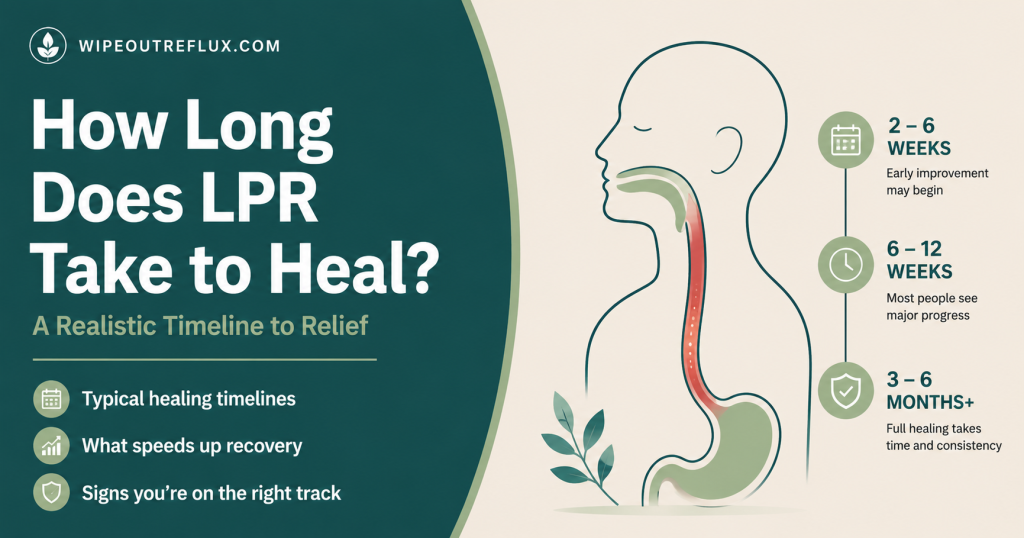
Most people with LPR start noticing symptom improvement within about 4 to 6 weeks of consistent treatment, but the throat tissue itself takes considerably longer to heal — typically 3 to 6 months or more. Feeling better is not the same as being healed, and that gap is the most important thing to understand about LPR recovery.
This is why the timeline matters so much. If you feel better at week six and treat that as the finish line — reintroducing trigger foods, dropping your routine — you’re acting on the symptom clock while your tissue is still mid-repair. That’s the classic relapse trap. Recovery is real and very achievable, but it asks for patience past the point where you feel fine.
Key Takeaways
- Symptoms improve before tissue heals. Symptom relief commonly lands around 4–6 weeks; visible tissue healing lags by several months.
- Full recovery usually takes 3–6+ months of consistent treatment — sometimes longer for stubborn or long-standing cases.
- Recovery happens in stages: a strict healing phase, a careful transition phase, then long-term maintenance.
- Reintroducing foods too early is the number-one relapse trigger, precisely because it happens during the tissue-healing lag.
- Healing speed depends on severity, the root cause, how consistently you stick to the plan, smoking, weight, and stress.
- Clear signs of healing exist — symptoms becoming less frequent, milder, and more predictable, even before they vanish entirely.
- If you’re not improving, the usual culprits are early food reintroduction, hidden triggers, the wrong treatment mechanism, or an untreated underlying cause.
- See a doctor if symptoms persist beyond around three months despite proper treatment, or if you have trouble swallowing or unexplained weight loss.
This article is about the whole recovery journey. If you want the fundamentals of what LPR actually is and what causes it, my complete guide to LPR covers that ground — here, we’re focused purely on healing and timelines.
The two-clock timeline: the thing no one tells you
This is the heart of the whole article, so let me slow down here.
When you treat LPR, two separate processes are running at once, on two different clocks.
Clock one is your symptoms. The throat clearing, the cough, the lump-in-throat feeling, the hoarseness. As you reduce reflux and stop reactivating pepsin in your throat, the irritation calms down and these symptoms ease. This is the fast clock — relief often begins around four to six weeks in.
Clock two is the tissue. Underneath the symptoms, the actual lining of your throat and larynx has been inflamed and irritated, and that physical inflammation takes much longer to genuinely resolve. This is the slow clock, lagging the symptom clock by several months.
This isn’t my theory — it’s how laryngologists describe it to their own patients. Stanford’s LPR treatment protocol states plainly that symptoms should start to improve within four to six weeks, but that the visual signs of healing lag behind the symptomatic relief by several months [[Sung, Stanford Health Care LPR Protocol]].
And there’s direct evidence that these two clocks run independently. In a prospective study, LPR patients’ symptom scores and their physical tissue findings both improved with treatment — but the improvement in symptoms did not correlate with the improvement in the tissue. In other words, how you feel genuinely doesn’t tell you how healed your tissue is [[Kim et al., Journal of Clinical Medicine, 2024]].
Once you understand this, the entire LPR recovery process makes sense — including why people relapse, and why the standard advice is to keep treatment going well past the point of feeling better. A leading review notes that although most patients improve symptomatically within three months, it often takes at least six months for the laryngeal findings to resolve, and stopping treatment just because symptoms have eased can be premature [[Lechien et al., International Journal of Head and Neck Surgery]].
The stages of LPR recovery
Recovery isn’t one long uniform slog — it moves through distinct phases. The most widely used framework comes from Dr Jamie Koufman, one of the pioneers of LPR research, whose staged model maps neatly onto the two-clock reality.
Stage 1: The healing (detox) phase
This is the strict, front-loaded phase — typically the first few weeks, often framed as a two-to-four week reset. The idea is to remove everything irritating the throat: foods and drinks below roughly pH 5 (which reactivate pepsin in the throat tissue), plus the usual reflux triggers. Koufman’s own framing is that a clean stretch like this gives irritated throat tissue the chance to heal and lets pepsin clear from the aerodigestive tract [[Koufman, Reflux Detox Diet]].
This phase maps onto the first part of the symptom clock — it’s when most people first feel things starting to ease. The discipline here is strict on purpose, because you’re trying to remove every source of irritation at once.
Stage 2: The transition phase
Once symptoms have meaningfully eased, you enter transition — and this is the danger zone. Here you begin carefully reintroducing foods, one at a time, while still avoiding the highest-risk triggers like chocolate, fatty foods, soft drinks and alcohol. The cardinal rule is to change only one variable at a time so you can actually tell what you tolerate.
This is exactly where the two-clock problem bites. You feel better, so it’s tempting to rush — but your tissue is still healing on the slow clock. Reintroduce too fast, and you re-irritate tissue that hasn’t finished repairing. Patience in transition is what separates lasting recovery from a frustrating relapse cycle.
Stage 3: The maintenance phase
Maintenance is the long-term, sustainable way of eating and living that keeps LPR from coming back. It’s more flexible than the healing phase — you’re no longer eliminating everything — but it stays broadly low-acid and reflux-aware. By this point your tissue has largely healed, and the goal shifts from active repair to prevention.
For the practical detail of what to eat across these phases, my LPR diet guide breaks it down, and you can read more on the staged approach in my write-up of the Koufman diet.
What speeds up or slows down healing
Two people starting treatment on the same day can have very different timelines. Here’s what tends to make the difference.
Severity and duration. Mild, recent LPR generally heals faster than severe, long-standing LPR where the tissue has been irritated for years. The longer it’s been going on, the more patience recovery tends to need.
The root cause. LPR driven mainly by diet and lifestyle often responds well to diet and lifestyle change. LPR with a structural or mechanical driver, or an untreated contributing condition, can stall until that underlying cause is addressed.
Diet adherence. This is the big lever you actually control. Because acidic foods directly irritate the throat lining and reactivate pepsin, even occasional slips can set the slow clock back — the tissue doesn’t care that you were “mostly” good. Consistency matters more than perfection, but consistency genuinely matters.
Your treatment approach. For LPR specifically, alginates (like Gaviscon Advance) work differently from PPIs — they form a physical barrier and have been shown to protect throat and oesophageal cells against pepsin, which is the main damage mechanism in LPR. A randomised trial found liquid alginate significantly improved LPR symptoms and findings over six months [[McGlashan et al., European Archives of Oto-Rhino-Laryngology, 2009]]. PPIs reduce stomach acid but, in many LPR trials, perform no better than placebo for symptoms — which is worth knowing if you’re relying on them alone and not improving. (If you’re on PPIs and thinking about your options, read getting off PPIs and acid rebound first, and don’t stop abruptly.)
Smoking, weight and stress. Smoking is one of the worst irritants and slows healing markedly. Excess weight, particularly central weight, increases reflux pressure. And chronic stress both worsens reflux and amplifies how intensely you feel throat symptoms. Each of these, addressed, can meaningfully shorten your timeline.
Signs your LPR is healing
Because the symptom clock moves before the tissue clock, you’ll usually feel progress before any doctor could see it — and recognising these early signs is genuinely reassuring when you’re in the thick of it.
- Symptoms become less frequent. The cough or throat clearing that was constant starts having quiet stretches.
- Symptoms become milder. When they do flare, they’re less intense and settle faster.
- Symptoms become more predictable. You start to notice they track with specific slip-ups rather than appearing at random — a sign your throat is calming and only reacting to genuine triggers.
- Mornings improve. Many people notice the early-morning throat symptoms (post-overnight reflux) ease as one of the first wins.
- Your voice steadies. Hoarseness and vocal fatigue lift as the larynx settles.
- You stop thinking about your throat constantly. The shift from “always aware of it” to “forgot about it for a few hours” is real progress.
One specific symptom — a raw or sore throat — has its own healing curve, and I’ve covered that timeline separately in how long an acid reflux sore throat takes to heal. Treat it as one item on the broader recovery timeline rather than the whole picture.
Why your LPR might not be getting better
If you’ve been at this a while and feel stuck, it’s almost always one of a handful of fixable reasons — not a sign you’re a lost cause.
You reintroduced foods too soon. This is the most common one, and it’s the two-clock trap in action. You felt better, eased off, and re-irritated tissue that was still healing. The fix is to return to the healing phase and respect the slow clock this time.
Hidden triggers. Something in your daily routine is still feeding the problem — a “healthy” acidic drink, a late meal, a supplement, mints, or carbonated water. LPR is unforgiving of small, repeated exposures because each one can reactivate pepsin.
The wrong mechanism. If you’re relying on acid suppression alone and not improving, you may be treating the wrong target. Much of LPR’s damage comes from pepsin and non-acid reflux, which acid-reducing drugs don’t fully address — one reason alginates and diet are often more effective for LPR specifically.
An untreated underlying cause. Sometimes there’s a contributing factor — a mechanical issue, an overlapping condition, or significant unmanaged stress — that keeps the fire lit no matter how clean your diet is. This is where a proper assessment earns its keep. My overview of silent reflux treatment walks through the fuller toolkit.
How long do LPR flare-ups last?
Even during good recovery, flare-ups happen — usually after a trigger food, a stressful stretch, illness, or a few late meals. A flare in someone whose tissue is largely healed is different from active, untreated LPR: it tends to be shorter and to settle once you return to your basics.
Most isolated flare-ups ease within a few days to a couple of weeks of tightening back up — getting strict on diet again, not eating late, and giving the throat a rest from irritants. If a “flare” drags on for many weeks despite doing the right things, that’s less a flare and more a sign something ongoing needs addressing. The key mindset is that a flare is a temporary setback within recovery, not a return to square one.
When to see a doctor
Most LPR recovers with consistent diet and lifestyle change and time. But there are clear points where you should get professional input rather than pressing on alone.
See a doctor if your symptoms persist beyond around three months despite proper, consistent treatment — that’s the point where it’s worth confirming the diagnosis and ruling out other causes rather than assuming it’s “just slow.” And seek prompt medical attention for any red-flag symptoms: difficulty or pain when swallowing, a sensation of food sticking, or unintentional weight loss. These aren’t typical of straightforward LPR and always warrant proper evaluation. The same goes for any coughing up of blood or progressive, worsening symptoms.
Getting checked isn’t a failure — for most people it brings reassurance, and for the minority with something else going on, it’s exactly the right move.
Frequently Asked Questions
Can silent reflux be cured, or is LPR permanent?
LPR is very treatable and, for most people, symptoms can resolve fully with consistent diet and lifestyle change. Whether it’s “cured” or “managed” depends partly on the cause — many people stay symptom-free as long as they maintain reflux-aware habits, while others find it returns if old habits creep back. It’s rarely permanent in the sense of being untreatable, but it can be recurrent without maintenance.
Does LPR go away on its own?
Mild LPR can sometimes settle on its own if whatever was driving it stops, and LPR is generally more likely than GERD to improve without medication because it may involve only small amounts of reflux. But it takes time, and waiting passively risks the tissue staying irritated. Active diet and lifestyle change reliably speeds things up.
How long until LPR symptoms improve?
Most people notice the first improvements around four to six weeks into consistent treatment. Remember that this is the symptom clock — feeling better at six weeks doesn’t mean the tissue has finished healing, which takes several more months.
Why do my symptoms come back when I eat normally again?
Almost always because you reintroduced foods before your tissue finished healing. Symptoms ease on the fast clock while tissue repairs on the slow clock, so “eating normally” at the point you feel better re-irritates a throat that’s still recovering. Slow, one-at-a-time reintroduction during the transition phase prevents this.
When can I reintroduce foods?
Once your symptoms have meaningfully and consistently improved — not at the first good day. Then reintroduce one food at a time, leaving a few days between each to see how your throat responds. If a food brings symptoms back, pull it out again and give it more time. The slower you go, the more reliably you’ll find your true tolerances.
How long does a silent reflux flare-up last?
For someone in recovery, an isolated flare usually settles within a few days to a couple of weeks once you return to strict basics. A flare that persists for many weeks despite doing the right things suggests an ongoing trigger or cause that needs addressing.
Conclusion
So, how long does silent reflux take to heal? The realistic answer is that you’ll likely feel meaningfully better within four to six weeks, but true healing — the tissue actually repairing — takes three to six months or more. Those two timelines running side by side is the single most important thing to understand about LPR recovery, because almost every relapse story comes down to treating the fast symptom clock as if it were the slow tissue clock. Feel better, but keep going. That’s the whole game.
Recovery moves through stages — a strict healing phase, a careful transition, then sustainable maintenance — and how fast you move through them depends on severity, your root cause, and how consistently you protect your throat from acid and pepsin along the way. The encouraging part is that the early signs of healing show up well before the finish line, so you don’t have to fly blind: less frequent, milder, more predictable symptoms all tell you it’s working.
The thing that makes the biggest difference to your timeline is getting the diet right and sticking with it through the lag — and that’s exactly what the Wipeout Diet Plan is built to do: it takes you through the healing, transition, and maintenance stages step by step, with the mechanism-first reasoning so you understand why each phase matters and don’t rush the slow clock. Because so much of healing comes down to keeping anything below pH 5 off your plate while your tissue repairs, it pairs naturally with the Wipeout Food Reference Guide — an essential, at-a-glance reference of which foods and drinks are safe for acid reflux and LPR, along with their pH values, so you can navigate reintroduction without guessing. Think of the Food Reference Guide as your everyday lookup tool and the Wipeout Diet Plan as the deeper, complete roadmap.
Be patient with the slow clock. It’s healing even on the days you can’t feel it — and if you give it the full runway, it gets there.
Research Sources
- [Sung, Stanford Health Care LPR Protocol] — Clinical patient protocol stating that LPR symptoms typically begin improving within 4–6 weeks of treatment while the visual signs of tissue healing lag behind symptomatic relief by several months.
- [Kim et al., Journal of Clinical Medicine, 2024] — Prospective study finding that LPR symptom scores (RSI) and tissue findings (RFS) both improved with PPI treatment but did not correlate with each other — direct evidence that symptom relief and tissue healing run on independent clocks.
- [Lechien et al., International Journal of Head and Neck Surgery] — Review noting most LPR patients improve symptomatically within 3 months, but laryngeal findings often take at least 6 months to resolve, and that stopping treatment on symptom relief alone can be premature.
- [McGlashan et al., European Archives of Oto-Rhino-Laryngology, 2009] — Randomised controlled trial showing liquid alginate suspension (Gaviscon Advance) significantly improved LPR symptoms and findings versus control across assessments at 2, 4, and 6 months, reinforcing the multi-month healing timeframe.

David Gray
12 years living with LPR · Consultant & researcher
I've lived with LPR for twelve years — the misdiagnoses, the PPI courses that did nothing, the slow work of figuring out what actually helps. Wipeout Reflux is where I translate the research into plain terms for people stuck in the same place. Every claim here is sourced to peer-reviewed work, and I consult one-to-one with LPR sufferers.