
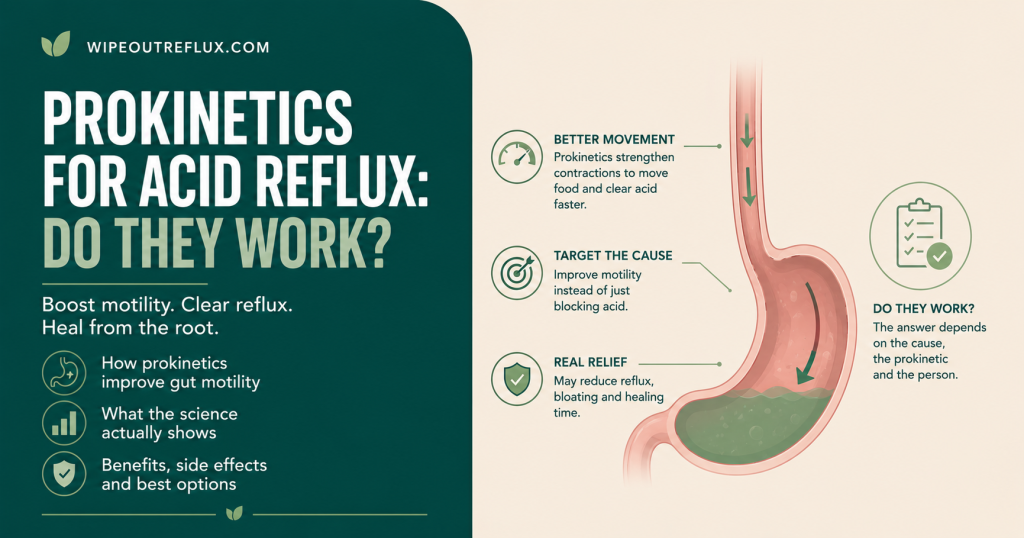
If you’ve been down the reflux rabbit hole, you’ve probably come across prokinetics — a class of drugs that speed up the movement of your digestive tract. The logic sounds compelling: empty the stomach faster and tighten the valve above it, and there should be less acid to reflux in the first place. So do they actually work for acid reflux?
Here’s the honest answer up front: prokinetics can help some people, but the evidence is modest and mixed, they aren’t a first-line treatment, and they carry real side-effect risks that make them prescription-only. They’re mainly used as an add-on when standard treatment isn’t enough — particularly when there’s a proven stomach-emptying or motility problem underneath.
I’m not a doctor, and nothing here is medical advice. The point of this article is to explain the science clearly enough that you can have a genuinely informed conversation with yours — not to encourage anyone to self-medicate.
Key takeaways
- Prokinetics are drugs that stimulate the movement of the digestive tract.
- For reflux, the theory is that they speed stomach emptying, tighten the lower valve, and help clear acid faster.
- The evidence in reflux is mixed: some studies show a modest symptom benefit, others show none, and they don’t reliably heal the oesophagus.
- PPIs remain the mainstay for reflux; prokinetics are an add-on, not a replacement.
- They’re mostly reserved for people with documented motility problems (like delayed stomach emptying) or symptoms that persist despite optimised treatment.
- Side effects are the big issue — metoclopramide carries a serious neurological warning, and domperidone carries a heart-rhythm risk.
- They are prescription-only and should only be used under medical supervision — never self-sourced.
- Evidence specifically for silent reflux (LPR) is thin, so their use there is largely extrapolated.
What prokinetics are and how they’re meant to work
Prokinetics are medications that increase the strength and coordination of gut muscle contractions. In the context of reflux, they’re proposed to help in three ways, each targeting a different part of the reflux mechanism.
First, by speeding up stomach emptying, so the stomach spends less time full — and since a distended stomach is the main trigger for the transient valve relaxations that cause reflux, a faster-emptying stomach means fewer of those events. Second, by increasing pressure at the lower oesophageal sphincter, the valve between the stomach and oesophagus, making it a more effective barrier. You can read more about that valve in my guide to the stomach sphincter and LPR. Third, by improving oesophageal motility, helping the oesophagus sweep refluxed acid back down more quickly.
The main agents you’ll hear about are metoclopramide and domperidone (both dopamine blockers), and newer agents such as mosapride, prucalopride, acotiamide and itopride. Erythromycin, an antibiotic, also has a prokinetic effect. And cisapride — once widely used — was withdrawn, for reasons I’ll come to.
Do prokinetics actually work for acid reflux?
This is where honesty matters, because the evidence genuinely cuts both ways.
On the cautious side, a meta-analysis of 12 randomised trials covering 2,403 patients found that adding a prokinetic to PPI therapy did not produce a significant improvement in symptom relief or in healing seen on endoscopy compared with the PPI alone [Ren et al., World Journal of Gastroenterology, 2014]. On the more favourable side, a later meta-analysis of 16 trials involving 1,446 patients concluded that combination treatment was more effective than a PPI alone for symptom improvement, identifying mosapride, domperidone, acotiamide and revexepride as the more useful agents [Journal of Neurogastroenterology and Motility, 2021].
Taken together, the picture is one of a modest, inconsistent benefit — helpful for some, especially as an add-on for symptoms, but not a reliable healer of the oesophagus and not a substitute for acid control. This is why guidelines generally position prokinetics as a second-line, add-on option, and why optimising your existing treatment usually comes first. If your current medication isn’t cutting it, my guide on what to do when acid reflux medication isn’t working is a useful starting point for that conversation.
Prokinetics and silent reflux (LPR)
The theory behind prokinetics is arguably even more appealing for laryngopharyngeal reflux, since slower stomach emptying means more reflux, and efficient clearance matters enormously when the refluxate has to be stopped before it reaches the throat.
The trouble is that the direct evidence in LPR is thin. Even PPIs show inconsistent results in silent reflux trials, and studies looking specifically at prokinetics for LPR are few and small. Some reviews suggest a prokinetic-plus-PPI combination may outperform a PPI alone for LPR, but they consistently call for proper randomised trials before drawing firm conclusions. So while prokinetics are sometimes tried in stubborn LPR, their use there is largely extrapolated from GERD rather than proven for the throat. For the bigger picture of how LPR differs, see my GERD vs LPR comparison and my overview of LPR symptoms.
The side effects: why these are prescription-only
This is the part that matters most, and the reason prokinetics aren’t something to experiment with.
Metoclopramide crosses into the brain, and with prolonged use can cause movement disorders — including tardive dyskinesia, which can be permanent. Because of this it carries a serious safety warning and its use is generally limited to short courses (around 12 weeks maximum). It can also cause drowsiness and restlessness.
Domperidone crosses into the brain far less, but it has been linked to heart-rhythm disturbances (QT prolongation), which is why it’s restricted in many places and not approved for use in the United States. Both metoclopramide and domperidone are dopamine blockers that can also raise the hormone prolactin, sometimes causing breast tenderness or discharge.
Cisapride is the cautionary tale: once a standard reflux prokinetic, it was withdrawn around 2000 after being linked to dangerous, sometimes fatal, cardiac arrhythmias. Newer agents like prucalopride, mosapride and acotiamide generally have a better cardiac safety profile, but their availability varies by country and their evidence base specifically for reflux is limited.
All of which is to say: these are genuine medicines with genuine risks, prescribed and monitored for good reason. They should never be bought online or self-administered.
Where prokinetics actually fit
For most people with reflux, prokinetics are not the answer — and they’re certainly not a starting point. They tend to be considered in specific situations: when acid-suppression has been properly optimised but symptoms persist, or when there’s a documented problem like delayed gastric emptying or ineffective oesophageal motility, confirmed by tests such as a gastric emptying study or manometry.
For everyone else, the bigger and safer levers remain the familiar ones. Reducing reflux at the source through diet, meal timing and weight management does more heavy lifting than most medications. An alginate such as Gaviscon Advance is a genuinely useful add-on with a far friendlier safety profile, forming a raft that physically blocks reflux. And if you’re struggling with PPIs specifically, my guide on coming off PPIs and acid rebound is worth a read. For silent reflux in particular, the pepsin-focused approach I describe in neutralising pepsin in the throat addresses a mechanism prokinetics don’t touch at all.
The bottom line on fit: prokinetics are a targeted tool for a particular subset of people, best decided on with a gastroenterologist — not a general-purpose reflux fix.
Conclusion
So, do prokinetics work for acid reflux? The fair answer is: sometimes, modestly, and for the right person. The theory is sound — a faster-emptying stomach, a tighter valve and better clearance should all reduce reflux — but the real-world evidence is mixed, the benefit is generally small, and they don’t reliably heal the oesophagus. They earn their place as a second-line, add-on option for people with persistent symptoms or a proven motility problem, not as a first move or a replacement for the fundamentals.
The side-effect profile is the real reason for caution. Between metoclopramide’s neurological risks and domperidone’s cardiac ones, these are medicines that belong firmly in the hands of a doctor who knows your full picture. If you think a prokinetic might be relevant for you — especially if slow stomach emptying is part of your story — the right next step is a conversation with your GP or a gastroenterologist, not an online order. Please treat this article as background for that conversation rather than as medical advice.
For the vast majority of people, though, the biggest gains still come from reducing reflux at the source, which is exactly what my Wipeout Diet Plan is built to do — a structured, step-by-step programme for calming reflux without reaching first for medication, going far deeper into the mechanisms and daily routine than any single article can. And to make everyday choices simple, the Wipeout Food Reference Guide is the essential companion, laying out the foods and drinks allowed on an acid reflux and LPR diet along with their pH values — so you can reduce reflux naturally before medication ever becomes the main event. Together they give you a foundation that works with your body rather than against it.
Frequently asked questions
What are prokinetics and how do they work?
Prokinetics are drugs that stimulate the muscles of the digestive tract to contract more effectively. For reflux, they aim to speed up stomach emptying, increase pressure at the lower oesophageal valve, and help the oesophagus clear acid faster. Common examples include metoclopramide, domperidone, and newer agents like mosapride and prucalopride.
Do prokinetics work for acid reflux?
The evidence is mixed. Some meta-analyses find a modest improvement in symptoms when a prokinetic is added to a PPI, while others find no significant benefit over the PPI alone, and they don’t reliably heal the oesophagus. Overall the effect is small and inconsistent, which is why prokinetics are an add-on option rather than a first-line treatment.
Are prokinetics better than PPIs for reflux?
No. PPIs remain the mainstay for controlling reflux, and prokinetics are used as an add-on, not a replacement. Prokinetics target motility rather than acid, so they address a different part of the problem. They’re generally considered only when acid suppression has been optimised but symptoms persist, or when there’s a documented motility issue.
What are the side effects of prokinetics?
They can be significant. Metoclopramide can cause movement disorders including tardive dyskinesia, which may be permanent, so its use is limited to short courses. Domperidone has been linked to heart-rhythm problems and isn’t approved in some countries. Both can raise prolactin, causing breast tenderness or discharge. The withdrawn drug cisapride caused dangerous arrhythmias. This is why prokinetics require medical supervision.
Do prokinetics help silent reflux (LPR)?
Possibly, but the evidence is thin. The theory is appealing because slow stomach emptying and poor clearance contribute to reflux reaching the throat. However, studies specifically on prokinetics for LPR are few and small, and their use there is largely extrapolated from GERD research rather than proven. Some reviews suggest a possible benefit but call for proper trials.
Can I buy prokinetics over the counter?
No. Prokinetics are prescription-only medicines because of their side-effect profiles, and they require a doctor’s assessment and monitoring. Buying them online or self-medicating is genuinely risky given the neurological and cardiac risks involved. If you think a prokinetic might help, that’s a conversation to have with your GP or gastroenterologist.
When are prokinetics actually used for reflux?
Typically in two situations: when a PPI has been properly optimised but troublesome symptoms remain, or when there’s a documented motility problem such as delayed gastric emptying or ineffective oesophageal motility, confirmed by tests like a gastric emptying study or manometry. For most people without these features, safer measures like diet, meal timing and alginates come first.
Research sources
- [Ren et al., World Journal of Gastroenterology, 2014] — A meta-analysis of 12 randomised trials (2,403 patients) that found adding a prokinetic to PPI therapy did not significantly improve symptom relief or endoscopic healing compared with the PPI alone, though it slightly improved symptom scores.
- [Journal of Neurogastroenterology and Motility, 2021] — A meta-analysis of 16 randomised trials (1,446 patients) concluding that combined PPI-plus-prokinetic treatment was more effective than PPI alone for symptom improvement, with mosapride, domperidone, acotiamide and revexepride identified as effective agents.

David Gray
12 years living with LPR · Consultant & researcher
I've lived with LPR for twelve years — the misdiagnoses, the PPI courses that did nothing, the slow work of figuring out what actually helps. Wipeout Reflux is where I translate the research into plain terms for people stuck in the same place. Every claim here is sourced to peer-reviewed work, and I consult one-to-one with LPR sufferers.