
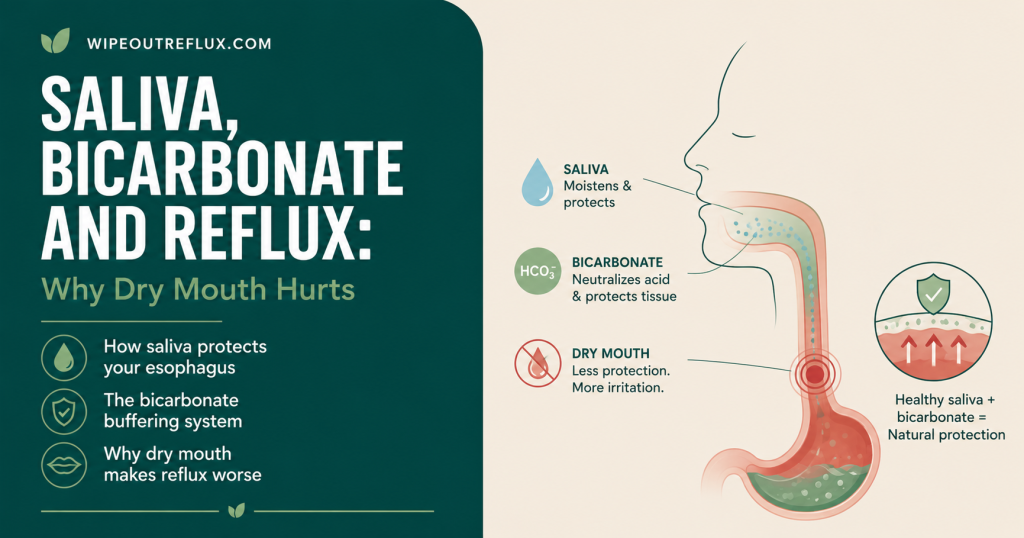
Here is something that took me embarrassingly long to appreciate: your saliva is a genuine anti-reflux weapon. It is mildly alkaline, it is loaded with bicarbonate — the same buffering compound in antacid tablets — and every single time you swallow it, it neutralises acid clinging to your oesophagus and throat and helps wash refluxed material back down where it belongs.
Which means the flip side is brutal. When your saliva dries up — overnight, from mouth breathing, from medications, from smoking or stress — you lose your main natural defence exactly when you need it. Acid and pepsin sit on the tissue longer, the local pH stays low, and symptoms get worse. That is why dry mouth and reflux are such a punishing combination, and it is a big part of why night-time is the worst time for reflux of all.
Let me explain how saliva actually protects you, why losing it hurts so much, and what you can practically do about it.
Key takeaways
- Saliva is your body’s natural antacid — mildly alkaline and rich in bicarbonate, which neutralises refluxed acid.
- Acid clearance happens in two steps: swallowing clears the bulk, then swallowed saliva neutralises the acid left behind.
- Bicarbonate is the main reason saliva can neutralise acid, and stimulated saliva (from chewing or eating) carries far more of it than resting saliva.
- Saliva also lubricates and contains growth factors that help the tissue repair itself.
- During sleep, saliva production drops to almost nothing and swallowing nearly stops — so night-time reflux lingers far longer and does more damage.
- For silent reflux (LPR), saliva matters even more: keeping throat pH up helps keep lodged pepsin dormant.
- Medications, mouth breathing, smoking, alcohol, dehydration and stress all reduce saliva and can worsen reflux.
- You can’t hugely raise baseline saliva, but you can stimulate it at the right moments and stop suppressing it.
What saliva actually does for reflux
Saliva does three protective jobs, and they matter more than most people realise.
It neutralises acid. Saliva has a pH of roughly 6.5 to 7.5 and carries bicarbonate. When you swallow it, that bicarbonate buffers and neutralises acid sitting on the lining of your oesophagus and throat, nudging the local pH back up towards neutral.
It clears the refluxate. The act of swallowing triggers a peristaltic wave that physically sweeps refluxed material back down into the stomach. Saliva is the medium that makes this work.
It protects and helps heal. Saliva forms a lubricating film over the tissue and contains mucins and growth factors, including epidermal growth factor, that support the repair of irritated mucosa.
The bicarbonate buffer, explained
The neutralising power of saliva comes down primarily to bicarbonate. In classic research measuring saliva’s ability to neutralise acid, the acid-neutralising capacity rose and fell with bicarbonate concentration, and stimulated saliva — the kind you produce when chewing or eating — carried substantially more bicarbonate than resting saliva [Helm et al., Gastroenterology, 1982].
That single fact has a practical consequence you can use: anything that gets you salivating more, at the moments you need it, raises your bicarbonate output and boosts your natural acid defence.
The two-step acid clearance system
Your oesophagus clears acid in two sequential steps, and saliva is essential to the second one. First, one or two peristaltic waves empty almost all of the acid volume from the oesophagus — but they leave behind a thin residual that keeps the pH low. Then, swallowed saliva neutralises that residual acid, restoring a safe pH.
The landmark work here showed exactly how much saliva matters: when saliva is removed from the equation, clearance of acid from the oesophagus is markedly prolonged [Helm et al., New England Journal of Medicine, 1984]. In other words, swallowing alone gets rid of the bulk, but without saliva the acid that remains just sits there, quietly irritating the lining.
Why saliva matters even more for silent reflux
Here is where this becomes especially important if your reflux is the silent, throat-based kind. Your oesophagus has some built-in defences of its own — glands in its lining secrete their own bicarbonate. Your throat and voice box do not have anywhere near the same protection, which is part of why they are so much more vulnerable to reflux.
That leaves the throat leaning heavily on swallowed saliva as its main line of defence. And this connects directly to pepsin. As I explain in my article on neutralising pepsin in the throat, pepsin lodged in your throat tissue stays dormant at a near-neutral pH but reactivates whenever the pH drops. Saliva, by keeping the throat’s pH up and buffering incoming acid, is one of the things quietly holding that pepsin in its dormant state. Less saliva means more acidic dips, which means more pepsin reactivation and more damage. If you want the full picture of how the two conditions differ, my GERD vs LPR comparison lays it out.
Why night-time is the worst time for reflux
If you take one thing from this article, make it this. During sleep, three protections switch off at once: saliva production drops to almost nothing, you stop swallowing, and lying flat removes gravity’s help. So any reflux that occurs overnight sits in your oesophagus and throat far longer, with nothing to neutralise it.
This is exactly why night-time reflux is disproportionately damaging, and why so many people with LPR wake up with their worst symptoms — a raw throat, a hoarse voice, the need to clear their throat. It is also why the single most valuable habits are the ones that stop reflux happening while your saliva defence is offline: leaving a proper gap before bed, elevating the head of the bed, and sleeping on your left side. I go into detail in my guides to night-time reflux and the best sleeping position for silent reflux.
Why dry mouth hurts: what reduces your saliva
Beyond sleep, plenty of everyday factors dry you out — and each one chips away at your acid defence:
- Mouth breathing and nasal congestion — breathing through your mouth, especially at night, dries the mouth and throat directly. Reflux-related congestion can make this worse, a link I cover in my piece on silent reflux and post-nasal drip.
- Medications — a huge range of common drugs reduce saliva, including many antihistamines, antidepressants, decongestants and diuretics. Worth reviewing with your doctor rather than stopping anything yourself.
- Smoking — reduces saliva flow and lowers the pressure of the valve that keeps reflux down, a double hit.
- Alcohol and caffeine — both have a mild drying effect, and alcohol-based mouthwashes dry the tissue further.
- Dehydration — simply not drinking enough leaves you with less to work with.
- Stress and anxiety — a racing sympathetic nervous system famously dries the mouth.
There is a nasty feedback loop hidden in here. Reflux irritates your throat, which can drive mouth breathing and anxiety, which reduce saliva, which lets reflux do more damage. Dry mouth can also contribute to the bad breath many people with reflux notice. Breaking the loop anywhere helps.
How to support your saliva
You can’t dramatically raise your baseline saliva with a supplement, but you can stimulate it when it counts and stop the things that suppress it.
Chew sugar-free gum after meals
This is the most evidence-backed move. Chewing dramatically increases saliva flow and bicarbonate output, and swallowing frequency rises with it. In a randomised study, chewing sugar-free gum for 30 minutes after a reflux-provoking meal cut the time the oesophagus spent at a damaging pH from 5.7% to 3.6% [Moazzez et al., Journal of Dental Research, 2005]. For LPR specifically, bicarbonate-containing gum raises throat pH more than regular gum. I cover the details, and which gums to choose, in my guide to chewing gum for acid reflux — the one rule is to avoid peppermint, which relaxes the lower valve.
Stay hydrated through the day
Sip water regularly to keep saliva flowing, rather than gulping large volumes at once. If you’re unsure what else is throat-friendly, my guide on what to drink with acid reflux is a good starting point.
Fix mouth breathing and protect the night
Address nasal congestion so you can breathe through your nose, particularly while asleep. And because your saliva defence is offline overnight, prioritise the anti-reflux basics before bed: a three to four hour gap after your last meal, an elevated head, and left-side sleeping.
Reduce what dries you out
Review drying medications with your doctor, cut down on smoking and alcohol, skip alcohol-based mouthwashes, and manage stress where you can. None of these is a magic fix alone, but together they meaningfully protect your natural buffer.
Conclusion
Saliva is one of the most underrated players in reflux. It is your body’s own antacid — buffering acid with bicarbonate, sweeping refluxed material back down, and helping damaged tissue heal — and it works quietly in the background every time you swallow. The moment it dries up, whether overnight or from medications, smoking or stress, you lose that protection precisely when your throat is most exposed. For silent reflux in particular, where the throat has so little defence of its own, saliva is often the difference between pepsin staying dormant and springing back to life.
The encouraging part is how much of this you can influence. Stimulating saliva after meals, protecting yourself during the vulnerable night-time hours, and removing the everyday things that dry you out all strengthen a defence you already have. It costs almost nothing and works with your physiology rather than against it.
Of course, the most reliable way to protect your throat is to give it less to neutralise in the first place. That is the whole aim of my Wipeout Diet Plan — a structured, step-by-step programme for calming reflux at the source so your saliva isn’t fighting a losing battle, going far deeper into the mechanisms and daily routine than any single article can. And to make everyday choices simple, the Wipeout Food Reference Guide is the essential companion, laying out the foods and drinks allowed on an acid reflux and LPR diet along with their pH values — so you know exactly what keeps your throat’s environment calm and what drags its pH down. Together they turn the science on this page into a plan you can genuinely live by.
Frequently asked questions
How does saliva protect against acid reflux?
Saliva is mildly alkaline and contains bicarbonate, which neutralises refluxed acid on the lining of your oesophagus and throat. Swallowing it also triggers a wave that sweeps refluxed material back into the stomach, and it carries growth factors that help the tissue heal. Together these make saliva a genuine natural defence against reflux damage.
Why is acid reflux worse at night?
During sleep, saliva production falls to almost nothing, you stop swallowing, and lying flat removes gravity’s help. So any reflux that occurs overnight sits on the tissue far longer with nothing to neutralise it. This is why night-time reflux causes disproportionate damage and why many people with silent reflux wake up with their worst throat symptoms.
Why does dry mouth make reflux worse?
Because saliva is your main natural buffer against refluxed acid. When you have dry mouth — from medications, mouth breathing, dehydration, smoking or stress — you lose that buffering and clearing capacity, so acid and pepsin linger longer and irritate the tissue more. Reflux and dry mouth can also feed each other in a vicious circle.
Does chewing gum really help reflux?
Yes, through saliva. Chewing sharply increases saliva flow and bicarbonate, and studies show chewing sugar-free gum after a meal reduces the time the oesophagus spends at a damaging pH. Bicarbonate gum is particularly useful for silent reflux. The one caveat is to avoid peppermint gum, since menthol can relax the lower oesophageal valve.
Can medications cause both dry mouth and reflux?
Some can contribute to both. Many common drugs — including certain antihistamines, antidepressants, decongestants and diuretics — reduce saliva, which weakens your acid defence. If you suspect a medication is drying you out and worsening reflux, raise it with your doctor rather than stopping it yourself, as there may be alternatives.
Does saliva help with silent reflux and pepsin specifically?
Very much so. The throat lacks the built-in bicarbonate defences the oesophagus has, so it relies heavily on swallowed saliva. By keeping throat pH up and buffering incoming acid, saliva helps keep lodged pepsin in its dormant state. Less saliva means more acidic dips and more pepsin reactivation, which is why dry mouth hits LPR sufferers especially hard.
How can I increase saliva naturally?
The most effective way is chewing sugar-free, non-mint gum after meals, which stimulates a large increase in saliva and bicarbonate. Staying well hydrated, breathing through your nose, and cutting back on smoking, alcohol and drying mouthwashes all help too. You can’t hugely raise your baseline production, but you can stimulate saliva when it matters most and stop suppressing it.
Research sources
- [Helm et al., New England Journal of Medicine, 1984] — Demonstrated that saliva is essential to oesophageal acid clearance: when saliva is absent, clearance of acid from the oesophagus is markedly prolonged.
- [Helm et al., Gastroenterology, 1982] — Established that saliva’s capacity to neutralise acid is due primarily to bicarbonate, and that stimulated saliva carries a higher bicarbonate concentration than resting saliva.
- [Moazzez et al., Journal of Dental Research, 2005] — A randomised study finding that chewing sugar-free gum for 30 minutes after a reflux-provoking meal significantly reduced the time the oesophagus spent below pH 4 (from 5.7% to 3.6%, p = 0.001).
- [Gastroesophageal Reflux Disease, StatPearls, 2025] — Outlines the pre-epithelial defences against reflux, including swallowed saliva’s bicarbonate and mucins and the oesophagus’s own submucosal bicarbonate secretion.

David Gray
12 years living with LPR · Consultant & researcher
I've lived with LPR for twelve years — the misdiagnoses, the PPI courses that did nothing, the slow work of figuring out what actually helps. Wipeout Reflux is where I translate the research into plain terms for people stuck in the same place. Every claim here is sourced to peer-reviewed work, and I consult one-to-one with LPR sufferers.