
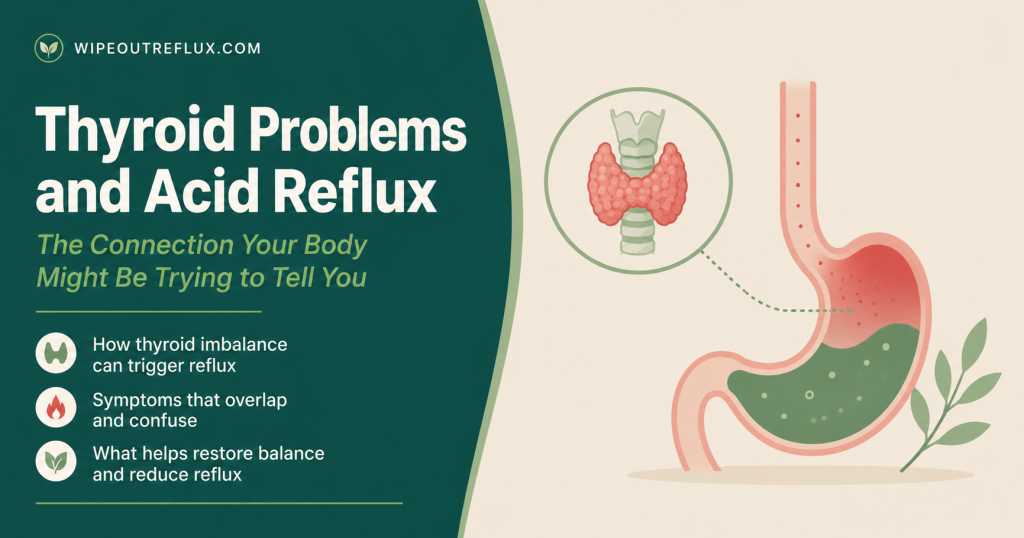
If you have a thyroid problem and persistent acid reflux, the two are more likely connected than coincidental — but not always in the way you’d assume. An underactive thyroid (hypothyroidism) is the strongest link: it slows the whole digestive system down, weakening the valve at the top of the stomach and delaying how quickly the stomach empties, both of which set the stage for reflux.
Beyond that, though, the thyroid–reflux relationship has some genuinely surprising twists: Hashimoto’s often travels with a condition that lowers stomach acid rather than raising it, common reflux medications can interfere with thyroid medication, and an enlarged thyroid can create throat symptoms that look exactly like silent reflux. Having managed LPR myself for over eight years, I think this is one of the more under-appreciated pieces of the reflux puzzle, so let me walk through what the evidence actually shows.
Key Takeaways
- Hypothyroidism is the main link. It slows gut motility, reduces lower oesophageal sphincter pressure, and delays stomach emptying — all of which promote reflux.
- Hashimoto’s has a low-acid twist. Autoimmune thyroid disease frequently coincides with autoimmune atrophic gastritis, which reduces stomach acid rather than increasing it.
- Reflux and thyroid medication interact. Acid-suppressing drugs like PPIs can reduce levothyroxine absorption and push your thyroid levels off, so timing and monitoring matter.
- An enlarged thyroid can mimic silent reflux. A goitre or nodules can cause globus (a lump-in-throat feeling) and swallowing difficulty that look just like LPR.
- If your reflux is unexplained or resistant to treatment, a simple thyroid blood test is worth requesting — thyroid problems are easy to miss and very treatable.
- Don’t assume your reflux means high acid; with a thyroid condition in the mix, the picture is often more nuanced, and worth investigating properly.
A quick primer: underactive vs overactive
Your thyroid sets your body’s metabolic pace. When it’s underactive (hypothyroid), everything runs slower — including your gut. When it’s overactive (hyperthyroid), things speed up. Most of the reflux connection sits with the underactive side, though both can cause digestive symptoms. Hashimoto’s thyroiditis, an autoimmune condition, is the most common cause of hypothyroidism, and it brings its own specific quirks that I’ll come to.
The main link: hypothyroidism slows your gut
This is the core mechanism, and it’s well-established. Thyroid hormones directly influence the muscle activity of the digestive tract, so when levels drop, gut motility slows across the board. Both underactive and overactive thyroid states can impair the movement of the pharynx and oesophagus, and specifically, reduced oesophageal sphincter pressure and weaker contractions in the body of the oesophagus can lead to reflux and difficulty swallowing [Xu et al., Frontiers in Physiology, 2024].
Two consequences of that slowdown matter most for reflux:
- A weaker valve. The lower oesophageal sphincter is the muscular ring that’s supposed to keep stomach contents down. When thyroid hormone is low, its tone can drop, making it easier for reflux to happen.
- Delayed stomach emptying. If food sits in the stomach longer, there’s more time and more pressure for contents to reflux upward. Sluggish emptying is a classic route to reflux, and it’s a recognised feature of hypothyroidism.
There’s a knock-on effect worth flagging too. When the gut slows down, it can allow bacteria to overgrow in the small intestine, and the gas and pressure that produces is its own driver of reflux and bloating. If your reflux comes with significant bloating, it’s worth understanding the link between bacterial overgrowth and acid reflux — because a slow thyroid can be the upstream cause of both.
The Hashimoto’s twist: low acid, not high
Here’s where thyroid-related reflux gets genuinely counterintuitive, and where a lot of generic advice goes wrong.
Hashimoto’s thyroiditis frequently travels with another autoimmune condition: autoimmune chronic atrophic gastritis. In fact, atrophic gastritis is the most common disorder associated with Hashimoto’s, and the antibodies involved — anti-parietal cell antibodies — are directed against the stomach’s acid-producing proton pump itself [Boutzios et al., Frontiers in Endocrinology, 2022]. When those cells are damaged, acid production falls.
The practical upshot is important: a meaningful subset of people with Hashimoto’s have reduced stomach acid, not excess. Yet their symptoms — reflux, bloating, discomfort after meals — can feel identical to high-acid reflux. This is why chasing acid suppression harder and harder sometimes doesn’t help, and can even make digestion worse. It also explains why some hypothyroid individuals are noted to have diminished acid secretion [Xu et al., Frontiers in Physiology, 2024].
I want to be careful here, because “you actually have low acid, stop your medication” is a popular and sometimes dangerous piece of internet advice. The low-acid picture is real, but it’s a specific, diagnosable situation (autoimmune atrophic gastritis) — not a blanket explanation for all reflux, and not a reason to abandon prescribed treatment. If you have Hashimoto’s and stubborn digestive symptoms, the right move is to ask your doctor about testing for it, not to self-diagnose. Low acid also has downstream consequences worth knowing about, including a greater tendency toward the kind of bacterial overgrowth mentioned above.
The medication catch-22: reflux drugs vs thyroid drugs
This one is practical and easy to overlook if you take both a reflux medication and thyroid replacement.
Levothyroxine, the standard thyroid hormone tablet, needs an acidic stomach to dissolve properly before it’s absorbed. When stomach acid is reduced — whether from atrophic gastritis, H. pylori, or acid-suppressing drugs — absorption drops and your thyroid levels can drift. In a study of Hashimoto’s patients, the levothyroxine dose needed to hit target thyroid levels rose as gastric pH went up, and gastric acidity turned out to be one of the most important factors (alongside body weight) in determining the effective dose [Virili et al., Endocrine, 2022].
So there’s a real interaction: taking a PPI for reflux can blunt the absorption of your thyroid tablet, potentially leaving you under-treated. This doesn’t mean stop either medication — it means the two should be managed together, with attention to timing and thyroid monitoring, and it’s exactly the kind of thing to raise with your prescriber. If you’re taking a PPI and wondering about your options more broadly, it’s worth understanding the realities of coming off PPIs and acid rebound before making any changes — and always with medical guidance.
The silent reflux angle: when it’s the gland itself
This is the differential I really don’t want you to miss, because it’s directly relevant to anyone with throat-based symptoms.
An enlarged thyroid (a goitre) or thyroid nodules sit right next to the oesophagus and throat. When they grow, they can physically press on those structures, producing globus (a persistent lump-in-throat sensation), difficulty swallowing, throat clearing and voice changes. A systematic review found that goitres caused oesophageal compression or deviation in a significant proportion of patients, increased how long it took food to transit the oesophagus, and reduced upper oesophageal sphincter pressure — with swallowing improving after the thyroid was treated [Sorensen et al., Frontiers in Endocrinology, 2018].
The problem is that these are almost exactly the symptoms of LPR (silent reflux). Globus, throat clearing and mild swallowing difficulty are the bread and butter of silent reflux, so it’s genuinely easy for a thyroid cause to be missed, or for someone to spend months treating reflux that was never the real issue. If you have a lump-in-throat sensation that isn’t responding to reflux measures, having your neck and thyroid examined is a sensible step. It’s not that thyroid enlargement is the usual cause of globus — reflux still is — but it’s a fixable one that shouldn’t be overlooked.
What about an overactive thyroid?
Hyperthyroidism is less classically tied to reflux, but it’s not irrelevant. It speeds the gut up, more often causing diarrhoea and, sometimes, altered stomach rhythms that can slow gastric emptying despite the overall faster tempo [Xu et al., Frontiers in Physiology, 2024]. The headline point is the same either way: when your thyroid is off in either direction, your digestive system tends to misbehave, and reflux-type symptoms can be part of that.
What to actually do about it
I’m not a doctor, so take this as a framework to discuss with yours rather than a protocol.
Get your thyroid checked if your reflux doesn’t add up. If your reflux is unexplained, resistant to treatment, or comes with other clues — fatigue, weight change, feeling cold, constipation, low mood, or a family history of thyroid or autoimmune disease — a simple TSH blood test is well worth requesting. Thyroid problems are common, easy to miss, and very treatable, and treating them often improves the digestive symptoms too.
Don’t assume high acid. Especially with Hashimoto’s, resist the reflex to keep escalating acid suppression. If standard reflux treatment isn’t working, that’s a signal to widen the investigation rather than push the same lever harder — it’s worth understanding the various reasons reflux medication sometimes doesn’t work, of which an unaddressed thyroid or low-acid picture is one.
Mind your medication timing. If you take levothyroxine, take it as advised — usually fasting, well before food — and if you also take a PPI or antacid, flag that combination to your doctor so your thyroid levels can be monitored. The two genuinely interact, and getting the sequencing and monitoring right matters.
Keep treating the fundamentals. A thyroid problem rarely acts alone. Meal timing, portion size, and protecting the throat from pepsin still do the heavy lifting for day-to-day reflux, whatever else is going on underneath.
The bottom line
Thyroid problems and acid reflux are linked in more ways than most people realise. The main thread is an underactive thyroid slowing the gut — weakening the oesophageal valve and delaying stomach emptying — but the story has real depth: Hashimoto’s can quietly lower stomach acid rather than raise it, reflux medication can interfere with thyroid medication, and the gland itself can cause throat symptoms that impersonate silent reflux. That’s a lot of moving parts, and it’s exactly why unexplained or stubborn reflux deserves a proper look at the thyroid rather than endless acid suppression.
The bigger lesson, as always with reflux, is that it’s rarely about a single villain. Motility, acid, pepsin, gut bacteria and hormones all interact, and lasting relief comes from understanding the whole system rather than fixating on one piece. That’s the thinking behind the Wipeout Diet Plan: a structured, pepsin-aware approach that calms reflux and gives your throat and oesophagus the conditions they need to heal, whatever’s driving things underneath. It’s the complete, in-depth system I wish I’d had when I started, and it works alongside proper thyroid care rather than instead of it.
For a practical foundation, the Wipeout Food Reference Guide is the essential companion — it sets out exactly which foods and drinks are safe for acid reflux and LPR along with their pH values, so you can make confident choices from day one. Pair that with a thyroid check if your reflux doesn’t add up, and you’re addressing the problem properly rather than treating a symptom while missing its cause.
Frequently Asked Questions
Can hypothyroidism cause acid reflux?
Yes. An underactive thyroid slows gut motility, weakens the lower oesophageal sphincter, and delays stomach emptying — all of which promote reflux. It can also predispose to bacterial overgrowth, which adds bloating and pressure. Treating the underactive thyroid often improves these digestive symptoms.
Does Hashimoto’s cause high or low stomach acid?
Often low, which surprises people. Hashimoto’s frequently coincides with autoimmune atrophic gastritis, where antibodies attack the stomach’s acid-producing cells and reduce acid output. So while symptoms can feel like classic acid reflux, the underlying acid level may actually be low — something worth testing for rather than assuming.
Can thyroid medication affect reflux, or reflux medication affect the thyroid?
The bigger interaction runs the other way: acid-suppressing reflux drugs like PPIs can reduce how well levothyroxine is absorbed, because the tablet needs stomach acid to dissolve. This can leave your thyroid under-treated. If you take both, they should be managed together with proper timing and thyroid monitoring by your doctor.
Can a thyroid problem cause a lump in the throat?
Yes. An enlarged thyroid (goitre) or nodules can press on the oesophagus and throat, causing globus (a lump-in-throat feeling), swallowing difficulty and throat clearing. These symptoms closely mimic silent reflux (LPR), so a thyroid cause can be missed. Persistent throat symptoms not responding to reflux measures deserve a neck and thyroid examination.
Should I get my thyroid tested for acid reflux?
It’s worth requesting if your reflux is unexplained or treatment-resistant, or if you have other signs like fatigue, weight change, feeling cold, constipation, or a family history of thyroid or autoimmune conditions. A simple TSH blood test is inexpensive, and identifying a thyroid issue can change your whole treatment approach.
Will treating my thyroid fix my reflux?
It can help significantly if the thyroid problem is genuinely driving the reflux, since correcting the hormone levels tends to improve gut motility. But reflux is usually multifactorial, so thyroid treatment works best alongside the usual reflux fundamentals rather than as a standalone cure.
Can an overactive thyroid cause reflux too?
It’s less classically linked than an underactive thyroid, but hyperthyroidism can disturb gastric rhythms and gut function, and reflux-type symptoms can occur. The general principle holds: when your thyroid is off in either direction, digestive symptoms including reflux become more likely.
References
- Xu et al., Frontiers in Physiology, 2024 — Review of thyroid disorders and gastrointestinal dysmotility, describing how reduced oesophageal sphincter pressure and weakened contractions can lead to reflux, and noting diminished acid secretion in some hypothyroid patients.
- Boutzios et al., Frontiers in Endocrinology, 2022 — Study showing chronic atrophic gastritis is the most frequent Hashimoto’s-associated disorder, with anti-parietal cell antibodies targeting the stomach’s acid-producing proton pump.
- Virili et al., Endocrine, 2022 — Found that levothyroxine requirement rose with gastric pH in Hashimoto’s patients, making stomach acidity one of the most important factors in determining the effective thyroid hormone dose.
- Sorensen et al., Frontiers in Endocrinology, 2018 — Systematic review showing goitres can compress and deviate the oesophagus, increase transit time and reduce upper oesophageal sphincter pressure, with swallowing improving after thyroid treatment.

David Gray
12 years living with LPR · Consultant & researcher
I've lived with LPR for twelve years — the misdiagnoses, the PPI courses that did nothing, the slow work of figuring out what actually helps. Wipeout Reflux is where I translate the research into plain terms for people stuck in the same place. Every claim here is sourced to peer-reviewed work, and I consult one-to-one with LPR sufferers.