
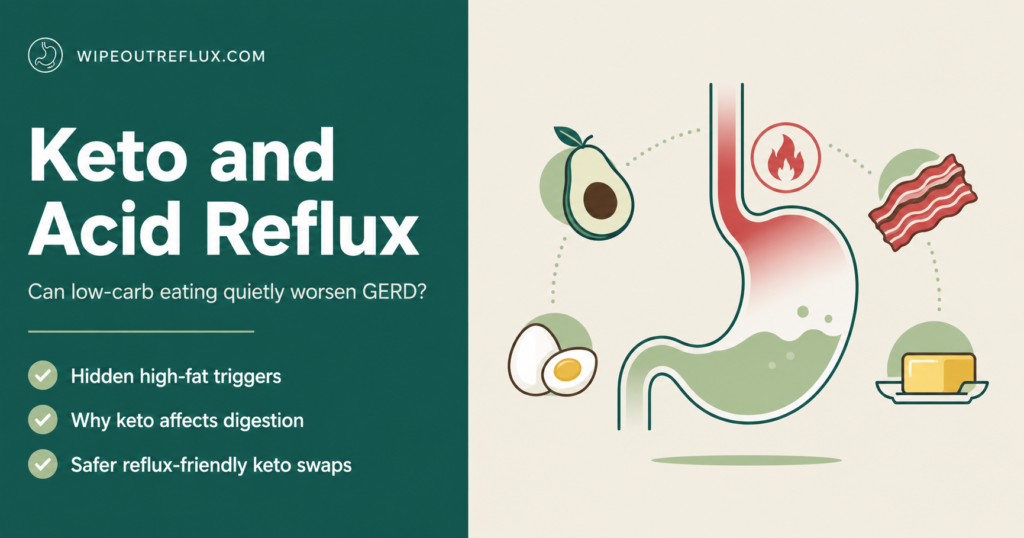
For most people with acid reflux or GERD, the keto diet is not a good fit. The high fat content that defines keto directly affects the valve between your stomach and esophagus — relaxing it when it should stay closed — and slows down how quickly your stomach empties. Both of those things increase the likelihood of acid refluxing upward.
That said, the picture is more nuanced than a simple “keto is bad for reflux.” Some research shows that cutting carbohydrates — particularly simple sugars — can actually reduce acid exposure in the esophagus. The problem is that keto replaces those carbs almost entirely with fat, and that fat-heavy shift is where the real reflux risk comes in.
If you have GERD and are drawn to keto for weight loss or other health reasons, this article will explain what is actually happening mechanically, what the research says, and what a better approach looks like.
Key Takeaways
- The high fat content of the keto diet triggers the release of a hormone called cholecystokinin (CCK), which causes the lower esophageal sphincter to relax and lets acid escape upward.
- Fat also slows gastric emptying, meaning food and acid sit in the stomach longer — increasing reflux risk throughout the day.
- Cutting simple sugars (not just total carbs) has shown genuine benefit in GERD research, reducing acid exposure time in several studies.
- Complex carbohydrates like rice, oats, and potatoes are actually helpful for acid reflux — they absorb excess acid and settle the stomach environment.
- For LPR (silent reflux), keto carries even greater risk because any weakening of the LES allows pepsin to reach the throat.
- The one indirect benefit of keto — weight loss — can help reflux by reducing abdominal pressure, but the same result can be achieved with a far more reflux-friendly eating approach.
- A low-simple-sugar, moderate-carb diet built around whole foods is a much better option than full keto for people with reflux.
What the Keto Diet Actually Does
The ketogenic diet works by reducing carbohydrate intake dramatically — typically below 20–50g per day — and replacing those calories almost entirely with fat. The goal is to shift the body into ketosis, a metabolic state where fat becomes the primary fuel source instead of glucose. This is effective for weight loss, and there is genuine research behind it for certain conditions.
For reflux, though, the core structure of keto creates two specific problems: the high fat load and the removal of foods that happen to be protective for the stomach lining. Understanding why those two things matter requires looking at what happens mechanically when you eat a high-fat meal.
Why Fat Is the Real Problem for Reflux
There is a valve at the bottom of your esophagus called the lower esophageal sphincter (LES). Its job is to open when you swallow food and then close tightly to stop stomach contents from travelling back up. When the LES is working properly, acid stays in the stomach. When it is weak or opens at the wrong time, you get reflux.
When you eat a high-fat meal, the small intestine releases a hormone called cholecystokinin (CCK). CCK has a useful digestive function — it signals the gallbladder and pancreas to release bile and enzymes to handle the fat. But CCK also causes transient relaxations of the LES. In other words, fat directly triggers the sphincter to open briefly when it should not, creating windows for acid to escape upward.
On top of the LES effect, fat slows gastric emptying. Your stomach takes significantly longer to pass a fatty meal into the small intestine than it does with a carbohydrate-heavy meal. The longer food sits in the stomach, the longer you are at risk of it refluxing — particularly after lying down or bending forward. Both of these mechanisms are well established and explain why fatty meals are one of the most consistently reported triggers by reflux patients.
A 2019 review published in the Journal of Thoracic Disease confirmed that fat decreases LES pressure, increases the rate of transient LES relaxations, and delays gastric emptying — all factors that increase esophageal acid exposure [__Newberry & Lynch, Journal of Thoracic Disease, 2019__]. It is worth noting that the same review flagged that the type of fat may matter — long-chain triglycerides (found in most animal fats and oils) appear more problematic than medium-chain triglycerides — though this distinction has not yet been studied directly in reflux patients.
When you follow keto, the vast majority of your calories come from fat. That means nearly every meal triggers the CCK response and creates the conditions for transient LES relaxations. For someone already prone to reflux, this is a significant daily burden on a sphincter that may already be compromised.
The Nuanced Truth About Carbs and GERD
Here is where the picture gets more interesting. If the keto problem were purely about “too many carbs being removed,” you might expect that any reduction in carbs would make reflux worse. But that is not quite what the research shows.
Several studies have found that cutting carbohydrates — particularly simple sugars — can actually reduce acid exposure time in GERD patients. A 2022 randomised controlled trial published in the American Journal of Gastroenterology assigned 98 veterans with symptomatic GERD to different carbohydrate diets for nine weeks. The group that reduced simple sugar intake — by an average of 62g per day — showed a significant reduction in acid exposure time compared to the high simple carb control group [__Gu et al., American Journal of Gastroenterology, 2022__].
Why would simple sugars worsen GERD? One proposed mechanism is that simple carbohydrates stimulate the release of gastrin — a hormone that promotes gastric acid secretion — and may also increase the frequency of transient LES relaxations through hormonal signalling [__Gu et al., Alimentary Pharmacology & Therapeutics, 2016__]. This means that a diet high in added sugars, white bread, fizzy drinks, and refined carbohydrates is genuinely worse for GERD than one that cuts those out.
A 2024 systematic review and meta-analysis published in PMC — which analysed 21 intervention studies covering 16 dietary interventions — found that low-carbohydrate diets produced a statistically significant reduction in esophageal acid exposure time, with a mean difference of -2.834% [__Martinucci et al., Nutrients, 2024__]. That is a real, measurable improvement.
But — and this is the crucial distinction — the studies producing those results used very low-carbohydrate diets that were not necessarily replacing carbs with large amounts of saturated fat. Keto as it is typically practised involves very high fat intake, including significant amounts of cheese, butter, fatty meats, and oils. The LES-relaxing, gastric-emptying-slowing effect of that fat load tends to cancel out — and in many cases outweigh — the potential benefit of reducing carbs.
The takeaway is not that carbs are all good for reflux. It is that complex carbohydrates — rice, oats, potatoes, whole grains — are genuinely soothing for an inflamed stomach, while simple sugars are worth minimising. Keto removes both together, which is part of the problem.
What the Research on Keto and GERD Shows
A 2024 literature review and exploratory study by Latorre-Rodríguez et al. examined five available studies on very low-carbohydrate diets and GERD. All five reported symptom relief and a reduction in distal acid exposure time over the short term (6 days to 16 weeks) [__Latorre-Rodríguez et al., Nutrition in Clinical Practice, 2024__]. The researchers’ own exploratory study in GERD patients with a BMI above 25 also showed a reduction in acid exposure time and improved quality-of-life scores after four weeks on a ketogenic diet.
This sounds promising, but there are important caveats. The studies were small, short-term, and conducted largely in overweight patients. Weight loss alone — which very low-calorie and very low-carb diets produce quickly — reduces abdominal pressure and improves reflux independently of what the diet is composed of. It is difficult to separate the direct dietary effect from the weight-loss effect in these studies.
My read of the available evidence is that the low-carb signal is genuinely interesting, and that cutting simple sugars and refined carbohydrates is probably beneficial for most GERD patients. But full ketogenic eating, with its heavy emphasis on fat, introduces a set of mechanical risks for the LES that are not adequately offset by the carb reduction — particularly for people with moderate to severe reflux, or those with LPR as opposed to classic GERD.
Keto and LPR (Silent Reflux): An Even Higher Risk
If you have LPR rather than classic GERD, keto is an even more problematic choice. In LPR, the issue is not just acid reaching the esophagus — it is acid and pepsin reaching the throat, larynx, and airways. The LES is one of two valves involved; the upper esophageal sphincter (UES) is the other. But any diet that repeatedly triggers transient LES relaxations creates more opportunities for refluxate to travel upward through the full length of the esophagus and reach those more sensitive structures.
Fatty foods are listed as a primary trigger to avoid for LPR specifically because of their LES-weakening effect. Following a diet that is structurally built around fat — as keto is — means you are working directly against what LPR management requires. For more detail on the foods that are most damaging for LPR and those that help, see my full LPR foods to avoid guide.
The One Scenario Where Keto Might Indirectly Help
If you are overweight and particularly carry excess weight around your abdomen, losing that weight is one of the most effective things you can do for reflux. Abdominal fat increases intra-abdominal pressure, which pushes against the stomach and forces the LES open more easily. Losing even 5–10% of body weight can make a noticeable difference for many people.
Keto is genuinely effective for rapid initial weight loss, so it is understandable why some people try it. If you go on keto, lose significant weight, and find your reflux improves, the weight loss is almost certainly the active ingredient — not the keto structure itself. And you could achieve the same weight-loss benefit, with far less LES disruption, by following a structured reflux-friendly eating plan that still creates a caloric deficit.
If you want a weight-loss approach that does not force you to choose between losing weight and managing your symptoms, the Wipeout Diet Plan is built around exactly that — reducing triggers while eating in a way that supports healthy weight management.
What to Do Instead If You Want the Benefits of Cutting Carbs
You do not have to go fully ketogenic to get the benefit of reducing simple sugars and refined carbohydrates. A much more reflux-friendly approach is to:
- Cut out added sugars, fizzy drinks, white bread, pastries, and processed snack foods
- Keep moderate amounts of complex carbohydrates like rice, oats, potatoes, and whole grains — these actively help calm the stomach
- Choose lean proteins like chicken, turkey, and fish rather than very fatty cuts of meat
- Use healthy fats in moderation (olive oil, avocado) rather than loading every meal with saturated fat
- Eat smaller meals more frequently, which reduces the volume-related pressure on the LES
This kind of moderate, whole-food approach captures most of the carb-reduction benefit without triggering the fat-related LES problems. For a practical guide on what to eat day to day, my best foods for LPR and acid reflux article covers the full list.
Frequently Asked Questions
Can keto cause GERD?
Keto is unlikely to cause GERD in someone who had no reflux at all, but it can definitely worsen existing reflux and may trigger symptoms in people who were borderline. The high fat load repeatedly stresses the LES throughout the day, and over time this can shift someone from occasional reflux to more persistent symptoms.
Can a low-carb diet help GERD?
Yes — but the benefit appears to come specifically from reducing simple sugars and refined carbohydrates, not from cutting all carbs. The research on very low-carbohydrate diets shows reductions in acid exposure time, but this has to be weighed against the fat increase that typically accompanies a low-carb approach. A moderate-carb diet that eliminates simple sugars is probably a better fit for most GERD patients than full keto.
Do carbs make acid reflux worse?
Simple carbohydrates — sugars, white bread, sweetened drinks, processed snacks — can worsen reflux through their effect on gastrin and LES signalling. Complex carbohydrates like rice, oats, and potatoes generally do not worsen reflux and can actually be soothing. Blanket removal of all carbs is not necessary or optimal.
Why does keto sometimes seem to help reflux at first?
Early improvement on keto is likely explained by a few things: cutting out obvious trigger foods like fizzy drinks, fried foods, and refined carbs; rapid initial weight loss reducing abdominal pressure; and overall caloric reduction. These benefits are real, but they are not specific to the keto structure and can be achieved with a less fat-heavy eating approach.
Is keto worse for LPR than for GERD?
Yes, likely. LPR requires stricter LES protection because any refluxate reaching the upper esophagus can irritate the throat and airways. A diet that repeatedly relaxes the LES — as keto’s high fat content tends to do — creates more risk for LPR sufferers than for classic GERD patients, who at least have a buffer from the esophageal mucosa before reflux reaches more sensitive tissue.
What should I eat for acid reflux if I want to lose weight?
Focus on lean proteins, plenty of vegetables, moderate complex carbohydrates, and minimal fat. Eating smaller portions more frequently helps reduce LES pressure. Cutting simple sugars and processed foods gives you the carb-reduction benefit without the fat-load risk. A structured reflux diet plan that incorporates these principles — rather than a generic weight-loss diet — is the most effective route.
Conclusion
The keto diet is not well suited to acid reflux or GERD, and it is especially poorly suited to LPR. The mechanism is straightforward: the high fat intake that defines keto triggers hormonal responses that relax the LES and slow gastric emptying — both of which directly increase the frequency and severity of reflux. While the carb-reduction element of keto has shown some benefit in research, particularly when it comes to cutting simple sugars, the net effect of the full ketogenic structure is negative for most reflux sufferers.
That said, the research on carbohydrates and GERD contains a genuine, useful signal: reducing simple sugars and refined carbohydrates is likely beneficial. You just do not need to go keto to achieve that. A whole-food approach that eliminates processed carbohydrates while keeping reflux-friendly complex carbohydrates in place — and avoids heavy fat loading — gives you the best of both worlds.
If you are trying to manage reflux through diet and are unsure how to structure your eating in a practical way, the Wipeout Diet Plan is built specifically for people with GERD and LPR. It covers what to eat, what to avoid, how to structure meals, and how to reduce symptoms systematically — without the trade-offs that come with something like keto. If you want personalised guidance on how to approach your specific case, you are also welcome to book a private acid reflux consultation.
Related Articles
- The Ultimate Guide to Acid Reflux and GERD
- LPR (Silent Reflux): Causes, Symptoms and Treatment
- LPR Foods to Avoid: A Complete Guide
- The Best Foods to Eat for LPR and Acid Reflux
- 2-Week Acid Reflux Diet Plan
- GERD vs LPR: What’s the Difference and Which Do You Have?
- Best Snacks for LPR and Acid Reflux
Research and References
- __Latorre-Rodríguez et al., Nutrition in Clinical Practice, 2024__ — A literature review and exploratory cohort study evaluating the effects of a ketogenic (very low-carbohydrate) diet on GERD outcomes. Five reviewed studies all reported symptom relief and reduced distal acid exposure time. The authors’ own 4-week cohort showed significant reductions in acid exposure time and improved quality-of-life scores.
- __Gu et al., American Journal of Gastroenterology, 2022__ — The first randomised controlled trial to test both the amount and type of dietary carbohydrate on GERD outcomes in 98 patients. Reducing simple sugar intake by an average of 62g/day significantly reduced esophageal acid exposure time and total reflux episodes compared to the high-simple-carb control group.
- __Martinucci et al., Nutrients, 2024__ — Systematic review and meta-analysis of 21 dietary intervention studies in GERD patients. Low-carbohydrate diets produced a statistically significant reduction in 24-hour esophageal acid exposure time (mean difference -2.834%). Most other individual dietary interventions showed effects in only single studies.
- __Gu et al., Alimentary Pharmacology & Therapeutics, 2016__ — Pilot study in obese women examining the relationship between dietary carbohydrate intake, insulin resistance, and GERD. Simple carbohydrates were found to potentially increase gastric acid secretion and transient LES relaxations through gastrin-mediated pathways, suggesting that carbohydrate type — not just quantity — matters for reflux outcomes.
- __Newberry & Lynch, Journal of Thoracic Disease, 2019__ — Comprehensive review of the role of diet in GERD development and management. Confirms that fat reduces LES pressure, increases the rate of transient LES relaxations, and delays gastric emptying. Notes that the type of fat (long-chain vs. medium-chain triglycerides) may be clinically relevant but has not been directly studied in reflux populations.

David Gray
12 years living with LPR · Consultant & researcher
I've lived with LPR for twelve years — the misdiagnoses, the PPI courses that did nothing, the slow work of figuring out what actually helps. Wipeout Reflux is where I translate the research into plain terms for people stuck in the same place. Every claim here is sourced to peer-reviewed work, and I consult one-to-one with LPR sufferers.