
If you have LPR and a doctor has prescribed proton pump inhibitors, there is something important you need to know: the clinical trial evidence now clearly shows that PPIs are no better than placebo for silent reflux throat symptoms. That is not a fringe opinion — it is the conclusion of the largest randomised controlled trial ever conducted on the question, confirmed by the 2024 international consensus on LPR, and it is why so many people spend months on omeprazole and see no improvement at all.
Understanding which medications actually work for LPR — and why — requires understanding one fundamental thing that most prescribers still miss: LPR is not primarily an acid problem. It is a pepsin problem. Stomach acid sets the conditions, but it is the pepsin enzyme that reaches your throat and causes the damage. Acid-suppressing drugs do not neutralise pepsin, do not prevent non-acid reflux events, and do not protect the laryngeal tissue that LPR actually inflames. This is why the wrong medication leaves people suffering for months or years without relief.
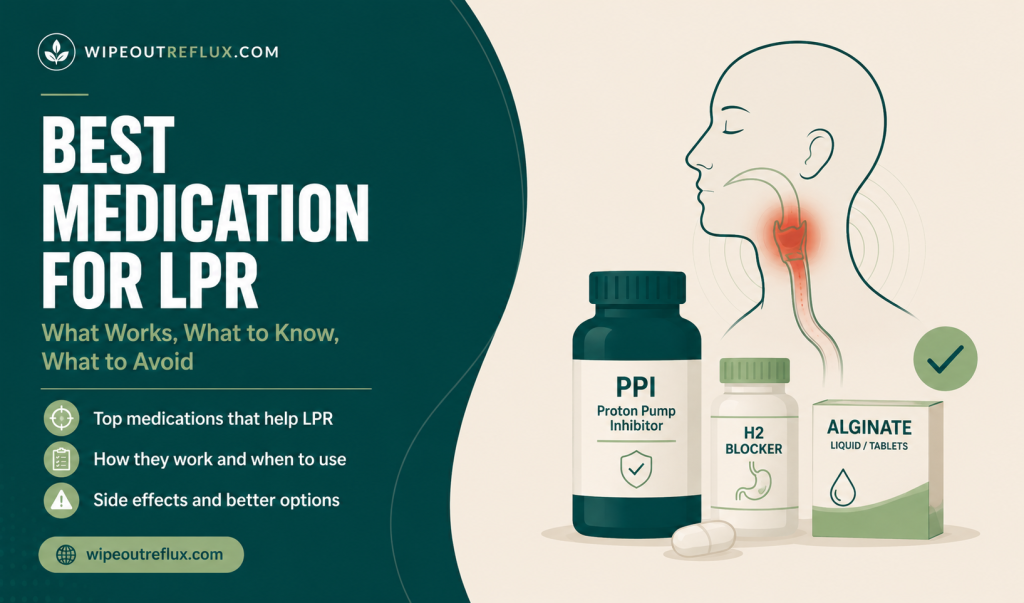
This article breaks down every medication category prescribed for LPR — starting with what the evidence actually shows, not what standard practice assumes. I will cover Gaviscon Advance (the best-evidenced option), PPIs, H2 blockers, baclofen, and antacids, and explain where each one sits in a genuinely evidence-based approach to managing silent reflux.
Key Takeaways
- The TOPPITS trial (2021, 346 patients) and the 2024 IFOS international consensus both confirm that PPIs are no better than placebo for persistent LPR throat symptoms.
- Gaviscon Advance (the UK alginate formulation) is the best-evidenced medication specifically for LPR — it works by forming a physical raft that prevents refluxate reaching the throat, regardless of its pH.
- A non-inferiority randomised trial found alginate to be equally effective to omeprazole for LPR, with a better side-effect profile.
- Gaviscon Advance works for LPR because it addresses pepsin and non-acid reflux — the two main drivers of LPR that PPIs completely miss.
- Famotidine (an H2 blocker) is a more LPR-relevant acid-suppressing option than PPIs, with less rebound risk and growing support from LPR specialists.
- Baclofen reduces the frequency of lower esophageal sphincter relaxations — the mechanism that drives most reflux events — and has meta-analytic support for reducing reflux episodes.
- The UK version of Gaviscon Advance and the US version are different products; only the UK version has clinical trial evidence for LPR.
- Diet and lifestyle changes are the most powerful long-term tools — medication works best when it is supporting a robust dietary approach, not replacing it.
Why Standard Medications Often Fail for LPR
To understand why treatment so often goes wrong, you need to understand what is actually happening in LPR versus GERD. In GERD, the primary problem is acid sitting in the esophagus for too long, causing inflammation and heartburn. Acid-suppressing drugs are reasonably logical for GERD — if you reduce the acid, you reduce the damage.
LPR is different. In LPR, refluxate travels all the way up through the esophagus and reaches the larynx, pharynx, and sometimes the sinuses and airways. The throat and voice box have almost no defence against the refluxate — and crucially, the damage is primarily caused by pepsin, a digestive enzyme, not just acid. Pepsin can remain active and damaging at pH levels as high as 6.5 and can be reactivated by subsequent acid exposure even after it has settled on throat tissue. A drug that reduces stomach acid from pH 1 to pH 4 does not deactivate pepsin. It does not stop non-acid reflux events from occurring. And it does not protect the laryngeal tissue that is doing the suffering.
This is why the right medication for LPR is fundamentally different from the right medication for GERD — and why most people diagnosed with LPR end up on the wrong treatment. The symptom picture of LPR — chronic throat clearing, globus, hoarseness, postnasal drip, cough — tends to respond to pepsin management and mucosal protection, not acid suppression alone.
Gaviscon Advance for LPR: The Best-Evidenced Medication
Gaviscon Advance — specifically the UK liquid formulation — is the medication with the strongest clinical evidence for LPR, and it works through a mechanism completely different from acid suppressants.
When you take Gaviscon Advance after a meal, the sodium alginate it contains reacts with stomach acid to form a gel raft that floats on top of the stomach contents. This raft physically prevents the post-meal acid pocket — the highly acidic layer that sits just below the gastroesophageal junction and is the primary source of reflux — from rising into the esophagus and throat. Critically, because it is a physical barrier rather than a chemical neutraliser, it works against all forms of reflux: acid, weakly acidic, and non-acid pepsin-containing reflux alike.
The clinical evidence is clear. A prospective study of 100 consecutive LPR patients found that Gaviscon Advance alone was effective in reducing LPR symptoms (RSI scores), and — importantly — that adding a twice-daily high-dose PPI to Gaviscon Advance produced no additional benefit over Gaviscon Advance alone [Wilkie et al., European Archives of Otorhinolaryngology, 2018]. This is a striking finding: Gaviscon Advance worked just as well without the PPI as it did with it.
A separate non-inferiority randomised controlled trial directly compared alginate suspension to omeprazole in 50 LPR patients over two months. Both groups showed significant reductions in RSI and RFS scores, and the alginate was confirmed as non-inferior to the PPI — producing equivalent LPR outcomes with a better tolerability profile and no acid rebound risk [Lechien et al., European Archives of Otorhinolaryngology, 2021].
How to use Gaviscon Advance for LPR: 10ml (two teaspoons) of the liquid, taken after each meal and at bedtime. The bedtime dose is particularly important — it provides protection during the night when lying flat removes gravity’s protection and throat tissues are most vulnerable to pepsin pooling. You must use the UK sodium alginate formulation (the one containing sodium alginate and potassium bicarbonate). The US Gaviscon products use a different formula and have not demonstrated the same LPR effectiveness. My dedicated Gaviscon Advance guide explains the difference and where to source the UK version.
PPIs for LPR: What the Evidence Actually Shows
PPIs (omeprazole, esomeprazole, lansoprazole, pantoprazole) are the most commonly prescribed medications for LPR, which makes it all the more important to be direct about what the evidence shows.
The TOPPITS trial — a multicentre, double-blind, randomised, placebo-controlled trial with 346 patients, the largest of its kind ever conducted — found no evidence of any benefit from lansoprazole over placebo for persistent throat symptoms [O’Hara et al., BMJ / Health Technology Assessment, 2021]. The conclusion was explicit: PPIs should not be prescribed for persistent throat symptoms.
The 2024 IFOS international consensus on LPR — produced by 48 international experts across otolaryngology, gastroenterology, and surgery — formally stated that acid suppression should not be considered first-line therapy for patients with isolated LPR symptoms without typical GERD findings [Lechien et al., The Laryngoscope, 2024]. Most doctors are still years behind this evidence.
This does not mean PPIs are useless in every LPR context. If you have both LPR and confirmed GERD — particularly if you have heartburn, regurgitation, or objective evidence of esophageal acid overexposure — PPIs can still help by reducing the acid load that pepsin travels with. But as a standalone treatment for isolated throat symptoms, they are not appropriate first-line therapy. If you have been taking PPIs for LPR and want to come off them, read my article on getting off PPIs safely — acid rebound is real and needs to be managed carefully.
Famotidine (H2 Blockers) for LPR
H2 receptor antagonists — most commonly famotidine (Pepcid) — work differently from PPIs. Rather than blocking the proton pump entirely, they competitively inhibit histamine at the H2 receptors of parietal cells, reducing acid output without switching off acid production completely. This matters for LPR for two reasons.
First, H2 blockers reduce acid more selectively than PPIs and do not cause the same degree of acid rebound hypersecretion when stopped. If you have LPR with some acid-driven component — particularly nighttime acid reaching the throat — famotidine at bedtime can meaningfully reduce acid exposure during the hours when you are most vulnerable. Dr Jamie Koufman, one of the world’s leading LPR specialists, advocates famotidine as a more appropriate acid-moderating option for respiratory reflux than PPIs, citing both the reduced rebound risk and the preserved digestive function.
Second, H2 blockers do not appear to lose efficacy as quickly with continuous use as PPIs, making them more suitable for longer-term acid management when that component is genuinely present.
For a direct comparison of your options in this category, see my article on Pepcid vs Gaviscon. The short version is that for pure LPR, Gaviscon Advance addresses the reflux mechanism directly and is a better first choice; famotidine is useful as an adjunct if there is a genuine acid component to your symptoms, particularly at night.
Baclofen for LPR
Baclofen is a GABA-B receptor agonist primarily used as a muscle relaxant and antispasticity drug, but it has a specific and relevant application for reflux: it reduces the frequency of transient lower esophageal sphincter relaxations (TLESRs), which are the primary mechanism driving most reflux events in both GERD and LPR.
When the lower esophageal sphincter relaxes inappropriately, stomach contents are free to travel upward. In LPR, a weak or frequently relaxing upper esophageal sphincter then allows that refluxate to reach the throat. Baclofen addresses the problem at the source by reducing how often the LES relaxes in the first place.
A meta-analysis of nine randomised controlled trials in GERD patients found that baclofen significantly reduced both the number of reflux episodes and the duration of reflux events compared to placebo, with no serious adverse events reported [Li et al., Gastroenterology Research and Practice, 2014]. A systematic review of LPR treatments also identified baclofen as a viable option for patients who do not respond adequately to acid-suppressing approaches [Lechien et al., European Archives of Otorhinolaryngology, 2019].
Baclofen is not without limitations. Side effects include drowsiness, dizziness, and cognitive dulling, which can be significant at therapeutic doses (typically 10–20mg three times daily). It is generally reserved for patients who have not responded adequately to Gaviscon Advance, dietary changes, or other frontline measures — and it should only be used under medical supervision. It is not an over-the-counter option.
What About Antacids for LPR?
Standard antacids (calcium carbonate, aluminium/magnesium hydroxide formulations) have a very limited role in LPR. They neutralise acid in the stomach and lower esophagus temporarily, but they do not form a protective raft, do not reach the throat, and have no effect on pepsin activity. Their duration of action is short — typically 20–30 minutes — and they provide no sustained protection.
Where antacids have some use in LPR is as immediate symptomatic relief for an acute episode — for example, if you have a breakthrough flare after a trigger meal. But they are not a management strategy. If you are relying on antacids regularly for LPR, that is a signal to address the underlying problem more systematically, not to keep reaching for chalk tablets.
The situation is different for alginate-antacid combinations — products like Gaviscon Double Action that combine an alginate raft with a bicarbonate-based antacid. These are more useful than plain antacids because the alginate component provides the physical barrier that matters for LPR. The UK Gaviscon Advance, however, remains the better-evidenced choice for dedicated LPR management.
Do You Even Need Medication for LPR?
This is a question more people should ask. A 2025 multicenter randomised trial published in Frontiers in Medicine found that dietary modifications alone — without any medication — produced significant, measurable improvements in both LPR symptoms (RSI scores) and clinical findings (RFS scores), as well as measurable reductions in salivary pepsin concentrations. The combination of diet plus mucosal protectors was most effective, but dietary change alone outperformed many medication-only approaches in the literature [Gelardi et al., Frontiers in Medicine, 2025].
The pattern I have seen consistently — in my own experience and through working with people managing LPR — is that medication provides support, but the dietary foundation is what drives real, lasting improvement. A low-acid, low-fat, low-pepsin diet that systematically avoids triggers and addresses meal timing and portion size will do more for LPR than any pill taken alongside an unchanged diet.
Where Gaviscon Advance and dietary changes have not been sufficient, and where there is genuine evidence of significant acid exposure, H2 blockers or — in combination with Gaviscon Advance — conservative PPI use may be appropriate. But the sequence matters: get the dietary approach right first, use Gaviscon Advance as your core medication, and layer additional pharmacological support based on what the evidence and your individual response warrant. For help building that dietary foundation, the LPR diet guide is the right starting point.
Frequently Asked Questions
What is the best medication for LPR?
Based on the available evidence, Gaviscon Advance (the UK sodium alginate formulation) is the best-evidenced medication specifically for LPR. It works by forming a physical raft over the stomach contents that prevents pepsin-containing refluxate from reaching the throat, regardless of the pH of what is being refluxed. Clinical trials have shown it to be effective for LPR symptoms as a standalone treatment and non-inferior to PPIs. For the acid component of LPR where it is genuinely present, famotidine at bedtime is a more appropriate adjunct than a PPI for most people.
Why aren’t my PPIs working for LPR?
Because PPIs are designed to treat acid-driven esophageal problems, and LPR is primarily a pepsin-driven throat problem. PPIs reduce stomach acid, but they do not stop reflux events from occurring, do not neutralise pepsin, and do not protect the laryngeal tissue from the damage pepsin causes. The TOPPITS trial with 346 patients confirmed that PPIs offer no benefit over placebo for persistent LPR throat symptoms. If your PPIs are not working, this is expected — not a sign that your LPR is untreatable. See my article on why acid reflux medication stops working for more context.
Can I take Gaviscon Advance long-term for LPR?
Yes — Gaviscon Advance is a medical device rather than a drug and does not carry the systemic risks associated with PPIs. It is not absorbed into the bloodstream and does not cause acid rebound when stopped. Long-term use is considered safe for most people. The main consideration for longer-term use is the sodium content (each 10ml dose contains sodium), which is relevant for people on very low-sodium diets or with certain cardiac or renal conditions — in which case a potassium-based alginate may be more appropriate.
Is famotidine better than omeprazole for LPR?
For LPR specifically, famotidine is generally a more appropriate choice than omeprazole if an acid-suppressing drug is to be used at all. It does not cause the same degree of rebound hypersecretion when stopped, does not carry the same long-term risk profile associated with prolonged PPI use, and preserves more normal digestive function. However, neither is as well-evidenced for LPR as Gaviscon Advance, which addresses the pepsin and non-acid reflux components that acid suppressors miss entirely.
How quickly does Gaviscon Advance work for LPR?
Gaviscon Advance provides mechanical protection within minutes of taking it — the raft forms rapidly on top of stomach contents. However, meaningful improvement in LPR symptoms (throat clearing, globus, hoarseness) typically takes four to eight weeks of consistent use alongside dietary changes, because inflamed laryngeal and pharyngeal tissue takes time to heal even when reflux is being controlled. Expecting rapid relief from any single medication for LPR is usually unrealistic — tissue healing is the rate-limiting step.
Can I use both Gaviscon Advance and a PPI for LPR?
Yes, and some specialists do use both, particularly in cases where there is confirmed GERD alongside LPR. The key finding from the Wilkie 2018 trial, however, is that adding a PPI to Gaviscon Advance did not improve LPR outcomes beyond Gaviscon Advance alone. If you are using both and not improving on the PPI component, that is clinically consistent with the evidence — the Gaviscon Advance is likely doing the meaningful work. Discuss this with your prescriber before making any changes.
Is surgery an option if medication isn’t working for LPR?
Laparoscopic fundoplication — which physically tightens the lower esophageal sphincter by wrapping the upper stomach around it — is considered when both medical management and dietary approaches have failed and there is objective evidence of significant reflux. It can be highly effective for LPR, particularly in people who have clear structural sphincter dysfunction. It is not a first-line or second-line option, but it is worth discussing with a specialist if you have tried a genuine six-month trial of Gaviscon Advance plus dietary changes with inadequate response. More detail is available in my silent reflux treatment overview.
Conclusion
The medication landscape for LPR is genuinely different from what most people are told. PPIs — the default prescription — are not the best-evidenced option for throat symptoms, and the clinical trial data is now unambiguous on this point. The medication that is actually backed by LPR-specific evidence is Gaviscon Advance, used consistently after meals and at bedtime, as part of a broader plan that includes meaningful dietary changes.
If you are on PPIs for LPR and they have not helped, please know that this is the expected outcome for most people — not a sign that your case is uniquely intractable. The approach that works is Gaviscon Advance as the frontline medication, a genuinely low-acid diet targeting pepsin reactivation, and appropriate acid modulation where objective evidence indicates it is needed.
The most complete resource I have built for managing LPR from the ground up is the Wipeout Diet Plan. It covers not just what to eat but the full framework for understanding LPR, choosing the right interventions, and building a sustainable routine that actually moves symptoms in the right direction. For a quick, practical reference on the foods and drinks that are safe versus those that drive pepsin reactivation and acid exposure, the Wipeout Essential Reflux Food List is the companion resource I recommend using alongside any medication protocol.
Research & References
The TOPPITS multicentre, double-blind, randomised placebo-controlled trial (346 patients, 16 weeks) found no evidence of any benefit from lansoprazole over placebo for persistent throat symptoms attributed to LPR, concluding that PPIs should not be prescribed for this indication. [O’Hara et al., BMJ / Health Technology Assessment, 2021]
An international consensus of 48 experts in otolaryngology, gastroenterology, and surgery (the IFOS Dubai Consensus) formally defined LPR and stated that acid suppression should not be considered first-line therapy for patients with isolated LPR throat symptoms without typical GERD findings. [Lechien et al., The Laryngoscope, 2024]
A prospective study of 100 LPR patients found that Gaviscon Advance alone was effective in reducing RSI scores, and that co-prescription with a twice-daily high-dose PPI offered no additional benefit over Gaviscon Advance as monotherapy. [Wilkie et al., European Archives of Otorhinolaryngology, 2018]
A non-inferiority randomised controlled trial in 50 LPR patients found that alginate suspension produced equivalent reductions in RSI and RFS scores to omeprazole over two months, confirming alginate as a viable alternative to PPI therapy for LPR with a better tolerability profile. [Lechien et al., European Archives of Otorhinolaryngology, 2021]
A meta-analysis of nine randomised controlled trials found that baclofen significantly reduced the number and duration of reflux episodes by reducing transient lower esophageal sphincter relaxations, with no serious adverse events and mild-to-moderate tolerability issues only. [Li et al., Gastroenterology Research and Practice, 2014]
A systematic review of controlled LPR treatment studies confirmed that alginate, H2 receptor antagonists, and baclofen are relevant pharmacological options for LPRD, and that dietary and behavioural modifications are important components of any comprehensive management approach. [Lechien et al., European Archives of Otorhinolaryngology, 2019]
A 2025 multicenter randomised trial confirmed that dietary modifications alone — without medication — produced significant improvements in LPR symptom scores and measurable reductions in pepsin concentrations, with the combination of diet plus mucosal protectors producing the greatest overall benefit. [Gelardi et al., Frontiers in Medicine, 2025]

David Gray
Content Researcher & Author
David Gray founded Wipeout Reflux to address a critical gap in reflux management. His research synthesizes over 100 peer-reviewed studies on laryngopharyngeal reflux (LPR), pepsin biology, and GERD pathophysiology. For LPR specifically—a condition most physicians misdiagnose—his work focuses on pepsin reactivation and why standard PPI therapy fails most patients. He develops evidence-based protocols targeting root causes of both LPR and GERD, integrating emerging research on sphincter dysfunction, dietary interventions, and newer clinical approaches. Wipeout Reflux represents practical application of clinical science for patients seeking real solutions.