
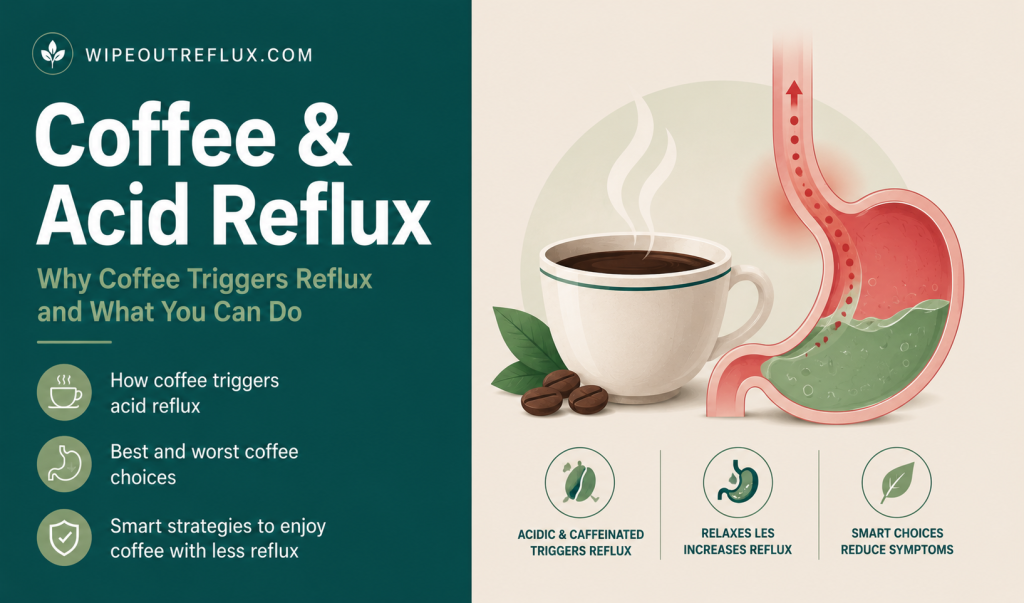
Coffee is one of the first things most reflux sufferers are told to cut out. The advice is consistent, authoritative, and almost universal — and the science behind it is weaker than most people assume. Coffee does have mechanisms that can worsen reflux. But the overall association between coffee and GERD turns out to be small, individual tolerance varies enormously, and blanket avoidance for everyone with reflux is not what the current research actually supports.
That honest framing is rarer than it should be online, because most pages on this topic are written by coffee brands with something to sell you, or by reflux education sites defaulting to the conservative maximum-restriction position. Neither is particularly useful if you’re trying to make an informed, practical decision about whether your morning coffee is actually driving your symptoms.
This guide covers what the evidence says about coffee and reflux, the chemistry behind why some coffees are gentler than others, the specific differences for LPR and silent reflux, and a set of practical levers that genuinely reduce the risk — including the best coffee options and caffeine-free alternatives worth considering.
Key Takeaways
- A large 2026 meta-analysis of 40 studies and 122,000+ patients found coffee drinkers had a slightly elevated GERD risk (OR 1.18) — real but modest, and of “unclear clinical significance”
- Coffee’s effect on reflux comes through two main routes: stimulating gastric acid secretion (via chlorogenic acids) and reducing lower oesophageal sphincter pressure
- Decaffeinated coffee stimulates gastric acid secretion almost as much as regular coffee — the acid-stimulating compounds are not caffeine
- Dark roast coffee contains higher levels of N-methylpyridinium (NMP), a compound that actually suppresses gastric acid secretion — making it gentler for many reflux sufferers than light roast
- Cold brew has lower total acid content (titratable acidity) than hot brew, though the pH difference is smaller than commonly claimed — a useful option for the acid-sensitive
- For LPR (silent reflux), the concern is less about the stomach and more about caffeine loosening the upper sphincter and acidic coffee reactivating pepsin already lodged in throat tissue — timing and quantity matter as much as coffee type
- Individual tolerance is the deciding factor — many coffee drinkers with reflux can tolerate one or two cups with food, particularly if choosing dark roast or cold brew
- Chicory, matcha, and herbal teas are the most useful alternatives if you’re reducing or eliminating coffee
Does Coffee Cause Acid Reflux?
Coffee is associated with acid reflux — but only modestly. The largest and most comprehensive analysis to date, published in 2026 in Clinical and Translational Gastroenterology, pooled data from 40 studies involving 122,074 patients and found that coffee drinkers had a slightly higher rate of GERD than non-drinkers: 34.9% versus 30.7%, giving an odds ratio of 1.18. The conclusion was measured: “Coffee use was associated with a small, statistically significant increased rate of GERD… the magnitude of this effect, however, is of unclear clinical significance.” [Meta-analysis, Clinical and Translational Gastroenterology, 2026]
The same review found no significant association between coffee and Barrett’s oesophagus — the more serious complication of long-term GERD — which further undermines the clinical weight of the coffee-reflux link. The authors also noted that restricting coffee “may be best reserved for patients who clearly identify coffee as a symptom trigger and report distinct symptom improvement with reduction or cessation.”
That’s a meaningfully different position from “everyone with acid reflux should stop drinking coffee.” There’s genuine variability: some people with GERD find coffee triggers their symptoms immediately and reliably; others drink it daily with no measurable impact. If you’re in the latter group, the evidence suggests you don’t need to stop. If you’re in the former, the mechanisms below explain why, and the levers further down this article will help you manage it.
Why Does Coffee Give Me Acid Reflux?
Coffee acts on reflux through two main pathways: it stimulates the stomach to produce more acid, and it reduces the pressure in the lower oesophageal sphincter (LES) that keeps stomach contents from rising. Here’s how each one works — and where the conventional wisdom needs some correction.
Chlorogenic Acids and Gastric Acid Secretion
Coffee contains chlorogenic acids (CGAs) — a family of polyphenol compounds that, among other things, stimulate gastric acid secretion. More acid in the stomach means a larger volume of corrosive material available if reflux does occur. CGAs are present in all coffee, but in different concentrations depending on roast level — light roasts contain significantly more than dark roasts, since extended roasting degrades them.
The important nuance here is that CGAs, not caffeine, are primarily responsible for coffee’s acid-stimulating effect. A study published in the New England Journal of Medicine found that decaffeinated coffee produced a maximal acid secretion response of 16.5 mEq/hour — nearly as high as regular coffee at 20.9 mEq/hour — while caffeine alone produced only 8.4 mEq/hour on a cup-equivalent basis [Cohen S., New England Journal of Medicine, 1975]. This is why switching to decaf doesn’t solve the problem for most reflux sufferers — the acid-stimulating compounds remain.
Caffeine, the LES, and What Else Coffee Does
Caffeine relaxes smooth muscle, including the LES — the valve that prevents stomach contents from escaping upward. A more relaxed LES means more frequent and larger reflux events. This is the most commonly cited mechanism, and it’s real. But it’s worth knowing that coffee also delays gastric emptying in some people, meaning stomach contents remain under pressure for longer, and that the combination of these effects — more acid, a weaker valve, and slower emptying — creates the most unfavourable conditions for reflux. You can read more about how the LES functions in my guide to the stomach sphincter and LPR.
Decaffeinating coffee removes the LES-relaxing effect of caffeine, which is why decaf is often better tolerated. But it doesn’t remove the CGAs, so gastric acid stimulation persists. The practical upshot: decaf reduces one of the two main drivers but not both.
Is Coffee Bad for Acid Reflux? How Much It Actually Matters
The magnitude of the coffee-reflux effect depends on several factors that vary between individuals: how much coffee, what type, on an empty stomach or with food, morning or evening, and underlying LES baseline tone. Someone with a structurally weak LES or hiatal hernia may be far more affected by the same cup than someone without these issues.
What the research suggests is that moderate coffee consumption — one to two cups, with food, earlier in the day — is tolerable for a significant proportion of reflux sufferers. Heavy consumption (six or more cups per day, as in the Nurses’ Health Study data) shows a clearer association. And consumption on an empty stomach, last thing at night, or in large quantities is where the mechanisms above converge most damagingly.
The honest answer to “is coffee bad for acid reflux” is: probably not very, for most people who drink it in moderation and with food. Significantly, for people who find it a clear personal trigger. The practical approach is to test systematically — eliminate coffee for two to four weeks, note whether your symptoms improve, and reintroduce if they don’t. That gives you actual data about your individual response rather than applying a blanket rule.
Best Coffee for Acid Reflux: Dark Roast, Cold Brew, and What to Look For
If you want to keep drinking coffee while managing reflux, the type and preparation method genuinely matter. These are the levers with research support behind them.
Dark Roast Coffee
The most robustly evidenced option for acid-sensitive coffee drinkers. Longer roasting time degrades the chlorogenic acids that stimulate gastric acid secretion — but more importantly, it generates a compound called N-methylpyridinium (NMP) that is not present in green beans and increases with roast duration. Research comparing dark roast and medium roast coffees with the same caffeine content found that the dark roast (containing 87 mg/L NMP vs 29 mg/L in medium roast) produced significantly less gastric acid secretion in healthy volunteers [Rubach M. et al., Molecular Nutrition and Food Research, 2014]. NMP appears to actively suppress acid production at the cellular level by reducing the expression of acid-secreting receptors.
The practical implication: a dark roast (French roast, Vienna roast, dark espresso blends) will generally produce less gastric acid than an equivalent light or medium roast. This doesn’t eliminate the LES-relaxing effect of caffeine, but it removes one of the two main drivers of reflux risk from coffee.
Cold Brew Coffee
Cold brew — coffee steeped in cold water for 12–24 hours rather than extracted with hot water — is widely marketed as being dramatically less acidic than regular coffee. The science is more nuanced. A study published in Scientific Reports measuring the chemistry of cold brew versus hot brew across six coffee origins found that the pH values were comparable, ranging from 4.85 to 5.13 for both methods. However, hot brew coffees had significantly higher concentrations of total titratable acids — the total acid load — than their cold brew counterparts [Rao N.Z. and Fuller M., Scientific Reports, 2018].
What this means practically: the pH difference between cold brew and hot brew is smaller than coffee brand marketing implies. But cold brew does extract fewer acidic compounds overall, which matters for the total acid load reaching the stomach — and many people with reflux find it significantly gentler. It’s worth trying if you haven’t, particularly dark roast cold brew, which combines both benefits. The lower temperature during extraction also means fewer volatile acid compounds are extracted, which likely accounts for the gentler mouthfeel and reduced stomach irritation many users report.
Decaf Coffee and Acid Reflux
Worth addressing directly here: decaf is frequently recommended as the simple fix for coffee-related reflux, but it only addresses one of two mechanisms. Decaffeination removes caffeine — reducing the LES-relaxing effect — but leaves the chlorogenic acids largely intact, so it still stimulates gastric acid secretion at close to the same rate as regular coffee. For people whose main sensitivity is to caffeine’s effect on the LES, decaf helps. For those whose main sensitivity is acid stimulation, it doesn’t. My dedicated article on whether decaf coffee is bad for acid reflux goes into this in more detail.
The best decaf option for reflux, if you want one: dark roast decaf cold brew — dark roast reduces CGAs and raises NMP (reducing acid stimulation), decaf removes caffeine (reducing LES relaxation), and cold brew lowers the total titratable acid load. It’s the closest thing to a reflux-friendly coffee that still tastes like coffee.
Low Acid Coffee Brands: What to Look For
The “low acid coffee” category has expanded significantly, with several brands specifically marketing to reflux and sensitive-stomach drinkers. When evaluating these products, the meaningful indicators are roast level and processing method rather than marketing claims:
- Roast level: Dark roast is the single most important factor. Any low acid coffee claiming to reduce acid through roasting is likely relying on the NMP and CGA degradation mechanism described above — this is legitimate science
- Steam processing: Some brands use steam treatment of green beans before roasting to remove irritating compounds. Research on steam-treated coffees showed reduced stomach acid stimulation, though the effect was partly attributed to removing compounds later found to include beneficial ones as well
- Cold brew format: Cold brew concentrates and ready-to-drink cold brews from reputable roasters offer the lower titratable acidity advantage without requiring home preparation
- Arabica vs Robusta: Arabica beans are generally higher in organic fruit acids (malic, citric) that contribute to perceived acidity and flavour complexity. Robusta is often lower in these acids but significantly higher in caffeine — which may offset any acid benefit through greater LES relaxation. Neither is clearly better for reflux; roast level and preparation method matter more than bean species
For a full reference on which drinks work for acid reflux and LPR with their pH values, the Wipeout Reflux Food Reference Guide covers coffee alongside all the other major food and drink categories.
Coffee and Silent Reflux (LPR): The Throat Perspective
For people with LPR (laryngopharyngeal reflux), the coffee picture is somewhat different from standard GERD — and requires more specific management than simply switching to a lower-acid roast.
In LPR, the refluxate doesn’t just reach the oesophagus — it travels through the upper oesophageal sphincter (UES) into the throat and larynx. The primary driver of tissue damage at that level is not acid alone but pepsin, which embeds in throat tissue and reactivates whenever the local pH drops. This creates a specific problem with coffee: the caffeine in regular coffee relaxes both the LES and the UES, giving refluxate easier access to the throat. And even low-acid coffee, with a pH of around 5, is acidic enough to reactivate pepsin that is already lodged in throat tissue. You can read more about this mechanism in my guide to neutralising pepsin in the throat.
This means that for LPR, the key variables are somewhat different:
- Timing matters more than type: Never drink coffee on an empty stomach — food provides a partial buffer and reduces the acid pulse that reaches the throat. A substantial breakfast before coffee makes a meaningful difference
- Avoid late-day coffee: Evening coffee means refluxate may reach the throat while you’re lying down — exactly when gravity is no longer helping keep contents in the stomach. If you have LPR, confine coffee to the morning. My guide to acid reflux at night explains why lying flat changes everything
- Quantity is the primary lever: One small cup with breakfast triggers far less LES and UES relaxation than two large cups on an empty stomach. For LPR specifically, quantity control is often more impactful than switching roast type
- Decaf helps more for LPR than GERD: Because caffeine’s effect on the UES is a key driver of LPR, removing it (with decaf) addresses the more relevant mechanism for throat reflux — even if it doesn’t fully solve the gastric acid stimulation issue
Coffee Alternatives for Acid Reflux
If you’ve decided to reduce or eliminate coffee — either because it’s clearly triggering your reflux or because you want to give your throat time to recover from LPR damage — these are the most useful alternatives.
Chicory Coffee
Roasted chicory root produces a dark, slightly bitter beverage that closely resembles the flavour profile of coffee. It’s entirely caffeine-free, contains inulin (a prebiotic fibre that supports gut bacteria), and has a naturally low acidity. It won’t provide the alertness of coffee, but it satisfies the ritual of a hot, dark morning drink remarkably well. Blends that combine chicory with small amounts of barley or dandelion root are widely available.
Matcha
Matcha — powdered green tea — contains caffeine but significantly less than coffee (roughly 70mg per serving versus 95–200mg in coffee), and its caffeine is buffered by L-theanine, an amino acid that modulates the stimulant effect for a more gradual, sustained energy. Green tea generally has a higher pH than coffee and is far lower in the compounds that stimulate gastric acid secretion. Many people who can’t tolerate coffee find matcha manageable. The catch: it still contains caffeine, so for LPR specifically it may still relax the LES somewhat — just less than coffee would.
Herbal Teas
Several herbal teas are not only caffeine-free but actively beneficial for reflux. Chamomile tea has mild anti-inflammatory properties and is well-tolerated. Marshmallow root tea provides a mucilaginous coating effect in the throat and oesophagus that may help soothe irritation from reflux. My article on chamomile tea and acid reflux covers the evidence in detail. Liquorice root (DGL form) and slippery elm are also worth considering.
Rooibos Tea
A South African herbal tea that’s caffeine-free, naturally low in acidity, and rich in antioxidants. It has a pleasant, slightly sweet flavour that makes it one of the more palatable complete coffee alternatives. It’s also safe for long-term daily use without the concerns that exist around excessive caffeine consumption.
Alkaline Water with Lemon Balm
For people managing LPR in particular, starting the morning with high-pH alkaline water rather than an acidic beverage gives the throat tissue time to recover before any food or drink challenge. My article on alkaline water and LPR covers the evidence for this approach.
How to Reduce Reflux from Coffee: Practical Levers
If you’re keeping coffee in your life but want to minimise its reflux impact, these are the changes with the best evidence-to-effort ratio:
- Always eat first: Food buffers the acid pulse from coffee and reduces the exposure of the LES and throat to the caffeine and CGA bolus. Even a small breakfast before coffee makes a significant difference
- Choose dark roast: The NMP content is higher, CGAs are lower, and the gastric acid stimulation is meaningfully reduced compared to light or medium roast
- Consider cold brew: Lower titratable acidity means a smaller total acid load even if the pH isn’t radically different — many people with reflux report real improvement
- One cup, not three: Every cup adds an incremental dose of caffeine (LES relaxation) and CGAs (acid stimulation). Limiting to one, particularly one with food, keeps the cumulative effect within manageable range for most people
- Morning only: Late-day caffeine keeps the LES partially relaxed into the evening and night — exactly when you’re moving toward a lying position. Cut off coffee by midday if reflux is symptomatic, earlier for LPR
- Avoid drinking hot coffee on an empty stomach last thing in the morning: The worst combination is a large hot light-roast coffee on an empty stomach taken immediately before lying down — this stacks every adverse variable simultaneously
- Use an alginate after coffee if needed: Gaviscon Advance taken after your morning coffee provides a physical raft that sits on stomach contents and reduces what escapes through a relaxed LES. My Gaviscon Advance guide covers timing and technique
Frequently Asked Questions
Is coffee bad for acid reflux?
For many people, not significantly — particularly if consumed in moderation with food. A 2026 meta-analysis of 40 studies found a small but real association between coffee and GERD (odds ratio 1.18), but concluded that the clinical significance is unclear and that blanket avoidance for all reflux patients is not warranted. Individual testing — eliminating coffee for a few weeks and noting the impact — is more informative than a blanket rule.
What is the best coffee for acid reflux?
Dark roast coffee, ideally cold brew. Dark roast degrades acid-stimulating chlorogenic acids and generates NMP, a compound that suppresses gastric acid production. Cold brew extracts fewer total acids than hot brew. Combining both — dark roast cold brew — gives the best chemical profile for acid-sensitive drinkers. Adding decaf to that combination removes the LES-relaxing caffeine, though decaf alone doesn’t solve the acid-stimulation issue.
Does decaf coffee cause acid reflux?
It can — because decaffeination removes caffeine but not the chlorogenic acids that stimulate gastric acid secretion. Research has shown that decaf and regular coffee produce similar levels of acid secretion, suggesting caffeine isn’t the primary driver of coffee’s acid-stimulating effect. Decaf does reduce the LES-relaxing effect, which helps, but it’s not a complete solution for reflux.
Is cold brew better for acid reflux than hot coffee?
Often yes, but not for the reason usually stated. Cold brew and hot brew have similar pH values. The difference is in total titratable acidity — the amount of acids extracted — where cold brew comes out lower. Many people with reflux find cold brew gentler to drink, and the research on lower titratable acidity supports that experience even if the pH numbers are close.
Can coffee cause silent reflux (LPR)?
Yes — and LPR may actually be more sensitive to coffee than standard GERD, because caffeine’s relaxation of the upper oesophageal sphincter allows refluxate to reach the throat more readily. The acidic pH of any coffee (including low-acid options) can also reactivate pepsin already embedded in throat tissue. For LPR, timing and quantity are the most important variables — morning only, with food, and in modest amounts.
How much coffee can you drink with acid reflux?
This is highly individual. The research association between coffee and GERD was most pronounced at very high consumption (six or more cups per day). One or two cups per day with food appears to be tolerable for a significant proportion of people with reflux. For LPR, lower amounts and stricter timing rules apply — one small cup with breakfast as the maximum is a practical starting point.
What can I drink instead of coffee for acid reflux?
Chicory coffee is the closest flavour match without any caffeine or acidity. Matcha provides caffeine with lower acidity and buffering from L-theanine. Chamomile, rooibos, and marshmallow root teas are all caffeine-free and well-tolerated. For a full reference on which drinks are safe for acid reflux with pH values, the acid reflux drinks guide covers this comprehensively.
Conclusion
The evidence on coffee and acid reflux turns out to be more nuanced than the standard “avoid it entirely” advice suggests. Coffee does have real mechanisms that can worsen reflux — chlorogenic acids stimulating gastric acid production, caffeine relaxing the LES — but the population-level association with GERD is modest, and plenty of coffee drinkers with reflux manage it without eliminating coffee at all.
The practical approach is to apply the right levers: choose dark roast (for lower CGAs and higher NMP), consider cold brew (for lower total acid load), drink with food rather than on an empty stomach, and confine coffee to the morning. If you have LPR specifically, timing and quantity matter more than bean choice, and decaf becomes more useful because caffeine’s effect on the upper sphincter is the more relevant mechanism at the throat level.
For people who do need to reduce or eliminate coffee, chicory and matcha are the most practical substitutes, and the overall diet changes in the Wipeout Diet Plan provide the most structured framework for getting reflux under control — coffee being one variable among several. The Wipeout Reflux Food Reference Guide covers the pH values and reflux ratings for coffee, tea, and all the common drink alternatives, so you always know where you stand.
Research & References
Meta-analysis, Clinical and Translational Gastroenterology (2026). Association of coffee intake with risk of gastroesophageal reflux disease and complications: a systematic review and meta-analysis. Pooled data from 40 studies and 122,074 patients found coffee drinkers had a slightly higher GERD rate than non-drinkers (34.9% vs 30.7%; OR 1.18), but no association with Barrett’s oesophagus. The authors concluded the clinical significance of the association is unclear and that restricting coffee intake is best reserved for those who identify it as a clear personal trigger. [Clinical and Translational Gastroenterology, 2026]
Cohen S. (1975). Gastric acid secretion and lower-esophageal-sphincter pressure in response to coffee and caffeine. This New England Journal of Medicine study compared the effects of caffeine alone, regular coffee, and decaffeinated coffee on gastric acid secretion. Decaffeinated coffee produced a maximal acid response of 16.5 mEq/hour — comparable to regular coffee at 20.9 mEq/hour — while caffeine alone produced only 8.4 mEq/hour, establishing that the acid-stimulating compounds in coffee are not primarily caffeine. [Cohen S., New England Journal of Medicine, 1975]
Rubach M. et al. (2014). A dark brown roast coffee blend is less effective at stimulating gastric acid secretion in healthy volunteers compared to a medium roast market blend. This study of nine healthy volunteers found that dark roast coffee (containing 87 mg/L of N-methylpyridinium, NMP) produced significantly less gastric acid than medium roast (29 mg/L NMP), despite equivalent caffeine content. NMP is generated during roasting and acts to suppress acid-secreting mechanisms at the cellular level. [Rubach M. et al., Molecular Nutrition and Food Research, 2014]
Rao N.Z. and Fuller M. (2018). Acidity and antioxidant activity of cold brew coffee. This Scientific Reports study measured pH and titratable acidity in cold and hot brew coffees across six origins. pH values were comparable (4.85–5.13 for both methods), but hot brew contained significantly higher concentrations of total titratable acids, indicating that cold brewing extracts fewer total acids despite similar pH — providing a plausible mechanism for the gentler stomach experience widely reported with cold brew. [Rao N.Z. and Fuller M., Scientific Reports, 2018]

David Gray
12 years living with LPR · Consultant & researcher
I've lived with LPR for twelve years — the misdiagnoses, the PPI courses that did nothing, the slow work of figuring out what actually helps. Wipeout Reflux is where I translate the research into plain terms for people stuck in the same place. Every claim here is sourced to peer-reviewed work, and I consult one-to-one with LPR sufferers.