
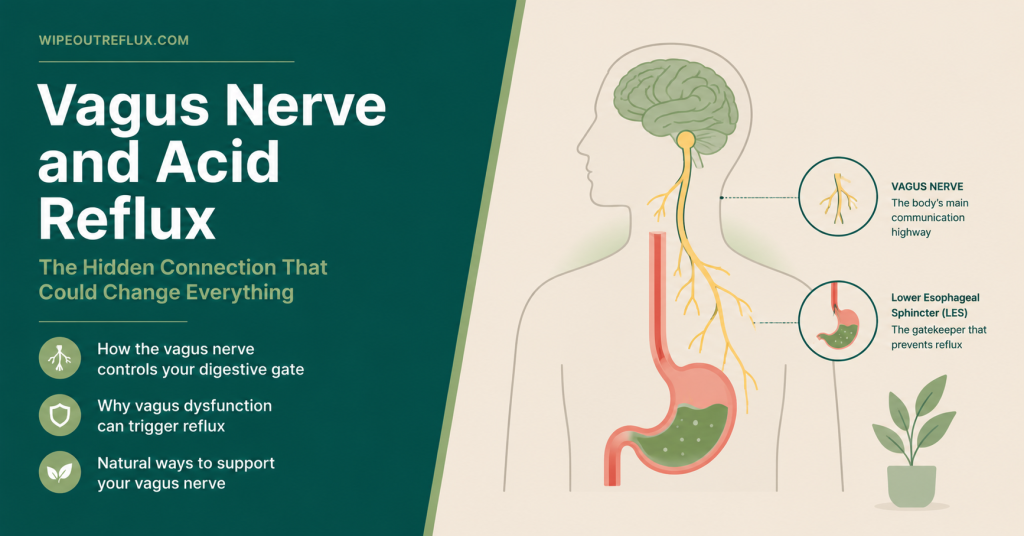
If you’ve been managing acid reflux or LPR for any length of time and keep hitting a ceiling with diet and medication alone, the vagus nerve is worth understanding. It’s the primary neural highway linking your brain to your digestive system, and its role in reflux is more specific and more significant than most people — and many clinicians — ever discuss.
The vagus nerve doesn’t just sit in the background of digestion. It actively controls whether your lower esophageal sphincter (LES) holds its pressure or lets acid escape upward. It regulates how fast your stomach empties. It governs the peristaltic contractions that clear acid from your esophagus after reflux occurs. When vagal function is impaired — as research shows it frequently is in GERD and LPR patients — those functions degrade together, creating a picture that medication alone can’t fully correct.
This article covers the mechanism in full, what the research says about vagal tone and reflux, and — most practically — the evidence-based approaches to improving vagal tone that can make a measurable difference to symptoms.
Key Takeaways
- Transient LES relaxations — the primary mechanism behind most reflux events — are triggered by a vago-vagal reflex: gastric stretch activates vagal sensors, signals travel to the brainstem, and vagal efferents cause the LES to open.
- Studies have found that 44% of GERD patients show abnormal autonomic nerve function, predominantly parasympathetic (vagal) dysfunction, and this correlates directly with impaired esophageal motility and delayed transit.
- GERD and related functional gut disorders are consistently associated with suppressed vagal tone and overactive sympathetic drive — measurable via heart rate variability (HRV).
- The vagus nerve carries roughly 80% of its signals from gut to brain — it’s primarily a sensing system, not just a control system. Disruption at either end affects the other.
- Diaphragmatic breathing directly activates vagal tone, increases LES pressure during the inspiratory phase, and has been shown in randomised controlled trials to significantly reduce esophageal acid exposure time.
- Transcutaneous vagus nerve stimulation (tVNS) has shown meaningful improvement in LPR symptoms and esophageal motility in a recent randomised controlled trial.
- Improving vagal tone is a trainable, practical intervention — not a passive process — and several evidence-informed approaches take minutes per day.
What Is the Vagus Nerve?
The vagus nerve — from the Latin for “wandering” — is the tenth cranial nerve and the longest nerve in the body. It originates in the brainstem and travels through the neck, chest, and abdomen, branching out to innervate the heart, lungs, esophagus, stomach, intestines, liver, kidneys, and beyond.
It’s the principal component of the parasympathetic nervous system — the “rest and digest” branch that counterbalances the “fight or flight” sympathetic system. Critically, it carries information in both directions. Roughly 80% of vagal fibres are afferent — they carry sensory information from the organs up to the brain. Only 20% are efferent, carrying instructions from the brain down to the organs. This means the vagus nerve is primarily a sensing system, continuously reporting the state of your gut, heart, and lungs upward to the brain, with the brain responding accordingly [Bonaz B et al., Frontiers in Neuroscience, 2018].
The term “vagal tone” refers to the baseline level of parasympathetic activity the vagus nerve is producing. High vagal tone means healthy parasympathetic dominance — digestion works efficiently, the gut is well-regulated, and inflammatory signals are actively suppressed. Low vagal tone means the sympathetic system is running too hot, and all the digestive functions the vagus normally supports — including those that prevent reflux — start to degrade.
How the Vagus Nerve Controls Acid Reflux and Digestion
The vagus nerve is involved at virtually every step of the anti-reflux system. Understanding where it sits in the chain of events helps explain why improving vagal tone isn’t just a general wellness idea — it’s a targeted intervention for reflux specifically.
Transient LES Relaxations — The Primary Reflux Mechanism
The most important thing to understand about reflux physiology is that most reflux events are not caused by a permanently weak LES. They’re caused by transient LES relaxations (TLESRs) — brief, sudden relaxations of the sphincter that occur independent of swallowing and allow stomach contents to escape upward.
TLESRs are almost entirely driven by a vago-vagal reflex. When gastric distension occurs — for instance, after eating — stretch receptors in the upper stomach activate vagal afferent nerve endings. This signal travels to the brainstem, where it is processed in the nucleus tractus solitarius and dorsal motor nucleus of the vagus. From there, vagal efferent pathways signal inhibitory neurons in the LES wall, causing the sphincter to relax. The reflex exists to allow belching — but in GERD patients, the system is dysregulated, and these relaxations occur too frequently, for too long, or at the wrong moments [NCBI Bookshelf: Motor Function of the Pharynx, Esophagus, and its Sphincters].
One of the most direct demonstrations of the vagal mechanism is the experimental finding that cooling the cervical vagus nerve physically blocks TLESRs. No vagal signal — no transient relaxation — no reflux. The vagal pathway is the gate through which the primary reflux mechanism operates.
Resting LES Pressure and Vagal Tone
Beyond TLESRs, resting LES pressure is itself partly maintained by vagal tone. The release of acetylcholine from vagal efferent endings maintains or increases LES contractility. When vagal tone is chronically suppressed — as happens under chronic stress or in patients with parasympathetic dysfunction — resting LES pressure can fall, widening the window through which reflux occurs.
Research published in Gut found that in 59 of 83 patients with reflux esophagitis, the LES response to abdominal pressure was subnormal — a response that normally occurs through a vagally-mediated protective mechanism. This vagal impairment was particularly prevalent in older patients and was unrelated to hiatal hernia, suggesting it was a primary dysfunction rather than a secondary effect [Bancewicz J et al., Gut, 1987].
Gastric Emptying, Esophageal Motility, and Acid Clearance
The vagus nerve also governs gastric emptying, esophageal peristalsis, and salivary secretion — three functions that directly affect how long acid spends in the esophagus and stomach after a meal. The vagus nerve is particularly important for regulating LES tone, gastric emptying, and salivary secretion through its parasympathetic control of the autonomic nervous system [et al., Frontiers in Medicine, 2025].
A study of 48 GERD patients examining the relationship between autonomic nerve dysfunction, esophageal motility, and gastric emptying found that 44% had abnormal autonomic nerve function — predominantly parasympathetic dysfunction. Esophageal transit was significantly slower in patients with abnormal vagal function, and abnormal synchronous contractions correlated with the degree of autonomic dysfunction. The researchers concluded that parasympathetic dysfunction was of pathogenic importance in GERD [Mayer EA et al., Gut, 1991].
This matters enormously for acid clearance. Even if a reflux event occurs, how quickly acid is cleared from the esophagus depends heavily on peristaltic contractions sweeping it back down — and those contractions are coordinated by vagal pathways. When peristalsis is disorganised or weakened due to vagal dysfunction, each reflux episode causes more cumulative acid exposure.
Low Vagal Tone and GERD — What the Research Shows
Heart rate variability (HRV) is one of the most reliable non-invasive markers of vagal tone. The high-frequency component of HRV specifically reflects vagal (parasympathetic) activity. A systematic review examining HRV across GERD and functional gastrointestinal disorders found consistently that GERD is associated with decreased parasympathetic activity and increased sympathetic nervous system activity — with the autonomic balance shifted toward the sympathetic system. The authors concluded that GERD is associated with impaired autonomic dysfunction driven by suppressed vagal and overactive sympathetic tone [Ali A et al., Diagnostics, 2023].
This matters because it establishes low vagal tone not as a consequence of reflux symptoms — but as part of the underlying pathophysiology. The autonomic imbalance is measurable, it’s consistently present in GERD populations, and it corresponds directly to the impaired LES function, slowed gastric emptying, and disordered peristalsis seen in these patients.
The practical implication is that any intervention which genuinely restores vagal tone — not just suppresses acid — is addressing one of the actual disease mechanisms. This is the rationale behind diaphragmatic breathing, vagus nerve stimulation research, and other approaches that target autonomic regulation directly.
It also helps explain why some people find their reflux heavily influenced by stress, anxiety, and sleep quality — all of which directly affect vagal tone. If you haven’t already read the article on how anxiety connects to LPR, it covers the cortisol and CRH pathways in detail and pairs naturally with the vagal tone picture described here.
The Vagus Nerve and LPR (Silent Reflux)
For those of us with LPR rather than classic GERD, the vagus nerve’s role extends all the way up to the upper esophageal sphincter (UES) — the second valve that guards the entrance to the throat.
The UES maintains a close anatomical and functional relationship with the vagus nerve. Altered vagal modulation can disrupt both LES and UES function — and this has been demonstrated in cases of vagal dysfunction where both sphincters show pressure irregularities. The UES in LPR patients frequently shows abnormal coordination, allowing acid and pepsin to escape into the pharynx and larynx even when the LES is only mildly compromised.
A randomised, single-blind, sham-controlled study of 44 patients with LPRD examined the effects of transcutaneous auricular vagus nerve stimulation (tVNS) — a non-invasive technique that stimulates the vagal branch in the outer ear. After two weeks of twice-daily tVNS, patients in the active treatment group showed significant improvement in reflux symptom scores compared to sham treatment. The improvements were attributed to enhanced esophageal motility mediated through vagal mechanisms, alongside measurable changes in autonomic function (HRV) [Huang Y et al., Frontiers in Neuroscience, 2024].
This is one of the first rigorous controlled trials to directly demonstrate that improving vagal activity produces measurable LPR symptom improvement — not through acid suppression, but through restoring the neural architecture that coordinates the anti-reflux barrier. It’s a significant finding for anyone managing persistent globus, throat clearing, or hoarseness that doesn’t fully respond to diet and PPIs.
How to Improve Vagal Tone to Reduce Acid Reflux
Vagal tone is trainable. This is one of the more empowering findings in the gut-brain axis research — the parasympathetic system responds to specific, consistent inputs, and its activity can be measurably increased with targeted practice. The following approaches are the most evidence-supported for digestive applications specifically.
1. Diaphragmatic Breathing — The Strongest Evidence for Reflux
This is the most directly evidenced vagal intervention for GERD and LPR, and it works through multiple mechanisms simultaneously: it activates vagal afferents through chest expansion, it directly strengthens the diaphragm muscle that forms part of the anti-reflux barrier alongside the LES, and it shifts autonomic tone toward parasympathetic dominance.
A landmark randomised controlled trial found that active diaphragmatic breathing training produced a significant reduction in esophageal acid exposure time (pH <4.0 fell from 9.1% to 4.7% in the training group vs. no change in controls) and improved both quality of life scores and on-demand PPI usage. The researchers concluded that diaphragmatic training is a clinically meaningful non-pharmacological intervention for GERD [Eherer AJ et al., American Journal of Gastroenterology, 2012].
A meta-analysis of seven studies involving 194 GERD patients and 16 healthy volunteers confirmed that breathing exercises significantly improve LES pressure, with a statistically significant effect observed across the pooled data [Qiu et al., Annals of Palliative Medicine, 2020].
A separate randomised study of GERD patients with ineffective esophageal motility found that four weeks of transcutaneous electrical acustimulation — which works by activating vagal pathways — significantly improved GERD questionnaire scores, esophageal contractility, and gastric accommodation, with effects attributed to integrative vagal mechanisms [Liu S et al., Neurogastroenterology & Motility, 2021].
The practical protocol is straightforward: belly breathing where the abdomen rises on inhale and falls on exhale, practiced for 5–10 minutes before or after meals and before bed. Extended exhale (breathing out for longer than you breathe in, such as 4 counts in, 6–8 counts out) shifts HRV toward the parasympathetic range particularly effectively. More detail on this technique is in the silent reflux treatment guide.
2. Cold Water on the Face or Cold Exposure
The diving reflex — triggered by cold water on the face or cold exposure — activates the vagus nerve directly, reducing heart rate and increasing parasympathetic tone. Splashing cold water on the face, cold showers, or brief cold immersion are fast, accessible vagal activators that many people find surprisingly effective for general stress and autonomic regulation. The evidence base here is primarily from HRV and cardiac studies rather than GERD-specific research, but the mechanism is direct and well-established.
3. Humming, Singing, and Gargling
The vagus nerve has pharyngeal branches that innervate the muscles of the throat and soft palate. Activating these muscles — through humming, singing, loud gargling, or even extended “aaah” sounds — provides direct afferent stimulation of vagal fibres. This technique is one of the most accessible vagal activators available and takes no equipment. For LPR patients specifically, the irony of using throat vibration to improve the very system causing throat symptoms is not lost — but the mechanism is sound. Even 2–3 minutes of humming can measurably shift HRV.
4. Slow Exhalation and HRV Biofeedback
Slow, resonant breathing at approximately 5–6 breaths per minute (roughly 5 seconds in, 5 seconds out) maximises HRV and parasympathetic drive through baroreflex activation. This is the basis of HRV biofeedback — a technique increasingly used in functional gut disorder management. Emerging evidence supports HRV biofeedback for functional GI disorders including GERD, with the hypothesis that restoring vagal modularity improves the gut-brain signalling that underlies these conditions.
5. Regular Moderate Exercise
Sustained aerobic exercise — walking, cycling, swimming — increases resting vagal tone over time by reducing HPA axis reactivity and improving the autonomic set point. The caveat for reflux patients is timing and intensity: vigorous exercise immediately after meals increases intra-abdominal pressure and can trigger reflux mechanically. Moderate exercise at appropriate timing (90+ minutes after eating) is the practical target.
6. Managing the Stress-Vagus Connection
Chronic stress is the most reliable route to chronically suppressed vagal tone. The sympathetic activation of the stress response directly overrides parasympathetic function — which means every intervention that reduces baseline stress also improves vagal tone. The stress and acid reflux article covers the cortisol and CRH pathways in depth. From a vagal tone perspective, they operate as two sides of the same coin: stress suppresses vagal tone, and low vagal tone makes the gut more vulnerable to the next stress response.
Frequently Asked Questions
Can a damaged vagus nerve cause acid reflux?
Yes — vagal nerve dysfunction is found in a substantial proportion of GERD patients and is considered a contributing aetiological factor. Research has demonstrated that impaired vagal function correlates with delayed esophageal transit, weakened peristalsis, and abnormal LES responses to pressure changes. Vagal dysfunction isn’t the only cause of reflux, but it’s a specific, measurable one that can be targeted directly.
What are the signs of low vagal tone related to reflux?
There’s no single diagnostic test for vagal tone in everyday practice, but low vagal tone is associated with: slow gastric emptying (feeling full or bloated for hours after meals), reflux that doesn’t respond well to acid suppression, symptoms that worsen significantly under stress or with poor sleep, irregular or weak esophageal contractions on manometry, and low heart rate variability on monitoring. These features together suggest an autonomic component to the reflux picture.
Does diaphragmatic breathing really reduce acid reflux?
Yes — there’s randomised controlled trial evidence and meta-analytic confirmation. Diaphragmatic breathing training has been shown to significantly reduce esophageal acid exposure time (measured by pH monitoring), improve quality of life scores, and reduce PPI dependence. The mechanism involves both direct physical strengthening of the diaphragm as part of the anti-reflux barrier and vagal activation shifting the autonomic system toward parasympathetic dominance.
What is vagus nerve stimulation for acid reflux?
Vagus nerve stimulation (VNS) for reflux ranges from non-invasive techniques (diaphragmatic breathing, cold exposure, humming) to transcutaneous auricular vagus nerve stimulation (tVNS) — a non-invasive device that stimulates the vagal branch in the outer ear — to clinical electrical stimulation approaches used in research settings. tVNS has shown measurable improvement in LPR symptoms in a recent randomised controlled trial, and transcutaneous electrical acustimulation has improved GERD outcomes via vagal mechanisms. These are promising emerging areas rather than established standard-of-care treatments.
Can improving vagal tone replace PPIs or medication for reflux?
For most people, vagal tone improvement is best understood as an adjunct that addresses one of the underlying mechanisms medication alone cannot target. There is evidence that diaphragmatic breathing can reduce PPI reliance over time, but it shouldn’t replace medication without medical guidance. The more useful framing is: improving vagal tone addresses the neurological dysfunction contributing to reflux, while medication manages acid; together they produce better outcomes than either alone.
Is the vagus nerve relevant to LPR specifically?
Yes — perhaps more so than for typical GERD. The upper esophageal sphincter (UES) that guards the entrance to the throat is closely regulated by vagal tone, and vagal dysfunction in LPR patients contributes to pressure irregularities in both the LES and UES. A randomised trial of transcutaneous auricular vagus nerve stimulation in LPR patients showed measurable symptom improvement via enhanced esophageal motility attributed to vagal mechanisms — directly linking vagal tone to LPR outcomes.
How long does it take to improve vagal tone?
HRV studies on structured breathing practices show measurable autonomic shifts within single sessions, and ongoing improvements in resting HRV with consistent practice over weeks. Structural improvements in esophageal motility from diaphragmatic training were measured over four weeks in the key RCT. More sustainable, lasting autonomic rebalancing takes months of consistent practice — which mirrors the timeline for broader reflux recovery with dietary and lifestyle change.
Conclusion
The vagus nerve sits at the centre of the anti-reflux system in ways that most standard reflux management doesn’t account for. It controls the reflex that opens the LES. It coordinates esophageal peristalsis. It regulates how fast the stomach empties. And when its tone is chronically suppressed — as it is in a large proportion of GERD and LPR patients, measurably, via heart rate variability data — all of those functions degrade together in a pattern that acid suppression alone cannot reverse.
This doesn’t mean medication isn’t useful — it is, for most people. But understanding the vagal dimension of reflux opens up interventions that address the actual neuromuscular dysfunction: diaphragmatic breathing with randomised controlled trial evidence behind it, autonomic rebalancing through stress management, and emerging approaches like transcutaneous vagal stimulation with direct LPR outcome data.
Vagal tone is trainable. The practices that improve it are accessible, evidence-informed, and integrate naturally with the dietary and lifestyle changes that form the foundation of long-term reflux management. To get the dietary side of that foundation right — knowing which foods and drinks to prioritise, their pH values, and what to avoid entirely — the Wipeout Food Reference Guide is the most practical starting point. For the complete, integrated approach to LPR and acid reflux recovery — combining diet, nervous system regulation, and the full mechanistic picture — the Wipeout Diet Plan goes into the depth needed for lasting improvement.
Research and References
- The vagus nerve is the principal component of the parasympathetic system, carrying approximately 80% of signals afferently from gut to brain; it regulates gastrointestinal motility, inflammation, and the gut-brain axis, with vagal tone playing a central role in digestive function. [Bonaz B et al., Frontiers in Neuroscience, 2018]
- Transient LES relaxation (TLESR) — the dominant mechanism of reflux — is triggered by a vago-vagal reflex initiated by gastric distension activating vagal mechanoreceptors; experimental cooling of the cervical vagus nerve blocks TLESRs entirely. [NCBI Bookshelf: Motor Function of the Pharynx, Esophagus, and its Sphincters]
- In 59 of 83 patients with reflux esophagitis, the vagally-mediated LES pressure response to abdominal pressure was subnormal; efferent gastric vagal function was also subnormal in the majority tested, confirming vagal impairment as a feature of reflux disease. [Bancewicz J et al., Gut, 1987]
- Among 48 GERD patients studied with cardiovascular reflex testing, 44% showed abnormal autonomic nerve function that was predominantly parasympathetic; this vagal dysfunction correlated significantly with delayed esophageal transit and disorganised peristalsis. [Mayer EA et al., Gut, 1991]
- A systematic review of heart rate variability in GERD and functional gastrointestinal disorders found consistent evidence of decreased parasympathetic (vagal) activity and increased sympathetic dominance in GERD patients, supporting impaired vagal tone as a pathophysiological feature. [Ali A et al., Diagnostics, 2023]
- The vagus nerve is particularly important for regulating LES tone, gastric emptying, and salivary secretion via autonomic nervous system parasympathetic control; GERD patients — especially those with non-erosive reflux — show sympathetic-parasympathetic imbalance correlated with symptom severity. [et al., Frontiers in Medicine, 2025]
- A randomised, sham-controlled study of 44 LPRD patients found that transcutaneous auricular vagus nerve stimulation (tVNS) significantly improved pharyngeal symptom scores and esophageal motility over two weeks, with effects attributed to vagus nerve-dependent mechanisms. [Huang Y et al., Frontiers in Neuroscience, 2024]
- A randomised controlled trial found that four weeks of transcutaneous electrical acustimulation significantly improved GERD symptom scores, esophageal contractility, and gastric accommodation in patients with ineffective esophageal motility, with improvements attributed to integrative vagal mechanisms. [Liu S et al., Neurogastroenterology & Motility, 2021]
- A randomised controlled trial of diaphragmatic breathing training in GERD patients found significant reduction in esophageal acid exposure time (pH <4.0: 9.1% vs 4.7%, p <0.05), improved quality of life scores, and reduced PPI usage; the authors concluded this is a clinically meaningful non-pharmacological intervention. [Eherer AJ et al., American Journal of Gastroenterology, 2012]
- A meta-analysis of seven studies (194 patients and 16 healthy volunteers) confirmed that breathing exercises significantly improve LES pressure in GERD patients, with a statistically significant pooled effect. [Qiu et al., Annals of Palliative Medicine, 2020]

David Gray
12 years living with LPR · Consultant & researcher
I've lived with LPR for twelve years — the misdiagnoses, the PPI courses that did nothing, the slow work of figuring out what actually helps. Wipeout Reflux is where I translate the research into plain terms for people stuck in the same place. Every claim here is sourced to peer-reviewed work, and I consult one-to-one with LPR sufferers.